There are two kinds of dosing confusion: the kind that comes from not knowing what to do, and the kind that comes from thinking you already know. The second category is the more dangerous one—because it feels familiar right up until it isn’t.
Below are some of the most common “how much / how often / when” questions that show up again and again, along with the corresponding DrugChatter answers. (Not medical advice—just a map of the misunderstandings.)
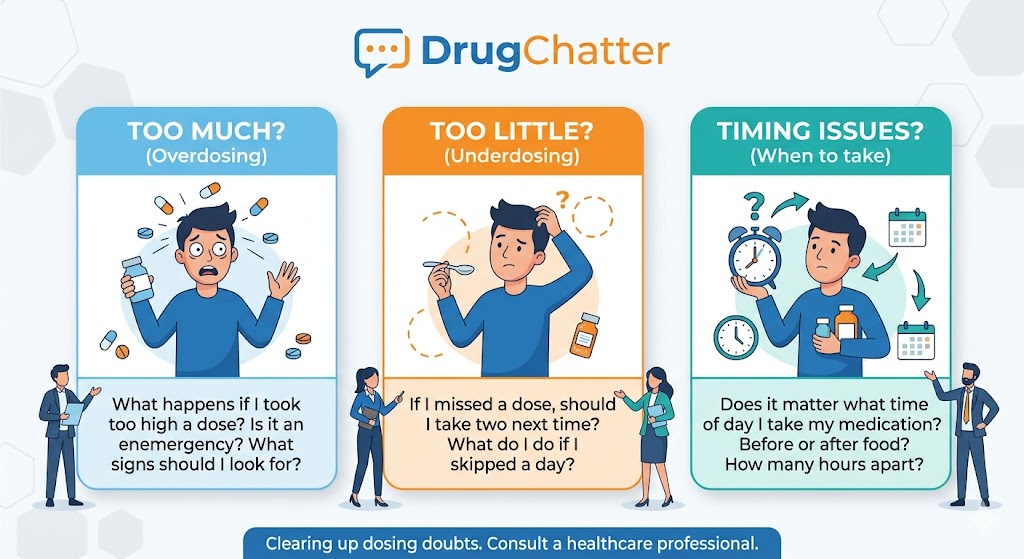
1) “Too much” dosing: when the dose is the problem
Overdosing isn’t always a dramatic event. Sometimes it’s a small misunderstanding: a strength mix-up, a schedule mix-up, or a “close enough” substitution that turns out not to be close at all.
2) “Too little” dosing: when underdosing quietly fails
Underdosing can be just as frustrating as overdosing—because it can look like “the drug isn’t working,” when the real issue is that the regimen never matched the intended plan.
3) The timing trap: dose timing that changes the outcome
Timing is where dosing confusion gets especially slippery. Some drugs are forgiving; others are not. Even when the dose is correct, the “when” can determine whether you get the intended effect—or a side-effect you didn’t bargain for.
- How does ozempic’s timing impact blood sugar levels?
- What’s the impact of a low fat diet on lipitor’s side effects?
- What impact do grapefruits have on lipitor’s drug efficiency?
4) “Schedule confusion” disguised as brand/generic confusion
Sometimes the dosing question isn’t really about the dose—it’s about the product. Strengths, formulations, and substitutions can change how a regimen should be followed.
5) The “I just need the right amount” questions
When people ask for dosing, they’re often trying to solve a practical problem: “What’s the correct adult amount?” “How often?” “What schedule?” These are the questions that deserve the clearest answers—because they’re the ones most likely to be acted on immediately.
A final note before you “dose and go”
If you’re staring at a label and wondering whether you’re about to take too much, too little, or at the wrong time, that’s not a minor uncertainty. It’s a stop-sign. Double-check the exact strength, the exact schedule, and the exact instructions for timing (including food interactions and administration rules) before taking the next dose.
And if you’re using a different formulation than before—brand vs. generic, tablet vs. liquid, once-daily vs. extended-release—treat that as a dosing change until proven otherwise.