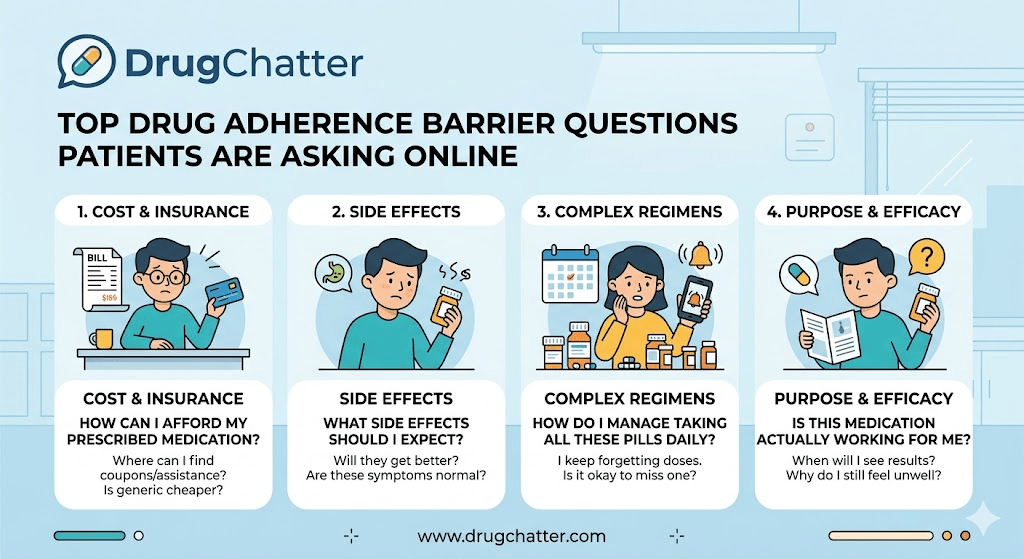
Patients don’t ask adherence questions the way clinicians do. They ask them the way life forces them to: with a calendar, a pharmacy counter, a credit-card limit, and a nagging fear that skipping one pill will somehow unravel everything.
Below are some of the most common barrier questions people are typing online—especially the ones that start as “How much?” and end as “Will I be able to stay on this?”
1) “How much does my medicine cost—really?”
When the price is unclear (or keeps changing), adherence becomes a budgeting problem. People look for alternatives, insurance answers, and “no prescription” shortcuts—often because they’re trying to avoid running out.
- Natazia birth control price?
- Topamax 10 mg price?
- Sarclisa price no prescription?
- Addyi vyleesi current status 2026?
- Addyi cost?
- How much is addyi with insurance?
- Ofev cost with insurance?
- Warum ist ofev so teuer?
- Ofev cost with insurance?
- Cost of ofev?
- Ofev drug cost?
- Ofev biosimilar?
- Ofev generic?
- Ofev loe?
- Ofev cost with insurance?
- Nintedanib price?
- Nintedanib cost?
- Multaq 400 mg alternative?
- Multaq price per month?
- Best price for multaq 400mg?
- Price of multaq?
- Multaq precio?
- When does multaq go generic?
- Multaq 400 mg alternative?
- Rocaltrol cost?
- Valproic acid price?
- Sodium valproate price?
- Divalproex sodium cost?
- Divalproex sodium er 250mg?
- Generic depakote 500 mg?
- Depakote er?
- Divalproex sustained release tablets?
- Depakote to valproic acid conversion?
- Valproic acid liquid?
- Generic valproic acid?
- Amcinonide price?
- Alclometasone dipropionate price?
- Naftin cost?
- Prevnar 20 price?
- Pneumovax23?
- How much does cresemba cost?
- Cresemba retail price 2026?
2) “Is there a cheaper version—or will it be available soon?”
Adherence often hinges on timing: people wait for generics, biosimilars, or licensing changes. If the wait is long, they may ration doses or switch plans.
- Ofev biosimilar?
- Ofev generic?
- Ofev loe?
- When does multaq go generic?
- When does vyndamax go generic?
- Generic aubagio?
- Generic names for aubagio from authoritative medical sources?
- What is apotex’s current status in ruxolitinib generic development?
3) “If I miss a dose, what happens?”
People don’t always ask this directly. But the subtext shows up in questions about monitoring, long-term use, and whether the regimen is “safe to keep going.”
- Depakote monitoring?
- Long term use of metoclopramide?
- How often are lurbinectedin’s adverse effects monitored?
- Metoclopramide maximum dose in 24 hours?
4) “Can I take this with other stuff—especially pain relievers and food?”
Adherence breaks when patients feel uncertain about interactions or when they’re told to change habits midstream.
- Aspirin and meloxicam?
- Aspirin nausea?
- Does lipitor reduce omega 3’s health benefits?
- Are there foods that hinder artesunate’s potency?
5) “What exactly is this drug—and what’s the right form?”
Confusion about names, formulations, and “what it is” can turn into hesitation at the pharmacy window.
- What is naftin?
- Ofev medication?
- Metoclopramide hydrochloride?
- Metoclopramide api?
- Metoclopramide api manufacturers?
- Valproic acid liquid?
- Valproic acid vs divalproex?
- Amiodarone brand name?
- Amiodarone nombre comercial?
- Amiodarone generic name and brand name?
- Amiodarone drug class?
6) “Where do I get it—and can I buy it online?”
When access feels fragile, patients look for purchase pathways. That’s where adherence can get derailed by delays, uncertainty, or outright risk.
7) “Is this even the right time to start—or is it already too late?”
Some adherence barriers are really “decision” barriers: patients want confirmation that their regimen is current, effective, and monitored.
- Addyi vyleesi current status 2026?
- Bremelanotide troche?
- How often are lurbinectedin’s adverse effects monitored?
8) The “side effects and logistics” questions that quietly decide whether people stay on therapy
Even when cost is manageable, adherence can fail if patients can’t predict what to expect—or if they don’t know what “normal” looks like.
- Do lipitor’s side effects differ between young and old adults?
- Aspirin and meloxicam?
- Aspirin nausea?
- Long term use of metoclopramide?
Bottom line: adherence barriers aren’t just about willpower. They’re about affordability, access, clarity, and monitoring—things patients can’t always get answered quickly enough when they’re already running out of time.