Some interactions are dramatic—two drugs collide, a vital mechanism flares, and a patient ends up in the wrong storyline. But the more common failures are quieter: the everyday beliefs that a “supplement” is somehow exempt from pharmacology, or that two things are “similar” (or “harmless”) because they sound alike. This is a roundup of interaction misunderstandings that pop up again and again, with pointers to the DrugChatter Q&A threads for context and follow-up.
1) “If it’s OTC or natural, it can’t interact.” (That’s not how enzymes and receptors work.)
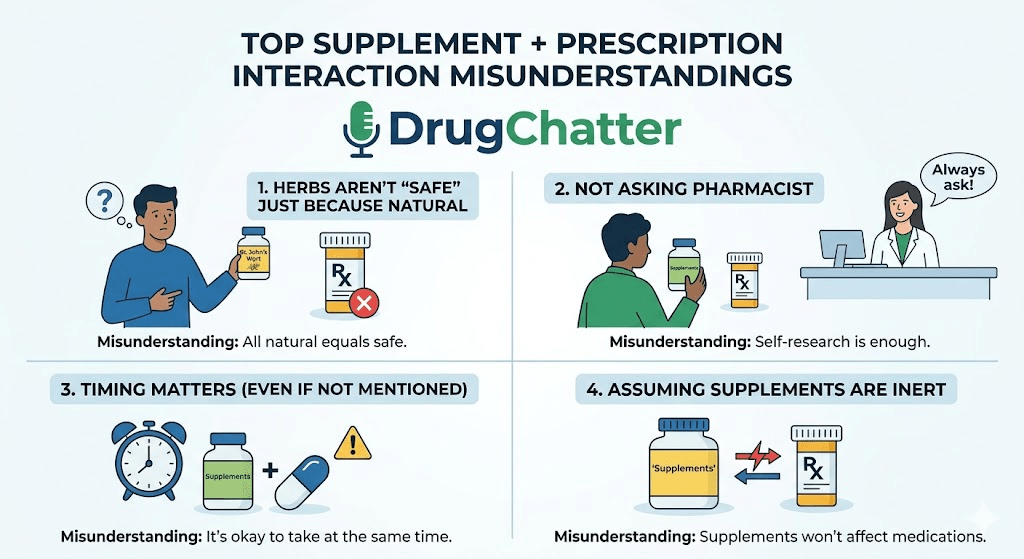
The most persistent myth is the belief that nonprescription equals non-interactive. In reality, many supplements affect absorption, metabolism, or blood levels—sometimes indirectly through liver enzymes, sometimes through gut transporters, sometimes by changing bleeding risk or blood pressure physiology. If you’re on a prescription medication, assume a supplement can matter until proven otherwise.
Start by reviewing any prescription interactions you already suspect, then treat supplements the same way you’d treat an additional prescription. For example, people often ask whether seemingly unrelated agents share effects or overlapping risk patterns.
2) “If two drugs are both for the same condition, they’ll add safely.” (They may double the same problem.)
Overlap is not the same thing as safety. Two agents can target different steps but still converge on the same adverse outcome—liver stress, gastrointestinal intolerance, electrolyte shifts, or blood pressure effects. When patients think “similar use = similar safety,” they often miss the mechanism-based reasons a combination can be risky.
- Can ace inhibitors increase or decrease lipitor’s benefits?
- Can lipitor’s effectiveness be affected by ace inhibitors?
3) “One small dietary trick can replace the drug—so nothing else matters.” (Lifestyle doesn’t ‘cancel’ pharmacology.)
Diet and supplements can help, but they don’t usually nullify a drug’s metabolism, side effects, or timing requirements. Patients sometimes ask whether a medication’s effect is strong enough to “negate” dietary missteps or whether a casual beverage/snack can shift outcomes enough to justify skipping counseling.
- Is lipitor’s effect strong enough to negate unhealthy fat intake?
- Can lipitor’s effectiveness be reduced by lemon water?
- Which snacks can increase lipitor’s effectiveness?
4) “Timing doesn’t matter if the dose is the same.” (Absorption windows do matter.)
Many interaction problems aren’t about chemistry—it’s about timing and absorption. Some meds behave very differently depending on meals, spacing, and stomach conditions. People then interpret the results as “the supplement didn’t interact,” when what really happened was “the drug wasn’t where it needed to be.”
- How long before or after meals should i take ozempic?
- How long until lipitor’s full effect before dose adjustment?
- What’s the typical onset of lipitor’s gastrointestinal effects?
5) “Exercise, stress relief, and ‘natural balance’ make the drug safer.” (Sometimes—maybe. But don’t assume.)
Movement and stress reduction can improve overall health and sometimes symptoms, but they don’t guarantee that a medication’s metabolic effects, side-effect profile, or interaction risk will disappear. If the concern is liver function, for instance, “feeling better” isn’t the same as “reduced risk.”
- Did you discuss lipitor’s potential impact on liver function with your doctor?
- Do exercise and stress relief methods minimize lipitor’s impact?
6) “Fish oil/supplements automatically help—and won’t complicate prescription therapy.” (Supplements are active drugs in disguise.)
Even when a supplement is generally considered beneficial, combining it with medications can change the risk profile (for example, bleeding tendency in some contexts) or simply adds uncertainty about which product is doing what. The key misunderstanding is treating supplements as “background noise” rather than an additional active input.
7) “Medication focus is enough—because interactions only happen between prescriptions.” (Supplement + prescription interactions are real.)
Most patients are trained to think about drug-drug interactions, but they’re often not trained to think the same way about drug-supplement combinations. The result: a supplement gets added with optimism, and the patient tries to interpret side effects as “random” or “unrelated.”
If you want an example of how people reason about “benefit” and “risk,” it helps to watch how common the misconception is in other medication questions—then apply the same caution to supplements.
What to do instead: the boring checklist that prevents harm
- Bring every supplement bottle (even “just vitamins” and “occasional” products) to your clinician or pharmacist.
- Ask specifically about interaction risk and timing: “Should I separate it from my prescription?”
- Don’t assume a supplement is neutral because it’s widely sold. “Sold” isn’t “safe for me.”
- If your medication is one with known monitoring concerns (e.g., liver-related questions), align supplement changes with that monitoring plan.
Bottom line: the most common interaction misunderstandings aren’t about ignorance of chemistry—they’re about overconfidence in categories. “Prescription” and “supplement” are labels, not safety guarantees. Use the same skepticism for both, and follow up when anything changes—new products, new symptoms, or new timing.