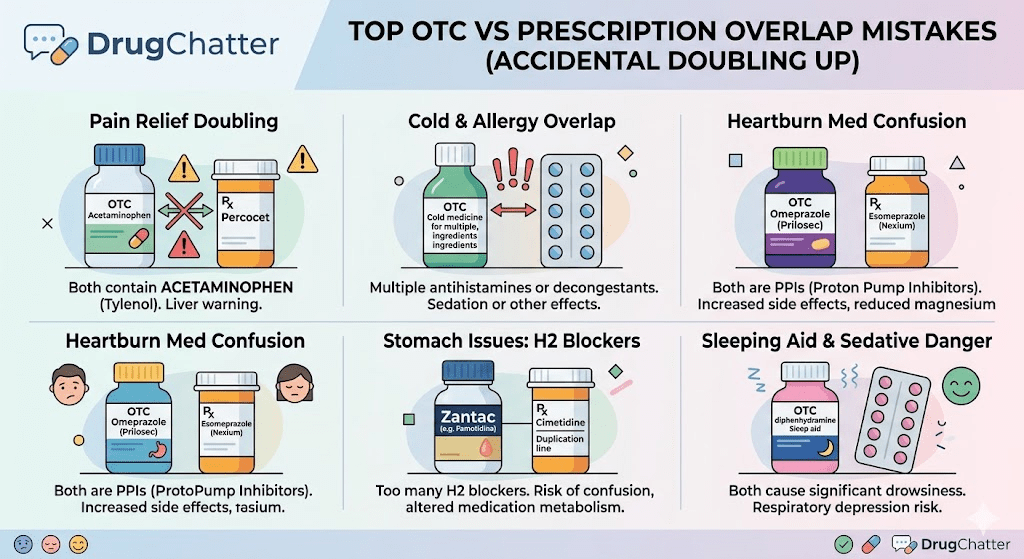
Every so often, the pharmacy call that makes you wince isn’t for a rare reaction or a mysterious lab result. It’s for something far more mundane: duplicate dosing—the accidental overlap where an over-the-counter product and a prescription quietly contain the same (or closely related) active ingredient.
Below are common “overlap mistakes” people make when trying to treat symptoms from both directions at once. I’m not judging—this is how medication systems quietly punish busy brains: one label for the prescription, another for the OTC box, and a third—sometimes—inside combo products.
1) The allergy/sleep/“I just need to take the edge off” double dip
Many OTC products for sleep, cold, or allergies contain antihistamines. People then add a prescription sedating med (or another antihistamine) and—boom—stacked drowsiness. Even if nothing terrible happens, you can get enough sedation to make driving, work, or basic coordination a gamble.
- Clemastine comes from a specific antihistamine class; knowing what you’re actually taking helps prevent the “two labels, same effect” scenario: https://www.drugchatter.com/chat/58854/clemastine-class-ethanolamine-antihistamine-classification
- If you’re pairing trazodone with other sleep aids, it’s easy to drift into unhelpful overlap: https://www.drugchatter.com/chat/38531/can-you-take-trazodone-and-melatonin-together
- And yes, trazodone can affect dreams—another reminder that “it’s just a sleep pill” can have very specific effects: https://www.drugchatter.com/chat/38860/trazodone-dreams
2) The “statin is statin” overlap (and the hidden ways it gets doubled)
Statins are common, and people frequently assume that if the brands are different, they’re different drugs. But most of the time, the active ingredient is what matters. If you end up with two statin sources—prescription plus an OTC product that includes something meant to “support cholesterol”—you may accidentally double up on the same therapeutic class.
- Does eating certain foods shift Lipitor’s efficacy? When you’re already juggling inputs, it’s another variable to keep straight: https://www.drugchatter.com/chat/35221/is-lipitor’s-efficacy-changed-by-eating-iron-rich-vegetables
- Do you need regular liver tests while taking Lipitor? Duplication plus monitoring gaps is a bad combination: https://www.drugchatter.com/chat/39473/do-you-need-regular-liver-tests-while-taking-lipitor
- What’s the typical timeline for Lipitor’s full impact? If you accidentally double dose timing, your expectations for “when it kicks in” will be wrong: https://www.drugchatter.com/chat/28125/what’s-the-typical-timeline-for-lipitor’s-full-impact
3) The “blood thinner vs pain reliever” trap
This is one of the oldest overlap mistakes: people see OTC pain relief as “harmless,” while forgetting that prescriptions for clotting risk (or related conditions) can make certain OTC choices significantly more dangerous.
- Eliquis and ibuprofen is a direct example of why the OTC aisle isn’t automatically safe for everyone: https://www.drugchatter.com/chat/38490/eliquis-ibuprofen
- If you’re managing Lipitor with warfarin, dosing and interaction nuance matters (and it’s easy to create a “two-drug system” by accident): https://www.drugchatter.com/chat/25976/what’s-the-recommended-lipitor-dose-with-warfarin
4) Steroids: energy, sleep, and the “I’ll just add more” reflex
Prednisone doesn’t behave like a gentle supplement. People add something else—OTC or prescription—because they don’t feel “right,” then the medication effects compound in ways that feel confusing rather than clearly “too much.”
- Prednisone can keep you awake: https://www.drugchatter.com/chat/20064/prednisone-keep-you-awake
- And even more directly, the question “Will prednisone keep you awake at night?” is exactly the sort of complaint that triggers double-adding: https://www.drugchatter.com/chat/62098/will-prednisone-keep-you-awake-at-night
5) “Cosentyx and my other products”—when you double up on inputs
Duplication isn’t always literal same-drug dosing. Sometimes overlap happens through the interaction between your prescription and whatever else you add—especially in the real world where “skincare” and “support supplements” come with their own active ingredients.
- Does using skincare products affect Cosentyx’s efficacy? It’s not duplication of the same pill, but it’s still a kind of overlap error people don’t foresee: https://www.drugchatter.com/chat/1147/does-using-skincare-products-affect-cosentyx’s-efficacy
- Cosentyx drug interactions (again: this is overlap territory): https://www.drugchatter.com/chat/63607/what-are-cosentyx’s-drug-interactions
6) Liver risk overlaps: when “side effects” start stacking
Some drugs have known liver-risk profiles. If you take an OTC product “for convenience”—or another prescription that stresses the same pathway—your risk can rise without anyone explicitly intending to “double the harm.”
- Tigecycline’s liver effects are not evenly distributed across risk groups: https://www.drugchatter.com/chat/58308/which-groups-have-higher-risk-for-tigecycline’s-liver-effects
- Known liver risks of tigecycline (basic risk framing): https://www.drugchatter.com/chat/39410/are-there-any-known-risks-of-tigecycline-on-liver-function
- Does tigecycline behave differently in elderly patients’ livers? Another risk dimension people miss when multiple meds enter the picture: https://www.drugchatter.com/chat/15702/does-tigecycline’s-effect-on-liver-differ-in-elderly
How to avoid the accidental double-dose (the boring but effective steps)
- Check the active ingredient, not the brand name. Labels love to hide behind marketing.
- Don’t combine “symptom relief” products unless you’ve verified ingredients. Two cold/flu products can contain the same core drug class.
- Bring a full med list (including OTCs and supplements) to appointments and pharmacy pickups.
- If something makes you feel “off,” don’t self-correct by adding more sedation or pain relief—overlap can be cumulative.
The worst overlap mistakes are rarely from bad intentions. They happen because the system is designed around convenience, and convenience is how the duplication sneaks in. If you’re unsure whether an OTC product overlaps with your prescription, treat that uncertainty as a stop sign—and ask before you take the next dose.