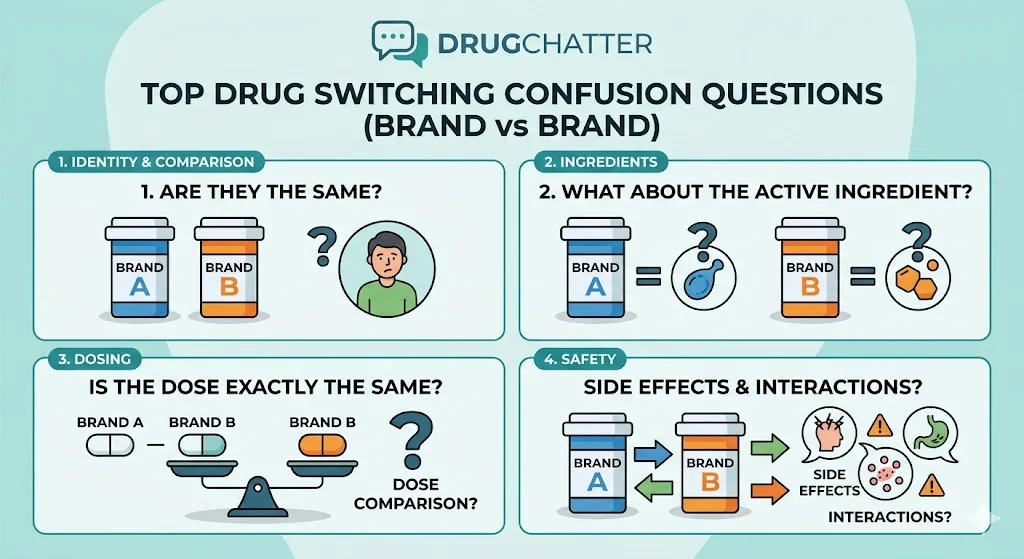
There are two kinds of confusion in drug switching: the harmless kind, where the active ingredient is the same; and the expensive kind, where the paperwork looks similar but the clinical reality does not. If you’ve ever wondered whether two names are “basically the same,” this is your reminder that brand-vs-brand is exactly where people get burned—by ingredients, interactions, timing, or plain human guesswork.
The brand-vs-brand trap (and why these questions keep coming up)
When people search “switching,” they often mean something like: Brand A → Brand B, same class, same outcome, right? But drug switching isn’t just a marketing exercise. Even when drugs share a therapeutic neighborhood, the details that matter—dose, absorption, food effects, metabolism, and side-effect profiles—don’t always travel together. The questions below are “confusion magnets”: they start with a plausible assumption, then hit the wall of how the drugs actually behave.
Switching confusion themes
- Brand name myths: “If it sounds like it, it probably is.”
- Food-and-drink cross-talk: The brand might be right—your stomach schedule isn’t.
- Safety questions disguised as convenience: “Is it okay with X?” is often the first step toward preventing a preventable mismatch.
- Cost/availability as a proxy for equivalence: Prices and coupons can change, but pharmacology doesn’t.
- Metabolic interactions: Switching sometimes means switching systems, too.
Questions and answers (brand-vs-brand confusion edition)
1) Potency confusion: “Is my drink messing with my statin?”
Can lipitor affect red wine’s potency?
2) “Same goal, different drug” pricing puzzles
How much does ranolazine cost?
3) The “what’s in the bottle?” reality check
4) Food and timing: the quiet co-author of therapeutic effectiveness
How does alcohol affect lyrica’s therapeutic effectiveness
5) When switching becomes a pharmacy counter negotiation
6) Brand availability and cost as the hidden driver of “switches”
7) “What am I taking?” vs “What should I take?”
8) Dosage form matters: injections aren’t interchangeable by vibe
9) Price questions that often precede equivalence assumptions
Dextromethorphan quinidine sulfate price?
10) Region/brand confusion: language makes switching feel like choice
11) The “is this the same thing?” question behind cost constraints
12) Alternatives aren’t swaps: they’re separate clinical problems
13) Patent expiry as the moment confusion multiplies
Pomalyst patent expiry june 2025?
14) Brand identity questions: “What’s the brand for this?”
15) “Kuvan cost” and the broader issue: coverage changes can force switches
16) If you switch brands, do your habits still match?
How does regular consumption of fatty foods affect lipitor’s efficacy
17) Unfamiliar brand names: start with the plain ingredient question
18) Interaction confusion: “Does citrus change what aspirin does?”
How does aspirin interact with citrus in the stomach?
19) Coupons and programs can look like equivalence (they’re not)
20) Side-effect expectations: switching can change your lived experience
Can my doctor list lipitor’s specific side effects?
21) Discount requirements: what changes when your “brand” changes?
What are vascepa’s discount requirements?
22) Insurance-driven substitution: does Medicare change the equation?
Does medicare cover wegovy for heart disease?
23) Lemon water and statins: the “natural” confusion route
Can lipitor’s effectiveness be reduced by lemon water?
24) Preservative-free questions: brand substitutions may hide formulation differences
Marcaine hydrochloride preservative free?
25) Biologics and identity: “biosimilar” is not the same as “the same”
26) Switching across evidence gaps: pregnancy data isn’t optional
Have fetal development studies been conducted for lurbinectedin?
27) Generic pricing can tempt shortcuts
28) Kidney disease and drug choice: one wrong substitute can matter
29) Patent/tech questions as indirect sources of confusion
Google patents histamine production us patent application?
30) Market questions: when products shift, switching confusion rises
31) Brand lists that people treat like equivalence lists
32) Ingredient uncertainty: “Gablofen?”
33) Dietary fiber and statin effectiveness: your regimen is part of the drug
Does higher dietary fiber reduce lipitor’s effectiveness?
34) Manufacturer questions: the “same drug” can still be different in practice
35) Coupons and switching behavior
36) Another coupon route to equivalence assumptions
37) Mechanism questions: understanding helps prevent brand confusion
38) Generic launch timelines: “soon” is not the same as “already safe for you”
When will apotex’s ruxolitinib generic launch in the us?
39) Definition-first questions: “What is this drug?” is the right start
40) Coupons: what you can’t see can still matter
41) Dose adjustment misconceptions
Does lipitor dosage adjust for athlete’s weight?
42) Availability questions that drive substitution
43) Exclusivity loss: the moment brand landscapes reorganize
Enhertu loss of exclusivity patent expiration
44) Formulation questions: creams aren’t pills, and “close” isn’t enough
Naftifine hydrochloride cream?
45) Expectations of onset: “switch timing” is real
What’s the typical timeline for lipitor’s full impact?
46) Price changes can trigger brand confusion
47) “Why is this expensive?”
Why is atorvastatin so expensive?
48) Another cost-related substitution stress test
49) Food interactions: brand switching plus meal habits is double trouble
How do food interactions affect lyrica’s safety
50) Gel price and formulation reality
51) Income-based aid and substitution pressure
What’s the process for vascepa’s income based patient aid?
52) Exercise and statins: the lifestyle context of brand switching
Lipitor and exercise endurance what’s the link?
53) Monitoring needs: don’t assume switching changes nothing medically
Do you need regular liver tests while taking lipitor?
54) Market/launch questions as the backdrop for “brand vs brand” confusion
Glyxambi commercialise en france?
55) Cost anxiety and “equivalent enough?” thinking
56) Alternatives can be misleadingly named
57) Sales/availability as the indirect driver of brand switching
58) Location pricing and formulation access
Icatibant injection price in india?
59) Patent questions again: the brand landscape shifts
60) Wholesale sourcing isn’t the same as clinical equivalence
Wholesale sodium fluoride for toothpaste?
61) Mechanism comparisons: “acts on the problem” isn’t “acts the same way”
How does lipitor’s plaque buildup prevention compare to antibiotics action?
62) API questions: when people conflate supply with substitution
63) Approval news can trigger “can I switch?” panic
64) Concomitant drugs: the “brand vs brand” story can become “brand + brand”
Can ace inhibitors increase or decrease lipitor’s benefits?
65) Regional approvals: not all “same drug” stories are simultaneous
66) Alcohol absorption misconceptions
Does calcium in almonds impact beer’s alcohol absorption?
67) Brand identity again: fulvestrant in real life
Fulvestrant pharmaceutical brand?
68) Dosage questions that look like “branding,” but are actually “how much”
69) Ophthalmic pricing and formulation confidence
Nepafenac ophthalmic suspension price?
70) Manufacturer questions for oncology
71) Purchasing questions that can bypass clinical guidance
72) Eating beforehand changes drug behavior—sometimes dramatically
Is aspirin’s effectiveness altered by eating beforehand
73) Generic name questions: the first step away from brand confusion
74) Side-effect confusion
75) Cost of cancer therapies and the substitution question behind it
76) Off-label curiosity can masquerade as “alternative” switching
77) Local pricing: the kind of question that changes what pharmacies can stock
78) Biosimilar curiosity (again: not the same as the same)
Asfotase alfa (strensiq) biosimilar,
79) Safety comparisons: the “brand vs brand” question at its most serious
How does cosentyx’s long term safety compare with similar drugs?
80) Patent expiry as the trigger for “is it equivalent now?”
81) Administration confidence reduces switching errors
82) Orphan designation date: evidence timelines affect what patients expect
Nusinersen fda orphan drug designation date?
83) “Ambien picture” style questions: the visual mismatch that leads to wrong-hand selection
84) Dosage misunderstandings
What’s the epa dosage in vascepa per capsule,
85) Concomitant therapy: switching doesn’t happen in a vacuum
Is it ok to take pepcid ac with statins?
86) Pricing and medication choice
87) Expected lab response (what you’re really monitoring after a switch)
What are typical ldl levels post lipitor?
88) Patent expiry in opioids/anesthetics: not a casual switch
89) Pharmacy logistics and cost questions
90) More brand/price confusion fodder
91) A single word query can hide a switching risk
92) Country-specific product availability
93) Salt form matters (even when it looks the same on a label)
94) Manufacturer questions again: “same drug” can be different supply chains
95) Specific strength/format confusion
96) Device equivalence questions
Spiriva respimat vs handihaler dose equivalent?,
97) Very specific dose/format
98) Why generics don’t always “win” (and why patients notice)
Why have vascepa generics not captured more volume?
99) Name confusion across anesthetics
100) Supplement interactions that can mimic brand failure
Can lipitor’s effectiveness be affected by low sodium supplements?,
Takeaway: when you see a brand-vs-brand question, ask the two boring things
If you’re being switched—whether by insurance, stock, or convenience—ask: (1) what’s the active ingredient and exact formulation/strength? and (2) are there food/drink or interaction rules I’m expected to follow now? Most confusion dissolves once those two facts are pinned down.