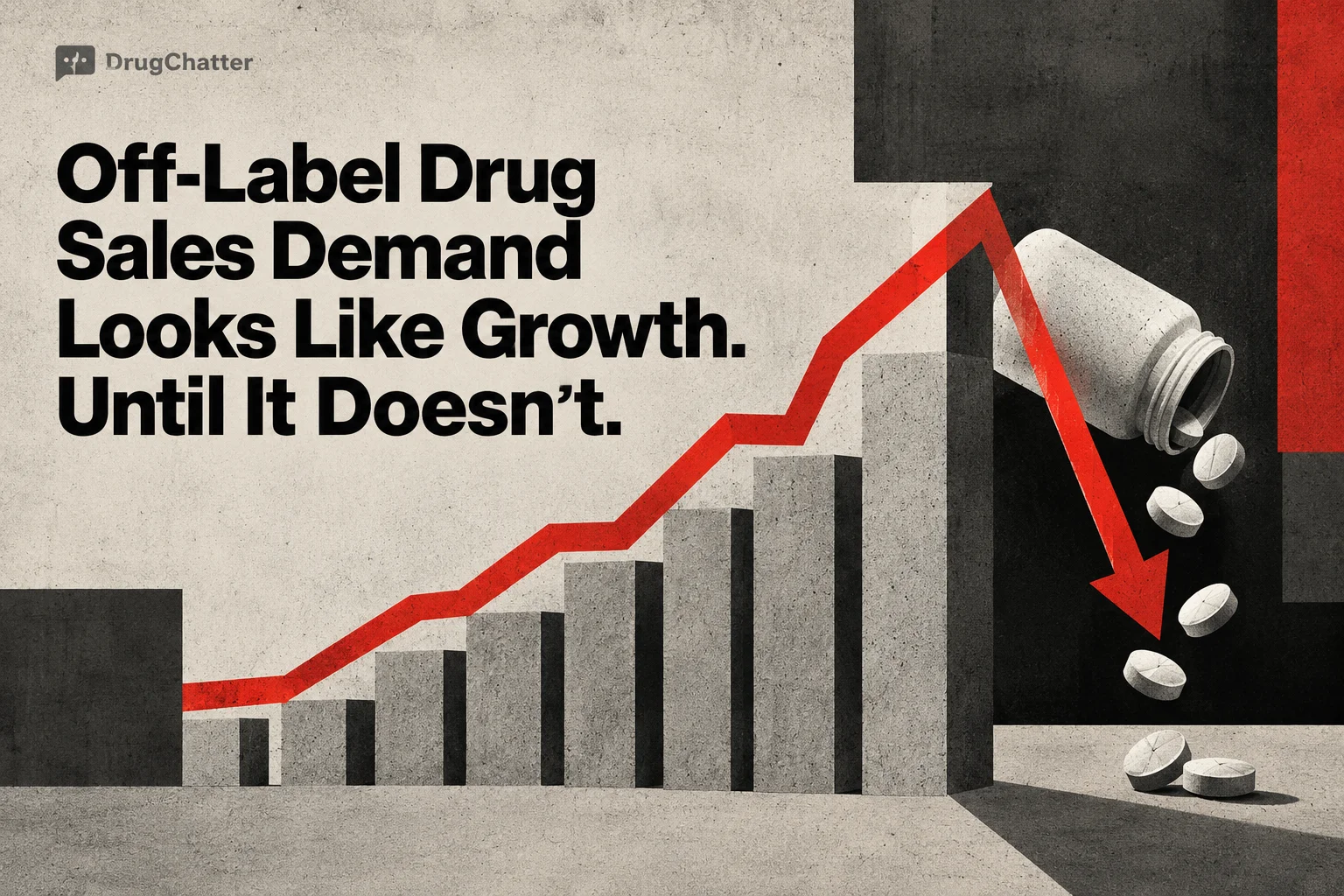
By 2002, an estimated 94% of gabapentin prescriptions were written for conditions the drug was never approved to treat [6]. Pfizer’s Warner-Lambert unit had built a nearly $2 billion franchise almost entirely outside its own label, and it took a $430 million settlement for the rest of the industry to notice what that meant for anyone still forecasting the drug off its epilepsy indication [5][6].
That is an extreme case, but it sits on a spectrum every commercial forecaster works on without naming it. Depending on which study a forecasting team cites, somewhere between 11% and 38% of U.S. outpatient prescriptions are off-label [1][2]. Most epidemiology-based forecasting models are not built to see any of it, because they start counting patients from the approved indication outward. A patient who never gets diagnosed with that indication does not exist in the model, no matter how many prescriptions they generate.
The Short Answer
Off-label prescribing is common, legal for physicians, and heavily restricted for manufacturers to promote. Its documented prevalence ranges from about one in nine prescriptions to more than one in three, depending on methodology and time period [1][2]. Standard patient-based and epidemiology-based forecasting methods model the approved indication, not the prescription itself, so off-label volume typically enters a forecast only if a team deliberately builds a line for it. Oncology is the clearest exception, because a 1993 federal law and five CMS-recognized compendia turn off-label cancer drug coverage into a documented, trackable pathway [14][15]. Outside oncology, off-label demand tends to show up in a forecast only after it has already reshaped the market, as it did with gabapentin, semaglutide, hydroxychloroquine, and atypical antipsychotics.
What “Off-Label” Means and Why It Is Legal
The FDA Approval Process Defines “On-Label,” Not Clinical Judgment
An FDA approval attaches to a specific indication, dose, patient population, and use documented in the label, based on the clinical trial data the sponsor submitted. Nothing about the approval process evaluates or restricts every other way a physician might reasonably use the same molecule. The label describes what the sponsor proved to the agency’s satisfaction, not the outer boundary of appropriate clinical use.
Physicians Can Prescribe Off-Label; Manufacturers Cannot Promote It
Once a drug is approved, a physician may lawfully prescribe it for any use supported by their own medical judgment, whether or not that use appears on the label [19]. The manufacturer faces a different and stricter standard. Promoting a drug for an unapproved use has historically exposed the FDA’s misbranding authority under the Federal Food, Drug, and Cosmetic Act, on the theory that off-label claims outside the approved labeling render the product misbranded [19].
Amarin v. FDA and the Fight Over Truthful Off-Label Speech
That enforcement theory narrowed in 2015. A federal district court in Amarin Pharma, Inc. v. FDA granted Amarin a preliminary injunction, holding that the company could make truthful, non-misleading statements to physicians about off-label uses of its drug Vascepa without facing a misbranding prosecution [19]. The ruling built on the Second Circuit’s 2012 decision in United States v. Caronia, which found FDA’s restriction on truthful off-label speech subject to First Amendment scrutiny [19]. The result reshaped the legal boundary around manufacturer communication, but it did not eliminate the underlying asymmetry: physicians can act on off-label evidence far more freely than manufacturers can discuss it.
How Common Is Off-Label Prescribing? What the Data Actually Shows
The 2006 Radley Study: 21% of Office-Based Prescriptions
The most frequently cited estimate comes from a 2006 study in Archives of Internal Medicine, which used 2001 data from the IMS Health National Disease and Therapeutic Index covering 160 commonly prescribed drugs [1]. The authors found an estimated 150 million off-label mentions, representing 21% of total use among the sampled medications, and reported that 73% of those off-label mentions had little or no supporting scientific evidence [1].
Off-Label Rates Have Moved in Different Directions Since Then
More recent studies do not converge on a single number, largely because they measure different populations with different methods. A 2025 study in the Journal of Pharmaceutical Policy and Practice, using 2016-2021 outpatient data from the Medical Expenditure Panel Survey and DrugCentral labeling records, analyzed 1,596,753 prescriptions and found 25% were off-label [2]. That same paper cites earlier work finding an 11% off-label rate in a 2005-2009 Quebec prescribing sample, and separate National Ambulatory Medical Care Survey data showing the U.S. off-label rate climbing from 29.9% in 1993 to 38.3% by 2008 [2]. No two of these figures use identical methodology, but every one of them describes a meaningful share of prescribing volume that a label-anchored forecast will not see.
Study period
Data source
Off-label rate
Notes
1993
National Ambulatory Medical Care Survey
29.9%
As cited in Blankart & Lichtenberg, 2025 [2]
2001
IMS Health National Disease and Therapeutic Index, 160 drugs
21%
Radley et al., 2006 [1]
2005-2009
Quebec prescribing sample
11%
As cited in Blankart & Lichtenberg, 2025 [2]
2008
National Ambulatory Medical Care Survey
38.3%
As cited in Blankart & Lichtenberg, 2025 [2]
2016-2021
Medical Expenditure Panel Survey, 1,596,753 prescriptions
25%
Blankart & Lichtenberg, 2025 [2]
Off-Label Use Concentrates by Drug Class
Off-label prescribing is not spread evenly across therapeutic categories. The Radley study found off-label use ran as high as 46% among cardiac medications, excluding lipid and blood-pressure drugs, and 46% among anticonvulsants [1]. A separate analysis of breast cancer treatment found the highest off-label rates concentrated in a small set of drugs including vinorelbine, carboplatin, and bevacizumab, most of it evidence-based rather than speculative [4].
Gabapentin and Amitriptyline: The Extreme Cases
Among individual drugs, the Radley study found gabapentin had an 83% off-label rate and amitriptyline hydrochloride had 81%, the two highest of any drug in the 160-drug sample [1]. Both findings predate the Warner-Lambert settlement discussed below, and both point to the same underlying pattern: a drug’s real-world use case can diverge almost entirely from its approved indication while remaining legally prescribable the whole time.
Why Off-Label Use Creates a Structural Forecasting Blind Spot
Epidemiology-Based Forecasts Model the Approved Indication, Not the Prescription Pad
Patient-based, or epidemiology-based, forecasting builds a revenue projection from prevalence, diagnosis rates, treatment rates, and market share within a defined patient population, typically the population matching the approved or targeted indication [7]. That structure is well suited to new launches and complex therapeutic areas, but it carries a built-in assumption: that the diagnosed population for the target indication is the addressable market. A prescription written outside that diagnosis code is invisible to the model unless someone explicitly adds a term for it.
The Case-Mix Assumption Forecasters Rarely State Out Loud
Every epidemiology-based forecast implicitly assumes that future prescribing will track the historical or projected disease population for the labeled indication. That assumption is reasonable for drugs with narrow, well-monitored use cases. It breaks down for any drug where clinicians, patients, or media attention create demand from outside that population, and it breaks down silently, because nothing in a standard model flags when the assumption stops holding.
Demand-Based Forecasts Inherit Off-Label Volume Without Labeling It
Demand-based, or sales-based, forecasting works from historical volume and revenue rather than epidemiology, alongside related methods such as time-series analysis and analog-based forecasting that similarly extrapolate from observed prescribing rather than diagnosed populations [7][24]. This approach captures off-label volume that is already occurring, since it counts actual prescriptions regardless of indication. The blind spot shifts rather than disappears: a demand-based forecast can extrapolate an existing off-label trend reasonably well, but it has no structural way to anticipate a new off-label use case before it appears in the sales data, which is precisely when a forecast is most valuable.
Pharmacovigilance Systems Do Not Tag Off-Label Use Either
The blind spot is not limited to commercial forecasting. Researchers building automated off-label detection tools have noted that the FDA Adverse Event Reporting System, the Observational Medical Outcomes Partnership, and the Sentinel Initiative do not specifically track whether an adverse event occurred during approved or off-label use [16]. That means the safety-surveillance infrastructure most likely to catch a problem with a fast-growing off-label use case is not built to distinguish it from on-label use in the first place, compounding the forecasting gap with a monitoring gap.
Case Study: Gabapentin’s Off-Label Market Was the Market
From Anti-Seizure Drug to a $2 Billion-a-Year Franchise
Gabapentin was approved in 1993 as a supplemental treatment for partial seizures in adults with epilepsy [5]. Within roughly five years, Warner-Lambert’s Parke-Davis division had built a marketing program using continuing medical education, ghostwritten research, and paid speakers to promote the drug for pain, psychiatric conditions, migraine, and other unapproved uses [3][5]. A 2004 U.S. Department of Justice statement described the company as having marketed the drug aggressively for conditions ranging from bipolar disorder to restless leg syndrome to amyotrophic lateral sclerosis [5].
94% Off-Label by 2002
By 2002, an estimated 94% of Neurontin sales were for off-label indications, and a Lehman Brothers estimate cited around the time of the 2004 settlement put the figure at roughly 90% [6]. Any forecasting model anchored to the epilepsy label would have captured perhaps one-tenth of the drug’s actual commercial performance.
The $430 Million Settlement and What the Sales Mix Revealed
In May 2004, Warner-Lambert pleaded guilty to violating the Food, Drug and Cosmetic Act, and agreed, with Pfizer, to pay $430 million in criminal fines and civil damages, including a $240 million criminal fine, $83.6 million to the federal government, and $68.4 million to state Medicaid programs [5]. A later class action added a $325 million settlement over related marketing conduct [3]. The case originated from a 1996 False Claims Act suit filed by a former Warner-Lambert employee, and it remains one of the clearest documented examples of a drug whose real market was almost entirely off-label while its regulatory identity remained narrowly on-label [3][5].
Case Study: Semaglutide and the Off-Label Demand Shock Nobody Modeled
Ozempic Was Approved for Type 2 Diabetes. The Market Had Other Plans.
The FDA approved Ozempic (semaglutide) in December 2017 for adults with type 2 diabetes [10]. A 2021 clinical trial highlighting semaglutide’s weight-loss effect, combined with social media attention and celebrity endorsement beginning in 2021 and intensifying through 2022, drove a surge in demand for the drug’s appetite-suppressing effect specifically, independent of any diabetes diagnosis [10]. Novo Nordisk received FDA approval for a higher-dose version, Wegovy, for chronic weight management in June 2021, but by then off-label use of the lower-dose diabetes product was already accelerating [10].
A Shortage That Ran Nearly Three Years
Novo Nordisk disclosed intermittent Ozempic supply disruptions beginning in 2022, attributing them to what the company called incredible demand coupled with global supply constraints [11]. The FDA listed Ozempic and Wegovy as being in shortage from 2022 onward and did not declare the shortage resolved until February 2025, when Novo Nordisk stated it was meeting or exceeding current and projected nationwide demand [9].
The FDA Shortage Listing Timeline
The gap between the shortage’s onset in 2022 and its resolution in February 2025 covers roughly three years during which a diabetes-indication epidemiology forecast, built on type 2 diabetes prevalence and diagnosis rates, would have had no structural reason to anticipate the actual demand driver [9][10]. Novo Nordisk’s own diabetes care sales rose 56% in 2022 and obesity care sales rose 101%, growth rates that a forecast keyed strictly to approved indications could not have reproduced [8].
What Happened When Insurers and Pharmacies Pushed Back
The demand shock also proved reversible. As health plans tightened coverage of GLP-1 drugs prescribed off-label, and as compounded semaglutide became unavailable following the FDA’s 2025 shortage resolution and subsequent restrictions on compounding, prescription volumes and availability shifted again [12][17]. That reversal illustrates a distinct property of off-label demand: it can be more sensitive to payer policy and regulatory status than on-label demand for a chronic, guideline-driven indication, which makes it a source of forecast variance in both directions.
Case Study: Hydroxychloroquine and a Demand Spike That Happened in Two Weeks
A 260% Order Spike in the First Two Weeks of March 2020
Hydroxychloroquine had a stable, well-understood market before 2020, prescribed primarily for lupus and rheumatoid arthritis. Data from the medical consulting firm Premier Inc. showed hydroxychloroquine orders spiked 260% in the first two weeks of March 2020 compared to typical demand, while orders for the related drug chloroquine spiked 3,000%, following public attention to the drugs as unproven potential COVID-19 treatments [25]. No epidemiology-based forecast built on lupus and rheumatoid arthritis prevalence, an estimated 1.5 million U.S. patients for hydroxychloroquine specifically, could have anticipated a demand shock originating entirely outside its modeled population [25].
Lupus Patients Absorbed the Cost of an Unmodeled Surge
A European survey of more than 2,000 people with lupus, conducted in April 2020 and again in August 2020, found that 51.8% of respondents reported difficulty obtaining the medication during the first wave of the shortage, and 9.1% could not obtain it at all [26]. High or extremely high anxiety about drug access was reported by 56.1% of respondents in the same April 2020 survey [26]. The episode is a reminder that a forecasting blind spot is not only a commercial problem. When off-label demand from outside the labeled population competes for finite supply with the patients the drug was approved to treat, the forecasting failure becomes a patient-access failure.
The Exception That Proves the Rule: How Oncology Forecasts Off-Label Use
The 1993 Law That Forces Medicare to Cover Off-Label Cancer Drug Use
Oncology is the one therapeutic area where off-label use is not just common but structurally documented for coverage purposes. Since the 1993 Omnibus Budget Reconciliation Act, Medicare has been required to cover off-label cancer drug uses that are supported by at least one of a small number of federally designated drug compendia [14]. That requirement converts off-label oncology prescribing from an invisible variable into a payer-recognized, trackable category.
Five Compendia, Category Ratings, and a Documented Coverage Pathway
CMS currently recognizes five compendia for this purpose: the American Hospital Formulary Service, the National Comprehensive Cancer Network (NCCN) Drugs and Biologics Compendium, Clinical Pharmacology, Micromedex DrugDex, and Lexi-Drugs [14]. Industry advisors describe NCCN recommendations as the gold standard public and private insurers use for coverage decisions on both labeled and off-label oncology drug use [13]. NCCN is the only one of the five focused exclusively on oncology, and industry surveys have found roughly 90% of insurers look to the NCCN compendium specifically when making off-label cancer coverage decisions [15]. Major payers including Aetna, Cigna, and UnitedHealthcare have each publicly adopted NCCN’s category rating system, typically covering category 1 and 2A listings automatically and reviewing category 2B listings case by case [15].
Bevacizumab and Erlotinib: Two Compendia-Listed Examples
Off-label oncology use documented through this compendia pathway includes bevacizumab in metastatic esophageal cancer and cetuximab in metastatic prostate cancer [14]. A separate cross-sectional analysis of breast cancer treatment found the drugs most commonly used off-label included vinorelbine, carboplatin, bevacizumab, leuprolide, liposomal doxorubicin, and cisplatin, and that the majority of these off-label uses were evidence-based rather than speculative [4].
Why Oncology Forecasters Build Off-Label Indications Into the Base Case
Because CMS coverage of off-label oncology use runs through a small, named, and monitorable set of compendia, an oncology forecasting team has a documented mechanism to track and even anticipate which off-label uses will translate into reimbursed volume. That is precisely the structural advantage most other therapeutic areas lack. A cardiology or psychiatry forecaster has no equivalent compendium to monitor, so an emerging off-label use case shows up first in prescribing data, not in a payer policy document a forecaster can watch in advance.
When Off-Label Demand Collapses: The Antipsychotic-Dementia Warning
83% of Nursing Home Antipsychotic Claims Were Off-Label
Atypical antipsychotics such as risperidone, olanzapine, quetiapine, and aripiprazole are approved to treat schizophrenia and bipolar disorder, not dementia-related behavioral symptoms. A 2011 Office of Inspector General report found that 88% of atypical antipsychotic claims for nursing home patients were for patients with dementia, an indication carrying a black box warning, and that 83% of these claims were for non-FDA-labeled indications [21]. The same report found that 50.2% of these claims were improperly billed to Medicare because they were not supported by any recognized drug compendium, and that 22% did not comply with CMS standards on unnecessary drug use in nursing homes [21].
The OIG Numbers Behind the Warning
An earlier OIG data point, covering just the first half of 2007, found 14% of elderly nursing home residents, roughly 305,000 people, had Medicare claims for atypical antipsychotics, generating $309 million in claims over six months, with 91% of those claims tied to the specific off-label dementia-psychosis use flagged by the FDA’s black box warning [20].
A Black Box Warning Cut Off-Label Volume by Nearly a Fifth
The FDA issued its first black box warning on off-label antipsychotic use in elderly dementia patients in April 2005, based on a review of 17 placebo-controlled trials showing a 1.6 to 1.7 times higher mortality rate compared to placebo, and extended the warning to conventional antipsychotics in 2008 [22]. A study published in Archives of Internal Medicine found that overall atypical antipsychotic use in dementia patients fell 19% in the year following the 2005 warning, with declines continuing across the broader patient population afterward [23]. That is the mirror image of the gabapentin and semaglutide cases: off-label demand did not just appear outside a forecast’s field of view, it also disappeared from that field of view once a single regulatory action changed the underlying risk calculus for prescribers.
An Original Framework: Four Types of Off-Label Demand
Not all off-label prescribing carries the same forecasting risk. The cases above suggest a useful working taxonomy, organized by how visible the off-label use is to a payer or regulator before it shows up in sales data.
Type 1: Compendia-Supported Off-Label
Use listed in a CMS-recognized compendium, most commonly in oncology. This type is documented, payer-transparent, and reasonably forecastable because the coverage pathway itself is public [14][15].
Type 2: Evidence-Based, Non-Compendia Off-Label
Use supported by clinical literature or guideline recommendations but with no formal compendium listing or payer policy. This type is visible to specialists and reflected gradually in prescribing data, but largely invisible to a forecast until claims data accumulates.
Type 3: Consumer- and Media-Driven Off-Label
Demand originating from patient or public interest rather than physician-initiated clinical practice, amplified by media coverage or social platforms, as with semaglutide and hydroxychloroquine. This type can appear within weeks and is the least forecastable of the four, because its trigger sits entirely outside epidemiology and clinical literature [10][25].
Type 4: Legacy-Marketing-Driven Off-Label
Use that originated from active manufacturer promotion, whether or not that promotion was lawful, and that persisted through prescriber habit after the marketing stopped, as with gabapentin. This type tends to be large, durable, and exposed to abrupt regulatory or legal risk, since its origin is a compliance liability rather than a documented coverage pathway [3][5][6].
Type
Example
Visibility before it hits sales data
Primary forecasting risk
Compendia-supported
Bevacizumab in off-label oncology indications
High: public compendium listings
Coverage-category downgrades
Evidence-based, non-compendia
Off-label cardiac and anticonvulsant use
Moderate: clinical literature lag
Slow, underestimated base-case growth
Consumer- and media-driven
Semaglutide for weight loss, hydroxychloroquine for COVID-19
Low: appears in weeks
Demand shocks and shortages
Legacy-marketing-driven
Gabapentin for pain and psychiatric conditions
Low until litigation or audit
Sudden legal, compliance, or billing exposure
Across a national sample of 160 commonly prescribed drugs, 73% of off-label prescriptions carried little or no supporting scientific evidence, based on 2001 prescribing data [1].
What This Means for Commercial Forecasting, Market Access, and Medical Affairs
For Commercial Forecasting Teams
Build an explicit off-label utilization line into the model, even where current data is thin, rather than leaving off-label volume implicit in a demand-based baseline or absent from an epidemiology-based one. Classify the drug’s likely off-label exposure against the four-type framework above, since a compendia-supported profile calls for a very different sensitivity analysis than a consumer-driven one. Treat off-label-derived revenue as higher variance than on-label revenue in scenario planning, not as zero and not as equally stable.
For Market Access and Payer Strategy
Where a compendium pathway exists, as in oncology, monitor category rating changes as a leading indicator the same way a forecaster would monitor a label expansion. Where no compendium exists, payer coverage of off-label use is discretionary and can change abruptly, as the shift in GLP-1 coverage policy during the semaglutide shortage demonstrated [12].
For Medical Affairs and Pharmacovigilance
The absence of off-label tagging in FAERS, OMOP, and the Sentinel Initiative means safety signals specific to off-label use are structurally harder to detect through standard pharmacovigilance channels [16]. Medical affairs teams fielding unsolicited off-label inquiries are often the first internal function to observe a shift in off-label use patterns before it appears in claims or sales data, which makes that inquiry volume an underused early signal for both safety monitoring and forecasting.
What a Compendia Flag Adds to a Forecast Model
For any drug with oncology or other compendia exposure, adding a simple flag for current compendium category, and a trigger for re-forecasting on category change, gives a forecasting team a documented, monitorable proxy for off-label demand that most therapeutic areas do not have. Building the habit of checking for one, even where none currently exists, is itself a useful discipline.
Where AI-Generated Drug Information Fits Into the Off-Label Blind Spot
What ChatGPT Got Wrong About Drug Questions in a Controlled Study
A study presented at the American Society of Health-System Pharmacists’ 2023 Midyear meeting posed 39 real medication-related questions, drawn from Long Island University’s College of Pharmacy drug information service, to the free version of ChatGPT. Investigators judged only 10 of the 39 responses satisfactory, with the remaining responses judged incomplete, inaccurate, or unresponsive to the question asked [18]. A separate ASHP-presented study found the chatbot provided non-existent references as citations for some of its answers [18].
Why Off-Label Questions Are a Particular Risk Point for AI Answers
Distinguishing approved from unapproved use requires a model to reason correctly about a specific label, a specific indication, and the regulatory status of a specific claim, not just about the underlying pharmacology. A model that blends approved-use and off-label-use information without clearly separating them risks presenting off-label claims with unwarranted authority, or missing legitimate off-label evidence entirely. Systematic monitoring of how AI systems answer drug questions, including off-label questions specifically, is the kind of structured evaluation that DrugChatter’s AI monitoring platform is built to run, comparing AI-generated answers against FDA prescribing information and other authoritative sources rather than treating a fluent chatbot response as evidence on its own.
Key Takeaways
Documented U.S. off-label prescribing rates range from 11% to 38% of outpatient volume depending on the study and time period, with the most-cited figure at 21% [1][2].
Physicians may lawfully prescribe off-label; manufacturers face a stricter, though narrowed, restriction on promoting off-label uses following the 2015 Amarin v. FDA ruling [19].
Gabapentin generated an estimated 94% of its sales from off-label use by 2002, leading to a $430 million federal settlement in 2004 [5][6].
Off-label demand for semaglutide, driven by weight-loss interest rather than diabetes diagnosis, produced a shortage that ran from 2022 until the FDA declared it resolved in February 2025 [9][10].
Hydroxychloroquine orders spiked 260% in the first two weeks of March 2020 due to unproven COVID-19 interest, disrupting supply for an estimated 1.5 million lupus patients [25][26].
Oncology is a structural exception: a 1993 federal law and five CMS-recognized compendia make off-label cancer drug coverage documented and forecastable in a way most other therapeutic areas are not [14][15].
Off-label demand can collapse as fast as it appears; atypical antipsychotic use in dementia patients fell 19% in the year following the FDA’s 2005 black box warning [23].
Standard pharmacovigilance systems, including FAERS, OMOP, and the Sentinel Initiative, do not tag adverse events by on-label or off-label status, limiting systematic safety monitoring of off-label use [16].
Frequently Asked Questions
What percentage of prescriptions in the United States are off-label?
Estimates range from 11% to 38% depending on the data source and time period studied. The most frequently cited figure is 21%, from a 2006 study of 2001 prescribing data covering 160 commonly prescribed drugs [1]. A 2025 study using 2016-2021 national survey data found 25% [2].
Is it legal for a doctor to prescribe a drug off-label?
Yes. Once the FDA approves a drug, a physician may lawfully prescribe it for any use supported by their own medical judgment, regardless of whether that use appears on the label [19].
Can a drug company promote off-label uses of its own product?
Historically, doing so has exposed manufacturers to FDA misbranding enforcement, producing some of the largest health care fraud settlements on record, including Warner-Lambert’s $430 million Neurontin settlement in 2004 [5]. A 2015 federal court ruling in Amarin Pharma, Inc. v. FDA found that truthful, non-misleading off-label communication is constitutionally protected speech, which narrowed, but did not eliminate, FDA’s restrictions [19].
Why don’t standard pharma forecasting models capture off-label use?
Epidemiology-based forecasts typically start from the diagnosed, treated patient population for the approved indication [7]. A patient prescribed the drug for a different condition falls outside that population by construction, so the model has no mechanism to count them unless a forecaster deliberately adds one.
Does oncology forecasting handle off-label use differently?
Yes. A 1993 federal law requires Medicare to cover off-label cancer drug use supported by at least one of five CMS-recognized compendia, most notably the NCCN Drugs and Biologics Compendium [14]. That documented coverage pathway lets oncology forecasters build compendia-listed off-label indications into the base case in a way most other specialties cannot.
What happened with Ozempic and off-label weight-loss demand?
Ozempic was approved in December 2017 for type 2 diabetes. Off-label use for weight loss, amplified by social media and celebrity attention beginning in 2021, drove demand a diabetes-indication forecast had no reason to anticipate. The resulting shortage lasted roughly three years, until the FDA declared it resolved in February 2025 [9][10].
Can off-label demand disappear as fast as it appears?
Yes. Atypical antipsychotic use in dementia patients fell 19% in the year following the FDA’s April 2005 black box warning on off-label use in elderly dementia patients [23]. Off-label revenue built on regulatory tolerance can be withdrawn by a single label action, coverage policy change, or enforcement settlement.
Do pharmacovigilance systems like FAERS track off-label adverse events separately?
No. Researchers have noted that FAERS, the Observational Medical Outcomes Partnership, and the Sentinel Initiative do not specifically flag whether an adverse event occurred during on-label or off-label use, limiting systematic safety surveillance of off-label prescribing [16].
How accurate is AI-generated drug information about off-label use?
Controlled studies have found meaningful accuracy gaps. A Long Island University study presented at the ASHP 2023 Midyear meeting found ChatGPT answered only 10 of 39 real drug-information questions satisfactorily [18]. Off-label questions, which require distinguishing approved from unapproved use, are a particular risk point for these gaps.
What is the gabapentin off-label case and why does it matter for forecasting?
Gabapentin was approved in 1993 as an add-on epilepsy treatment. By 2002, an estimated 94% of its sales were for off-label uses including pain and psychiatric conditions [6]. Any forecast anchored to the epilepsy indication would have missed almost the entire commercial market for the drug.
References
Radley, D. C., Finkelstein, S. N., & Stafford, R. S. (2006). Off-label prescribing among office-based physicians. Archives of Internal Medicine, 166(9), 1021-1026. https://doi.org/10.1001/archinte.166.9.1021
Blankart, K. E., & Lichtenberg, F. R. (2025). Prevalence and relationship with health of off-label and contraindicated drug use in the United States: a cross-sectional study. Journal of Pharmaceutical Policy and Practice, 18(1). https://doi.org/10.1080/20523211.2025.2472221
OpenClassActions.com. (n.d.). The $325 million Neurontin (gabapentin) open class action settlement and what it reveals about big pharma’s hidden marketing practices. https://openclassactions.substack.com/p/the-325-million-neurontin-gabapentin
National Center for Biotechnology Information. Off-label use of cancer therapies in women diagnosed with breast cancer in the United States. PMC4422830. https://www.ncbi.nlm.nih.gov/pmc/articles/PMC4422830/
Georgia Department of Law. (2004, May 13). Attorney General Baker announces nationwide Medicaid settlement over labeling of epilepsy drug. https://law.georgia.gov/node/1302
Healthy Skepticism. Off-label promotion of Neurontin: 94 percent of sales by 2002. https://healthyskepticism.org/global/library/item/8750
IQVIA. (2022, February 7). Bridging the divide between demand- and patient-based forecasting. https://www.iqvia.com/blogs/2022/02/bridging-the-divide-between-demand–and-patient-based-forecasting
CBS News. (2023, February 16). Diabetes drug Ozempic is being prescribed for weight loss. Now the drug is in short supply. https://www.cbsnews.com/news/ozempic-type-2-diabetes-drug-weight-loss-supply-shortage/
CNN. (2025, February 21). Ozempic and Wegovy are no longer in shortage, FDA says. https://www.cnn.com/2025/02/21/health/ozempic-wegovy-shortage-over-fda-says
American Journal of Managed Care. An ongoing crisis: semaglutide shortage raises dual concerns for obesity and diabetes treatment. https://www.ajmc.com/view/an-ongoing-crisis-semaglutide-shortage-raises-dual-concerns-for-obesity-and-diabetes-treatment
MM+M. Novo Nordisk comments on role of off-label use in Ozempic shortfall. https://www.mmm-online.com/home/channel/novo-nordisk-addresses-role-of-off-label-use-in-ozempic-shortfall/
WeightWatchers. Ozempic shortage 2025: is Ozempic on backorder and what to do. https://www.weightwatchers.com/us/blog/weight-loss/ozempic-shortage
L.E.K. Consulting. Maximizing oncology success through world-class guideline and compendia strategies. https://www.lek.com/sites/default/files/insights/pdf-attachments/2213-Oncology-Success.pdf
ESMO. Off-label drug coverage in oncology. https://www.esmo.org/Oncology-News/Off-Label-Drug-Coverage-in-Oncology
Managed Care Magazine. UnitedHealth to rely on NCCN compendium for off-label oncology coverage, and related coverage of insurer adoption of the NCCN compendium. https://www.managedcaremag.com/?p=21735
National Center for Biotechnology Information. Automated detection of off-label drug use. PMC3929699. https://www.ncbi.nlm.nih.gov/pmc/articles/PMC3929699/
Fierce Pharma. Novo Nordisk’s semaglutide shortage officially concludes in the US, spelling major threat for weight loss drug compounders. https://www.fiercepharma.com/pharma/novo-nordisks-semaglutide-shortage-officially-concludes-us-spelling-major-threat-weight-loss
CNBC. (2023, December 5). Free ChatGPT may incorrectly answer drug questions, study says. https://www.cnbc.com/2023/12/05/free-chatgpt-may-incorrectly-answer-drug-questions-study-says.html
Arent Fox / AFSLaw. US District Court affirms First Amendment protection of off-label drug promotion. https://www.afslaw.com/newsroom/alerts/us-district-court-affirms-first-amendment-protection-label-drug-promotion
Worst Pills, Best Pills. Office of Inspector General report on atypical antipsychotic use in nursing home residents. https://www.worstpills.org/newsletters/view/758
BCBS Oklahoma. CMS National Partnership to Improve Dementia Care in Nursing Homes; Office of Inspector General 2011 report data on antipsychotic use in the elderly. https://www.bcbsok.com/docs/provider/ok/pharmacy/medicare-part-d/cms-partnership.pdf
FDAnews. FDA asks drugmakers to add black-box warning on certain antipsychotic drugs. https://fdanews.com/articles/71299-fda-asks-drugmakers-to-add-black-box-warning-on-certain-antipsychotic-drugs
MDedge. FDA black box warning prompts reduction in atypical antipsychotics use, citing Dorsey et al., Archives of Internal Medicine. https://qa00.mdedge.com/node/72608/path_term/51946
WBUR. (2020, May 19). Lupus patient fears greater shortages of hydroxychloroquine. https://www.wbur.org/hereandnow/2020/05/19/lupus-patient-hydroxycholoroquine-shortages
Lupus Foundation of America. People with lupus continue to feel anxious about possible hydroxychloroquine shortage. https://www.lupus.org/news/people-with-lupus-continue-to-feel-anxious-about-possible-hydroxychloroquine-shortage