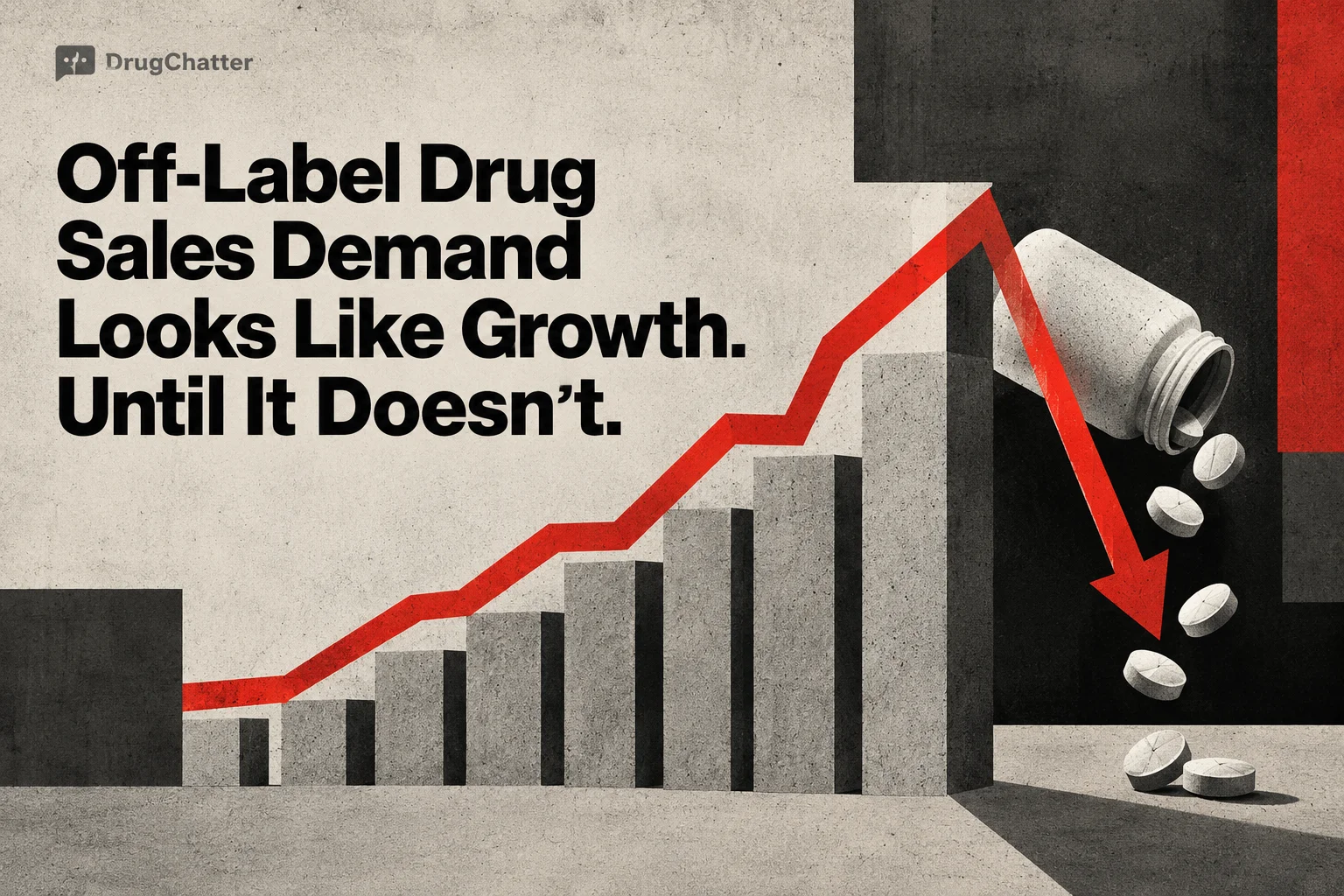
In March 2025, a federal judge in New Jersey ordered a Johnson & Johnson subsidiary to pay more than $1.6 billion for how it promoted two HIV drugs. A jury had already found that Janssen Products caused 159,574 false claims to be submitted to Medicare and Medicaid by promoting Prezista and Intelence for uses and dosing regimens the FDA had not approved [1]. The judgment, $360 million in treble damages plus $1.28 billion in statutory penalties, is the largest False Claims Act award in the history of the statute [2]. Janssen is appealing. The Third Circuit heard arguments in March 2026 [3].
The same week that case was working through appellate briefing, Novo Nordisk and Eli Lilly were living the other side of the same coin. Semaglutide and tirzepatide, both approved first for type 2 diabetes, had been used off-label for weight loss on such a scale that the FDA placed them on its drug shortage list for more than two years [4]. That demand did not just create a compounding crisis. It also generated the real-world signal that helped justify the clinical trials behind Wegovy’s 2021 obesity approval, its 2024 cardiovascular indication, and Zepbound’s 2024 sleep apnea indication [5][6][7].
Off-label prescribing sits at the center of both stories. It is the mechanism by which manufacturers discover that a drug has commercial life beyond its label, and it is the mechanism by which manufacturers end up writing nine- and ten-figure checks to the Department of Justice. This article separates the two functions, shows how the compendia and reimbursement system already treats off-label use as a parallel approval track for entire drug classes, and lays out where the current enforcement and AI-information landscape is moving in 2026.
The Short Answer
Physicians may legally prescribe an approved drug for any use, dose, or population, regardless of what the FDA-approved label says. Manufacturers may not promote a drug for an unapproved use. That asymmetry is the entire off-label problem. Between 12% and over 40% of prescriptions in the United States are off-label depending on drug class and dataset [8][9][10][11], and that volume of real-world use routinely becomes the commercial and clinical justification for a manufacturer’s next supplemental approval. The same volume, mishandled by a sales or marketing organization, becomes the fact pattern in a False Claims Act complaint. Both things are true of the same underlying behavior, which is why off-label strategy sits jointly with Commercial, Medical Affairs, Regulatory, and Legal rather than any one of them alone.
What Off-Label Prescribing Actually Means
When the FDA approves a new drug application, it approves a specific label: indication, dose, patient population, and route of administration. “Off-label use” means prescribing that same FDA-approved product for anything outside that label, whether a different disease, a different age group, a different dose, or a different combination [12]. It is not illegal. The Food, Drug and Cosmetic Act regulates manufacturers, not the practice of medicine, and physicians have had the discretion to prescribe off-label since the modern drug approval system was built.
Off-Label Use vs. Off-Label Promotion
The distinction that governs everything downstream is use versus promotion. A physician prescribing gabapentin for anxiety is off-label use. A sales representative telling that physician gabapentin works for anxiety, without that claim being consistent with the FDA-required labeling, is off-label promotion, and promotion is what triggers liability under the FDCA’s misbranding provisions and, when government payers foot the bill, the False Claims Act [13]. The FDA’s operative legal theory is “intended use”: a company markets a product for the use it intends, and if that intended use has not been approved, the product is misbranded regardless of what the label itself says. In 2021, the FDA broadened the evidentiary sources it will consider when determining intended use to include essentially any relevant marketing or communication material, not just formal labeling [13].
Why the Line Moves
Two Supreme Court-adjacent flashpoints, Sorrell v. IMS Health and United States v. Caronia, along with FDA’s own settlement with Amarin Pharma over fish-oil drug Vascepa, forced the agency to reckon with First Amendment limits on restricting truthful, non-misleading manufacturer speech [14]. That pressure produced a decade of incremental guidance rather than a single bright-line rule, which is why a manufacturer’s off-label communications program in 2026 looks nothing like it did in 2010.
How Common Is Off-Label Prescribing?
Estimates vary by dataset, time period, and drug class, but they consistently land well above zero and often well above a quarter of all prescriptions.
Study / Source
Population or Drug Class
Off-Label Rate
Radley et al., 2006 (160 commonly prescribed drugs, U.S.)
General outpatient prescribing
21%
Eguale et al., 2016 (Quebec, 2005-2009)
General outpatient prescribing
11%
Bradford et al., 2018 (National Ambulatory Medical Care Survey)
Psychiatric prescribing study, U.S. outpatient visits
Psychiatric drugs
12.9%
Sources: [8][9][10][15][16]
“41% of cancer drug utilization was off-label based on MarketScan data from 1997 to 2007, of which 17% were considered inappropriate and 29% appropriate uses.” [16]
The spread between drug classes is the important finding, not the topline average. Diabetes therapies sit at roughly 1% off-label because the approved indications already cover most of the clinically useful patient population. Cardiovascular drugs excluding statins and antihypertensives sit closer to 46% because prescribers routinely extend heart-failure and arrhythmia agents into adjacent conditions the original trials never enrolled for [15]. Oncology sits near 41% because tumor biology, not label language, drives prescribing decisions once a drug’s mechanism is understood [16].
The Market Validation Pattern: How Off-Label Demand Becomes a New Indication
Manufacturers do not usually discover a new indication in a vacuum. They discover it because prescribers are already writing the drug for that use, and that pattern repeats across therapeutic areas with enough consistency to treat it as a taxonomy rather than a coincidence.
Case Study: Semaglutide’s Four-Stage Label Expansion
Semaglutide illustrates the pattern most cleanly because every stage is publicly dated. Novo Nordisk’s injectable semaglutide launched as Ozempic for type 2 diabetes in December 2017. The FDA expanded that approval to cardiovascular risk reduction in diabetic patients in January 2020. Novo Nordisk then won a separate obesity approval under the brand Wegovy in June 2021, extended to adolescents in December 2022 [17]. Off-label use of both diabetes-approved formulations for weight loss in patients without diabetes had already become widespread enough by 2022 to create a persistent national shortage [4]. On March 8, 2024, the FDA approved Wegovy for cardiovascular risk reduction in overweight or obese adults with established heart disease, based on the 17,604-patient SELECT trial, which showed a 20% reduction in the composite of cardiovascular death, heart attack, and stroke, a 15% reduction in cardiovascular death alone, and a 19% reduction in all-cause mortality [5][18]. FDA’s Dr. John Sharretts noted at the time that the population studied faces elevated cardiovascular risk [19]. In January 2025, Ozempic became the first GLP-1 receptor agonist approved specifically to slow kidney disease progression and reduce cardiovascular death in patients with type 2 diabetes and chronic kidney disease [17].
Case Study: Tirzepatide and Sleep Apnea
Tirzepatide followed a faster version of the same arc. Eli Lilly’s dual GIP/GLP-1 agonist launched as Mounjaro for type 2 diabetes in 2022 and as Zepbound for obesity in November 2023. On December 20, 2024, the FDA approved Zepbound for moderate-to-severe obstructive sleep apnea in adults with obesity, the first drug approved for that condition, based on the SURMOUNT-OSA trial’s 469 patients, in which participants averaged roughly 20% weight loss and at least 25 fewer breathing interruptions per hour [6][20][21]. FDA’s Dr. Sally Seymour called it a major step forward for sleep apnea patients [21].
Case Study: Botox’s Serendipitous Path to Chronic Migraine
Botulinum toxin A shows that market validation from off-label use does not require a manufacturer’s design. OnabotulinumtoxinA was approved in 1989 for eye-muscle disorders including blepharospasm and strabismus. Ophthalmologists treating blepharospasm noticed patients’ facial wrinkles smoothed as a side effect, which led dermatologists to inject it cosmetically starting in the late 1980s [22]. A Beverly Hills plastic surgeon, William Binder, then observed that patients receiving cosmetic injections reported their migraines improved, and reported that finding in the mid-1990s [23]. Physicians used Botox off-label for migraine prevention for roughly a decade before Allergan ran the PREEMPT trials, which enrolled 1,384 chronic migraine patients across two Phase III studies, leading to FDA approval for chronic migraine in 2010 [24][25].
The Common Structure Across Cases
Each case runs through the same four stages: an approved drug is used off-label at meaningful volume; that volume generates either commercial data, physician-reported outcomes, or shortage-level demand; the manufacturer or an independent investigator runs a confirmatory trial; the FDA grants a supplemental approval that converts off-label use into on-label use. The gap between stage one and stage four ranged from roughly a decade for Botox and semaglutide’s obesity indication to about one year for Zepbound’s sleep apnea approval, reflecting how much clinical infrastructure and trial capacity a sponsor already had in place when the off-label signal became undeniable.
Why Manufacturers Read Off-Label Demand as Market Validation
From a commercial standpoint, off-label prescribing is one of the few genuinely unpaid signals a manufacturer receives. Detail spend, direct-to-consumer advertising, and formulary negotiations all shape prescribing in ways that make it hard to isolate authentic physician demand. Off-label use, especially before a company has marketed for that indication, is closer to a revealed preference: a prescriber decided independently that the drug’s mechanism justified the risk for a patient the label does not cover. That is commercially valuable information, and it routinely shows up in a sponsor’s rationale for prioritizing a supplemental trial, even though sponsors rarely say so on the record given the promotional risk of appearing to have engineered the off-label demand in the first place.
The Compendia System: Reimbursement Already Treats Off-Label Use as Approved
Nowhere is off-label use more institutionalized than oncology, where Medicare Part B is statutorily required to cover a drug for an off-label indication if that indication appears in one of a small set of CMS-recognized compendia, regardless of whether the FDA has approved it [26]. The current list includes the American Hospital Formulary Service Drug Information, the National Comprehensive Cancer Network Drugs and Biologics Compendium, Micromedex DrugDex, Clinical Pharmacology, and Lexi-Drugs [27]. Medicaid and commercial payers frequently follow the same compendia rather than building independent coverage criteria, and UnitedHealth has publicly designated the NCCN compendium as its own reference standard for off-label oncology coverage [28].
What This Means in Practice
A cancer drug can be reimbursed by the federal government for an indication the FDA has never reviewed, provided a panel of oncologists convened by NCCN has voted to list it. This is not a loophole; it is a deliberate 2008 policy answer to the reality that oncology practice moves faster than the sNDA process, and that compendia listing functions, in effect, as a second, faster approval track running in parallel with the FDA’s [29]. Any competitive intelligence or market access team modeling addressable oncology market size for a drug needs to treat compendia listings as a distinct, trackable event from FDA label expansion, because the two often move years apart and the compendium listing is usually what drives near-term volume.
Where Off-Label Becomes a Governance Problem
The governance risk does not come from prescribers using a drug off-label. It comes from how a manufacturer talks about that use, what evidence supports the claims made, and whether federal healthcare dollars end up paying for it. Three FDA guidance tracks currently define the boundary manufacturers must operate inside.
Track One: Communications Consistent With the Label
FDA finalized its “Medical Product Communications That Are Consistent With the FDA-Required Labeling” guidance in June 2018, commonly called the CFL Guidance. It lays out a three-factor test for whether information a firm shares, even if not printed on the label itself, still counts as consistent with it, and therefore permissible [30][31].
Track Two: Scientific Exchange on Unapproved Uses
The more consequential track for off-label communications specifically is FDA’s guidance on Scientific Information on Unapproved Uses, known as SIUU. FDA issued a revised draft in October 2023 and finalized it on January 6, 2025 [32][33]. The final guidance loosened several draft-stage restrictions: firms are no longer limited to sharing SIUU only through reprint articles, and firm-generated presentations of unapproved-use data are now permitted under defined conditions, provided the communication is truthful, non-misleading, and separated from promotional material for approved uses [33][34]. FDA also published an updated First Amendment memorandum alongside the final guidance in January 2025, underscoring that the agency continues to calibrate this policy against the same constitutional pressure that produced the Amarin settlement a decade earlier [32].
Track Three: Communications With Payers
A companion 2018 guidance governs what manufacturers can tell payers, formulary committees, and similar entities about off-label uses and healthcare economic information, reflecting the 21st Century Cures Act’s 2016 amendment that explicitly authorized sharing healthcare economic information with payers under defined conditions, separate from the stricter rules that apply to communications with individual prescribers [35].
A Recent History of Off-Label Enforcement
Off-label promotion enforcement is not new, but the dollar figures involved have made it one of the most expensive categories of pharmaceutical compliance failure for two decades running.
Year
Company / Drug
Settlement or Judgment
Core Allegation
2004
Warner-Lambert/Pfizer, Neurontin (gabapentin)
$430 million
Promoted for bipolar disorder, pain, ALS, ADHD, and other unapproved uses
2009
Pfizer, Bextra and others
$2.3 billion
Off-label promotion and misbranding
2012
GlaxoSmithKline, Paxil, Wellbutrin, Avandia
$3 billion
Off-label pediatric and weight-loss promotion; withheld Avandia safety data
2013
Johnson & Johnson/Janssen, Risperdal, Invega, Natrecor
$2.2 billion
Promoted antipsychotics for dementia and pediatric use outside approved population
2025
Johnson & Johnson/Janssen, Prezista, Intelence
$1.6 billion judgment (on appeal)
Promoted HIV drugs with misleading claims about lipid effects and dosing
Sources: [36][37][38][2]
By the time Pfizer settled the Neurontin case in 2004, the underlying drug’s off-label share had reportedly grown so large that industry analysts estimated off-label prescriptions accounted for roughly 90% of Neurontin sales at the time of settlement [39]. That gap between the $430 million penalty and the scale of the underlying off-label revenue is a recurring feature of these cases: the settlement is calibrated to the harm the government can prove, not necessarily to the commercial value the off-label use generated for the company.
The Current Enforcement Environment: Janssen’s Appeal and the 2025-2026 Wave
The Janssen HIV-drug case is now the largest False Claims Act judgment ever entered, and it accounted for close to a quarter of the Department of Justice’s more than $6.8 billion in total False Claims Act recoveries in 2025, a record year for the statute [40]. The underlying allegation was narrower than a blanket off-label promotion claim: whistleblowers Jessica Penelow and Christine Brancaccio argued that Janssen misrepresented Prezista’s lipid effects and Intelence’s approved dosing frequency, misleading prescribers in ways that made resulting Medicare and Medicaid claims false [2][40]. Janssen’s appeal centers on the FCA’s materiality requirement, arguing the government kept paying claims after learning of the allegations, which it says undercuts any claim that the misrepresentations were material to payment decisions [3].
Other 2025-2026 Actions Signal a Kickback-Adjacent Enforcement Pattern
Recent settlements suggest enforcement priority has shifted somewhat from classic off-label sales-force promotion toward speaker-program and honoraria arrangements that function as a kickback mechanism supporting off-label or otherwise non-compliant prescribing. In January 2025, Pfizer paid nearly $60 million to resolve allegations that its Biohaven subsidiary used speaker honoraria and meals to induce migraine-drug prescriptions [41]. In April 2025, Gilead Sciences paid $202 million over an alleged kickback scheme involving payments to hundreds of healthcare providers tied to HIV medication prescribing [41]. In May 2026, Takeda paid roughly $13.7 million to resolve allegations tied to speaker-program kickbacks for its antidepressant Trintellix [42]. None of these three required a jury trial; all were negotiated settlements, which suggests companies are increasingly settling early rather than litigating to the Janssen outcome.
GLP-1 Compounding: The Newest Off-Label Governance Flashpoint
The GLP-1 shortage created a distinct and still-unresolved governance problem: compounded, unapproved versions of semaglutide and tirzepatide filled the demand gap under the FDA’s shortage exception, which allows 503A pharmacies and 503B outsourcing facilities to compound a drug during a declared shortage. FDA declared the tirzepatide shortage resolved on December 19, 2024, and the semaglutide shortage resolved on February 21, 2025, triggering wind-down deadlines of 60 to 90 days for compounders to stop [43][44]. The Outsourcing Facilities Association sued to block both determinations; district courts denied preliminary injunctions in both cases, and the consolidated appeals were argued before the Fifth Circuit on March 30, 2026, with a ruling still pending as of this writing [45]. Separately, on May 1, 2026, FDA proposed keeping semaglutide, tirzepatide, and liraglutide off its 503B bulk drug substances list entirely, which would bar outsourcing facilities from compounding them from raw ingredient even during a future shortage, absent a formal drug-shortage trigger [45].
Why This Matters for Off-Label Governance Specifically
Compounded GLP-1 products are, by definition, not the FDA-approved product, so their off-label use for weight loss sits entirely outside the label, compendia, and promotion framework that governs branded semaglutide or tirzepatide. Medical affairs and pharmacovigilance teams monitoring adverse events tied to “semaglutide” broadly need to distinguish compounded-product signals from branded-product signals, because dosing, formulation, and impurity profiles differ and the FDA’s own enforcement posture toward each is now diverging sharply.
What AI Is Doing to the Off-Label Information Landscape
Manufacturers spent two decades building a compliance infrastructure around one channel: what a sales representative, a speaker program, or a written communication tells a prescriber about an unapproved use. That infrastructure assumes the manufacturer controls, or at least can audit, the channel. Generative AI chatbots break that assumption. A physician or a patient can now ask ChatGPT, Copilot, or Gemini directly whether a drug works for an off-label condition, and the model answers using training data and web search rather than FDA-required labeling, with no promotional review, no medical-legal sign-off, and no manufacturer visibility into what was said.
What the Accuracy Research Shows
A 2025 study in JACCP: Journal of the American College of Clinical Pharmacy tested ChatGPT-3.5 and ChatGPT-4 against 30 real-world drug information questions, scoring accuracy against Lexicomp on a four-point scale [46]. The same research program has previously reported that a meaningful share of chatbot responses to pharmacology questions contain errors serious enough to affect a dosing or safety decision, and that reproducibility of the same question asked days apart is inconsistent, meaning a chatbot can give a different answer to an identical off-label question depending on when it is asked [46][47]. A separate case-study evaluation found ChatGPT could not yet be considered a reliable standalone source of patient medication instructions despite generally correct responses on straightforward questions [48].
Where AI and the Evidence Diverge on Off-Label Uses Specifically
GLP-1 drugs are a useful stress test because the branded and off-label off-label use, dosing, and formulation questions are unusually entangled. A chatbot asked about semaglutide for weight loss has to correctly distinguish Ozempic’s diabetes-only label from Wegovy’s obesity label, correctly flag that compounded versions are not FDA-approved products at all, and correctly represent that dosing for obesity differs from dosing for diabetes, three distinctions that require reading current labeling rather than pattern-matching on training data. Models trained predominantly on general clinical literature rather than current regulatory labeling documents have a structural tendency to blur exactly this kind of distinction, because the clinical mechanism is identical across formulations even though the regulatory status is not.
An Original Taxonomy: Four Types of Off-Label Market Validation
Not all off-label demand behaves the same way commercially or regulatorily. Sorting cases by mechanism clarifies what governance response fits each type.
Type 1: Serendipitous clinical discovery. A prescriber or patient notices an unintended effect during approved use, as with Botox and facial wrinkles leading to migraine treatment. Governance risk is low until a manufacturer starts actively promoting the observed effect.
Type 2: Mechanism-driven class expansion. A drug class’s core mechanism plausibly extends beyond its first indication, as with GLP-1 receptor agonists moving from diabetes to obesity to cardiovascular and renal indications. Governance risk is moderate and concentrated in how aggressively a sponsor communicates about the not-yet-approved extension before the supplemental trial reads out.
Type 3: Compendia-legitimized specialty off-label. Oncology and other specialty areas where a recognized compendium listing effectively substitutes for FDA approval in reimbursement terms. Governance risk is low for the off-label use itself but concentrated in whether promotional claims track the compendium listing precisely or overstate it.
Type 4: Demand-driven supply-chain off-label. Off-label demand large enough to create a shortage, which then draws in unapproved compounded substitutes, as with GLP-1s in 2023-2025. Governance risk is highest here because it involves an entirely separate, less-regulated supply chain rather than the branded product’s own label.
What This Means for Medical Affairs
Medical Science Liaisons operating in the scientific exchange space now have more room under the final SIUU guidance to proactively share firm-generated data on unapproved uses, provided the communication is scientifically sound, clearly separated from promotional material, and appropriately caveated as not FDA-approved. That expanded room comes with expanded documentation burden: every SIUU communication needs a defensible evidentiary basis that would survive the same scrutiny a whistleblower’s attorney would apply years later.
What This Means for Regulatory Affairs and Compliance
The compendia system means Regulatory and Market Access should track compendium committee decisions with the same rigor as FDA label supplements, since a positive NCCN listing can drive reimbursed off-label volume well before, or entirely instead of, a formal sNDA. Compliance teams should treat the 2025-2026 settlement pattern, smaller dollar amounts but a steady drumbeat of speaker-program and honoraria cases, as a signal that DOJ scrutiny has shifted toward the mechanisms that fund off-label-adjacent promotion rather than only the promotional claims themselves.
What This Means for Brand and Marketing Teams
Off-label demand signals are legitimate market intelligence, but documenting how that intelligence was gathered matters as much as the intelligence itself. A brand team that can show its supplemental-indication trial was prioritized based on independently observed prescribing patterns, physician-initiated inquiries, or published real-world evidence is in a fundamentally different position than one that cannot separate organic off-label demand from demand its own field force helped create.
What This Means for Pharmacovigilance
Off-label use complicates signal detection because adverse event reports rarely distinguish on-label from off-label indication at the point of capture, and for drugs like semaglutide and tirzepatide, they increasingly need to distinguish branded from compounded product as well. PV teams should treat off-label-heavy drug classes, cardiovascular agents and oncology drugs chief among them, as requiring indication-stratified signal review rather than aggregate review, since the risk-benefit calculus genuinely differs by use.
FAQ
Is it illegal for a doctor to prescribe a drug off-label?
No. Physicians have broad legal discretion to prescribe an FDA-approved drug for any use, dose, or patient population, based on their own medical judgment. The FDCA regulates manufacturer conduct, not the practice of medicine [12].
Can a drug company ever legally discuss an off-label use with a doctor?
Yes, within defined limits. FDA’s 2025 final SIUU guidance permits firms to share scientifically sound, truthful, non-misleading information about unapproved uses with healthcare providers, provided it is clearly separated from promotional material for approved uses [33][34].
Why do insurance companies sometimes pay for off-label drugs?
For cancer drugs specifically, Medicare Part B is required by law to cover an off-label use if it appears in one of five CMS-recognized compendia, including the NCCN Drugs and Biologics Compendium, regardless of FDA approval status [26][27].
What is the difference between off-label use and misbranding?
Off-label use describes what a physician does. Misbranding describes what happens when a manufacturer’s labeling or promotional claims do not match the approved use, which is the legal theory underlying most off-label enforcement actions [13].
Why did the FDA crack down on compounded semaglutide?
Compounding of semaglutide and tirzepatide was legally permitted only while both drugs sat on FDA’s official drug shortage list. Once FDA declared the shortages resolved in December 2024 and February 2025, the legal basis for most compounding ended, triggering wind-down deadlines that compounders are still litigating [43][44][45].
How much did Johnson & Johnson pay for the Janssen HIV drug case?
A federal judge entered judgment for $1.6 billion in March 2025, combining $360 million in treble damages with $1.28 billion in statutory per-claim penalties. Janssen is appealing to the Third Circuit, with arguments heard in March 2026 [2][3].
Does off-label use ever lead to a new FDA-approved indication?
Yes, routinely. Botox’s chronic migraine indication, Wegovy’s cardiovascular indication, and Zepbound’s sleep apnea indication all followed years of documented off-label use that helped justify the confirmatory trials sponsors eventually ran [5][6][24].
Can AI chatbots reliably answer questions about off-label drug uses?
Current research finds meaningful accuracy and consistency problems. A 2025 JACCP study found ChatGPT’s drug information responses often diverge from reference sources like Lexicomp, and responses to identical questions were not always reproducible over time [46].
What is the “intended use” doctrine and why does it matter for off-label marketing?
Intended use is FDA’s legal theory that a product’s regulatory status depends on what use a manufacturer intends for it, evidenced by any relevant marketing or communication material, not just the printed label. FDA broadened the evidence it considers under this doctrine in 2021 [13].
Is off-label promotion enforcement increasing or decreasing?
The dollar volume in individual cases like Janssen’s $1.6 billion judgment is at an all-time high, and total False Claims Act recoveries hit a record in 2025. Recent settlements increasingly target speaker-program and kickback structures adjacent to off-label promotion rather than only direct promotional claims [40][41][42].
Key Takeaways
Off-label prescribing ranges from roughly 1% of prescriptions for diabetes drugs to over 45% for some cardiovascular medications, with a widely cited overall estimate near 21% [8][15].
Physician off-label prescribing is legal; manufacturer off-label promotion is not, and the line between them is governed by FDA’s intended-use doctrine and three separate 2018-2025 guidance tracks [13][30][33].
Documented off-label use has directly preceded FDA label expansions for Botox (chronic migraine, 2010), Wegovy (cardiovascular risk reduction, 2024), and Zepbound (obstructive sleep apnea, 2024) [5][6][24].
Medicare Part B is statutorily required to cover off-label oncology drug use listed in CMS-recognized compendia, making compendia listing a de facto second approval track for cancer drugs [26][27].
Janssen’s $1.6 billion False Claims Act judgment over off-label HIV drug promotion is the largest in the statute’s history and is on appeal to the Third Circuit as of 2026 [2][3].
GLP-1 compounding, permitted only during FDA-declared shortages, is now being wound down through litigation that reached the Fifth Circuit in March 2026, creating a distinct off-label governance track separate from the branded products [45].
AI chatbots now answer off-label drug questions directly to patients and prescribers outside any manufacturer-controlled promotional channel, and published accuracy studies find meaningful error rates and inconsistent reproducibility in those answers [46][47][48].
References
Berger Montague. United States et al. ex rel. Penelow v. Janssen Products, LP. Case summary. Retrieved 2026. https://bergermontague.com/cases/united-states-et-al-ex-rel-penelow-v-janssen-products-lp-qui-tam-false-claims-act-settlement/
Bloomberg Law. Janssen Liability Increased to $1.6 Billion in Drug Fraud Suit. March 29, 2025. https://news.bloomberglaw.com/us-law-week/janssen-liability-increased-to-1-6-billion-in-drug-fraud-suit
Bloomberg Law. J&J Unit to Fight Historic $1.6 Billion False Claims Act Award. March 17, 2026. https://news.bloomberglaw.com/us-law-week/j-j-unit-to-fight-historic-1-6-billion-false-claims-act-award
American Medical Spa Association. FDA Announces Semaglutide Shortage Resolved. February 24, 2025. https://americanmedspa.org/news/fda-announces-semaglutide-shortage-resolved
HCPLive. Semaglutide (Wegovy) Receives FDA Label Expansion to Include Cardiovascular Risk Reduction. March 2024. https://www.hcplive.com/view/semaglutide-wegovy-receives-fda-label-expansion-to-include-cardiovascular-risk-reduction
Drug Topics. FDA Approves Tirzepatide for Obstructive Sleep Apnea in Patients with Obesity. December 20, 2024. https://www.drugtopics.com/view/fda-approves-tirzepatide-for-obstructive-sleep-apnea-in-patients-with-obesity
Eli Lilly and Company. FDA approves Zepbound (tirzepatide) as first and only prescription medicine for moderate-to-severe obstructive sleep apnea. Press release, December 20, 2024. https://investor.lilly.com/node/51756
Radley DC, Finkelstein SN, Stafford RS. Off-label prescribing among office-based physicians, cited in: Prevalence and relationship with health of off-label and contraindicated drug use in the United States. PMC. https://pmc.ncbi.nlm.nih.gov/articles/PMC11892052/
Eguale T et al. Off-label prescribing in Quebec, cited in same source as above.
Bradford WD et al. Off-label prescribing trends 1993-2008, cited in same source as above.
Off-Label Use vs Off-Label Marketing of Drugs, Part 1. JACC: Basic to Translational Science. ScienceDirect. https://www.sciencedirect.com/science/article/pii/S2452302X23000116
Congressional Research Service. Off-Label Use of Prescription Drugs. February 23, 2021. https://www.congress.gov/crs_external_products/R/PDF/R45792/R45792.3.pdf
Greenberg Traurig. FDA Increasingly Active in “Off-Label” Space Despite Patchwork Regulatory Scheme. January 2024. https://www.gtlaw.com/en/insights/2024/01/fda-increasingly-active-in-off-label-space-despite-patchwork-regulatory-scheme
DIA Global Forum. How to Communicate Unapproved Uses Without Breaking the Law. July 2, 2024. https://globalforum.diaglobal.org/issue/july-2024/how-to-communicate-unapproved-uses-without-breaking-the-law/
Off-Label Use vs Off-Label Marketing of Drugs, Part 1. JACC: Basic to Translational Science. https://www.jacc.org/doi/10.1016/j.jacbts.2022.12.011
Smieliauskas F et al. Off-label cancer drug utilization, MarketScan 1997-2007, cited in: Prevalence and relationship with health of off-label and contraindicated drug use in the United States. https://pmc.ncbi.nlm.nih.gov/articles/PMC11892052/
ClinicalTrials.gov protocol document. Comparative Effectiveness of Tirzepatide and Semaglutide in Individuals at Cardiovascular Risk. https://cdn.clinicaltrials.gov/large-docs/63/NCT07096063/Prot_SAP_001.pdf
AJMC. FDA Approves Semaglutide to Prevent Heart Events in Patients With CVD and Excess Weight. March 2024. https://www.ajmc.com/view/fda-approves-semaglutide-to-prevent-heart-events-in-patients-with-cvd-and-excess-weight
DAIC. FDA Approves Wegovy for Cardiovascular Risk Reduction in Adults with Known Heart Disease and Overweight or Obesity. March 8, 2024. https://www.dicardiology.com/content/fda-approves-wegovy-cardiovascular-risk-reduction-adults-known-heart-disease-and-overweight
Epocrates. FDA approves first medication for sleep apnea. December 24, 2024. https://epocrates.com/online/article/fda-approves-first-medication-for-sleep-apnea
Pharmacist.com. FDA approves Zepbound for obstructive sleep apnea. https://www.pharmacist.com/Blogs/CEO-Blog/fda-approves-zepbound-for-obstructive-sleep-apnea
Springer. Botulinum toxin type A: history and off-label oculofacial uses. https://link.springer.com/10.1007/978-1-4939-1544-6_113
NeurologyLive. Preventing Chronic Migraine Using OnabotulinumtoxinA. https://neurologylive.com/view/preventing-chronic-migraine-using-onabotulinumtoxina
Practical Neurology. OnabotulinumtoxinA for Headache: An Update. https://practicalneurology.com/articles/2012-jan-feb/onabotulinumtoxin-a-for-headache-an-update
NYHeadache.com. 100 Migraine Drugs, A to Z: onabotulinumtoxinA. https://nyheadache.com/blog/100-migraine-drugs-a-to-z-onabotulinumtoxina
ASCO. ASCO Requests CMS to Recognize NCCN Compendium. July 18, 2006. https://www.nccn.org/home/news/newsdetails?NewsID=76
Noridian Medicare. Determination of Approved and Accepted Off-label Drug Indications. https://med.noridianmedicare.com/web/jfb/topics/drugs-biologicals-injections/determination-of-approved-and-accepted-off-label-drug-indications
Pink Sheet. CMS Works Toward Additional Compendia For Off-Label Cancer Drug Coverage. https://pink.pharmaintelligence.informa.com/PS047082/CMS-Works-Toward-Additional-Compendia-For-Off-Label-Cancer-Drug-Coverage
Federal Register. Medical Product Communications That Are Consistent With the FDA-Required Labeling. June 13, 2018. https://www.federalregister.gov/documents/2018/06/13/2018-12631/
Loeb & Loeb. FDA Finalizes Guidance on Medical Product Communications that are Consistent with Approved Labeling. June 2018. https://www.loeb.com/en/insights/publications/2018/06/fda-finalizes-guidance-on-medical-product-commun__
King & Spalding. FDA Finalizes Guidance on Scientific Information on Unapproved Uses (SIUU). January 13, 2025. https://www.kslaw.com/news-and-insights/fda-finalizes-guidance-on-scientific-information-on-unapproved-uses-siuu
Foley Hoag. FDA Finalizes Guidance on Scientific Information on Unapproved Uses (SIUU) Communications. February 2025. https://foleyhoag.com/news-and-insights/publications/alerts-and-updates/2025/february/fda-finalizes-guidance-on-scientific-information-on-unapproved-uses-siuu-communications/
Arnold & Porter. FDA Finalizes Its SIUU Guidance: An Analysis of the Key Changes From the 2023 Draft Guidance. January 2025. https://www.arnoldporter.com/en/perspectives/advisories/2025/01/fda-finalizes-its-siuu-guidance
Ropes & Gray. FDA Issues Final Guidance Documents Relating to Medical Product Manufacturer Communications. 2018. https://www.ropesgray.com/en/insights/alerts/2018/06/fda-issues-final-guidance-documents-relating-to-medical-product-manufacturer-communications
Wikipedia. List of off-label promotion pharmaceutical settlements. https://en.wikipedia.org/wiki/List_of_off-label_promotion_pharmaceutical_settlements
RAPS. J&J to Pay $2.2 Billion for Off-Label Marketing of Risperdal in Third-Largest Settlement Ever. November 4, 2013. https://www.raps.org/resource/j-j-to-pay-2-2-billion-for-off-label-marketing-of.html
Bricker Graydon. GlaxoSmithKline LLC to Pay the Largest Health Care Fraud Settlement in U.S. History. 2012. https://www.bricker.com/insights/publications/GlaxoSmithKline-LLC-to-Pay-the-Largest-Health-Care-Fraud-Settlement-in-U-S-History
Healthy Skepticism. Pfizer Neurontin settlement background, citing USA Today, August 16, 2004. https://healthyskepticism.org/global/library/item/8750
Constantine Cannon. Takeda Pays $13.7M to Settle False Claims Act Violations of Paying Kickbacks to Physicians. May 2026. https://constantinecannon.com/whistleblower/takeda-pays-13-7m-to-settle-false-claims-act-violations/
Pharmacy Times. FDA Affirms Decision on Tirzepatide Shortage Resolved, Sets Transition Period for Compounding. December 20, 2024. https://pharmacytimes.com/view/fda-affirms-tirzepatide-shortage-resolved-sets-transition-period-for-compounding
McDermott Will & Emery. Semaglutide Shortage Resolved. 2025. https://www.mwe.com/?p=311415
Black Health. Compounded Semaglutide, Tirzepatide FDA Crackdown. 2026. https://www.blackhealth.org/articles/compounded-semaglutide-tirzepatide-fda-crackdown/
Khatri et al. Accuracy and reproducibility of ChatGPT responses to real-world drug information questions. JACCP: Journal of the American College of Clinical Pharmacy. 2025. https://accpjournals.onlinelibrary.wiley.com/doi/10.1002/jac5.70038
PMC. Human vs. artificial intelligence: Physicians outperform ChatGPT in real-world pharmacotherapy counselling. 2025. https://pmc.ncbi.nlm.nih.gov/articles/PMC12930016/
Frontiers in Artificial Intelligence. Evaluating the accuracy of ChatGPT in delivering patient instructions for medications. 2025. https://www.frontiersin.org/journals/artificial-intelligence/articles/10.3389/frai.2025.1550591/full