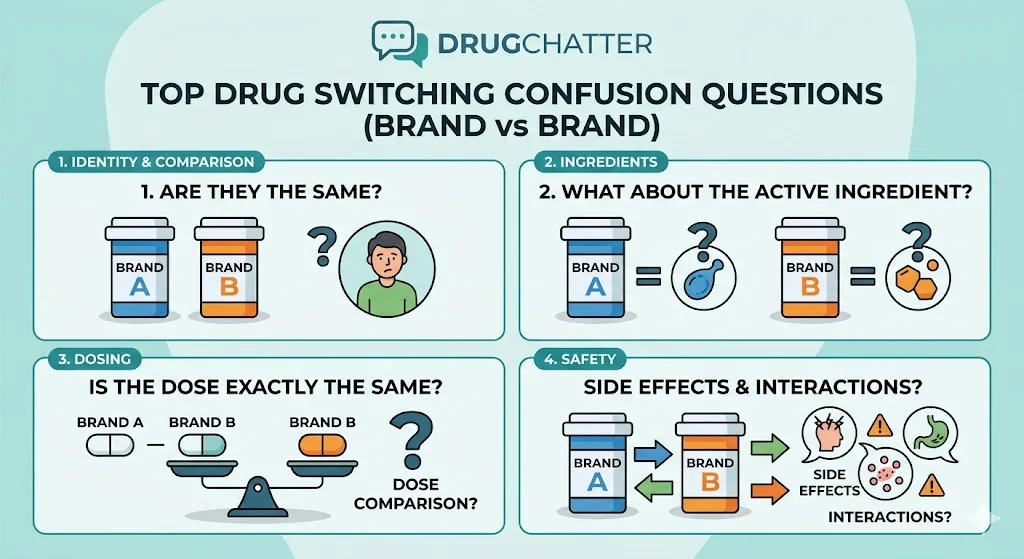
Drug switching is supposed to be boring: swap one product for another and keep the active ingredient, the dose, and the outcome the same. But anyone who has tried to navigate “brand vs brand” changes knows the reality is messier. Sometimes the active ingredient stays the same, sometimes it doesn’t (and the names look like they ought to). Sometimes the issue is formulation, timing, or patient-specific risk. And sometimes—most dangerously—the question you ask sounds straightforward, but the premise is shaky.
1) When the brand name makes you forget the regulatory paperwork
Start with the classic anxiety: “Is this still protected?” People ask about patents because they’re trying to forecast whether the brand will be stable—or whether a switch is coming with it. The confusion is less about the patent itself than what it implies for availability and substitution.
2) “Same ingredient” doesn’t always mean “same practical reality”
Even when you’re not mixing brands arbitrarily, brand-to-brand comparisons get people into trouble because they assume supply/handling is trivial. It isn’t. Storage, preparation, and administration can change the day-to-day experience dramatically.
Some brand switching confusion begins as pure curiosity—“tell me about it.” But “impoyz info” style questions often open into the same underlying concern: what exactly is being offered, and how is it different from the thing it’s replacing?
4) Safety scares: patients don’t only compare efficacy—they compare risk
Switching products isn’t just about whether you hit the numbers. People also worry whether they’re trading one side-effect profile for another, or whether a particular risk shows up more prominently on one brand.
5) Timing and dosing: when “brand switching” becomes “schedule switching”
Brand changes can accidentally change the rhythm of dosing. And once the schedule drifts, interactions and missed doses become more likely. That’s how a “brand vs brand” conversation turns into a “why do I feel different?” conversation.
6) Switching triggers: cost, availability, and the “generic” temptation
When the pharmacy says “we don’t have that,” the conversation shifts instantly from pharmacology to logistics. Cost becomes a proxy for equivalence. Availability becomes a proxy for “safe enough.” This is how brand switching confusions become patient decisions that should be clinical decisions.
7) Interaction confusion: brand names are the easy part; the drug pairing isn’t
Patients often notice differences after switching and then—quite reasonably—wonder whether some other substance is now interacting differently. But the bigger lesson is that brand switching doesn’t happen in isolation; it stacks onto existing meds and habits.
8) Lifestyle/food questions that sneak into the substitution story
Brand switching often leads to broader worry: “Did the new product change what I should eat, drink, or supplement?” Those are real questions—but the safest instinct is to verify timing and evidence, not guess.
Some confusion isn’t about biology—it’s about identity. Similar-looking names, overlapping indications, and inconsistent shorthand lead people to assume that two products must be interchangeable. They aren’t.
10) Switching across borders: approvals, supply chains, and what “approved” even means
When patients travel—or when families source information internationally—the brand-vs-brand question gets tangled with what’s authorized where. Approval status is not a synonym for availability, interchangeability, or identical labeling.
Brand switching confusion becomes a different species when people encounter biosimilars and assume they behave like identical generics. They’re not. And the switching conversation should be grounded in what regulatory pathway and substitution rules apply.
12) Bottom line: the safest question is the one with specifics
When the conversation is “brand vs brand,” the trap is to ask what sounds easy—price, generic name, whether the switch is allowed—while leaving out the details that actually determine safety and performance (exact active ingredient, strength, route, dosing schedule, formulation differences, interaction context, and patient-specific risks).
If you want to see how this plays out across many drug categories, the most useful habit is to read the underlying question—not just the final claim—and then translate it into what your clinician and pharmacist actually need: which drug you had, which you’re getting, and how you take it.