The Short Answer
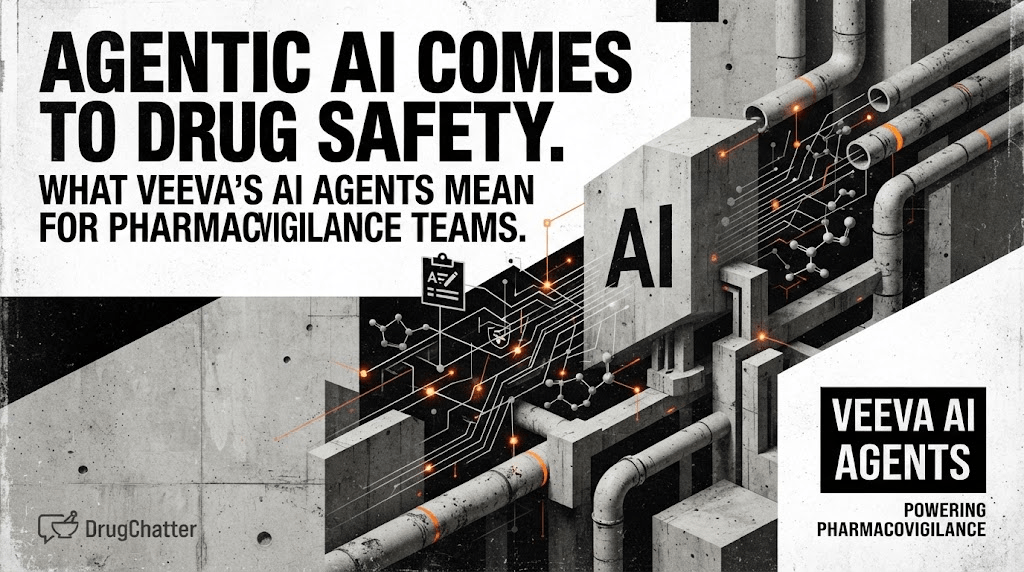
Veeva Systems is running two parallel agentic AI programs in drug safety at once, and they are not the same thing. The first is a set of AI agents embedded inside Vault Safety itself, part of the broader “Veeva AI Agents” rollout that Veeva announced on October 14, 2025, with safety and quality agents targeted for April 2026 availability [1][3]. The second is Falcon Safety, a standalone “agentic safety operations” product announced September 1, 2026, that works across any E2B-compliant safety system, including Oracle Argus and ArisGlobal LifeSphere MultiVigilance, with early adopter availability planned for November 2026 [6][7]. The distinction matters commercially and operationally: one is a feature inside the platform pharmacovigilance (PV) teams already own, the other is a bet that safety operations can be automated as a layer on top of whatever case management system a company already runs.
Neither product has years of production history yet. What has changed, concretely, is the shift from AI that fills in fields to AI that is designed to carry out multi-step case-processing work with less human intervention at each step. That shift is what “agentic” means in this context, and it is also what raises the QPPV oversight and audit-trail questions this piece works through.
What “Agentic” Actually Means in Case Processing
The word “agentic” gets used loosely in pharma marketing, so it is worth being precise about what changed. A chatbot answers a question when asked. Robotic process automation (RPA) executes a fixed, pre-programmed sequence of steps and breaks when the input format changes. An agentic system is designed to take a goal, decide which of several available actions to take next based on the specific case in front of it, execute that action, and then decide the next step based on the result, with a human reviewing the output rather than approving every intermediate step.
Applied to an individual case safety report (ICSR), that distinction plays out concretely. A rules-based intake tool extracts named fields from a fixed document template. An agentic case-intake system is designed to receive a report from any channel, an email, a call-center transcript, a literature abstract, a patient support program note, decide what type of document it is, extract the relevant data elements, check the extraction against duplicate cases already in the database, flag missing information, and route the case to the right queue, adjusting its approach based on what it finds in each specific report rather than following one fixed script.
From Rules-Based Automation to Autonomous Agents
Pharmacovigilance case processing already has two decades of automation history, and most of it was rules-based rather than agentic. Veeva’s own product line illustrates the progression. In August 2019, Veeva announced Vault Safety.AI, described at launch as using natural language processing and machine learning to convert unstructured text from call-center notes, literature, and other sources into structured case fields [8]. That product automated a specific, bounded task: field extraction. It did not decide what to do with a case once the fields were filled in, and it did not operate across systems it wasn’t built for.
A 2018 peer-reviewed pilot from Sanofi researchers, published in Clinical Pharmacology & Therapeutics, tested exactly this earlier generation of technology. The study describes automation of case processing as the single strongest cost driver in a company’s overall pharmacovigilance budget, and it ran a structured pilot comparing three commercial vendors’ AI and RPA solutions for extracting data from adverse event source documents and evaluating case validity [9]. The pilot confirmed that AI-assisted extraction was feasible and that vendor capabilities differed enough to be worth scoring, but it was explicitly testing assistive automation of discrete steps, not autonomous, multi-step case handling. That is the baseline agentic systems are being compared against, and it is a useful reminder that “AI in drug safety” is not a new headline; what is new is the scope of what the AI is asked to do without a human directing each step.
The Cognitive-Computing Precedent, and Why It’s Worth Remembering
Pharma has also seen an earlier hype cycle for autonomous-sounding safety AI, and it is worth naming directly rather than skipping past it. IBM Watson Health announced a collaboration with Celgene in November 2016 to build Watson for Patient Safety, described at the time as a highly automated, end-to-end drug safety platform intended to analyze large volumes of individual case safety reports and identify emerging safety signals. A separate IBM Watson Health product, Watson for Drug Discovery, was discontinued in April 2019 after IBM cited weak commercial returns, even as the company kept servicing existing clients. IBM framed the decision as a reallocation toward adjacent areas of clinical development rather than an admission that the underlying approach had failed [10]. The lesson for PV teams evaluating a new wave of agentic vendors is not that cognitive computing was fraudulent, it is that commercial durability and clinical accuracy are separate questions, and a vendor’s roadmap slide is not evidence that either has been solved.
Veeva’s Actual AI Agent Timeline: What Shipped, What’s Still a Roadmap
Because the terminology here moves fast and press coverage tends to compress the sequence, it is worth reconstructing exactly what Veeva announced and when, from primary sources.
October 2025: The Announcement
On October 14, 2025, Veeva Systems announced that AI Agents would be added across the Vault Platform, described as “deep, industry-specific agents” for clinical, regulatory, safety, quality, medical, and commercial applications, with commercial agents planned for December 2025 and R&D and quality agents, including safety, planned across 2026 [1].
December 2025: What Actually Launched First
Veeva delivered the first wave on December 3, 2025: the Free Text Agent, Voice Agent, and Pre-call Agent for Vault CRM, plus the Quick Check Agent and Content Agent for PromoMats. Safety agents were not part of this release; Veeva’s own release named clinical, regulatory, safety, quality, medical, and commercial as still to come throughout 2026 [2].
April 2026: Safety and Quality Agents Arrive Inside Vault
Veeva’s published schedule targeted April 2026 for the Safety and Quality wave [3][4]. Independent analysis published around that date noted that specific capabilities, interface details, and the extent of automation were still emerging even as the release window opened, with the agents referred to internally as “Veeva AI for Safety” [4]. By the time Veeva held its R&D and Quality Summit in Copenhagen in May 2026, company executives described safety and quality agents as already live, with clinical and regulatory agents slated to follow in August 2026 alongside the 26R2 platform release [5].
September 2026: Falcon Safety and the Interoperability Bet
The Copenhagen summit also introduced Falcon, described as a platform that sits outside Vault entirely and delivers what Veeva calls “agentic labor”: standardized agents built to run high-volume, repetitive workflows end to end. The three initial Falcon agents named at the summit covered trial master file (TMF) document intake and quality checking, safety case intake and processing, and health authority interaction management [5]. On September 1, 2026, Veeva formally announced Falcon Safety, described as an agentic safety operations product for adverse event intake, case processing, and follow-up tracking, with a specific design choice: it works with any E2B-compliant safety system, not only Veeva’s own, naming Oracle Argus and ArisGlobal LifeSphere MultiVigilance explicitly [6][7]. Marius Mortensen, Veeva’s vice president of product for Falcon, framed the launch as building on the company’s existing relationships with case processors and safety specialists to rethink safety operations more broadly [7]. Early adopter availability is planned for November 2026 [6][7].
Veeva’s Agentic AI Rollout in Drug Safety: A Timeline
| Date | Announcement | Scope | Source |
|---|---|---|---|
| Aug. 13, 2019 | Vault Safety.AI | NLP-based field extraction from unstructured intake documents (rules-based automation, not agentic) | [8] |
| Oct. 14, 2025 | Veeva AI Agents announced | Company-wide agentic AI roadmap across commercial, clinical, regulatory, safety, quality, medical | [1] |
| Dec. 3, 2025 | First AI Agents shipped | Vault CRM and PromoMats only; no safety agents yet | [2] |
| Apr. 2026 (targeted); live by May 2026 | Safety and Quality AI Agents | Embedded agents inside Vault Safety and Vault Quality | [3][4][5] |
| May 2026 | Falcon platform unveiled | Cross-platform “agentic labor” for TMF, safety case processing, and health authority interactions | [5] |
| Sept. 1, 2026 | Falcon Safety announced | Standalone agentic safety operations product; works with any E2B-compliant system; early adopter access Nov. 2026 | [6][7] |
What Falcon Safety and Vault’s Safety Agents Actually Automate
Stripped of launch-language, the documented scope of these products covers three case-processing functions: adverse event intake across multiple channels (portals, email, call-center notes, literature, patient support programs), case processing steps such as data extraction and structuring, and follow-up tracking, the ongoing work of requesting and incorporating missing information from reporters [6][7]. Falcon Safety’s stated architectural difference from an AI-assisted workflow is that it is designed to operate autonomously across intake channels rather than requiring a human to drive each case step, which is what makes it “agentic” rather than merely “AI-enabled” [6].
What is not yet publicly documented, as of this writing, is equally important. Veeva has not published a detailed account of which specific case-processing decisions the agents make without human sign-off, what confidence thresholds trigger escalation to a human reviewer, or how causality and seriousness assessment, the two most consequential medical judgment calls in a case narrative, are handled. Independent analysis published in April 2026 speculated that a duplicate-search agent or a causality and seriousness checker would be logical additions, but explicitly noted these were not confirmed capabilities [4]. Treat any vendor claim about “automated causality assessment” or “automated seriousness determination” with the same scrutiny applied to any claim about a discretionary regulatory judgment being delegated to software; as of September 2026 there is no public evidence that this exists in production.
An Original Framework: Three Levels of PV Automation Maturity
To make the rest of this piece easier to apply, it helps to separate three distinct levels of automation that get flattened together under the single word “AI” in vendor marketing. This is DrugChatter’s own classification, built from the documented capabilities above, not an industry-standard taxonomy.
- Level 1, field-level automation: NLP or OCR extracts named data elements from a fixed document type into a case record. A human performs every subsequent step. Vault Safety.AI (2019) and the vendor solutions tested in the 2018 Sanofi pilot sit here [8][9].
- Level 2, embedded assistive agents: Software operating inside an existing case management platform performs a bounded, multi-step task, drafting a narrative, flagging a likely duplicate, on a single case at a time, with a human approving before the case advances. The April 2026 Vault Safety AI agents appear to sit here, based on the capabilities Veeva has publicly described [3][4].
- Level 3, cross-platform agentic labor: Software operates across intake channels and across safety systems it was not custom-built for, deciding on its own what action a given case requires next, with human review concentrated at defined checkpoints rather than every step. Falcon Safety is positioned here by Veeva’s own description [6][7].
The QPPV oversight and validation burden increases at each level, because the further removed a human is from each individual decision, the more the audit trail has to document the system’s decision logic itself rather than just its output.
Why Now: The Volume and Cost Math Behind the Shift
Agentic AI is arriving in drug safety at a specific moment in the underlying workload data, and that timing is not coincidental.
Case Volume Has Roughly Doubled in a Decade
FDA’s own background materials on the FAERS database describe the system as containing more than 24 million adverse event and medication error reports accumulated since 1969 through March 2022, with FDA receiving over 2 million such reports annually in recent years [22]. That annual figure has climbed steadily: FDA materials from 2017 described the database as receiving over 1 million reports a year at that point, meaning the annual intake volume roughly doubled in the space of about five years [90][22]. Industry estimates from IDC, cited in vendor analysis, put annual safety case volume growth at 30 to 50 percent in some recent years, driven by an expanding pool of approved medicines, broader awareness among patients and prescribers, and the increasing complexity of combination and biologic therapies [23]. None of that volume growth is unique to Veeva’s customers; it is the industry-wide backdrop against which every PV automation vendor is selling.
What a Case Actually Costs
Cost data specific to case processing is harder to source than volume data, and figures vary by geography, case complexity, and whether the work is done in-house or outsourced. An Everest Group study cited in industry analysis put the average cost per PV case processed at $420 to $425 as of 2019 [23]. The 2018 Sanofi-authored pilot, describing the same cost pressure from the inside of a major manufacturer’s PV organization, characterized case processing automation as addressing the single strongest driver of overall pharmacovigilance budget [9]. Neither figure should be treated as a current, universal benchmark, cost varies too much by company size, geography, and case mix for that, but both point in the same direction: case volume and per-case cost were already under upward pressure well before agentic AI vendors started selling into the category.
FDA’s own background materials describe the FAERS database as receiving more than 2 million adverse event and medication error reports every year, a volume that has roughly doubled since 2017 [22][90].
How Big Is the Pharmacovigilance Software Market? Nobody Fully Agrees, and the Gap Is Informative
Market research firms do not converge on a single pharmacovigilance market size, and the spread is wide enough that it is worth showing rather than picking one number and presenting it as settled. Part of the divergence is definitional: some reports size “pharmacovigilance software” narrowly, others size the broader “pharmacovigilance market” that includes outsourced services, and forecast horizons differ by years. The table below is DrugChatter’s own compilation of five independent market reports published in 2026, shown side by side specifically to make that divergence visible rather than to endorse any single figure.
| Source | Base year size | Forecast year size | CAGR | Scope |
|---|---|---|---|---|
| Meticulous Research [17] | $1.62B (2026) | $3.75B (2036) | 8.1% | PV software only |
| SNS Insider (via [6]) | $207M (2023) | $372M (2032) | 6.76% | PV and drug safety software |
| Towards Healthcare [19] | $9.61B (2026) | $16.87B (2035) | 6.45% | Full PV market, services + software |
| The Business Research Company [20] | $10.86B (2026) | $17.41B (2030) | 12.5% | Full PV market |
| Mordor Intelligence / Fortune Business Insights [21] | ~$9.35–10.5B (2025–26) | $18.26B–$31.56B (2031–34) | Varies | Full PV market |
The two smallest figures, Meticulous Research’s and SNS Insider’s, both isolate PV-specific software, and their CAGRs cluster around 6.8 to 8.1 percent, a growth rate one industry analysis described as reflecting steady regulatory pressure rather than explosive adoption [6]. The broader “full market” figures, which fold in outsourced PV services, run five to ten times larger in absolute dollars and show far more disagreement on both size and growth rate. What every report agrees on, regardless of methodology, is the direction: AI and automation adoption inside PV software is cited as a growth driver, not merely a feature, across nearly all of them [17][60][61].
What Changes for QPPV Oversight
This is the section where the marketing language runs out and the compliance obligations start, because none of the regulatory requirements governing pharmacovigilance systems were written with autonomous, multi-step case processing in mind, and none of them have been rewritten yet to address it directly.
GVP Module I’s System-Oversight Mandate Does Not Bend for Software
In the EU, the Qualified Person Responsible for Pharmacovigilance (QPPV) is personally accountable for the pharmacovigilance system as a whole, an obligation established by Article 23 of Regulation (EC) No 726/2004 and elaborated in Good Pharmacovigilance Practices (GVP) Module I. Per GVP, the QPPV must have sufficient authority to influence the performance of the pharmacovigilance quality system and to promote and maintain legal compliance across it [15][68]. That obligation attaches to the system, not to the personnel operating it, which means it does not disappear or transfer to a software vendor when a case-processing step is automated. If an agent decides a case does not meet seriousness criteria and therefore is not escalated for expedited reporting, that decision sits inside the QPPV’s oversight scope exactly as if a case processor had made the same call. GVP Module I’s own emphasis on system oversight, highlighted repeatedly in industry commentary on frequent inspection findings, is specifically about maintaining visibility into how the system behaves across a complex and changing organization, a requirement that gets harder, not easier, to satisfy as more case-processing logic moves into an opaque model [69][74].
The Audit Trail Question: 21 CFR Part 11 and E2B(R3) Were Not Written for Adaptive Decision-Making
Two long-standing technical standards frame the audit-trail obligation in PV: 21 CFR Part 11 in the US, which governs electronic records and requires a secure, computer-generated, time-stamped audit trail that independently records operator actions, and ICH E2B(R3), the international standard defining the minimum structured data elements an electronic individual case safety report must contain [4]. Both standards were built around the assumption that a record’s provenance is a fixed, traceable chain: a person or a deterministic system performed a specific, repeatable action on a specific data field. An agentic system that dynamically decides which of several possible actions to take on a given case, and that could plausibly take a different action on a superficially similar case depending on subtle differences in the input, strains that assumption without necessarily breaking the letter of either standard. The practical implication for a validation team is that the audit trail increasingly needs to capture not just what value was entered and by whom, but which decision path the agent took and why, information that traditional field-level audit trails were never designed to hold.
A Precedent for “Automated but Verified”: The 2018 Sanofi Pilot
The 2018 Sanofi-authored pilot offers a useful, already-precedented model for how to validate automation without ceding oversight, even though it predates agentic architectures. The study’s authors ran a structured, scored comparison of three vendors specifically to differentiate their capabilities before committing to any one solution, and it treated the safety database’s existing structured data fields as a usable substitute for the more time-consuming and costly process of manually annotating source documents from scratch, rather than assuming vendor claims about accuracy could stand on their own [9]. That evaluate-before-adopt discipline, scoring vendors against a defined validation dataset rather than accepting vendor-reported accuracy figures, is the same discipline QPPV and quality teams need to apply to agentic vendors now, arguably with a wider evaluation scope, since an agentic system’s behavior needs to be validated across a broader range of case types and decision branches than a single-purpose extraction tool.
Where Regulators Actually Stand on Agentic AI in Drug Safety
No regulator has issued guidance specifically written for agentic AI in pharmacovigilance case processing. What exists is a set of adjacent documents, at different stages of maturity, that PV teams will need to interpret by analogy until something more specific arrives.
FDA’s Draft AI Credibility Framework Is Still a Draft
FDA issued its first AI-specific guidance for drug and biological products on January 6, 2025: “Considerations for the Use of Artificial Intelligence to Support Regulatory Decision-Making for Drug and Biological Products.” The draft proposes a seven-step, risk-based credibility assessment framework built around defining a “context of use” for a given AI model, then scaling the rigor of validation evidence to the risk that context carries [11][31]. The guidance explicitly covers AI used in the post-marketing phase, including pharmacovigilance, and FDA has specifically flagged post-marketing pharmacovigilance as a higher-risk application warranting early engagement with the agency [34]. The public comment period closed in April 2025. As of mid-2026, the document remains in draft status; FDA’s own AI program materials still describe it that way, and finalization has been anticipated without a confirmed date [42].
EMA’s Reflection Paper Predates the Agentic Wave
The European Medicines Agency finalized its own foundational document, a “Reflection paper on the use of Artificial Intelligence (AI) in the medicinal product lifecycle,” on September 30, 2024, adopted jointly by the CHMP and CVMP [13][50]. The paper covers AI and machine learning across the full product lifecycle, including post-authorization pharmacovigilance, and sets out general principles: a human-centric approach to AI development and deployment, and active measures to identify and mitigate bias in AI/ML applications [13]. It predates the current generation of agentic case-processing products by roughly two years and does not address multi-step autonomous decision-making specifically.
The Joint FDA-EMA Guiding Principles Are New, and Explicitly Non-Binding
FDA and EMA published joint “Guiding Principles of Good AI Practice in Drug Development” in January 2026, establishing a shared, non-binding framework for AI governance, validation, and lifecycle management across both agencies’ jurisdictions [14][42]. The document is a foundation for future, more specific guidance rather than an enforceable standard, and it is not written specifically for pharmacovigilance case processing or for agentic architectures.
What None of These Documents Address Yet
Reading the three documents together surfaces a consistent gap: none of them specify how a “context of use” risk assessment should treat a system that takes a different action on similar inputs based on internal, non-deterministic reasoning, which is close to the definition of an agentic system’s behavior. None of them define what audit trail granularity is sufficient for a multi-step autonomous decision, as distinct from a single automated field extraction. And none of them address the specific case where the automation vendor’s system spans multiple companies’ safety databases, as Falcon Safety is designed to do, raising questions about how a QPPV maintains system oversight over a shared, cross-customer automation layer that the QPPV’s own company does not fully control. FDA does run an Emerging Drug Safety Technology Meeting (EDSTM) program specifically to let sponsors discuss new pharmacovigilance technologies with the agency ahead of deployment, which is the most concrete existing channel for a company deploying agentic case processing to get early regulatory feedback before these gaps get resolved by guidance [34].
The Compliance Risk Nobody Has Priced In Yet
FDA issued its first AI-specific current Good Manufacturing Practice warning letter in April 2026, to Purolea Cosmetics Lab, citing 21 CFR 211.22(c) over inadequate oversight of an AI-driven process. That letter was issued in a manufacturing context, not pharmacovigilance, and it does not establish a PV-specific enforcement precedent. What it does establish is that FDA is already willing to cite a specific regulation over inadequate human oversight of an AI system’s output, rather than treating AI involvement as a novel category requiring new enforcement tools. A PV organization deploying agentic case processing without a documented, tested escalation threshold for when a case gets kicked to a human reviewer is building the same exposure into a different regulation: GVP Module I’s system-oversight requirement in the EU, or FDA’s post-marketing safety reporting regulations in the US, rather than 21 CFR 211.22(c). The specific rule cited would differ, but the underlying finding, inadequate documented oversight of an automated system’s decisions, transfers directly.
Separately, published research on AI-generated drug information more broadly has repeatedly found that general-purpose AI models produce clinically significant errors, including missed drug interactions and outdated dosing information, when tested against current prescribing information, even though that research generally tests consumer-facing or general-purpose chatbots rather than purpose-built case-processing agents. The relevance to agentic PV case processing is one of category, not one of the specific vendors: any system that makes an autonomous judgment call using a language model carries some risk of a plausible-sounding but incorrect output, which is precisely why the escalation-threshold and audit-trail questions above are not theoretical.
What This Means, by Function
Case Processors
The realistic near-term change is not job elimination but role compression toward review and exception-handling. Vendors across this category, including Veeva, are consistently positioning agentic tools as handling first-pass intake and structuring so processors spend more time on medical judgment calls and complex cases, less on manual data entry [4][6].
QPPV and PV Quality
The validation burden shifts from validating a fixed workflow to validating a decision space. Before deploying any Level 2 or Level 3 automation as defined above, PV quality teams need a documented answer to what confidence threshold triggers human escalation, what the audit trail captures about the agent’s decision path, and how the system’s behavior is periodically re-tested as the underlying model changes, not just at initial validation.
Medical Review and Signal Management
None of the products discussed in this piece are documented as performing autonomous signal detection or causality assessment in production. Vault Safety Signal, Veeva’s dedicated signal management module, is listed among the company’s safety applications, but the AI-agent capabilities Veeva has publicly detailed are concentrated on intake and case processing, not signal detection [4][11]. Medical reviewers should not assume signal-detection workflows are currently automated by these specific products; that is a distinct claim requiring its own evidence.
IT and Computer System Validation
Falcon Safety’s cross-system design, working with Vault Safety, Oracle Argus, and ArisGlobal LifeSphere MultiVigilance alike, means IT and validation teams evaluating it need to assess integration and data-integrity risk at the interface between systems they may not have built or fully control, not just within a single vendor’s platform [6][7].
Where Veeva Sits Competitively
Veeva is not the only vendor selling AI into pharmacovigilance case processing, though it is the most visible in 2026 press coverage. The broader competitive landscape documented in industry analysis includes Sanofi and Deloitte’s ConvergeHEALTH Safety platform, which uses AI to streamline case intake, ArisGlobal’s own integration with FDA’s FAERS II submission system, and Saama Technologies’ ASAP solution, which draws on FDA’s Sentinel Common Data Model and TreeScan methodology for real-time risk detection [61]. Falcon Safety’s explicit interoperability with Oracle Argus and ArisGlobal LifeSphere is a direct strategic response to that landscape: rather than requiring a customer to migrate off a competing safety database to access agentic automation, Veeva is positioning the automation layer as portable across the installed base [6][7]. Whether that claim holds up in practice against deeply embedded Argus deployments specifically is the open question industry coverage has flagged for the November 2026 early adopter cohort to answer [6].
For teams responsible for monitoring how AI systems, including general-purpose models patients and prescribers query directly, describe a drug’s safety profile relative to its current label, this is a related but distinct discipline from case-processing automation. DrugChatter’s own AI monitoring work tracks how large language models answer drug safety questions against the current prescribing information, which is a downstream check on public-facing AI accuracy rather than an internal case-processing tool; it is a useful complement to, not a substitute for, the case-processing validation discussed in this piece.
Key Takeaways
- Veeva is running two distinct agentic AI programs in drug safety: embedded Vault Safety AI agents (targeted for April 2026, live by May 2026) and the standalone Falcon Safety product (announced Sept. 1, 2026, early adopter access Nov. 2026), and they are not interchangeable [1][3][5][6][7].
- “Agentic” specifically means multi-step, autonomous decision-making across a case, not single-field automation; Veeva’s own 2019 Vault Safety.AI and the vendor tools tested in a 2018 Sanofi-authored pilot represent the earlier, rules-based generation this is being compared against [8][9].
- FDA’s draft AI credibility guidance (Jan. 2025) remains in draft status as of this writing and explicitly flags post-marketing pharmacovigilance as a higher-risk AI application warranting early agency engagement [11][34][42].
- No FDA, EMA, or joint FDA-EMA AI document specifically addresses audit-trail requirements for autonomous, multi-step case-processing decisions; QPPVs and PV quality teams are currently applying general system-oversight principles from GVP Module I by analogy [13][14][15][68].
- Pharmacovigilance software market-size estimates for 2026 range from roughly $1.6 billion to nearly $11 billion depending on scope and methodology, though independent reports converge on AI and automation adoption as a growth driver regardless of which market-size estimate is used [17][19][20][21].
FAQ
Is Veeva’s agentic AI already live in production pharmacovigilance systems?
Partially. Vault Safety and Quality AI agents were targeted for April 2026 and described as live by Veeva executives at a May 2026 conference. Falcon Safety, the newer and more autonomous product, is not yet generally available; early adopter access is planned for November 2026 [3][5][6].
Does Falcon Safety work with safety systems other than Veeva’s own?
Yes. Veeva has explicitly designed Falcon Safety to work with any E2B-compliant safety system, naming Oracle Argus and ArisGlobal LifeSphere MultiVigilance as examples, in addition to Veeva Safety itself [6][7].
Does an agentic AI system replace the QPPV’s oversight obligation?
No. GVP Module I attaches the QPPV’s oversight obligation to the pharmacovigilance system as a whole, and that obligation does not transfer to a software vendor when a case-processing step is automated [15][68].
Is there FDA or EMA guidance specifically covering agentic AI in drug safety case processing?
No dedicated guidance exists yet. FDA’s January 2025 draft AI credibility guidance and the January 2026 joint FDA-EMA guiding principles both touch on AI in pharmacovigilance generally, but neither was written with autonomous, multi-step agentic decision-making specifically in mind, and FDA’s draft guidance remains unfinalized [11][13][14][42].
What is the difference between “AI-assisted” and “agentic” case processing?
AI-assisted tools typically automate a single, bounded task, such as extracting data fields from a document, with a human directing every subsequent step. Agentic systems are designed to decide which of several possible actions to take on a given case and execute a sequence of steps with less human intervention at each stage [6][9].
Has an agentic AI system been shown to autonomously perform causality or seriousness assessment on adverse event cases?
Not based on publicly documented capabilities as of this writing. Industry analysis has speculated that such features could be logical future additions to Veeva’s safety agents, but this is explicitly framed as speculation, not a confirmed, deployed capability [4].
How much does pharmacovigilance case processing typically cost per case?
Estimates vary widely by geography, case complexity, and whether work is outsourced. An Everest Group study cited in industry analysis put the average at $420 to $425 per case as of 2019; more recent, PV-specific figures are not consistently published across the industry, so this should be treated as a dated reference point rather than a current benchmark [23].
Why do pharmacovigilance market-size reports disagree so much with each other?
Largely because of scope differences. Reports that size “PV software” narrowly produce figures in the low billions; reports that size the “full pharmacovigilance market,” including outsourced services, produce figures five to ten times larger, and forecast horizons and growth-rate assumptions differ further from there [17][19][20][21].
Did FDA’s first AI-specific warning letter involve pharmacovigilance?
No. FDA’s first AI-specific current Good Manufacturing Practice warning letter, issued in April 2026 to Purolea Cosmetics Lab under 21 CFR 211.22(c), addressed a manufacturing process, not case processing or drug safety reporting. It is relevant to PV teams mainly as a signal that FDA is willing to cite specific regulations over inadequate human oversight of an AI system’s output.
What happened to earlier “cognitive computing” efforts in drug safety, like IBM Watson?
IBM Watson Health announced a drug-safety collaboration with Celgene in 2016, and separately discontinued its Watson for Drug Discovery product in April 2019 after citing weak commercial returns, while continuing to support existing clients. That history is a reminder that commercial durability and clinical accuracy are separate questions when evaluating any new generation of AI vendors in this space [10].
References
- Veeva Systems. (2025, October 14). Veeva AI Agents to Be Released Across All Veeva Applications. veeva.com.
- Veeva Systems. (2025, December 3). Veeva AI Agents Now Available to Increase Productivity and Customer Centricity. ir.veeva.com.
- IntuitionLabs. (2026). Veeva AI Agents: Agentic AI for the Life Sciences Industry. intuitionlabs.ai.
- IntuitionLabs. (2026, April). Veeva AI Agents for Pharmacovigilance Case Processing. intuitionlabs.ai.
- The Clinical Trial Vanguard. (2026, May 28). Veeva Unveils Falcon AI Platform and Agentic Authoring at 2026 Summit. clinicaltrialvanguard.com.
- The Clinical Trial Vanguard. (2026, September 2). Veeva Launches Falcon Safety AI for Adverse Event Processing Across E2B Systems. clinicaltrialvanguard.com.
- Veeva Systems. (2026, September 1). Veeva Falcon Safety to Work with All E2B-Compliant Safety Systems Across Any Intake Channels. PR Newswire.
- Veeva Systems. (2019, August 13). Veeva Brings Artificial Intelligence to Drug Safety. BusinessWire.
- Schmider, J., Kumar, K., LaForest, C., Swankoski, B., Naim, K., & Caubel, P. M. (2018). Innovation in Pharmacovigilance: Use of Artificial Intelligence in Adverse Event Case Processing. Clinical Pharmacology & Therapeutics, 105(4), 954–961. PMC6590385.
- SiliconANGLE / Becker’s Hospital Review. (2019, April). IBM Stops Development, Sales of Watson for Drug Discovery.
- U.S. Food and Drug Administration. (2025, January 6). Considerations for the Use of Artificial Intelligence to Support Regulatory Decision-Making for Drug and Biological Products [Draft guidance]. fda.gov.
- Drug Discovery News. (2026). Regulating AI in Drug Discovery: What FDA, EMA, and ICH Guidance Means for Pharma R&D. drugdiscoverynews.com.
- European Medicines Agency. (2024, September 30). Reflection Paper on the Use of Artificial Intelligence (AI) in the Medicinal Product Lifecycle. ema.europa.eu.
- IQVIA. (2026). Key RWE and AI Regulatory Policy Developments, January–June 2026. iqvia.com.
- Wikipedia. Qualified Person Responsible For Pharmacovigilance (citing GVP Module I, Section I.C.1.3).
- SNS Insider. Pharmacovigilance and Drug Safety Software Market, cited in [6].
- Meticulous Research. (2026). Pharmacovigilance Software Market.
- IMARC Group. (2026). Pharmacovigilance Market.
- Towards Healthcare. (2026, April 30). Pharmacovigilance Market Sizing.
- The Business Research Company. (2026). Pharmacovigilance Global Market Report 2026.
- IntuitionLabs. (2026, August 1). FAERS 2026: Adverse Event Report Data, Top Drugs & Outcomes (citing Mordor Intelligence and Fortune Business Insights market figures).
- U.S. Food and Drug Administration. FAERS Public Dashboard background materials. fda.gov/media/158614.
- WinWire. Pharmacovigilance automation blog (citing IDC case-volume growth estimates and a 2019 Everest Group per-case cost study).