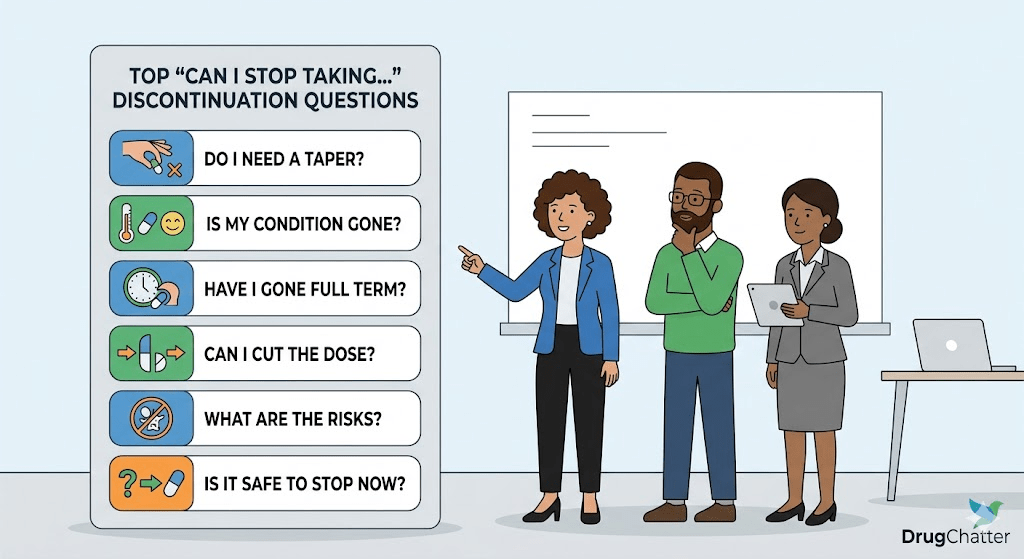
There are only so many ways a question can start: “Can I stop taking…”—and then the name of a drug that has been propping up your health routine. The trouble is that discontinuation is rarely a single decision. It’s a chain: how the medication works, how long you’ve taken it, why you started, what your body has adapted to, and what risks show up if you stop too quickly.
Below are the discontinuation-flavored questions people tend to ask when they’re tired of costs, side effects, or just the daily reminder of being “on something.” The links point to the original DrugChatter discussions, where you’ll find the specific, practical angles each drug brings to the conversation.
1) “Can I stop because I don’t know what ‘generic’ changes?”
If you’re considering stopping—or switching—because you think the generic will be different, you’re in the right neighborhood. Start by clarifying what’s actually interchangeable, and what might not be.
- Generic marcaine?
- Generic crestor name?
- Norgesic generic?
- Generic for tricor?
- Generic for enablex?
- Daliresp generic name?
- Alprostadil generic name?
- Detrol generic?
2) “Can I stop because it costs too much?”
People don’t only discontinue out of physiology; they discontinue out of arithmetic. If a medication has become unaffordable, it’s easy to slide from “I can’t pay” into “I’ll just stop.” But cost-driven changes should usually be paired with a plan: dose adjustment, assistance programs, therapeutic alternatives, or a controlled taper when needed.
- Myleran cost?
- How much does ranolazine cost?
- Secuado cost?
- Generic atorvastatin cost us?
- Epoprostenol cost?
- Cost of enbrel in canada
- Survanta cost?
- Ranexa cost?
- Safyral cost?
3) “Can I stop because I missed doses… or it feels like it’s ‘not doing anything’?”
This is the most seductive question: the idea that if you feel okay, the drug must be optional. Sometimes you can stop safely; sometimes you’ll feel fine right up until your body remembers what the medication was preventing.
- What’s the typical timeline for lipitor’s full impact?
- Does ozempic’s effect change based on meal times?
4) “Can I stop because I heard it interacts with food or alcohol?”
Interactions can be scary. But a bad interaction story is not the same thing as a reason to stop abruptly—especially for medications where withdrawal or rebound can be the real danger.
- Does alcohol consumption reduce lipitor’s effectiveness?
- Can red wine interfere with lipitor’s cholesterol reduction?
- Can red wine fully replace lipitor’s cholesterol lowering effects?
- Can bananas interfere with lipitor’s effectiveness?
- Which snacks can increase lipitor’s effectiveness?
- Red beet and lipitor interaction?
- Does lipitor interfere with garlic’s cholesterol lowering effect?
5) “Can I stop because I’m worried about side effects?”
If your question is really “Will stopping fix this?” the honest answer depends on what the side effect is and what the medication is doing physiologically. Some problems improve after stopping; others require a careful plan, monitoring, or a different workaround.
- Which groups have higher risk for tigecycline’s liver effects?
- What is the safe limit of acetaminophen intake?
- What is the recommended monitoring frequency for lurbinectedin’s side effects?
- Did simvastatin use contribute to patient’s liver issues?
- Gabapentin drowsiness?
- Trazodone dreams?
6) “Can I stop because it’s complicated with other drugs?”
Sometimes the fear isn’t the medication itself; it’s what happens when you stack it with other prescriptions, supplements, or timing constraints. Again: stopping might be part of the solution, but usually you want a coordinated transition.
- Influences rifampin on famciclovir’s drug interactions?
- What’s the recommended lipitor dose with warfarin?
- Naproxen with aspirin?
- Can you take trazodone and melatonin together?
- Foods to avoid whilst taking low dose aspirin hns
7) “Can I stop because I’m switching formulations or brands?”
Some medicines come in multiple forms (or have preservative-free options), and the change can affect tolerability. Before discontinuing, check whether the real need is formulation adjustment—not stopping.
- Marcaine hydrochloride preservative free?
- Marcaine other names?
- Spiriva handihaler vs spiriva respimat?
- Can tadalafil be used for pulmonary arterial hypertension?
The practical takeaway
If you’re asking “can I stop taking it,” the safest next step is usually not the stop itself, but the plan: confirm whether stopping is safe, whether a taper is needed, what symptoms to watch for, and what alternative exists if the drug was chosen for a specific reason.
Use the links above as starting points for your specific medication—then take the question to your prescriber or pharmacist with the exact wording: “What’s the safest discontinuation plan for me, and what would make us change course?”