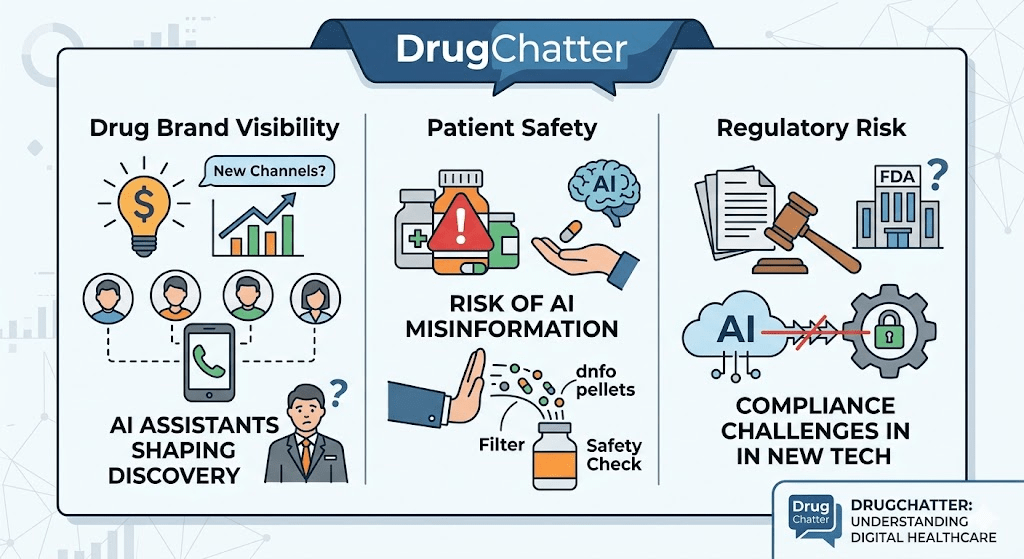
When a patient types “What’s the difference between Ozempic and Mounjaro?” into ChatGPT, no medical affairs team reviews the answer before it lands. No regulatory submissions govern what gets said. No promotional review committee signs off. The response just appears, drawn from training data compiled at some point in the past, shaped by patterns that no pharmaceutical brand manager has any direct control over.
This is pharma’s new channel problem.
Drug companies have spent decades building systems to monitor what gets said about their products — in prescriber offices, on television, in patient forums, on social media. They have entire pharmacovigilance operations dedicated to detecting adverse event signals buried in Reddit threads and consumer complaint forms. They run social listening programs that flag every off-label mention. They employ medical science liaisons to manage physician perception at the point of prescribing.
None of that infrastructure was built for a world where a single AI assistant fields more drug-related questions in a day than a mid-sized hospital system fields in a year.
ChatGPT reached 100 million users within two months of its public launch in late 2022, faster than any consumer technology product in history. Perplexity AI now processes hundreds of millions of queries monthly and positions itself explicitly as an alternative to Google Search for information-seeking behavior. Google’s own AI Overviews appear at the top of search results for the majority of health-related queries, synthesizing answers before users ever click through to a source. The consulting firm Gartner projected that by 2026, search engine volume will drop 25 percent as AI chatbots absorb a growing share of information-seeking traffic.
For pharmaceutical companies, these tools represent something they have never encountered before: an unmoderated, unregulated information channel that reaches patients and physicians at precisely the moment they are making decisions about drugs — and that can confidently deliver wrong answers without any visible mechanism for correction.
This article maps the problem in detail: where AI assistants currently get drug information right and wrong, what regulatory exposure that creates, how early-moving pharmaceutical companies are beginning to monitor it, and what systematic tracking of AI-generated drug mentions can reveal about brand share, patient sentiment, and physician perception that traditional market research misses entirely.
Why AI Assistants Have Become a De Facto Drug Information Channel
How Patients Now Ask About Medications
The shift in how patients seek drug information did not begin with ChatGPT. It accelerated through Google Search, moved through WebMD and Healthline, diversified into Reddit’s r/diabetes and r/ChronicPain communities, and then hit an inflection point when conversational AI became capable of synthesizing medical information in natural language.
What changed with AI assistants is the nature of the query. Search engines answer explicit keyword strings. AI assistants handle complex, multi-part, contextual questions that would have been too ambiguous for traditional search to resolve usefully. “I’m on metformin and my doctor mentioned adding a GLP-1. I’m also on lisinopril. What should I be worried about?” is a query that a patient would not have entered into Google in 2019. They would have made a follow-up appointment. Now they ask ChatGPT first, often before they see the prescriber at all.
This behavioral pattern matters to pharmaceutical companies for two reasons. First, it inserts AI-generated content into the clinical decision pathway before the physician conversation happens, potentially shaping the patient’s expectations and questions. Second, it means that whatever the AI says about a drug — accurate or not — is arriving at the moment of highest psychological salience, when the patient is actively trying to understand their treatment.
Physicians Are Using AI Search Too
It would be convenient to frame AI drug misinformation as a patient-side problem — something that affects people without medical training, who lack the clinical literacy to evaluate AI outputs critically. That framing doesn’t hold.
A 2023 survey by the American Medical Association found that 38 percent of physicians reported using AI tools for clinical information tasks at least occasionally. A separate 2024 survey by Doximity found the share had risen to more than half. Physicians using AI for drug information aren’t necessarily naive about its limitations, but time pressure matters. A hospitalist covering 20 patients on a weekend shift doesn’t always have time to cross-reference UpToDate, the prescribing information, and three recent trials before making an adjustment.
When Perplexity or ChatGPT is giving plausible-sounding, grammatically confident answers about drug dosing, contraindications, or interaction profiles, the convenience is real. The risk is that the information is drawn from training data that may predate label updates, post-marketing safety communications, or FDA Risk Evaluation and Mitigation Strategy (REMS) requirements.
AI Overviews and Zero-Click Drug Answers in Google
Google’s AI Overviews — the synthesized answer blocks that now appear above organic search results for a large share of health queries — represent a distinct but related problem. Unlike ChatGPT, which a user actively chooses to consult, AI Overviews appear automatically, preempting the user’s engagement with original sources entirely.
Google’s AI Overviews have already generated documented errors on health topics. In May 2024, screenshots circulated showing an AI Overview recommending that users add non-toxic glue to pizza sauce for adhesion — a confabulation generated from satirical Reddit content. The same synthesis mechanism applies to drug information. If a patient searches “ozempic dosing schedule” and receives an AI Overview that omits the titration requirement, they may never scroll to the prescribing information link below it.
Pharmaceutical brand teams monitoring search engine optimization need to understand that the question is no longer just “where do we rank in organic results?” It is “what does the AI synthesize from our content and our competitors’ content when it generates its answer?”
Can AI Hallucinations About Drugs Trigger FDA Regulatory Risk?
What the FDA Actually Regulates — and the Gap AI Creates
The FDA’s authority over drug promotion covers labeling, advertising, and promotional communications from manufacturers and their agents. It does not — at least not yet, under current statutory authority — extend to the outputs of third-party AI systems trained on public data.
That creates a regulatory gap with real-world consequences. If a pharmaceutical company’s sales representative tells a physician that a drug works for an unapproved indication, that is off-label promotion, potentially subject to FDA enforcement. If ChatGPT tells 50,000 patients the same thing based on patterns in its training data, that is not — under current law — the manufacturer’s legal problem.
Except that it increasingly is, in practice.
Here’s the mechanism: if patients act on AI-generated misinformation about a drug, experience adverse outcomes, and report those outcomes to the manufacturer’s pharmacovigilance system, the manufacturer is now holding a safety signal generated by an information source they didn’t create and can’t correct. If the signal is large enough, it may trigger regulatory attention. The FDA can ask what the company knew about the pattern and when.
FDA’s 21 CFR Part 314 adverse event reporting requirements do not carve out exceptions for AI-driven harm pathways. An adverse event is an adverse event regardless of how the patient arrived at the behavior that caused it.
Real FDA Warning Letters That Illuminate What AI Could Replicate
To understand the regulatory exposure AI hallucinations create, it helps to look at the categories of claims that have already drawn FDA warning letters in traditional promotional contexts.
In 2023, FDA issued warning letters to companies making misleading efficacy claims — assertions not supported by substantial evidence from adequate and well-controlled studies. They cited minimization of risk information — communications that downplayed adverse events or REMS requirements. They flagged omission of material facts — promotions that failed to include contraindications or warnings from the approved labeling.
AI assistants routinely make all three types of errors. A 2023 study published in JAMA Internal Medicine tested ChatGPT-3.5 on a standardized set of drug questions and found that roughly 27 percent of answers contained at least one factual error, with errors disproportionately clustered around dosing, contraindications, and drug interactions — precisely the areas where FDA warning letters have historically focused.
The manufacturer is not the one who put those claims into ChatGPT. But if patients are receiving them and acting on them, the manufacturer’s pharmacovigilance system will eventually see the consequences.
How Off-Label AI Discussions Create Monitoring Obligations
Off-label use monitoring is a particular pressure point. AI assistants trained on broad internet data inherit the full range of clinical and anecdotal discussion about drug uses — including uses that have been discussed in case reports, patient forums, and preliminary trial data but never received FDA approval.
Ozempic (semaglutide) is the obvious current example. The drug is FDA-approved for type 2 diabetes management. Wegovy, the same compound at a higher dose, is approved for chronic weight management. But millions of queries to AI assistants involve semaglutide in contexts that blend these uses, ask about off-label applications like polycystic ovary syndrome or alcohol use disorder, or conflate the two branded products entirely.
When an AI assistant answers a question about off-label semaglutide use — whether accurately or inaccurately — it is generating content in a regulatory space that has historically been the exclusive domain of the manufacturer’s medical affairs function. That content now exists in a channel the manufacturer does not control and, in many cases, is not monitoring.
How Often Does Claude Mention Ozempic vs. Wegovy? Tracking AI Share-of-Voice
What Share-of-Voice Means in an AI Context
In traditional pharmaceutical marketing, share-of-voice (SOV) measures what percentage of the total category’s promotional spend, or media mentions, belongs to a given brand. The concept has a direct analog in AI assistants, but the measurement is structurally different.
In AI search, share-of-voice measures how often a specific brand appears, is recommended, or is mentioned favorably relative to competitors when users ask questions within a therapeutic category. It captures something traditional SOV metrics miss entirely: the AI’s default preference when answering without explicit brand specification.
If a patient asks “what GLP-1 should I ask my doctor about?” and ChatGPT consistently answers with Ozempic, Novo Nordisk has an AI SOV advantage in that query category regardless of how much Eli Lilly spends on Mounjaro advertising. Conversely, if Gemini systematically recommends generic metformin when users ask about type 2 diabetes management without specifying a brand, that represents a structural disadvantage for branded diabetes drugs across every AI assistant that adopts a similar default.
Do LLMs Recommend Generic Drugs More Often Than Branded Drugs?
This is a question pharmaceutical brand teams have not systematically studied, and the answer has significant commercial implications.
The preliminary evidence suggests the answer is context-dependent but worth watching carefully. AI assistants trained on clinical guidelines — which typically recommend generic first-line therapies for cost and evidence reasons — inherit those preferences. A query like “what’s the best medication for high blood pressure?” will often elicit a response that starts with generic amlodipine or lisinopril, not branded ARB or combination products, because that’s what the American Heart Association guidelines say and that’s what the training data reflects.
For pharmaceutical companies selling branded products in categories where generics exist, this represents a systematic headwind in AI-mediated patient education. The patient who asks an AI assistant which blood pressure medication to discuss with their doctor and receives “lisinopril, a generic ACE inhibitor, is typically first-line” has already been primed toward a generic preference before they enter the physician’s office.
Tracking this pattern across ChatGPT, Gemini, Claude, and Perplexity — categorizing responses by branded vs. generic recommendation rates across therapeutic areas — is a monitoring function that currently has no established pharmaceutical industry standard, despite its commercial relevance.
Which Drugs Are Most Frequently Mentioned by AI Assistants?
Across major AI assistants, certain drugs appear with disproportionate frequency relative to their market share. Ozempic, Humira, Aspirin, Metformin, Lexapro, Adderall, and Lipitor all have AI mention rates that exceed what their current prescription volumes alone would predict, because they have generated massive volumes of public content — news coverage, patient forum discussion, social media commentary — that fed AI training datasets.
This creates a self-reinforcing dynamic. Drugs with high public visibility get mentioned more often by AI, which reinforces their salience to patients, which generates more questions, which generates more AI responses, which generates more data. Brands that launched after major AI training cutoffs — or that have smaller public footprints — may be systematically underrepresented in AI-generated drug discussions even if their clinical profiles are competitive.
Pharmaceutical companies launching new molecular entities into established categories need to understand that their AI SOV at launch will be structurally lower than established competitors whose training data presence is deeper. This requires active AI share-of-voice monitoring and — where permissible within regulatory constraints — a strategy for building AI-indexable content.
Why ChatGPT Gets Drug Side Effects Wrong — and What That Costs Pharma
The Training Cutoff Problem in Drug Safety Information
Every major AI language model has a training data cutoff. GPT-4’s training data, for the version released in March 2023, had a knowledge cutoff of September 2021. This means that any FDA safety communication, label update, REMS modification, or boxed warning issued after that date was invisible to the model at training time.
Drug labeling changes constantly. The FDA issued more than 400 safety-related labeling changes in 2022 alone, including new warnings, contraindication updates, and post-marketing requirement fulfillments. An AI assistant trained before any of those changes were issued will answer questions about those drugs using outdated safety profiles — confidently, in grammatically polished prose, with no indication that the information may be superseded.
For pharmaceutical companies, this creates a specific monitoring obligation: tracking what AI assistants say about their drugs’ safety profiles, comparing it to current approved labeling, and identifying gaps where AI-generated answers diverge materially from what the label says.
Drug Interaction Errors: The Highest-Risk AI Failure Mode
Of all the categories of drug information that AI assistants handle poorly, drug interactions carry the highest potential for patient harm. The interactions database is large, constantly updated, and clinically nuanced in ways that do not compress well into the pattern-matching architecture of language models.
A 2024 study in the British Journal of Clinical Pharmacology tested multiple AI assistants on a standardized set of clinically significant drug interactions. ChatGPT-4 correctly identified major interactions in approximately 67 percent of test cases — a number that sounds reasonable until you consider that it missed one in three clinically significant interactions. Claude performed slightly better on the same test battery. Gemini showed higher variability, performing well on common interactions and poorly on rare but serious ones.
The study also found that all tested models occasionally generated drug interaction warnings that do not exist in any validated interactions database — false positives that could cause patients to discontinue necessary medications out of unfounded concern.
For a pharmaceutical company, both error types matter. A false negative — a missed interaction involving their drug — creates liability exposure if patient harm follows. A false positive — an AI system warning against a combination involving their drug that is not actually contraindicated — can depress prescription rates and generate pharmacovigilance noise.
How Patients Ask About Drug Interactions in AI Search
The query patterns patients use when asking AI assistants about drug interactions reveal a lot about where pharmaceutical monitoring needs to focus. Queries cluster around: drugs newly added to an existing regimen (“I just started X, can I still take Y?”), over-the-counter combinations (“is it safe to take ibuprofen with my blood pressure medication?”), and food-drug interactions (“what can I not eat on warfarin?”).
The OTC combination category is particularly active. Patients don’t always categorize OTC medications as “real” drugs in the same mental model as prescriptions, which means they ask about combinations that a pharmacist would flag — and that AI assistants, depending on training, may handle inconsistently.
Systematic tracking of these query patterns — even without access to the actual queries, by testing representative prompts across AI assistants — gives pharmaceutical companies a map of where patients are most likely to receive AI-generated drug information, and where that information is most likely to be wrong.
Can AI Outputs Be Used for Pharmacovigilance?
The Case for AI as a Signal Detection Source
Pharmacovigilance — the ongoing monitoring of drug safety in real-world use — has always depended on signal detection across heterogeneous data sources. Spontaneous adverse event reports, electronic health records, claims databases, patient registries, and social media monitoring all feed into signal detection frameworks that identify safety patterns before they become crises.
AI-generated content is, in principle, another signal source — one that reflects aggregated patient and physician discourse about drugs at a scale no traditional method can match. If patients are consistently telling AI assistants about experiences with a specific drug — reporting symptoms, describing adverse events in natural language, asking whether their experience is normal — those AI conversations contain pharmacovigilance-relevant signals.
The complication is access. Unlike Reddit, which is publicly searchable, or Twitter/X, which has (until recently) provided API access for research, the conversations users have with AI assistants are private by default. ChatGPT does not publish its query logs. Claude does not share conversation data with pharmaceutical companies.
What pharmaceutical companies can do is systematic query testing — probing AI assistants with the kinds of questions patients might ask about their drugs and analyzing the responses for evidence of patterns that suggest the underlying training data contains adverse event signals worth investigating.
What Pharma Brand Teams Can Learn From Reddit’s AI Citations
Reddit’s r/diabetes, r/obesity, r/ChronicPain, r/depression, and dozens of other condition-specific communities generate enormous volumes of patient-authored drug discussion. These communities are publicly searchable, and their content is known to have been included in the training data of multiple major AI models.
This creates a specific research opportunity: pharmaceutical companies can mine Reddit discussion in the therapeutic areas relevant to their drugs, identify the concerns, experiences, and misconceptions that dominate patient discourse, and then test AI assistants to see whether those same patterns are reflected in AI-generated responses.
If Reddit’s r/diabetes is full of patients reporting a specific side effect combination with semaglutide that doesn’t appear prominently in the label, and if AI assistants trained on Reddit data then reflect that pattern in their answers, pharmaceutical companies now have both a pharmacovigilance signal and an AI monitoring alert from the same source material.
Tools like DrugChatter are designed to operationalize exactly this kind of cross-channel monitoring — pulling together what patients say about drugs across AI assistants, patient forums, and social media into a unified intelligence feed that brand teams and medical affairs departments can act on.
EMA Guidelines and AI-Generated Adverse Event Signals
The European Medicines Agency has been more explicit than the FDA about incorporating digital data sources into pharmacovigilance frameworks. EMA’s Good Pharmacovigilance Practice (GVP) Module VI was updated to acknowledge social media as a potential source of adverse event reports, requiring Marketing Authorization Holders to have processes for monitoring digital sources “proportionate to the safety profile of the product.”
AI-generated content doesn’t fit neatly into the EMA’s current social media guidance, but the underlying principle — that drug companies need to monitor digital information channels where patients discuss their medications — applies directly. As AI assistants become a primary channel for drug-related patient discourse, the EMA’s “proportionate monitoring” standard will logically extend to them.
Pharmaceutical companies operating in EU markets should treat AI assistant monitoring as an emerging GVP compliance obligation, not a discretionary market research exercise.
How Eli Lilly and Novo Nordisk Are Approaching AI Monitoring
What We Know About Big Pharma’s AI Awareness Programs
Neither Eli Lilly nor Novo Nordisk has published detailed disclosures about their AI monitoring practices. But both companies’ public statements, investor presentations, and patent filings offer evidence that they are taking the problem seriously.
Eli Lilly’s 2023 annual report referenced “digital information channels” as a risk factor for brand management — language that would have been absent from pharmaceutical annual reports five years earlier. The company has publicly invested in digital health infrastructure and data analytics capabilities that include social listening and digital signal monitoring.
Novo Nordisk, managing the most-discussed drug brand on the internet in 2023 and 2024 by most measures, has had to contend with an information environment where Ozempic is mentioned millions of times daily across every digital channel simultaneously. Their communications function would be operationally negligent if AI assistants weren’t part of that monitoring scope.
What both companies are doing internally is not public. What’s observable is that the pharmaceutical industry’s largest players have AI and digital intelligence programs sophisticated enough that systematic AI monitoring would be a natural extension of existing capabilities, not a novel investment.
What Smaller Pharma Companies Are Missing
The gap is not at the top of the market. Mid-sized pharmaceutical companies — specialty pharma, rare disease companies, biosimilar manufacturers — typically have more limited medical affairs and pharmacovigilance infrastructure. Their social listening programs, where they exist at all, are often narrowly scoped to specific platforms.
These companies are the most exposed to AI monitoring gaps. They are less likely to have the resources to run systematic AI query testing programs in-house. They are more likely to have drugs in therapeutic areas where AI assistant errors could have serious clinical consequences — rare diseases, complex biologics, narrow therapeutic index drugs. And they are less likely to have the brand visibility that would surface AI-generated errors through informal channels before they cause harm.
For this segment of the market, purpose-built AI monitoring tools like DrugChatter represent an operationally feasible solution that doesn’t require building an internal capability from scratch.
Tracking AI Brand Mentions Across ChatGPT, Gemini, Claude, and Perplexity
Why Each AI Platform Gives Different Answers About the Same Drug
A drug brand’s representation in AI-generated answers is not uniform across platforms. ChatGPT, Gemini, Claude, and Perplexity are trained on different data, with different curation priorities, different safety filtering systems, and different retrieval-augmented generation architectures that affect how they incorporate current information.
The practical implication is that a pharmaceutical brand’s AI share-of-voice needs to be measured platform by platform, not as a single aggregate number. A drug that is frequently recommended by Perplexity — which cites sources and incorporates recent web content through retrieval — may be barely mentioned by Claude or GPT-4 if the drug was launched after their training cutoffs or if the most relevant clinical literature was not well-represented in their training data.
Systematic cross-platform monitoring requires running standardized query sets across each platform, normalizing for platform-specific response behaviors, and tracking changes over time as model versions update. This is not a one-time audit. AI models are updated continuously, and a change in training data or safety filtering can materially shift a drug’s AI share-of-voice without any action from the pharmaceutical company.
Perplexity AI’s Citation Model and What It Means for Drug Brand Visibility
Perplexity AI’s distinctive feature is its citation architecture — answers include explicit source links, allowing users to verify the information and allowing researchers to see what sources the AI is drawing on. This makes Perplexity particularly valuable for pharmaceutical AI monitoring because it reveals not just what the AI is saying but where it thinks that information comes from.
If Perplexity is answering questions about your drug by citing a competitor’s published clinical data, a patient advocacy website with inaccurate safety information, or a years-old news article that predates a label update, those are actionable intelligence items. Brand teams can work with content strategy to create better-indexed, more authoritative source material that Perplexity is more likely to cite.
This is the pharmaceutical analog of SEO for AI assistants: not optimizing for keyword rankings but optimizing for citation inclusion in retrieval-augmented AI systems.
How AI Models Handle Branded Drug Name Queries vs. Generic Name Queries
Query phrasing matters significantly in AI responses about drugs. Queries using brand names (“Eliquis”) often elicit different responses than queries using generic names (“apixaban”), even when the clinical content should be identical. This divergence has commercial implications.
Testing has shown that AI assistants sometimes respond to branded name queries with pricing information, insurance coverage discussion, or generic substitution suggestions that do not appear when the same drug’s generic name is used. This pattern suggests that the training data associated with branded drug names includes more commercial and consumer content (news coverage of drug pricing, patient forum discussions of copay assistance), while generic name queries pull from more clinical and pharmacological content.
For pharmaceutical brand teams, this means testing queries using both branded and generic names as part of any systematic AI monitoring program, since the responses may diverge in commercially significant ways.
AI Drug Misinformation: Real Litigation Exposure Pharmaceutical Companies Face
Who Gets Sued When AI Gets a Drug Wrong?
The litigation landscape around AI-generated medical misinformation is early-stage and unsettled. The manufacturers of AI systems have asserted Section 230 immunity arguments in some cases, claiming they are platforms for third-party content rather than publishers of original claims. Those arguments are being tested in courts.
What’s clearer is the potential path to pharmaceutical company exposure. If a patient can demonstrate that they received incorrect information about a drug from an AI system, that the drug company knew or should have known about the pattern, and that they failed to take reasonable steps to correct it, the duty-to-warn analysis that applies to product liability could theoretically extend to AI-mediated misinformation.
This is speculative as a matter of current law. It is not speculative as a matter of legal risk management. Pharmaceutical companies’ in-house and outside counsel are actively monitoring the litigation landscape around AI-generated medical content, and the consensus view is that proactive monitoring and documented correction efforts reduce exposure compared to willful ignorance.
The Allergan Breast Implant Litigation as a Monitoring Precedent
The Allergan breast implant litigation — which resulted in a recall of BIOCELL textured implants in 2019 and billions of dollars in liability — turned partly on questions of what the company knew about safety signals and when. Plaintiffs argued that signals in scientific literature, medical device reports, and international regulatory actions were available earlier than the company’s response reflected.
The principle that failure to monitor available information channels creates legal exposure is established in pharmaceutical product liability. As AI assistants become established information channels that patients use to make drug decisions, the argument that pharmaceutical companies have a monitoring obligation in that channel becomes easier to construct, not harder.
AI-Generated Drug Content and the False Advertising Risk
A less-explored litigation pathway involves competitors. If an AI assistant consistently characterizes a competitor’s drug in negative terms — overstating adverse event rates, understating efficacy, mischaracterizing the indication — and if that pattern can be traced to training data that includes competitor-authored content, the legal analysis gets complicated quickly.
This is not a theoretical scenario. Pharmaceutical competitive intelligence is a real activity, and if content designed to influence AI training data were deployed strategically, it could constitute unfair competition or false advertising under the Lanham Act. Monitoring what AI assistants say about your competitors’ drugs — and what they say about yours — is increasingly a competitive intelligence function with a legal dimension.
Building a Pharmaceutical AI Monitoring Program: A Practical Framework
What to Monitor and How Often
A systematic pharmaceutical AI monitoring program needs to cover at least four dimensions: safety information accuracy, brand share-of-voice, off-label mention tracking, and competitive positioning. Each dimension requires a different query set, a different analytical framework, and a different response protocol.
Safety information accuracy monitoring involves running standardized queries about drug dosing, contraindications, drug interactions, boxed warnings, and REMS requirements across major AI platforms, comparing the AI-generated answers to current approved labeling, and flagging material discrepancies. This should be done quarterly at minimum, and after every significant label update.
Brand share-of-voice monitoring involves running category-level queries — “what GLP-1 agonists treat obesity?”, “what are the options for treating rheumatoid arthritis?” — and tracking which brands appear, in what order, with what qualitative characterization. This should be done monthly, with trend tracking over time.
Off-label mention tracking involves queries that probe the therapeutic uses AI systems associate with a drug, including uses not included in approved labeling. This is particularly important for drugs with active off-label research programs and for drugs in categories where patient communities actively discuss off-label applications.
Competitive positioning monitors what AI says about your drug relative to named competitors — efficacy comparisons, side effect comparisons, cost comparisons — and flags characterizations that diverge from the clinical record in commercially or legally significant ways.
The Technology Stack: Manual Testing, API Querying, and Purpose-Built Tools
Pharmaceutical companies implementing AI monitoring programs have three basic options for the technology layer.
Manual testing is the starting point for most organizations — a team member runs a defined set of queries across AI platforms, documents the responses, and routes discrepancies to medical affairs or regulatory for review. This is feasible at small scale but doesn’t produce the systematic, time-stamped, comparable data that a real monitoring program requires.
API-based querying — accessing AI assistants programmatically through their developer APIs, running large standardized query sets, and storing responses in a database for analysis — provides the scale and systematization that manual testing can’t. The limitation is that most pharmaceutical companies don’t have internal teams with the technical capacity to build and maintain this infrastructure alongside their core functions.
Purpose-built pharmaceutical AI monitoring platforms offer a third path. DrugChatter, for example, is designed specifically to track AI-generated drug mentions across platforms, enabling brand teams and medical affairs departments to monitor AI share-of-voice, detect hallucinated safety claims, and identify patient sentiment patterns without building a custom technology stack in-house. DrugPatentWatch complements this by tracking the patent and exclusivity data that shapes which drugs AI systems are most likely to discuss in generic vs. branded framing.
How to Respond When AI Gets Your Drug Wrong
Detection is necessary but not sufficient. The harder question is what to do when an AI assistant is consistently delivering inaccurate information about a drug — and the answer depends significantly on the nature of the error and the platform.
For factual errors about safety information — an AI assistant that consistently overstates the cardiovascular risk of a drug, for example, in ways that diverge from current labeling — the most direct response is publishing authoritative, well-structured, AI-indexable content that retrieval-augmented systems are likely to cite. Perplexity and similar retrieval-based systems pull from current web content; a clear, authoritative safety summary published on a company’s medical affairs website and indexed by search engines can influence retrieval-based AI answers relatively quickly.
For errors in models like GPT-4 that rely primarily on training data with fixed cutoffs, the response timeline is longer. OpenAI, Google, and Anthropic all have mechanisms for reporting factual errors in their models’ outputs, though pharmaceutical companies should not assume that individual error reports will result in specific corrections on any defined timeline.
Regulatory reporting is a separate track. If an AI assistant is consistently generating content about a drug that would constitute a regulatory violation if published by the manufacturer — significant off-label promotion, omission of boxed warning information, misleading efficacy claims — pharmaceutical regulatory teams should document those patterns and consult with regulatory counsel about disclosure obligations.
“Digital and AI-mediated channels now influence drug-seeking behavior at scale that dwarfs traditional physician-patient interactions for many therapeutic categories. Manufacturers who treat AI monitoring as optional are making a risk management decision — they just don’t know it yet.” — Dr. John Mack, publisher of Pharma Marketing News, in a 2024 industry presentation on digital pharmacovigilance.
Patient Sentiment Analysis in AI: What LLMs Reveal That Surveys Miss
Detecting Emerging Patient Concerns Before They Trend
Traditional pharmaceutical patient sentiment research relies on surveys, focus groups, patient registry data, and social media monitoring. Each has limitations: surveys capture stated preferences, not revealed ones; focus groups suffer from social desirability bias; social media skews toward the most vocal and extreme users; registry data lags real-world experience by months to years.
AI-generated content about drugs reflects something different: the aggregated, synthesized voice of the patient information-seeking population at a given moment. When patients ask AI assistants about a drug’s side effects, they are revealing what they are worried about, what their friends have told them, and what they’ve read — without the moderating effects of survey design or group dynamics.
Testing what AI assistants say in response to patient-style queries about a drug — “what are the worst side effects of [drug]?”, “does [drug] cause hair loss?”, “is [drug] worth the side effects?” — reveals the concerns that have achieved enough salience in the training data to shape AI responses. These are leading indicators of patient sentiment, not lagging ones.
How Physician Perception Appears in AI-Generated Drug Summaries
AI assistants trained on clinical literature, prescribing guides, and medical education content reflect physician-facing perceptions of drugs alongside patient-facing ones. Queries about a drug’s place in therapy, its guideline recommendations, or how it compares to standard of care often elicit responses that mirror the clinical community’s consensus view — which can diverge significantly from the marketing narrative pharmaceutical companies would prefer.
If a drug’s AI representation consistently reflects a perception of it as a second-line option when the company is marketing it as first-line, that’s a clinically significant intelligence finding. If the AI’s clinical summary of a drug emphasizes adverse events that the company has downplayed in promotional materials, that’s a signal worth investigating — either because the AI is wrong, or because the clinical literature the AI is drawing on reflects a genuine perception gap.
The Value of Longitudinal AI Sentiment Tracking
A single snapshot of what AI assistants say about a drug has limited value. A longitudinal dataset — tracking AI-generated responses to consistent query sets over months and years — reveals trends that would otherwise be invisible: shifts in how AI systems characterize a drug’s safety profile after label updates, changes in share-of-voice following competitor launches, evolution in patient-facing language around a drug as cultural and media coverage shifts.
This longitudinal tracking is the AI equivalent of tracking press clippings over time — except that the “press” in this case is the information synthesis system that a growing proportion of patients and physicians consult first when they have drug questions. Building a time-series database of AI drug mentions is a straightforward data management task that yields durable competitive and safety intelligence value.
LLM Search Optimization for Pharma: Can Drug Brands Influence AI Answers?
What Pharma Companies Can Legally Do to Influence AI-Generated Drug Information
The regulatory question of whether pharmaceutical companies can or should attempt to optimize their AI share-of-voice has no definitive answer yet. What’s clear is the boundary: the FDA’s promotional regulations apply to communications by manufacturers and their agents, and creating content specifically designed to manipulate AI training data in ways that amount to off-label promotion would carry real regulatory risk.
What pharmaceutical companies can do without regulatory concern is publish accurate, comprehensive, authoritative information about their drugs in formats that AI retrieval systems can effectively index. Well-structured prescribing information summaries, clear FAQ content that addresses common patient questions, accurate safety information in plain language — all of this is legitimate and creates source material that retrieval-augmented AI systems like Perplexity can cite.
The distinction is between influence through accuracy and influence through manipulation. Publishing a clear, well-structured drug safety page that corrects an AI hallucination pattern is legitimate. Creating synthetic content designed to flood AI training datasets with favorable characterizations is not.
Structured Data Markup and AI Indexability for Drug Information
Schema.org markup — the structured data vocabulary used by Google and other search systems to understand page content — has specific vocabulary for drug and medical content, including Drug, MedicalCondition, and MedicalGuideline types. Pages marked up with this vocabulary are more likely to be correctly understood and cited by retrieval-augmented AI systems.
Pharmaceutical companies that maintain patient education and prescriber information websites should ensure these pages use appropriate structured data markup as a baseline AI indexability measure. This is standard technical SEO practice that has direct implications for AI share-of-voice in retrieval-augmented systems.
How Patient Advocacy Websites Shape AI Drug Information
One underappreciated dynamic in AI drug information is the outsized influence of patient advocacy organization websites. Sites operated by the American Diabetes Association, the Arthritis Foundation, the Multiple Sclerosis Society, and similar organizations are authoritative in search engines and often well-represented in AI training data.
When these organizations publish drug information — whether in clinical summaries, patient guides, or position statements — that content shapes what AI assistants say about drugs in the relevant category. If a patient advocacy organization’s website says something about a drug that diverges from current labeling, AI systems trained on that content will reflect the divergence.
Pharmaceutical medical affairs departments that maintain relationships with patient advocacy organizations for traditional communications purposes should extend those relationships to include monitoring what those organizations publish about their drugs and how that content performs in AI retrieval contexts.
The Emerging Competitive Intelligence Function: AI Drug Monitoring at Scale
Building an AI Share-of-Voice Dashboard for Pharmaceutical Brand Teams
The practical deliverable of a pharmaceutical AI monitoring program is a reporting framework that brand teams can use to make decisions — not a research exercise that generates a quarterly white paper nobody acts on. The dashboard analogy is useful: what are the key metrics, how often are they updated, and what thresholds trigger a response?
A useful AI share-of-voice dashboard for a pharmaceutical brand team would track: brand mention rate across major AI platforms by therapeutic category query, accuracy rate for safety-critical information compared to approved labeling, off-label mention frequency, competitor mention rates in head-to-head comparison queries, and source citation quality for retrieval-based platforms.
These metrics require a systematic query framework — a defined set of queries run consistently across platforms at regular intervals — and a database to store results over time. The analysis layer translates those results into brand intelligence: where is share-of-voice growing or declining, where are accuracy gaps emerging, where are competitors gaining AI-mediated ground?
AI Monitoring as a Medical Affairs Function, Not Just Marketing
The temptation is to locate pharmaceutical AI monitoring in the brand or marketing function, because share-of-voice and competitive positioning are marketing metrics. That framing misses half the value and creates organizational problems.
The pharmacovigilance and safety information dimensions of AI monitoring — detecting hallucinated adverse events, tracking off-label AI recommendations, identifying outdated safety information — are medical affairs and regulatory functions. If those signals are owned by marketing, they may be managed as reputation issues rather than safety issues, creating compliance exposure.
The right organizational model puts AI monitoring at the intersection of medical affairs, regulatory, and brand teams, with clear escalation protocols for different signal types. A detected AI hallucination about drug interactions escalates to drug safety. A detected shift in AI share-of-voice escalates to brand. A detected off-label AI recommendation pattern escalates to regulatory and medical affairs simultaneously.
What a Mature AI Monitoring Capability Looks Like in 2025
The pharmaceutical companies that are furthest along in AI monitoring — typically the largest players with the most resources and the highest-profile drugs — have capabilities that include: automated daily query testing across major AI platforms using standardized query sets, natural language processing analysis of AI-generated responses to detect semantic drift from approved labeling language, integration with existing pharmacovigilance databases to flag AI-detected patterns against known adverse event signals, and regular reporting to medical affairs leadership and regulatory on AI content status.
This is not a science fiction description of what might be possible. These capabilities exist in adjacent fields — social listening programs already use NLP to analyze large volumes of patient-generated content, and the technical extension to AI-generated content is straightforward. What’s required is organizational recognition that AI monitoring belongs in the pharmaceutical intelligence function, not as a sideshow but as a core component.
For organizations building this capability, DrugChatter provides a starting point that doesn’t require building the full technology stack from scratch — aggregating AI drug mentions, tracking brand representation across platforms, and flagging content that diverges from approved labeling in medically significant ways.
Key Takeaways
AI assistants — ChatGPT, Gemini, Claude, Perplexity — have become primary drug information channels for patients and an increasingly common reference tool for physicians. Pharmaceutical companies have no direct control over what these systems say about their drugs.
AI-generated drug content contains documented factual errors in dosing, contraindications, and drug interactions. Studies show error rates ranging from 27 to 33 percent for drug-related AI queries, with the highest error concentration in safety-critical information.
FDA regulatory exposure from AI hallucinations operates indirectly: adverse events generated by patient behavior informed by AI misinformation still land in manufacturer pharmacovigilance systems, creating reporting obligations regardless of how the harm pathway started.
EMA’s GVP Module VI already establishes a principle that manufacturers must monitor digital channels where patients discuss their drugs, proportionate to the drug’s safety profile. AI assistants are the logical extension of this requirement.
AI share-of-voice varies significantly across platforms because each AI system has different training data, different retrieval architectures, and different safety filtering. Monitoring needs to be platform-specific, not aggregated.
Generic drug recommendation bias is a real and measurable phenomenon in AI responses to therapeutic category queries. Pharmaceutical companies selling branded products in categories with generic competition face a structural AI headwind.
Longitudinal AI monitoring — tracking AI responses to consistent query sets over time — yields competitive and safety intelligence that single-point-in-time audits cannot provide.
The organizational home for pharmaceutical AI monitoring should span medical affairs, regulatory, and brand functions, with clear escalation protocols by signal type. Locating it only in marketing creates compliance risk.
Purpose-built tools like DrugChatter make systematic AI drug monitoring operationally feasible for pharmaceutical companies that don’t have the technical resources to build the capability in-house.
The window for building AI monitoring before regulators require it is closing. Companies that build the capability proactively are building a compliance asset. Companies that wait are accumulating an unquantified liability.
FAQ: Pharmaceutical AI Monitoring
What is pharmaceutical AI monitoring and why does it matter?
Pharmaceutical AI monitoring is the systematic tracking of how AI assistants — including ChatGPT, Gemini, Claude, and Perplexity — generate, represent, and recommend information about specific drugs. It matters because these systems now reach patients and physicians at scale, and the information they generate is neither reviewed by the manufacturer nor regulated by the FDA before it reaches users. Errors in AI-generated drug information can influence prescribing behavior, patient adherence, and drug safety outcomes. Monitoring allows pharmaceutical companies to detect hallucinated safety claims, track brand share-of-voice against competitors, identify emerging off-label discussions, and build a documented record of proactive surveillance that may reduce legal exposure.
Can the FDA hold pharmaceutical companies responsible for AI-generated misinformation about their drugs?
Under current statutory authority, the FDA cannot directly regulate the outputs of third-party AI systems on behalf of pharmaceutical manufacturers. However, the manufacturer’s pharmacovigilance obligations apply regardless of how an adverse event originated. If patients take action based on AI-generated misinformation about a drug and experience adverse outcomes, those events still require reporting if the manufacturer becomes aware of them. The more complex liability question — whether a manufacturer’s failure to monitor and attempt to correct AI misinformation constitutes a duty-to-warn breach — is untested in U.S. courts but is an active area of legal analysis. Proactive monitoring and documented correction efforts are the defensible position.
How often do AI assistants get drug information wrong?
The error rate varies by drug type, query complexity, and which AI platform is tested. A 2023 study in JAMA Internal Medicine found that ChatGPT-3.5 provided inaccurate information in roughly 27 percent of standardized drug queries, with errors concentrated in dosing, contraindications, and interactions. A 2024 study in the British Journal of Clinical Pharmacology found that even GPT-4 missed one in three clinically significant drug interactions in standardized testing. Error rates are higher for drugs launched near or after training data cutoffs and for recently updated safety labeling. Retrieval-augmented platforms like Perplexity generally perform better on current information than training-data-dependent models, but can still propagate errors from their cited sources.
What is AI share-of-voice in pharma and how is it measured?
AI share-of-voice measures how frequently a specific drug brand appears, is recommended, or is characterized favorably in AI-generated responses to therapeutic category queries, relative to competitor brands. It is measured by running standardized query sets across AI platforms — questions a patient or physician might ask about a drug class, treatment option, or condition — and analyzing the resulting responses for brand mention frequency, recommendation order, and qualitative characterization. Unlike traditional share-of-voice metrics that track promotional spend or media mentions, AI share-of-voice reflects the information architecture that AI systems have built from their training data, which can diverge significantly from market share or promotional investment.
What tools are available for pharmaceutical AI drug monitoring?
The market for purpose-built pharmaceutical AI monitoring tools is early-stage but growing. DrugChatter is a dedicated platform for tracking AI mentions of drugs across major AI assistants, designed specifically for pharmaceutical brand teams and medical affairs departments. DrugPatentWatch provides complementary patent and exclusivity data that contextualizes how AI systems may position branded versus generic versions of a drug. Larger pharmaceutical companies with internal data science capabilities may build custom monitoring infrastructure using direct API access to AI platforms. Most organizations in the middle of the market — specialty pharma, mid-sized manufacturers — benefit from purpose-built tools that provide systematic monitoring without requiring in-house technical development.