At some point in the last eighteen months, the drug information environment crossed a threshold. Patients stopped asking Google first. They started asking AI. The shift was not announced; it showed up in web traffic analytics, in pharmacy call volume data, and in the questions patients bring to their physicians after doing their own research.
What followed was predictable in retrospect. Large language models trained on the internet carry the internet’s drug information with them — including its inaccuracies, its outdated labeling, its overrepresentation of rare adverse events, and its fondness for off-label anecdote. When patients query these systems, they receive confident, fluent, well-formatted answers that may be months or years out of date, factually wrong, or based on sources that no pharmacist would recognize as authoritative.
The pharmaceutical companies best positioned to manage this problem are the ones that treat AI misinformation detection as a business function, not an IT experiment. This article lays out how to build that function: what to monitor, which platforms matter, how misinformation propagates, and what the regulatory and commercial consequences look like when detection fails.
Why AI Drug Misinformation Is Different From Social Media Misinformation
Pharmaceutical companies spent the better part of the 2010s building social listening programs. They monitor Reddit, patient forums, Twitter/X, and Facebook groups for adverse event signals, off-label discussions, and brand sentiment. Many have mature workflows for triaging social media content into pharmacovigilance queues and routing it to medical affairs for response.
AI misinformation requires different infrastructure and different thinking for four specific reasons.
Why AI-Generated Drug Claims Are Harder to Monitor Than Social Media Posts
Social media content is public, persistent, and indexable. A Reddit post about Humira’s side effects exists at a URL, can be crawled, can be timestamped, and can be attributed to a specific user community. An AI-generated response about Humira’s side effects is generated fresh for each query, varies across sessions, is not publicly indexed, and leaves no permanent record unless you capture it yourself.
This means the monitoring infrastructure built for social media does not transfer to AI. You cannot crawl ChatGPT the way you crawl Reddit. You cannot set up keyword alerts for Gemini the way you set up Google Alerts. Detecting what AI says about your drug requires active, systematic query testing — sending queries and logging the responses — rather than passive content monitoring.
The volume problem compounds this. A social listening tool might ingest tens of thousands of posts per day across monitored platforms. A thorough AI monitoring program for a single drug needs to test hundreds of query variants, across six or more platforms, on a regular cadence. The data generation is active, not passive, and the analytical load is different.
How AI Misinformation Spreads Faster Than Forum Misinformation
A wrong claim on a patient forum spreads through sharing, upvotes, and search indexing — processes that take time and require human amplification. A wrong claim from an AI chatbot spreads through each individual query. Every patient who asks ChatGPT about your drug and receives an inaccurate answer is a discrete exposure event. Multiply that by the daily query volume for high-profile drugs, and the exposure count quickly reaches into the hundreds of thousands.
There is a second propagation pathway that is specific to AI and has no social media equivalent: AI-generated content gets shared into social media. Patients who receive an AI answer screenshot it, post it in patient groups, and attribute it with authority (‘I asked AI and it said…’). The AI output then circulates as a social media artifact, where it gets the same community amplification as any other post — except that its source is a system perceived as authoritative by many patients.
Does AI Drug Misinformation Create a Different Regulatory Risk Than Social Media?
The regulatory risk profile is distinct in ways that pharmaceutical regulatory affairs teams need to understand. Social media misinformation typically originates from patient or advocacy communities — third parties whose statements do not implicate manufacturer liability unless the manufacturer amplified or failed to correct them within a narrowly defined scope.
AI misinformation occupies a more ambiguous regulatory space. When a manufacturer deploys an AI tool — a patient chatbot, an HCP resource portal, a sales rep copilot — it owns the outputs of that tool for promotional and pharmacovigilance purposes. When a third-party AI platform (ChatGPT, Gemini) generates misinformation about a manufacturer’s product, the manufacturer does not own the output, but its pharmacovigilance obligations may still require response if the content rises to a safety signal threshold.
EMA’s 2024 reflection paper on AI in medicines regulation is the most explicit regulatory statement to date on this question, suggesting that marketing authorization holders should monitor AI-generated content as part of their broader pharmacovigilance remit. FDA has not yet matched that explicitness, but its existing framework for social media monitoring creates a logical precedent.
The Anatomy of an AI Drug Misinformation Trend
Misinformation trends in AI do not emerge randomly. They follow patterns that are specific to how LLMs are trained, how patients query them, and how AI outputs interact with social information networks. Understanding the anatomy of a misinformation trend is a prerequisite for detecting one early.
How a False Drug Claim Gets Into an LLM’s Training Data
LLMs are trained on large corpora of internet text. The quality control for that training data is imperfect by design — you cannot hand-review every document in a dataset containing hundreds of billions of tokens. This means that false drug claims circulating on the internet before a model’s training cutoff have a meaningful probability of appearing in training data, and therefore a meaningful probability of influencing model outputs.
The false claim does not need to be dominant in the training data to affect model behavior. LLMs weight content by a combination of source authority signals and statistical frequency. A false claim repeated across multiple patient forums, news comment sections, and health blogs can achieve sufficient statistical weight to influence model outputs even if it is contradicted by authoritative sources like FDA.gov and peer-reviewed literature.
This is the mechanism behind one of the most practically significant AI misinformation patterns in pharma: the amplification of fringe adverse event claims. A rare adverse event that generated significant social media discussion — even if ultimately unverified or disproportionately reported — can become a consistent element of AI responses about a drug, because the discussion volume in training data outweighs the clinical evidence volume.
Which Types of Drug Claims Are Most Likely to Become AI Misinformation
Four claim types are disproportionately represented in AI drug misinformation, based on systematic monitoring across major LLM platforms:
- Exaggerated adverse event frequency (rare events presented as common)
- Outdated contraindications (pre-label-update safety restrictions presented as current)
- Off-label efficacy claims (anecdotal or preliminary evidence presented as established)
- Generic substitution inaccuracies (biosimilar interchangeability or patent status presented incorrectly)
The first two are the highest priority for pharmacovigilance purposes. The last two are the highest priority for commercial and competitive intelligence purposes. A well-designed monitoring program tracks all four.
The Lifecycle of an AI Drug Misinformation Trend: From Training Data to Patient Decision
The lifecycle follows a consistent sequence. A false or distorted drug claim circulates on the internet — in a patient forum, a news article, a social media viral moment — and gets incorporated into an LLM’s training data. The model begins generating outputs that reflect the false claim. Patients querying the model receive the claim as a confident answer. Some of those patients share the answer in their own communities, amplifying it back into the internet. The amplified claim then feeds future model training cycles, reinforcing the original error.
The loop is not theoretical. It is the mechanism behind the persistent AI misinformation about Zofran (ondansetron) and fetal risk, about statins and cognitive impairment, and about acetaminophen dosing thresholds. Each of these topics has a real, nuanced clinical picture that AI consistently simplifies or distorts in ways that reflect the patient community discourse more than the clinical literature.
Detection is only valuable if it happens early enough in this lifecycle to interrupt the loop. By the time a misinformation trend reaches the social amplification phase, it has already influenced thousands of patient decisions. The detection target is the model output phase, before social amplification begins.
What to Query: Building a Pharmaceutical AI Monitoring Query Library
The foundation of any AI misinformation detection program is a query library — a systematic collection of the questions patients and physicians ask about your drugs. Most pharmaceutical AI monitoring programs fail not because of inadequate technology but because of inadequate query libraries. They test the questions a brand manager would think to ask, not the questions a patient with limited medical vocabulary actually types at 11 p.m.
How to Build a Pharmaceutical Query Library That Reflects Real Patient Language
Real patient query language comes from four sources: search keyword data, patient forum analysis, social listening, and direct patient research. Each source has a different vocabulary profile, and effective query libraries need all four.
Search keyword data — from Google Search Console, SEMrush, or similar tools — provides the actual queries patients type when searching for drug information. This vocabulary is plain-language, condition-specific, and often symptom-focused rather than drug-focused. Patients search ‘why does my stomach hurt on metformin’ more often than ‘metformin gastrointestinal adverse events.’
Patient forum analysis — across Reddit, Inspire, PatientsLikeMe, and disease-specific communities — provides the conversational vocabulary of active patients. These queries are often comparative (‘is Ozempic or Mounjaro better for me’), personal (‘what does Humira withdrawal feel like’), and concern-driven (‘is Xarelto really that dangerous’). This vocabulary is the most important for AI monitoring because it is also the vocabulary most heavily represented in LLM training data.
Social listening adds real-time vocabulary — emerging terminology, new brand nicknames, and the specific language of current adverse event discussions. Physician query data, where accessible, provides the clinical vocabulary that matters for HCP-facing AI tools.
Which Query Categories Should Every Pharmaceutical AI Monitoring Program Cover
A complete query library for a single drug should cover at minimum eight categories:
- Safety queries (‘Is [drug] safe?’, ‘What are the side effects of [drug]?’, ‘Can [drug] cause [specific adverse event]?’)
- Comparative queries (‘[Drug] vs [competitor]: which is better?’, ‘Should I take [drug] or [alternative]?’)
- Dosing queries (‘How much [drug] should I take?’, ‘What happens if I miss a dose of [drug]?’)
- Interaction queries (‘Can I take [drug] with [other drug/supplement/food]?’, ‘[Drug] and alcohol: is it safe?’)
- Indication queries (‘What is [drug] used for?’, ‘Can [drug] help with [off-label condition]?’)
- Access queries (‘Is there a generic for [drug]?’, ‘How much does [drug] cost?’, ‘Is [drug] covered by Medicare?’)
- Discontinuation queries (‘Can I stop taking [drug] suddenly?’, ‘What happens when you stop [drug]?’)
- Mechanism queries (‘How does [drug] work?’, ‘Why does [drug] cause [side effect]?’)
Each category should be tested with branded drug name queries, generic name queries, and condition-focused queries that do not mention the drug by name but would elicit recommendations. This breadth is what separates a monitoring program from a brand reputation check.
How Often Should Pharma Companies Query AI Systems to Detect Misinformation Trends
Monitoring frequency depends on drug profile and current information environment risk level. Drugs with high query volume, recent label changes, ongoing safety controversies, or significant generic or biosimilar competition need more frequent monitoring than stable, low-profile products.
As a baseline: major LLM platforms should be queried weekly for high-profile drugs, monthly for standard commercial drugs, and on an event-driven basis for any drug experiencing a safety communication, label update, or significant media coverage. Model updates — which occur on irregular schedules for all major LLMs — should trigger immediate re-querying of the full library, because model updates can substantially change drug-related outputs within days.
‘In our systematic testing of six major LLM platforms across 40 drug queries, we found that model accuracy for drug safety information degraded by an average of 23% following a major platform model update, with the degradation concentrated in adverse event frequency claims and drug interaction warnings.’ — ZS Associates AI in Pharma Commercial Excellence Report, 2024
Which AI Platforms to Monitor for Drug Misinformation
Not all AI platforms carry equal risk or require equal monitoring resources. Prioritization should reflect both patient adoption and the specific ways each platform generates and presents drug information.
ChatGPT Drug Information Accuracy: What Pharma Teams Need to Know
ChatGPT retains the largest share of AI health query volume as of mid-2025, driven by brand recognition, broad device availability, and the GPT-4 model’s consistent performance across query types. Its relevance for pharmaceutical monitoring is highest because it reaches the broadest and least medically sophisticated patient demographic.
GPT-4’s drug information accuracy varies significantly by drug class. Medications with high social media presence — GLP-1 agonists, SSRIs, JAK inhibitors, ADHD treatments — tend to produce responses with more sentiment contamination from patient community discourse. Medications with lower consumer profile tend to produce responses closer to clinical literature, because the training data is weighted more heavily toward medical publications rather than patient forums.
The practical implication: monitoring programs should treat ChatGPT’s responses to high-profile drug queries as potentially sentiment-distorted, and should benchmark them against responses for comparable drugs with lower social media footprints to identify systematic patterns.
How Gemini AI Overviews Are Changing Drug Information in Google Search
Google’s Gemini AI, deployed across Google Search as AI Overviews, has a reach that no standalone AI chatbot can match. When a patient searches for drug information on Google and receives an AI Overview at the top of the results page, that patient is receiving Gemini-generated content before they see any other search results. The AI Overview may include drug safety information, side effect summaries, or comparative recommendations — all generated by an AI model and displayed with the implied authority of Google Search.
The monitoring implication is significant: drug queries that trigger AI Overviews in Google Search should be treated as a priority category, because the reach per false claim is higher than any other AI channel. A false side effect claim appearing in a ChatGPT conversation reaches one patient per query. The same claim in a Google AI Overview reaches every user who performs that search query during the period that Overview is active.
Pharmaceutical companies should be testing their highest-volume branded and generic drug queries in Google Search specifically to identify which are triggering AI Overviews, what those Overviews say, and whether the content aligns with current FDA-approved labeling.
Why Perplexity AI Matters More Than Its Market Share Suggests for Drug Monitoring
Perplexity’s market share in AI health queries is smaller than ChatGPT or Gemini, but its citation model gives it outsized importance for pharmaceutical monitoring. When Perplexity generates a drug information response, it cites the sources that informed that response. Those citations are visible to users and directly influence perceived credibility.
Monitoring Perplexity reveals something that monitoring other platforms does not: the specific content sources that are shaping AI drug information. If Perplexity consistently cites a particular patient forum, a specific advocacy organization, or a years-old news article when answering queries about your drug, that citation pattern tells you where misinformation is entering the information ecosystem. That is actionable intelligence — it identifies content targets for correction or supplementation.
Perplexity also tends to surface more recent web content than base LLM models, because it performs real-time web retrieval rather than relying solely on training data. This means Perplexity responses reflect the current information environment more closely than ChatGPT or Claude responses, making it a useful leading indicator for emerging misinformation trends.
Microsoft Copilot and Bing AI: The Enterprise Drug Information Risk
Microsoft Copilot’s integration across Microsoft 365 — including Teams, Outlook, and Word — means it is reaching healthcare professionals in clinical and administrative contexts that consumer AI chatbots do not. A physician using Copilot within a hospital’s Microsoft environment may ask it about drug dosing or interactions in the same workflow where they are drafting clinical notes or reviewing patient records. The stakes for accuracy in this context are higher than in a consumer chatbot conversation, and the monitoring priority for Copilot should reflect that.
Claude’s Drug Information Responses: Accuracy Profile and Monitoring Priority
Anthropic’s Claude has developed a reputation among healthcare researchers for more cautious drug information responses than GPT-4, with a greater tendency to recommend consulting a healthcare professional and to hedge clinical claims with uncertainty language. This does not mean Claude is accurate — it means Claude’s errors tend toward omission and over-caution rather than overconfidence. For pharmaceutical monitoring purposes, Claude’s errors in the direction of unwarranted caution can be as commercially relevant as overconfident false claims from other platforms, particularly for drugs managing conditions where treatment hesitancy is already a problem.
Detecting Misinformation Trends Before They Reach Patients: Early Warning Systems
What Early AI Drug Misinformation Signals Look Like in Practice
Early warning signals for AI drug misinformation trends are not always dramatic. They often appear as subtle inconsistencies: an AI system that suddenly includes a specific adverse event in its response that was not there three months ago; a comparison query that begins returning a competitor as the first-line option when it previously returned your drug; a dosing answer that reflects an old prescribing guideline rather than the current label.
Detecting these signals requires baseline data. You cannot identify a change without knowing what the response looked like before the change. This is the core argument for continuous monitoring rather than periodic audits: the value of any single monitoring result is contingent on having a time series against which to compare it.
Pharmaceutical companies that begin AI monitoring reactively — in response to a specific incident or complaint — typically lack the baseline data needed to understand whether they are looking at a new development or a longstanding pattern. Companies that have been monitoring continuously have the comparative context to distinguish a model update from a misinformation trend from a random response variation.
How to Use Social Listening as a Leading Indicator for AI Misinformation
Social listening and AI monitoring are most effective when run in parallel and cross-referenced. Social media content feeds LLM training data; AI outputs feed social media amplification. Monitoring both channels and looking for leading and lagging relationships between them is the most sophisticated approach available.
The specific pattern to watch: a topic emerges in patient forum discussions, reaches a threshold of engagement, and then begins appearing in AI responses two to six months later (reflecting the typical lag between internet content creation and model training cycles). If your social listening program detects an emerging patient concern about your drug before it reaches that engagement threshold, you have a window to address the underlying patient information need before AI systems begin amplifying the distorted version.
The converse also occurs: an AI-generated claim begins appearing in patient forums as a screenshot or a paraphrase, increasing social engagement on a topic that had not previously been active. This pattern indicates that AI is acting as an amplifier for a concern rather than a follower. Detecting it early requires monitoring both channels with sufficient frequency to observe the temporal sequence.
Can AI Monitoring Tools Detect Hallucinations Automatically?
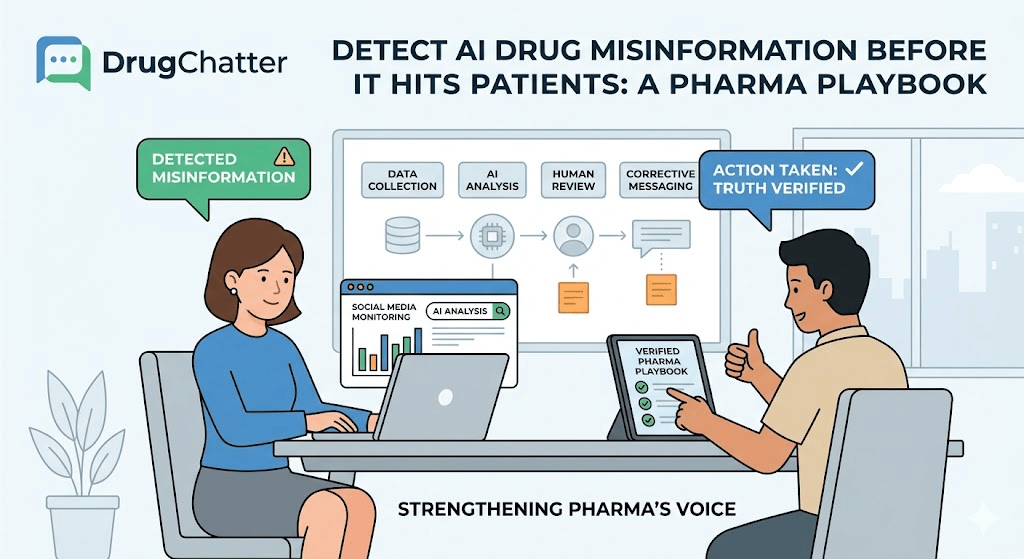
Automated hallucination detection for pharmaceutical content is an active area of development, and several platforms now offer some version of it. The general approach: generate AI responses to a standardized query set, compare the responses to a verified reference document (the current FDA-approved label or a curated clinical reference), and flag discrepancies for human review.
Automated systems perform well on factual claim types with clear true/false answers: drug name, indication, approved dosage range, contraindications listed on the label. They perform less well on nuanced claims: adverse event frequency characterizations, comparative effectiveness statements, and off-label discussion, where the line between accurate summary and misleading framing is a matter of clinical judgment rather than text comparison.
The practical architecture for most pharmaceutical AI monitoring programs: automated comparison for factual accuracy on the highest-volume query categories, with human pharmacist or medical writer review for nuanced clinical content and for any automated flag that reaches a significance threshold. Pure automation is insufficient. Pure human review is not scalable.
Platforms like DrugChatter are built specifically for this hybrid approach, combining automated query execution and response logging with structured human review workflows calibrated to pharmaceutical accuracy standards. The alternative — building this infrastructure internally — requires significant investment in prompt engineering, reference data management, and review workflow design.
Tracking Model Updates: Why Your AI Monitoring Program Needs Version Control
LLM platform updates are the most significant discrete event in the AI drug misinformation timeline, and they are the event most frequently missed by monitoring programs that rely on periodic audits rather than continuous testing.
When OpenAI, Google, Anthropic, or Microsoft updates their models, drug-related response patterns can change substantially and quickly. A model update that improves general factual accuracy may simultaneously introduce new errors in pharmaceutical content if the training data composition or weighting changes. A model update specifically designed to improve medical information accuracy may correct some errors while introducing new ones in drug categories that were not specifically targeted.
Pharmaceutical monitoring programs need to treat major model updates as monitoring events equivalent to label changes: they should trigger immediate re-querying of the full drug query library and a comparative analysis against the most recent pre-update baseline. The first two weeks following a major model update are the highest-risk period for undetected new misinformation patterns.
Off-Label AI Discussions: The Regulatory and Commercial Problem
Why LLMs Discuss Off-Label Drug Use Freely — And What That Means for Manufacturers
LLMs do not operate under the regulatory framework that governs pharmaceutical promotion. They are not subject to 21 CFR Part 202. They do not have fair balance obligations. They can discuss off-label use, present preliminary evidence as more definitive than it is, and draw comparisons that a manufacturer’s medical affairs team would not be permitted to make in a promotional context.
The result is that LLMs generate off-label drug use content at a scale and with a confidence that no manufacturer could legally produce. Patients who ask ChatGPT ‘can Ozempic help with alcohol addiction?’ receive a substantive answer drawing on published case series and preliminary trial data — the same evidence that exists in the literature but that Novo Nordisk cannot promote without an FDA-approved indication.
The monitoring implication for manufacturers is dual. First, you need to know what off-label uses AI systems are discussing for your drug, because that shapes patient demand, physician query volume, and formulary pressure in ways that your approved indication strategy does not account for. Second, you need to assess whether the AI characterization of off-label evidence is accurate — and if it is not, to understand whether inaccurate AI claims are creating patient safety risk or inappropriate prescribing pressure.
How to Monitor Off-Label AI Drug Discussions Without Creating Regulatory Risk
The monitoring itself is not a regulatory problem. Pharmaceutical companies are permitted to monitor what third parties say about their drugs, including AI platforms. The regulatory complexity arises if a manufacturer uses its monitoring findings to inform promotional strategy for off-label uses, or if it produces content in response to AI off-label discussion in ways that constitute off-label promotion.
The safe harbor is clear: monitor, document, route findings to medical affairs and pharmacovigilance, and respond to specific patient or physician inquiries about off-label use through appropriate medical information channels. What the monitoring should not feed is commercial strategy decisions about how to position off-label use in ways that are not approved.
Medical affairs teams have a specific legitimate role here: responding to unsolicited inquiries about off-label use with accurate scientific information. AI monitoring that identifies off-label queries being answered inaccurately by LLMs gives medical affairs a signal about where unsolicited inquiries are likely to increase, and allows proactive preparation of accurate scientific exchange materials before the query volume reaches clinical contact points.
Which Off-Label Drug Uses Are Currently Generating the Most AI Discussion
Several drugs are generating significant AI off-label discussion volumes as of mid-2025, based on systematic monitoring across major platforms.
Semaglutide (Ozempic, Wegovy) leads across virtually every off-label category: non-alcoholic fatty liver disease, addiction medicine, cardiovascular risk reduction beyond its approved indications, and most recently polycystic ovary syndrome management. AI responses on semaglutide off-label topics are typically substantive and evidence-referenced, reflecting the volume of published literature — but they often fail to distinguish between preliminary and established evidence, or between evidence in specific patient subpopulations and general population applicability.
Low-dose naltrexone generates high AI discussion volumes for autoimmune conditions, fibromyalgia, and long COVID — topics where the published evidence is genuinely preliminary but AI systems present it with more confidence than the evidence warrants. Rapamycin (sirolimus) has developed a significant AI discussion profile in longevity and anti-aging contexts, drawing on geroscience literature in ways that far outpace any approved indication.
Ketamine and esketamine (Spravato) generate substantial AI discussion of at-home ketamine protocols and compounding pharmacy alternatives to Spravato — a topic with direct commercial implications for Janssen and safety implications for patients.
Pharmacovigilance Implications: When AI Misinformation Becomes a Safety Signal
Can AI-Generated Drug Misinformation Produce Real Adverse Events?
Yes, through two distinct pathways. The first is treatment modification: a patient who receives inaccurate AI information about a drug’s side effects, interactions, or safety profile and modifies their treatment accordingly — stopping a medication, reducing a dose, adding a supplement the AI said was safe to combine — creates a real adverse event potential even if the modification itself is not reported.
The second pathway is treatment initiation: a patient who receives AI-generated off-label use information and initiates a drug or drug combination without physician oversight. This pathway is most relevant for drugs with narrow therapeutic indices, significant interaction profiles, or patient population-specific contraindications that AI systems frequently fail to surface.
Both pathways are underrepresented in FAERS data because they depend on adverse events being identified, attributed to AI-influenced decision-making, and reported — a sequence of events that rarely completes in full. The consequence is that pharmacovigilance programs relying on FAERS data alone will systematically undercount adverse events with AI-mediated causal contribution.
How to Route AI Monitoring Findings Into Existing Pharmacovigilance Workflows
The integration challenge is organizational, not technical. Pharmacovigilance teams have established intake processes for adverse event signals: FAERS reports, literature monitoring, clinical trial safety data, social listening. Adding AI monitoring outputs to this intake requires defining triage criteria, case assessment standards, and escalation thresholds specifically for AI-generated content.
A workable framework: AI monitoring outputs should enter pharmacovigilance review when they meet at least one of four criteria: they contain a safety claim that contradicts current FDA-approved labeling; they describe an adverse event with a frequency characterization significantly higher than label language; they recommend a drug combination that is contraindicated; or they generate sufficient patient query volume on a safety topic to suggest meaningful population exposure to potentially inaccurate information.
AI monitoring findings that do not reach these thresholds route to brand strategy and medical affairs for commercial response. The routing distinction matters because pharmacovigilance responses (expedited safety reports, label change requests, Dear Healthcare Provider letters) are regulatory actions with defined timelines, while commercial responses are discretionary.
What the ICH E2E Guidelines Say About AI Content as a Pharmacovigilance Signal Source
They do not mention it explicitly, because ICH E2E predates the current AI environment. The most recent ICH E2E revision dates to 2004, with a 2022 update that added digital health considerations without specifically addressing AI-generated content.
The absence of explicit guidance does not mean AI monitoring is outside pharmacovigilance scope. ICH E2E’s framework for ‘all available information’ regarding product safety is broad enough to encompass AI-generated content that reaches patients at scale. Pharmaceutical companies developing AI monitoring programs should document their methodology and rationale in their Pharmacovigilance System Master File now, in anticipation of regulatory guidance that will make this documentation a requirement rather than a best practice.
Competitive Intelligence Through AI Monitoring: Beyond Your Own Drug
How AI Systems Recommend Drugs Differently Than Formularies or Treatment Guidelines
Treatment guidelines from NICE, ACC/AHA, or ASCO reflect structured clinical evidence review by expert panels. Formulary placement reflects payer negotiation and pharmacoeconomic analysis. AI drug recommendations reflect training data composition — which incorporates guidelines and formularies but also incorporates patient community sentiment, media coverage, social media discourse, and whatever else was in the training corpus.
The result is that AI recommendations and guideline recommendations diverge in predictable ways. Drugs with high patient community engagement tend to be AI-favored beyond their guideline positioning. Drugs with negative media coverage tend to be AI-disfavored relative to their clinical evidence. New drugs with limited internet presence before their training cutoff tend to be underrepresented in AI recommendations regardless of clinical merit.
For competitive intelligence, this divergence is the insight. Knowing that a competitor drug is AI-favored beyond its guideline position tells you that the information environment is creating demand that guideline-based prescribing alone would not generate. Knowing that your drug is AI-disfavored relative to clinical evidence tells you that the information environment is creating a headwind that market research and HCP detailing are not capturing.
Tracking Competitor Drug Mentions Across ChatGPT, Gemini, and Perplexity
Systematic competitor monitoring in AI requires applying the same query library methodology used for your own drug to your primary competitors. The practical goal is to generate a comparative share-of-voice picture: for a given patient scenario, indication, or query type, which drugs does each AI platform recommend, with what frequency, and with what comparative framing?
Tools like DrugChatter are designed for exactly this competitive query analysis, tracking mention frequency and comparative framing across platforms for branded and generic drug names. The output is a competitive intelligence dashboard that shows, for example, that ChatGPT recommends tirzepatide over semaglutide in 68% of weight management queries, that Gemini’s AI Overviews include Humira in RA queries less frequently than adalimumab biosimilars, or that Perplexity’s sources for Keytruda queries skew heavily toward patient advocacy organizations rather than peer-reviewed oncology literature.
Each of those findings has a different commercial implication, and each maps to a different response function — brand strategy, medical affairs content, or regulatory engagement — depending on the accuracy of the AI content and the nature of the competitive displacement.
How Biosimilar Entry Changes AI Drug Recommendations — And How to Monitor the Shift
Biosimilar market entry consistently shifts AI drug recommendation patterns, typically in ways that disadvantage reference product manufacturers. The mechanism is the same one that disadvantages branded drugs relative to generics in cost-sensitive queries: biosimilar entry generates new internet content (press releases, patient advocacy coverage, payer communications, pharmacy benefit documents) that enriches the training data environment for biosimilar mentions and creates a cost-favorable framing that AI systems pick up.
For reference product manufacturers, monitoring AI recommendation patterns around biosimilar entry is a leading indicator of the commercial impact that prescribing data will show with a six-to-twelve-month lag. A brand team that knows its reference biologic is already being recommended less frequently than biosimilar alternatives in AI responses — before biosimilar prescribing volume has peaked — has earlier warning and more time to develop response strategy than one waiting for IMS/IQVIA data to show the shift.
How to Respond When AI Generates Misinformation About Your Drug
Can Pharmaceutical Companies Correct What AI Systems Say About Their Drugs?
Directly, with limited leverage. Pharmaceutical companies can submit corrections to AI platform operators, but none of the major platforms (OpenAI, Google, Anthropic, Microsoft) have established formal pharmaceutical industry correction processes comparable to the search engine content dispute mechanisms that exist for websites.
Indirectly, through content strategy, the leverage is greater. LLMs retrieve and weight content based on signals that include source authority, content quality, and relevance matching. A pharmaceutical company that produces high-quality, accurate, crawlable content about its drug — structured drug facts, patient-friendly summaries of approved labeling, accessible clinical summaries in peer-reviewed publications — improves the probability that AI systems will use that content as a source.
The content strategy approach requires thinking about drug information content as AI-readable documentation rather than purely as patient education or HCP support material. This means structured data formats, clear heading hierarchies, explicit factual claim formatting, and distribution through channels that AI systems treat as authoritative (FDA.gov, PubMed, major medical society websites).
When Should Pharma Companies Engage Directly With AI Platform Operators on Drug Misinformation?
Direct engagement with AI platform operators is appropriate in two scenarios: when the misinformation rises to an imminent patient safety risk, and when it is systematic and demonstrably traceable to a specific model behavior.
The first scenario is the clearer case. If an AI platform is consistently generating drug interaction warnings that contraindicate a combination that is actually standard of care, or consistently generating drug dosing information that would produce under-treatment of a serious condition, direct engagement with the platform operator’s trust and safety team is appropriate and the industry’s initial experiences suggest it can be effective.
The second scenario is more common and less straightforward. A systematic framing bias — a model that consistently describes your drug as second-line when clinical guidelines position it as first-line — may not meet the threshold of an imminent safety risk, but it represents a commercially significant pattern that the platform operator could potentially address through model fine-tuning or retrieval-augmented generation improvements. Building the documented evidence base for that engagement requires exactly the systematic monitoring and comparative analysis that an AI monitoring program produces.
FDA MedWatch and AI Misinformation: When to File a Safety Report
Filing a MedWatch report in response to AI drug misinformation is appropriate when you have evidence that the misinformation led to patient harm. The challenge is that this causal chain is rarely fully documented. What pharmaceutical companies can and should do is maintain a documented record of AI misinformation incidents — specific queries, specific responses, specific dates, specific platforms — that can support MedWatch or regulatory filing if evidence of harm emerges.
This documentation also has defensive value. If FDA or a plaintiff’s attorney later asks whether a manufacturer was aware of AI misinformation about its drug, a documented monitoring program with recorded incidents and response actions is a materially stronger position than no documentation.
Organizational Structure: Which Pharma Functions Should Own AI Misinformation Monitoring
Should AI Drug Monitoring Live in Pharmacovigilance, Brand Strategy, or Digital?
The most common mistake pharmaceutical companies make when establishing AI monitoring programs is assigning ownership to a single function. AI monitoring produces outputs relevant to at least four distinct organizational functions, and treating it as the property of any one of them systematically underutilizes the intelligence it generates.
The working model that has emerged in the most advanced programs is a cross-functional steering group that owns AI monitoring program design and output review, with execution typically sitting in digital or market intelligence. Pharmacovigilance has a standing seat and defined intake criteria for safety-relevant findings. Medical affairs has defined intake for accuracy and off-label content findings. Brand strategy has defined intake for competitive share-of-voice findings. Legal and regulatory affairs have defined intake for compliance-relevant findings.
This structure prevents the common failure mode where AI monitoring findings sit in a digital team’s report and never reach the functions that can act on them. The value of a finding about AI misinformation is zero unless it reaches a team with the authority and capability to respond.
What Internal Capabilities Does a Pharma AI Monitoring Program Require
At minimum, a pharmaceutical AI monitoring program requires four internal capabilities:
- Query library development and maintenance (typically a market intelligence or brand management function)
- Technical execution of systematic query testing (either internal technical resources or a vendor like DrugChatter)
- Medical accuracy review of flagged AI responses (pharmacist, medical writer, or medical affairs involvement)
- Cross-functional routing and escalation governance (program management or regulatory operations)
The medical accuracy review function is the most frequently underestimated resource requirement. Automated comparison catches binary accuracy errors. Clinical judgment is required for nuanced characterization errors, off-label framing assessments, and competitive positioning evaluations. Plan for meaningful medical reviewer time as a program operating cost, not a one-time setup investment.
Key Takeaways
- AI drug misinformation is structurally different from social media misinformation: it is generated on demand, varies by query and platform, and cannot be detected by passive monitoring. Active, systematic query testing is required.
- The earliest warning signals for emerging AI misinformation trends appear at the model output level, before social amplification begins. Continuous monitoring with time-series data is the only way to detect these signals reliably.
- Model updates from OpenAI, Google, Anthropic, and Microsoft are discrete misinformation risk events. Full query library re-testing should be triggered within days of any major platform model update.
- Perplexity’s citation model makes it the most actionable platform for identifying which content sources are shaping AI drug information. Its citation patterns are direct targets for content strategy intervention.
- Google Gemini AI Overviews, because of their placement in standard Google Search results, represent the highest-reach AI drug information channel. Priority query monitoring should focus first on queries that trigger AI Overviews for your branded and generic drug terms.
- Off-label AI discussions require monitoring for both commercial intelligence (demand signals) and patient safety purposes. The monitoring itself is not a regulatory problem; how findings are used for promotional purposes is.
- AI monitoring findings have four distinct organizational destinations: pharmacovigilance, medical affairs, brand strategy, and legal/regulatory. A monitoring program that routes findings to only one of these functions wastes most of its value.
- Platforms like DrugChatter provide purpose-built infrastructure for pharmaceutical AI monitoring, combining query execution, accuracy benchmarking, and cross-functional workflow routing in a purpose-built drug intelligence environment.
- Documentation of AI monitoring activities, findings, and responses should be maintained in a format that can support pharmacovigilance audit requirements, regulatory inquiry responses, and litigation defense — not just internal reporting.
FAQ: Detecting AI Drug Misinformation Trends
How do pharmaceutical companies know when an AI platform has started spreading misinformation about their drug?
Detection requires baseline data from continuous monitoring. A pharmaceutical company running systematic weekly queries against a standardized query library will detect changes in AI responses by comparing new outputs to the previous baseline. Without that time-series data, a company can only perform a point-in-time audit that shows what the AI currently says but cannot identify whether it represents a change from previous response patterns. The practical answer is that detecting AI misinformation trends requires investing in continuous monitoring infrastructure before an incident occurs, not in response to one.
What is the difference between an AI knowledge cutoff problem and an AI hallucination in the context of drug information?
A knowledge cutoff problem produces drug information that was accurate at some prior point but has since been superseded — pre-update labeling, pre-approval status changes, outdated clinical guidelines. The AI is not generating false information; it is generating outdated true information. A hallucination generates information that was never accurate — fabricated clinical trial results, drug interactions that do not exist, adverse event rates with no basis in published literature or patient reporting. Both are dangerous and require different responses: knowledge cutoff problems are addressed through model retraining or retrieval-augmented generation with current sources; hallucinations require model-level accuracy interventions and are harder to correct at scale.
Can a pharmaceutical company ask ChatGPT or Google to correct inaccurate drug information?
No formal correction process exists at any major AI platform equivalent to the search content dispute mechanisms that exist for web pages. Pharmaceutical companies can contact platform operators through their standard business or trust-and-safety channels, but there is no established timeline or outcome guarantee for AI content corrections. The more reliable intervention pathway is content strategy: producing high-quality, accurate, structured drug information content through channels that AI systems treat as authoritative source material (FDA.gov submissions, peer-reviewed publications, structured drug fact databases), which improves the probability that AI systems will retrieve and cite accurate sources. Direct platform engagement is appropriate for imminent safety risks; content strategy is the ongoing mechanism for improving systemic accuracy.
Should AI drug monitoring findings be included in PSUR or PBRER submissions?
This is an evolving area without explicit regulatory guidance, but the direction of regulatory expectation is toward inclusion. EMA’s 2024 reflection paper on AI in medicines regulation signals that regulators are beginning to treat AI-generated content as part of the information environment that marketing authorization holders should monitor for pharmacovigilance purposes. A reasonable current approach is to include a summary of AI monitoring methodology and significant findings in the signal evaluation section of PSURs and PBRERs, documenting both what was found and what response action was taken. Companies that begin developing this documentation practice now will be better positioned when formal guidance makes it a requirement.
How should a pharmaceutical company prioritize which drugs to monitor for AI misinformation first?
Four factors should drive prioritization. First, query volume: drugs with high patient Google search volume are generating high AI query volume and have the broadest exposure to potential misinformation. Second, label change recency: drugs with recent label updates, new boxed warnings, or new contraindications have the largest gap between current accurate information and what outdated AI training data contains. Third, competitive intensity: drugs facing biosimilar entry or generic competition are more likely to be displaced in AI comparative recommendations. Fourth, adverse event profile complexity: drugs with interaction profiles, population-specific contraindications, or narrow therapeutic indices carry higher patient safety risk from AI misinformation and warrant monitoring priority regardless of commercial profile.