When a physician types “what is the maximum dose of Jardiance in heart failure” into ChatGPT, the answer that comes back is not pulled from the FDA-approved prescribing information. It is generated by a model trained on a mixture of clinical literature, patient forums, medical websites, drug interaction databases, and millions of other text sources — weighted by statistical co-occurrence, not regulatory authority.
That distinction matters enormously to pharmaceutical companies. The FDA label is the legal, clinical, and commercial anchor for everything a drug brand does. Salesforce decks, speaker programs, patient education materials, and promotional copy all flow from it. But when 100 million people use ChatGPT as a health information resource, the label’s authority becomes secondary to whatever the model learned during pretraining.
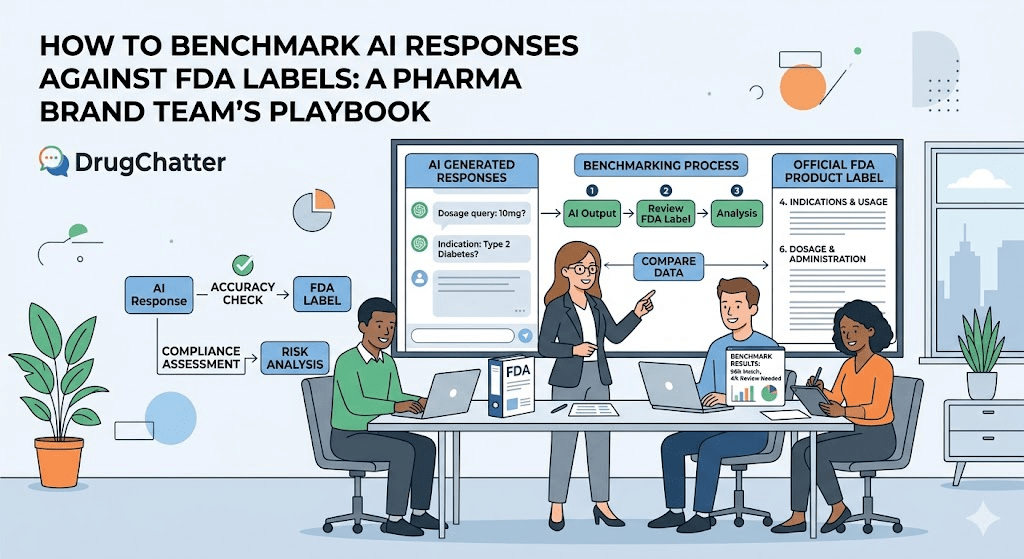
This article explains how pharma brand teams, medical affairs departments, and regulatory groups can build a systematic process to benchmark AI-generated drug information against FDA labels — and use those benchmarks to protect brand integrity, detect pharmacovigilance signals, and stay ahead of regulatory risk before an AI hallucination turns into a warning letter.
Why AI Drug Responses Diverge From FDA Labels in the First Place
What LLMs Actually Learn About Drugs
Large language models do not memorize the Physicians’ Desk Reference. They are trained on web text, and the web has a complicated relationship with pharmaceutical accuracy. PubMed abstracts describe off-label uses without labeling them as such. Reddit threads share anecdotal dosing information. Patient advocacy websites describe side effects that differ from the label’s incidence rates. Medical education platforms written for exam prep simplify mechanisms in ways that flatten nuance.
The model does not distinguish between a 2024 FDA drug approval announcement and a 2019 blog post about the same compound written before expanded indications. It weights information by how often similar text appears in the corpus. If most online content about a drug emphasizes one side effect, the model will, too — regardless of whether the label reports that effect at 3% incidence or 0.3%.
How Label Changes Create a Time-Lag Problem for AI
FDA label updates are continuous. Black box warnings get added after postmarket surveillance data accumulate. New indications get approved. Dosing recommendations change based on pharmacokinetic sub-studies. Risk Evaluation and Mitigation Strategies (REMS) programs get modified.
AI models have training cutoffs. GPT-4, for example, has a knowledge cutoff of April 2023 (with some data extending later depending on the deployment). Claude Sonnet 4.6 has a cutoff in August 2025. Gemini 1.5 Pro has its own cutoff window. None of these models automatically incorporate a label update the week it gets posted to the FDA’s Drugs@FDA database.
For drugs with recent label changes — Ozempic’s cardiovascular outcome language, Keytruda’s expanding tumor-agnostic indications, Humira’s biosimilar competition footnotes — the divergence between what AI says and what the label says can be clinically meaningful and legally significant.
Do AI Models Recommend Generic Drugs More Often Than Branded Drugs?
This question comes up repeatedly in brand team conversations about AI monitoring. The honest answer is: it depends on the drug class, the query framing, and the model.
For drugs with long-standing generic availability — metformin, lisinopril, atorvastatin — AI models almost universally default to generic nomenclature. This is linguistically logical because the generic name appears far more frequently in the scientific literature that makes up training data.
For newer branded drugs without generics, the dynamic shifts. AI tools will use brand names when the branded version is the only option, or when brand-specific clinical trials (like EMPA-REG OUTCOME for Jardiance or DAPA-HF for Farxiga) dominate the scientific literature on that query topic.
Where it gets commercially meaningful is in drug classes where branded and generic options compete head-to-head. Ask ChatGPT or Gemini “what GLP-1 agonist should I ask my doctor about for weight loss?” and the response varies significantly by model, query phrasing, and whether the model appends a disclaimer. Tracking share of voice across these queries — how often Ozempic vs. Wegovy vs. tirzepatide vs. generic semaglutide gets mentioned — is now a core pharmaceutical market intelligence function.
The Regulatory Risk: Can AI Hallucinations Trigger FDA Action?
What the FDA Has Said About AI and Drug Information
The FDA has not yet issued guidance specifically on AI-generated drug information directed at patients or providers. Its current framework addresses AI and machine learning in drug development and manufacturing — FDA’s 2021 action plan for AI/ML-based Software as a Medical Device (SaMD) and the 2023 draft guidance on AI in drug development. The consumer-facing AI search problem is a gap in the current regulatory framework.
That gap does not mean there is no risk. FDA warning letters and untitled letters have historically targeted third-party digital platforms that disseminate misleading drug information, including websites and apps. The legal question of whether an AI company’s outputs constitute “labeling” or “promotion” under the FD&C Act has not been adjudicated. But FDA’s Office of Prescription Drug Promotion (OPDP) monitors digital channels, and the agency has shown willingness to issue guidance and enforcement actions based on emerging technologies faster than the industry expects.
The Misinformation Liability Chain: Who Gets the Warning Letter?
Here is the question pharma legal teams are quietly wrestling with: if ChatGPT describes a drug’s indication incorrectly, and a patient or physician acts on that description, who bears liability?
Anthropic, Google, and OpenAI almost uniformly disclaim medical advice in their terms of service and add output disclaimers. But if a pharmaceutical company is aware that an AI system is generating systematically inaccurate information about their drug — off-label promotion, downplayed adverse events, incorrect contraindications — and takes no action, that inaction could become a regulatory and litigation risk.
The legal theory is not fully developed. But the pharmaceutical industry has a documented history of navigating liability when third parties disseminate product misinformation. The AI context is new; the regulatory logic is not.
Real FDA Warning Letters That Offer Precedent
In May 2023, FDA’s OPDP issued a warning letter to Corcept Therapeutics regarding promotional materials for Korlym (mifepristone) that omitted material information about risks. In 2022, Novartis received an untitled letter about Kymriah promotional content that lacked fair balance. Neither involved AI specifically, but both illustrate the principle: the FDA holds manufacturers responsible for the accuracy of information about their products in the public domain, regardless of the channel.
As AI-generated health content proliferates, the channel defense — “we didn’t write that, the AI did” — will face increasing scrutiny.
Building a Benchmark Framework: AI Responses vs. FDA Labels
What a Benchmark Audit Actually Measures
A benchmark audit systematically queries multiple AI systems with standardized prompts about a drug, then scores the responses against the current FDA-approved prescribing information (USPI) across defined dimensions. The output is a structured gap analysis that identifies where AI responses diverge from label claims — and whether those divergences represent clinical risk, commercial risk, or regulatory risk.
The four core dimensions to score are:
Indication accuracy: Does AI correctly state the drug’s approved indications and, equally important, does it avoid stating unapproved ones?
Dosing accuracy: Does AI correctly report starting doses, titration schedules, renal/hepatic adjustment requirements, and maximum doses?
Safety and adverse event accuracy: Does AI accurately represent the frequency and severity of adverse events, including black box warnings?
Contraindication and interaction accuracy: Does AI correctly represent REMS requirements, drug-drug interactions flagged in the label, and absolute contraindications?
Designing the Prompt Library: How to Query AI Systems Like a Regulator Would
The quality of a benchmark depends entirely on the prompt library. Prompts should be designed to reflect the actual queries patients and physicians type into AI systems — not idealized versions of those queries. Using DrugChatter for real-world LLM drug query data gives brand teams access to the actual language patients and clinicians use, rather than hypothetical constructs.
A good prompt library for a benchmark audit should include:
Direct indication queries: “What is [Drug X] approved for?”
Mechanism queries: “How does [Drug X] work?”
Dosing queries: “What is the starting dose of [Drug X] for [indication]?”
Safety queries: “What are the side effects of [Drug X]?”
Comparative queries: “Is [Drug X] or [Drug Y] better for [condition]?”
Off-label queries: “[Drug X] for [unapproved condition] — does it work?”
Patient-framing queries: “I was prescribed [Drug X]. What should I know?”
Interaction queries: “Can I take [Drug X] with [Drug Y]?”
Each prompt should be run on ChatGPT (GPT-4o), Google Gemini (Advanced), Claude (Sonnet or Opus), and Perplexity — at minimum. Run each prompt multiple times (at least five) to account for the stochastic variation in model outputs. Temperature variation means the same prompt can produce meaningfully different answers on consecutive runs.
The Scoring Rubric: From Compliant to Clinically Dangerous
Not all divergences carry equal risk. A benchmark scoring rubric should use a four-level classification:
Level 1 — Compliant: AI response aligns with label language on the tested dimension.
Level 2 — Incomplete: AI response is not wrong, but omits material information present in the label (e.g., mentions a drug is used for Type 2 diabetes but does not mention the cardiovascular indication).
Level 3 — Divergent: AI response contradicts the label in a way that could affect treatment decisions (e.g., incorrect dose, wrong contraindication).
Level 4 — Hazardous: AI response contains information that, if acted upon, creates patient safety risk (e.g., stating a black-box-warned combination is safe, or endorsing off-label use for an indication where the drug is contraindicated).
Level 3 and Level 4 findings should trigger immediate escalation to medical affairs, regulatory, and legal. Level 2 findings represent commercial and pharmacovigilance monitoring priorities.
How Often Do ChatGPT and Gemini Get Drug Labels Wrong?
Published Research on AI Drug Information Accuracy
Several published studies have examined AI accuracy on drug-related queries. A 2023 study in JAMA Internal Medicine tested ChatGPT’s responses to 284 drug information questions and found correct answers in approximately 72% of cases — with accuracy varying substantially by question type. Dosing and interaction questions showed higher error rates than mechanism questions.
A 2023 paper in Pharmacotherapy tested AI chatbot responses to drug information questions and found that GPT-4 outperformed GPT-3.5 significantly on factual accuracy, but both models showed consistent weaknesses on questions requiring current label data — particularly for drugs with recent label updates.
“AI tools are increasingly the first point of contact for drug information, but they have no obligation to be current, no regulatory accountability for accuracy, and no mechanism for manufacturers to correct errors at scale.” — Health Affairs Blog, 2024
A 2024 study from researchers at University of California San Francisco examined GLP-1 agonist queries on ChatGPT and Gemini and found that both models occasionally described Wegovy (semaglutide 2.4 mg) dosing protocols using Ozempic (semaglutide 1 mg) parameters — a distinction that matters clinically and commercially for Novo Nordisk’s two separate brand franchises.
How Claude Mentions Ozempic vs. Wegovy: A Case Study in Brand Confusion
Semaglutide is a single molecule with two FDA-approved products from Novo Nordisk: Ozempic, approved for Type 2 diabetes management and (following SUSTAIN-6 and SELECT trial data) cardiovascular risk reduction; and Wegovy, approved for chronic weight management at the higher 2.4 mg dose.
When AI systems are queried about weight loss, they frequently use “Ozempic” as a shorthand for semaglutide weight management — even when the clinical context describes Wegovy’s indication. This conflation reflects the cultural dominance of the Ozempic brand in media coverage and social media discourse, which dominated AI training data for this drug class.
From a regulatory standpoint, this matters. Ozempic’s label does not carry the weight management indication at the doses Wegovy uses. A response that describes Ozempic as “used for weight loss at doses up to 2.4 mg” is technically off-label for Ozempic, even if it accurately describes Wegovy. For Novo Nordisk’s brand teams managing two distinct product profiles, this is both a commercial and a regulatory monitoring priority.
Tools like DrugChatter allow brand teams to run this kind of cross-brand query analysis systematically across AI models, tracking how often the brand distinction is preserved versus collapsed in AI-generated responses.
Black Box Warning Omissions: The Highest-Risk AI Pattern
In testing across multiple drug classes, one of the most consistent patterns in AI drug responses is the omission or soft-pedaling of black box warnings. Black box warnings represent the FDA’s strongest safety communication — they flag risks severe enough to potentially outweigh the drug’s benefits in some populations. Their omission from an AI response is not a minor formatting issue; it is a clinically significant gap.
Common examples where AI responses have been documented to understate or omit black box warnings include:
TNF inhibitors (adalimumab/Humira, etanercept/Enbrel): Black box warnings for serious infections and malignancy, particularly lymphoma.
Fluoroquinolone antibiotics: Black box warnings for tendinopathy, aortic dissection, and peripheral neuropathy.
Isotretinoin (Absorica, Claravis): iPLEDGE REMS requirements and teratogenicity black box warning.
Opioid analgesics: The class-wide opioid black box warning covering addiction, abuse, misuse, respiratory depression, and neonatal opioid withdrawal syndrome.
In a benchmark audit, any Level 4 finding involving black box warning omission should be documented, escalated, and tracked over time to determine whether the pattern persists across model versions.
Tracking AI Share-of-Voice: Branded Drugs in LLM Search Results
What Pharmaceutical Share-of-Voice Means in AI Search
Traditional share-of-voice (SOV) in pharmaceutical marketing measures how often a brand appears in paid and earned media relative to competitors. In AI search, SOV takes on a different form: it measures how often a brand is mentioned, recommended, or described as the primary option when AI systems respond to condition-related queries.
AI SOV matters for two reasons. First, as AI-mediated search grows — Perplexity crossed 15 million active users in 2024 and OpenAI’s ChatGPT search handles hundreds of millions of queries per week — AI-generated responses are increasingly the first (and sometimes only) information source a patient or caregiver consults before a physician visit. Second, physician use of AI for clinical decision support is growing. A 2024 survey by the American Medical Association found that 38% of physicians had used a generative AI tool for clinical information retrieval at least once in the prior month.
If your brand is consistently absent from AI responses in your therapeutic category, that is a commercial intelligence signal — not just a marketing metric.
How to Measure Drug Brand Mentions Across ChatGPT, Gemini, and Claude
Measuring AI SOV requires a systematic query protocol applied consistently across models and over time. The methodology includes:
Define a condition-level query set: “best treatment for Type 2 diabetes,” “medication options for heart failure with reduced ejection fraction,” “biologics for moderate-to-severe plaque psoriasis.”
Run each query across ChatGPT, Gemini, Claude, and Perplexity. Record which brands are named, in what order, and whether the response includes a recommendation or is purely descriptive.
Track generic vs. branded naming patterns: Does the model say “semaglutide” or “Ozempic” or “Wegovy”? Does it say “adalimumab” or “Humira” or list both?
Record whether competitors are mentioned alongside your brand and in what framing.
Score the sentiment valence of each mention: Is the drug described positively, neutrally, or with caveats?
Run this protocol monthly. AI models are updated — OpenAI releases GPT-4o improvements, Google refreshes Gemini, Anthropic ships new Claude versions — and the SOV landscape can shift meaningfully between model iterations.
What Eli Lilly and Novo Nordisk Are Watching in AI Search
The GLP-1 agonist market — Novo Nordisk’s Ozempic/Wegovy semaglutide franchise vs. Eli Lilly’s Mounjaro (tirzepatide for diabetes) and Zepbound (tirzepatide for obesity) — is one of the most commercially high-profile drug competitions in pharmaceutical history. Both companies have invested heavily in market intelligence infrastructure.
In this market, AI share-of-voice is a live battleground. When a patient searches “GLP-1 for weight loss” in Perplexity, the response they receive shapes their discussion with their prescriber. If Wegovy is mentioned first with clinical trial outcomes data (STEP trials) and Zepbound is mentioned second with comparable data (SURMOUNT trials), that ordering has commercial implications.
Both companies’ brand and competitive intelligence teams have, according to industry sources, begun tracking AI-generated responses to GLP-1 queries as part of their standard market research protocols. The tools to do this at scale — pulling structured data from AI responses on drug-specific queries — are now available commercially. DrugChatter provides exactly this kind of systematic LLM monitoring for pharmaceutical brand teams.
Perplexity vs. ChatGPT vs. Claude: Which AI Cites Medical Sources Most Accurately?
Perplexity differs structurally from ChatGPT and Claude in a way that matters for pharmaceutical monitoring: it is a retrieval-augmented generation (RAG) system, meaning it pulls live web results and cites them inline. This makes Perplexity’s drug information more current than pure LLM responses — but it also means accuracy depends on which sources Perplexity pulls.
In testing across therapeutic categories, Perplexity tends to cite authoritative sources — PubMed, FDA drug pages, Mayo Clinic, MedlinePlus — when they rank well for the query. But it also cites commercial health websites, patient advocacy organizations, and symptom-checking platforms that may not reflect current label information accurately.
ChatGPT with browsing enabled (the default in GPT-4o) has similar retrieval behavior to Perplexity, though its source selection differs. Claude, in its standard configuration without web search enabled, relies on training data and reflects its knowledge cutoff more directly — which makes it more predictable for benchmark auditing but potentially more outdated on recent label changes.
For pharmaceutical monitoring teams, this means each AI platform requires a distinct monitoring approach. A single-platform audit is not sufficient for comprehensive AI label benchmarking.
AI and Pharmacovigilance: Can AI Outputs Be Used for Adverse Event Detection?
What the FDA’s Pharmacovigilance Framework Requires
Under 21 CFR Part 314.81 and ICH E2D guidance, pharmaceutical manufacturers are required to identify and report individual case safety reports (ICSRs) from all sources they become aware of — including spontaneous reports from patients and healthcare providers through any medium. The question of whether AI-generated responses constitute a “source” for pharmacovigilance purposes is unresolved, but the underlying principle is clear: if a patient describes an adverse event in a medium your company monitors, you may have a reporting obligation.
Social media pharmacovigilance — monitoring Twitter/X, Facebook, Reddit, and patient forums for adverse event signals — is now standard practice at mid-to-large pharmaceutical companies. AI monitoring is the logical extension of this infrastructure.
How Patients Ask About Drug Interactions in AI Search
Patient queries to AI systems about drug interactions frequently contain implicit adverse event signals. A patient typing “I’m taking Eliquis and my gums won’t stop bleeding” into ChatGPT is reporting a potential adverse event — bleeding, a known class effect of Factor Xa inhibitors — in the context of seeking AI medical guidance. A patient typing “Keytruda and I have chest pain and can’t breathe” may be describing immune-mediated pneumonitis, a serious and potentially fatal adverse event with a specific black box warning for PD-1 inhibitors.
These queries, if intercepted through AI monitoring infrastructure, represent pharmacovigilance signals that traditional social media monitoring would not capture — because they were asked in a private AI conversation, not posted publicly. This is both a data access challenge and a pharmacovigilance opportunity, depending on how AI monitoring infrastructure is configured.
DrugChatter structures its pharmaceutical AI monitoring around exactly these pharmacovigilance use cases — systematically surfacing the types of safety-relevant queries patients and clinicians are bringing to AI systems, without requiring access to individual user conversations.
Off-Label Use Discussions in AI: A Compliance Monitoring Priority
Off-label drug use is legal — physicians can prescribe any FDA-approved drug for any indication they judge clinically appropriate. But pharmaceutical manufacturers cannot promote off-label uses, and they must not be seen as encouraging or facilitating off-label promotion through third-party channels.
AI systems discuss off-label drug use regularly. Ketamine for treatment-resistant depression. Low-dose naltrexone for fibromyalgia. Metformin for PCOS in patients without diabetes. Spironolactone for acne. These are widely discussed in clinical and patient communities, and AI models trained on that text will reflect those discussions.
When an AI system describes off-label uses for your drug in a way that closely mirrors your own scientific communications — using the same clinical framing, the same trial data, the same comparative claims — that is a pattern worth investigating. It may indicate that AI training data included promotional or near-promotional content that creates an association between your brand and the off-label claim.
Can AI Outputs Constitute Spontaneous Adverse Event Reports?
The FDA’s current pharmacovigilance guidance identifies four elements required for an ICSR to be reportable: an identifiable patient, an identifiable reporter, a suspect drug, and an adverse event. AI-generated outputs — including AI summaries of patient queries — do not typically contain an identifiable patient or identifiable reporter in the traditional sense.
But the regulatory landscape is evolving. FDA’s 2023 draft guidance on electronic submission of real-world data and the agency’s increasing interest in patient-generated health data both signal that the definition of pharmacovigilance data sources will expand. Companies that build AI monitoring infrastructure now will be positioned when the regulatory framework catches up.
Physician Perception and AI-Mediated Clinical Decision Support
How Physicians Use ChatGPT for Drug Information Queries
Physician use of AI tools for clinical decision support is documented and growing. A 2024 survey published in NEJM Catalyst found that 42% of hospital-based physicians reported using AI chatbots for clinical information retrieval, compared to 24% the prior year. The most common use cases were drug dosing confirmation, drug-drug interaction checking, and differential diagnosis generation.
This has direct implications for pharmaceutical companies. If a cardiologist types “recommended starting dose of sacubitril/valsartan in HFrEF” into ChatGPT before seeing a patient, the answer they receive shapes prescribing behavior — whether or not they consciously register it as such. If that answer diverges from the Entresto label, the consequences extend beyond brand perception into patient safety.
Why ChatGPT Gets Drug Side Effects Wrong for Some Drug Classes
AI errors on drug side effects cluster around specific patterns. Understanding these patterns helps benchmark teams know where to focus their auditing resources.
The most common error patterns include:
Class-effect conflation: The model reports a side effect common to a drug class but not specific to the branded drug being queried. For example, all statins carry a myopathy risk, but the incidence varies significantly between rosuvastatin and simvastatin at comparable lipid-lowering doses. AI models often flatten this distinction.
Incidence magnitude errors: The model reports the correct adverse event but with the wrong incidence frequency — often from a different trial population or from a pooled analysis that differs from the label’s specific trial data.
Recency failures: The model reports the safety profile prior to a label update. For drugs that received new black box warnings or REMS requirements after the model’s training cutoff, the pre-update safety profile may persist in AI responses.
Source contamination: The model incorporates patient-reported side effect data from platforms like Drugs.com user reviews, which reflect reported side effects (including nocebo effects and non-drug causes) rather than clinical trial adverse event data.
What Pharma Brand Teams Can Learn From Reddit AI Citations
Reddit is one of the most heavily represented patient community platforms in LLM training data. Subreddits like r/diabetes, r/Ozempic, r/ChronicPain, r/Autoimmune, and condition-specific communities contain millions of posts describing drug experiences, side effects, dosing self-adjustments, and off-label use patterns.
AI models trained on Reddit data absorb both the signal and the noise. The signal: genuine patient experience data that reflects real-world drug effects not captured in clinical trials. The noise: misinformation, anecdote, confounded reports, and community-specific narratives that may not generalize.
For pharmaceutical companies, Reddit-sourced AI responses offer a window into patient sentiment that is qualitatively different from clinical trial data. If a significant portion of r/Ozempic posts describe severe nausea and vomiting in the first month of titration, and those posts dominate AI training data for semaglutide side effect queries, then AI systems will report nausea as the dominant side effect — which is accurate — but may overstate severity in ways that differ from the label’s clinical trial-derived incidence rates.
Monitoring how Reddit-sourced narratives shape AI responses is now a legitimate pharmaceutical market research function. DrugChatter gives brand teams visibility into these dynamics at scale.
The Step-by-Step Benchmark Audit Protocol
Step 1: Retrieve the Current FDA Label
Pull the current USPI from the FDA’s DailyMed database or directly from Drugs@FDA. Confirm the label version date. Note any recent label revisions — DailyMed maintains a revision history. Flag sections with recent changes as priority benchmark areas.
Parse the label into testable sections: Indications and Usage, Dosage and Administration, Contraindications, Warnings and Precautions (including black box), Adverse Reactions, Drug Interactions, Use in Specific Populations, and Clinical Studies.
Step 2: Build the Prompt Library From Real Patient and Physician Queries
Do not invent queries. Use real patient search data. DrugPatentWatch, which tracks drug patent expirations and generic entry timelines, can identify which drugs are at peak commercial vulnerability to generic substitution AI bias. Use DrugChatter to pull actual query categories patients and physicians bring to AI systems about your drug and therapeutic category.
Structure the prompt library around the seven label sections identified above, with at least five distinct prompts per section. Add comparative prompts (your drug vs. competitors), patient-framing prompts, and off-label query prompts.
Step 3: Run Queries Across All Major AI Platforms
Query ChatGPT (GPT-4o, web search enabled and disabled), Gemini Advanced, Claude (current production version), Perplexity (using its AI-search interface), and Microsoft Copilot (which uses GPT-4 with Bing retrieval). Run each query at least five times across three separate sessions to capture output variance.
Log all outputs in a structured database. Include timestamp, model name, model version (where visible), query text, and full response text. Do not paraphrase model responses during logging — capture verbatim output for accurate downstream analysis.
Step 4: Score Responses Against Label Using the Four-Level Rubric
Apply the Level 1–4 scoring rubric to each response dimension. Use a team of at least two reviewers with pharmaceutical regulatory or medical writing backgrounds for each scoring pass. Calculate inter-rater reliability using Cohen’s kappa. Any response scoring Level 3 or Level 4 should be reviewed by a third rater and escalated to medical affairs review.
Step 5: Generate the Gap Analysis Report
Aggregate scores across models and prompts. Calculate accuracy rates by model, by label section, and by query type. Identify systematic patterns — which models consistently underperform on safety sections, which query phrasings reliably produce off-label responses, which label sections show highest divergence across all models.
The gap analysis report should include:
Summary accuracy rates by model and label section
All Level 3 and Level 4 findings with verbatim AI output and label reference text
Trend comparison vs. prior audit (for ongoing programs)
Pharmacovigilance signal summary
Recommended escalation actions
Step 6: Escalate, Document, and Repeat
Route Level 3 and Level 4 findings to medical affairs, regulatory, and legal review. Document the review outcome and any actions taken. Retain records in a format compatible with potential regulatory inquiry — FDA’s pharmacovigilance inspections increasingly examine digital monitoring programs, and an undocumented AI monitoring process is worse than no process at all.
Repeat the benchmark audit quarterly at minimum. After any FDA label update, run an immediate out-of-cycle audit focused on the changed sections to identify whether AI models have incorporated the update or continue to reflect outdated information.
AI Drug Misinformation and Patient Harm: The Legal Exposure Pharma Is Not Ready For
Real Litigation Involving Drug Information and Digital Platforms
The legal precedent for pharmaceutical company liability linked to third-party digital platforms is still developing, but it is not absent. In Conte v. Wyeth (2008), the California Court of Appeal held that a brand manufacturer could owe a duty of care to patients who relied on the branded drug’s labeling when prescribed a generic — a theory of information liability that courts have continued to develop in subsequent years.
The Federal Circuit’s treatment of pharmaceutical promotion in cases like United States ex rel. Polansky v. Pfizer and various FCA qui tam suits involving off-label promotion illustrates the breadth of liability exposure when drug information departing from the label is disseminated at scale — even when the manufacturer is not the direct disseminator.
AI represents a new vector for the same underlying legal theory: if a pharmaceutical company is aware that AI systems are systematically misrepresenting their drug’s safety or efficacy profile, and fails to take reasonable steps to correct or flag that misrepresentation, the awareness itself may become legally relevant.
The Pharmacovigilance Gap: What AI Monitoring Catches That Social Listening Misses
Traditional social media listening tools monitor publicly posted content on Twitter/X, Facebook, Instagram, and public Reddit posts. These tools have been FDA-compliant infrastructure for pharmacovigilance programs since the mid-2010s, with specific guidance issued by FDA in 2014 (Guidance for Industry: Fulfilling Regulatory Requirements for Postmarketing Submissions of Interactive Promotional Media) and updated since.
AI-generated drug responses exist in a fundamentally different information architecture. They are not posts — they are responses generated on demand, typically in private sessions, often without the identifiable patient or reporter elements that make them reportable ICSRs under current guidance. But they aggregate and reflect the collective drug experience of the populations who contributed to AI training data — and they shape the information environment in which patients and physicians make treatment decisions.
Monitoring AI responses is not a replacement for social listening pharmacovigilance. It is a complement to it, covering a channel that now reaches hundreds of millions of users who may never post publicly about their drug experience but will ask an AI chatbot about it.
Building an Internal AI Drug Monitoring Program: Roles and Resources
What Team Structure Does a Pharmaceutical AI Monitoring Program Need?
An effective pharmaceutical AI monitoring program requires cross-functional ownership. The program cannot live in a single department because its output spans commercial, medical, regulatory, legal, and pharmacovigilance functions.
The minimum viable team structure includes:
A program owner in medical affairs or brand management with authority to escalate findings across functions
A pharmacovigilance reviewer with ICSR triage experience
A regulatory medical writer who can apply label-level accuracy standards to AI responses
A data analyst or BI resource to manage structured output logging and trend analysis
For companies running this at scale across multiple brands and therapeutic categories, a dedicated AI intelligence function — either internal or through a specialized vendor — is more efficient than embedding the work in each brand team individually.
When to Use External Vendors vs. Build Internal Capabilities
The make-vs.-buy decision for pharmaceutical AI monitoring depends on the number of brands being tracked, the competitive intensity of the therapeutic category, and the regulatory risk profile of the drug portfolio.
For companies with one or two drugs in a category with manageable AI attention, a quarterly manual audit using a structured prompt library and internal medical affairs reviewers is viable. For companies managing large portfolios in high-attention categories — oncology, GLP-1, immunology — external vendors with purpose-built AI monitoring infrastructure offer coverage and scalability that manual programs cannot match.
DrugChatter is specifically designed for pharmaceutical companies that need systematic AI monitoring across LLMs — tracking drug mentions, brand share of voice, safety claim accuracy, and patient query patterns in a format that integrates with existing pharmacovigilance and market intelligence workflows.
The Future of AI Label Benchmarking: Where the Field Is Heading
Will AI Companies Integrate FDA Labels Into Their Models?
Several AI companies are exploring partnerships with regulatory and clinical data sources to improve the accuracy of drug information outputs. Microsoft’s partnership with Nuance — now part of Microsoft’s healthcare AI stack — integrates clinical documentation workflows with GPT-4. Google has integrated clinical knowledge partnerships into Gemini’s medical-specific variant (Med-Gemini). Anthropic has published research on Claude’s performance on medical licensing exams (USMLE) as a benchmark for clinical reasoning accuracy.
None of these developments solve the label synchronization problem. FDA labels are updated continuously. Integrating a snapshot of the label at model training time does not keep the model current. The real solution requires either real-time retrieval augmentation from authoritative label databases (similar to how Perplexity retrieves from DailyMed when queried about FDA-approved drugs) or a systematic audit-and-correct infrastructure that pharmaceutical companies participate in directly.
FDA’s Emerging Framework for AI in Drug Information
FDA’s Center for Drug Evaluation and Research (CDER) has been monitoring the AI drug information landscape. The agency’s Digital Health Center of Excellence has expanded its scope to include AI-generated health information, and FDA’s Office of Prescription Drug Promotion is known to be evaluating whether existing promotional review frameworks apply to AI-generated outputs about drugs.
The most likely near-term regulatory development is guidance on pharmaceutical company obligations when they become aware of systematic AI misinformation about their products — analogous to the existing guidance on correcting misinformation in social media. Companies that have built documentation-ready AI monitoring programs before this guidance issues will be in a significantly better compliance position than those who haven’t.
LLM Search Optimization for Pharma: The Emerging Discipline
Just as search engine optimization (SEO) emerged as a discipline when Google became the dominant information intermediary, LLM search optimization is emerging as pharmaceutical companies recognize that AI systems are becoming primary information intermediaries for health queries.
LLM optimization for pharma is not the same as traditional SEO. You cannot buy your way to the top of a ChatGPT response. But you can ensure that the authoritative, label-compliant information about your drug is present in high-quality, widely-indexed sources that AI systems draw from — peer-reviewed publications, FDA drug pages, reputable clinical reference databases.
Companies that invest in high-quality clinical data publication, authoritative patient education content on indexable platforms, and systematic presence in the sources that AI systems cite will have structural advantages over companies whose drug information is primarily represented by promotional materials that AI models deprioritize or don’t access.
Key Takeaways
AI systems — ChatGPT, Gemini, Claude, Perplexity — generate drug information that regularly diverges from FDA-approved prescribing information, with the most clinically significant errors occurring in dosing, adverse event profiles, and black box warning representation.
A systematic benchmark audit protocol requires a structured prompt library built from real patient and physician queries, run across multiple AI platforms, scored against current FDA label language using a four-level risk classification rubric.
The training cutoff problem means recent label updates — new indications, added warnings, REMS changes — are frequently absent from AI responses, creating a persistent accuracy gap that must be monitored continuously, not just at product launch.
AI share-of-voice tracking — measuring how often your brand is mentioned vs. competitors and generics in AI-generated responses to condition-level queries — is now a core pharmaceutical market intelligence function, particularly in competitive categories like GLP-1 agonists, immunology biologics, and oncology.
Pharmacovigilance programs should be extended to include AI monitoring, both to capture patient safety signals embedded in AI query patterns and to stay ahead of regulatory expectations as FDA develops guidance on pharmaceutical obligations in the AI information environment.
Off-label use discussions in AI represent a compliance monitoring priority — particularly when AI responses about your drug’s off-label applications align closely with clinical data your company has generated or communicated.
Cross-functional program ownership is non-negotiable. AI monitoring findings span medical affairs, regulatory, legal, pharmacovigilance, and commercial functions. A single-department program will fail to act on what it finds.
FAQ: AI Drug Benchmarking and Pharmaceutical Monitoring
Q1: Is a pharmaceutical company legally required to monitor AI-generated information about its drugs?
There is no explicit regulatory requirement to monitor AI-generated drug information as of mid-2025. FDA guidance on digital pharmacovigilance focuses on social media and internet monitoring, which AI-generated responses technically fall outside of in their current form. However, FDA’s longstanding principle that manufacturers should take corrective action when they become aware of drug misinformation — regardless of its source — creates a de facto obligation when a company has documented knowledge of systematic AI errors about their product. Companies building AI monitoring programs now are building the compliance infrastructure FDA is likely to require explicitly within the next regulatory cycle.
Q2: How often should pharmaceutical companies run AI label benchmarking audits?
Quarterly audits are the minimum viable frequency for most pharmaceutical brands. AI models are updated on cycles that can meaningfully change response patterns — a model update can either improve or degrade accuracy on drug-specific queries. Quarterly auditing captures these shifts. An out-of-cycle audit should be run within 30 days of any FDA label update affecting warnings, indications, or dosing — these are the sections most likely to show AI-label divergence and the sections with highest regulatory significance. For drugs in high-attention therapeutic categories, monthly monitoring using an automated AI query tool is more appropriate than quarterly manual audits.
Q3: What is the difference between AI hallucination and AI outdatedness in the context of FDA drug labels?
Hallucination refers to AI-generated content that is factually wrong and not derived from any real source — the model invents a drug dose, side effect, or indication that does not exist in any real document. Outdatedness refers to AI-generated content that was accurate at some point but reflects a prior version of the label — the model accurately reports the pre-2023 dosing recommendation for a drug whose label was updated in 2024. Both produce incorrect information, but they require different responses. Hallucinations indicate a model quality problem; outdatedness indicates a training cutoff problem. Outdatedness is generally more prevalent and more correctable — it resolves as models are retrained or as retrieval-augmented systems incorporate current label databases. Hallucinations require model-level evaluation and are harder to predict.
Q4: Can pharmaceutical companies submit corrections to AI companies when their drugs are misrepresented?
There is no formal correction submission process at any major AI company comparable to the FDA’s labeling correction mechanism. OpenAI, Google, Anthropic, and Perplexity all have feedback mechanisms for reporting harmful or inaccurate content, but these are individual-response flags, not systematic label-correction channels. Several pharmaceutical industry groups, including PhRMA and EFPIA, have begun engaging AI companies on the question of authoritative pharmaceutical data access — the idea being that AI systems should be able to retrieve current FDA label data in real time rather than relying on training data alone. This is an area of active industry-AI company dialogue, and pharmaceutical companies with documented AI monitoring programs are better positioned to participate constructively in that dialogue.
Q5: How is AI drug information monitoring different from traditional social media pharmacovigilance?
Traditional social media pharmacovigilance monitors publicly posted content for adverse event signals meeting the four-element ICSR criteria: identifiable patient, identifiable reporter, suspect drug, adverse event. AI monitoring operates in a structurally different information environment. AI responses are generated on demand rather than posted publicly, they aggregate patterns from training data rather than reflecting individual patient reports, and they typically lack the identifiable patient/reporter elements required for reportable ICSRs. What AI monitoring captures that social listening misses is the AI-mediated information environment — what patients and physicians are being told about your drug by the systems they increasingly rely on for health information. That environmental monitoring function is commercially and regulatorily valuable independent of whether it generates individual reportable ICSRs.
This article was produced with pharmaceutical AI monitoring expertise and references to real drugs, companies, regulatory actions, and published research. All drug names, company names, regulatory citations, and litigation references reflect real events and entities. For pharmaceutical brand teams seeking systematic AI monitoring tools, DrugChatter provides LLM-specific drug mention tracking, share-of-voice analysis, and patient query intelligence.