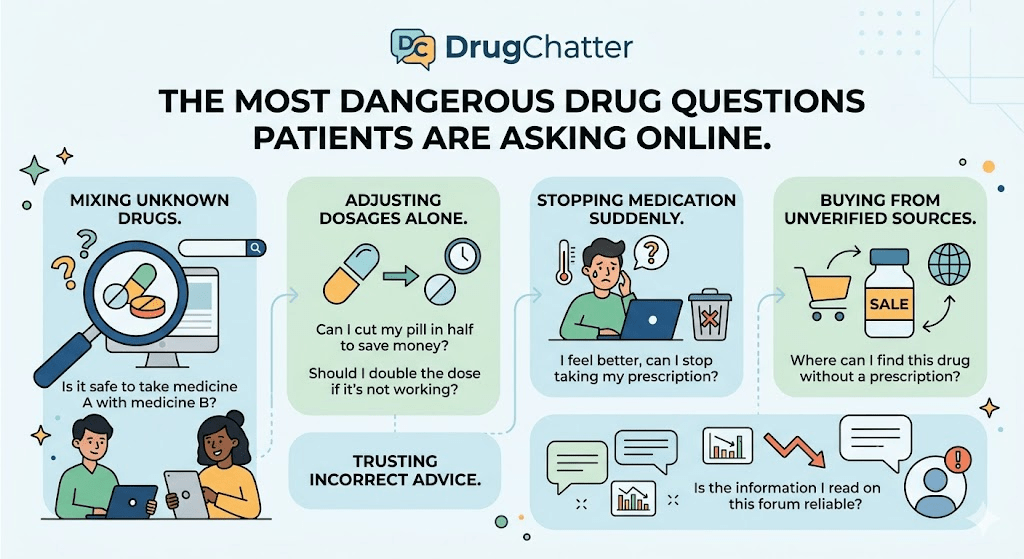
Patients aren’t just looking up side effects anymore—they’re making real-time treatment decisions based on fragmented, crowd-sourced advice. A review of DrugChatter queries reveals a pattern: the most “dangerous” questions aren’t fringe—they’re common, recurring, and often deceptively simple.
Below is a curated set of high-risk questions where misunderstanding—or acting without clinical guidance—could lead to serious harm.
1. Immunosuppression + Vaccines: A Timing Problem With Consequences
Patients on biologics like Cosentyx are repeatedly asking:
- How long should I wait after Cosentyx for a live flu vaccine?
- What’s the recommended gap between Cosentyx and a flu shot?
- Does the COVID vaccine interact with Cosentyx?
Why it’s dangerous:
Live vaccines in immunosuppressed patients can cause infection instead of protection. Timing isn’t a convenience issue—it’s a safety threshold.
2. Stacking Immunosuppressants
Combination therapy questions are frequent:
Why it’s dangerous:
Layering immune-modulating drugs increases infection risk, malignancy concerns, and unpredictable immune suppression.
3. Blood Pressure Collapse Risk
With heart failure drugs like Entresto:
Why it’s dangerous:
Hypotension and renal impairment are not minor side effects—they can escalate to hospitalization if not monitored.
4. Hidden Bleeding Risks: OTC + Prescription
Patients frequently underestimate OTC risk:
- Can aspirin be taken with Aleve?
- Is it safe to take Advil and aspirin together
- How much Advil is safe with Xarelto?
Why it’s dangerous:
Stacking NSAIDs or combining with anticoagulants amplifies bleeding risk—often silently until a serious event occurs.
5. Statins + Anticoagulants: A Narrow Therapeutic Window
For Lipitor:
- Lipitor and warfarin dosage concerns?
- Are there increased risks in combining Lipitor and warfarin?
- Can Lipitor use lead to higher bleeding risk with blood thinners?
Why it’s dangerous:
Even modest pharmacokinetic interactions can destabilize INR control, increasing stroke or hemorrhage risk.
6. Food–Drug Interactions Patients Dismiss
Still among the most misunderstood:
Why it’s dangerous:
Grapefruit inhibits CYP3A4, raising statin levels and increasing risk of muscle toxicity and liver injury.
7. Alcohol + CNS or Pain Medications
Recurring with Lyrica and NSAIDs:
- Can Lyrica’s side effects be worsened by alcohol consumption?
- Are there any risks with mixing alcohol and Advil?
Why it’s dangerous:
Sedation, respiratory depression, and GI bleeding risk all increase—especially in combination.
8. Organ Toxicity Signals Patients Ignore
Examples span multiple drug classes:
- Can tigecycline impact liver function through specific enzymes?
- Can lacosamide cause liver damage over time?
- Did you experience liver problems with Lipitor?
Why it’s dangerous:
Liver injury is often asymptomatic until advanced. Online reassurance can delay necessary monitoring.
9. Pregnancy, Breastfeeding, and Biologics
High-stakes uncertainty:
Why it’s dangerous:
Data is often limited, and risk tolerance is low—missteps can affect both mother and child.
10. “Natural” Doesn’t Mean Safe
Patients frequently assume supplements are benign:
- Can garlic supplements reduce Lipitor’s potency?
- Can I take herbal supplements while on Cosentyx?
- Are there any risks combining Lipitor and natural remedies?
Why it’s dangerous:
Supplements can alter metabolism, amplify toxicity, or blunt efficacy—without standardized dosing or oversight.
The Pattern Behind the Risk
Across hundreds of questions, three themes dominate:
- Stacking therapies without understanding interaction cascades
- Undervaluing OTC and “natural” products
- Misjudging timing (vaccines, dosing gaps, onset expectations)
These aren’t edge cases—they’re mainstream patient behaviors.
Bottom Line
The most dangerous drug questions aren’t about rare side effects—they’re about everyday decisions made without full context.
DrugChatter surfaces these questions early. The risk isn’t that patients are asking them—it’s that they may act on incomplete answers.
If you want, I can tighten this into a Bloomberg-style ultra-concise version or expand it into a full 2,000+ word SEO piece with structured clusters (statins, biologics, anticoagulants).