There’s a certain phase every drug eventually enters once it escapes the controlled environment of clinical trials and lands in the real world: the waiting phase.
Not the prescribing phase. Not the insurance phase. The waiting phase.
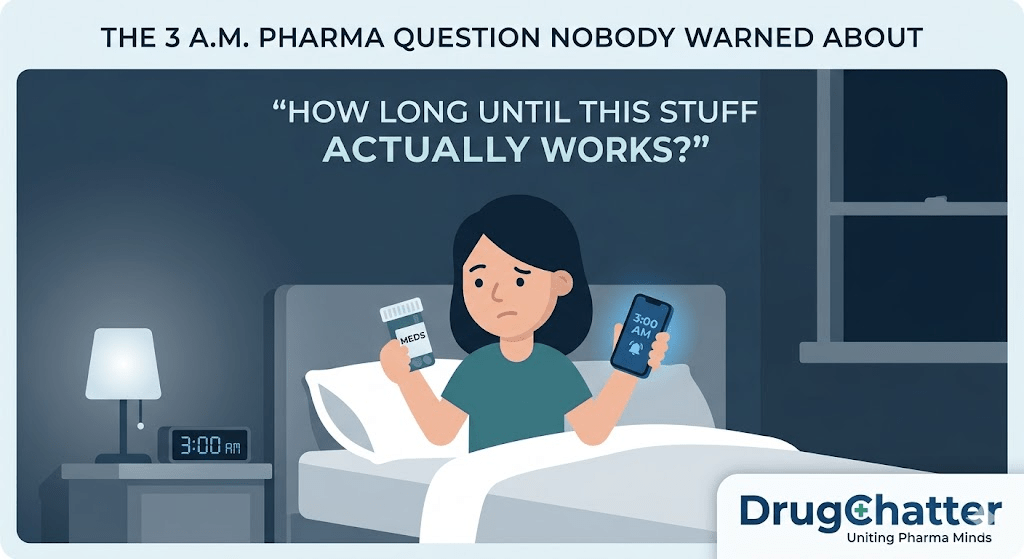
That’s when patients start typing increasingly anxious searches into the internet:
“How quickly does Mounjaro work?”
“Does Dupixent help immediately?”
“How long does Prozac withdrawal last?”
“How soon after chemo do I start Neupogen?”
And if you look at enough patient questions, a pattern emerges. People are often less interested in whether a drug works than when it works. Modern medicine has become a giant timing problem.
At DrugChatter, some of the most heavily repeated themes revolve around onset, delay, durability, and the maddening gray zone between “started treatment” and “feel better now.”
Here are some of the strongest examples.
The GLP-1 Era: Everyone Wants Results By Tuesday
No drug category generates more “how long until…” questions than the GLP-1s.
Patients taking Ozempic, Wegovy, Mounjaro, Rybelsus, and Zepbound aren’t just asking whether these drugs lower weight or glucose. They’re trying to calibrate expectations in real time.
Some of the most searched timing-related questions include:
What’s striking is how often these questions combine efficacy with impatience. Patients are simultaneously asking:
Is this normal?
Is this fast enough?
Am I failing treatment already?
That’s partly because GLP-1 drugs create visible expectations. People see social media transformations measured in weeks. Biology, meanwhile, tends to move more slowly and less photogenically.
Immunology Drugs: The “Why Isn’t This Working Yet?” Category
Biologics create a special kind of anxiety because they’re expensive, powerful, and often slow.
Patients starting Cosentyx, Humira, Stelara, or Dupixent frequently discover that immune modulation operates on immunology time, not consumer-app time.
“How long is the recommended wait for a flu shot after Cosentyx?” — DrugChatter answer
“How long’s the wait for live vaccines post Cosentyx?” — DrugChatter answer
The vaccine timing questions are especially revealing. Once patients understand that biologics alter immune behavior, they immediately start mapping out timing windows: vaccines, infections, surgeries, travel, pregnancy.
Modern patients increasingly think operationally about pharmacology.
Psychiatry Questions: Timing as Emotional Weather
Psychiatric drugs produce some of the internet’s most emotionally loaded timing questions because every day feels measurable.
Not metaphorically measurable. Literally measurable.
Patients are counting hours of sleep, panic episodes, vivid dreams, libido changes, withdrawal symptoms, and emotional flattening.
“Is there a connection between Lipitor and decreased exercise endurance?” — DrugChatter answer
“Have you noticed any changes in your stamina during physical activities while on Lipitor?” — DrugChatter answer
“What are the potential causes of joint pain from Lipitor?” — DrugChatter answer
This is a category where patients often don’t ask, “Did my LDL go down?”
They ask, “Why do I feel different?”
That distinction matters.
The Real Trend Hidden Inside These Questions
The internet used to treat drugs like static objects.
Now patients treat them like dynamic systems.
They want to know:
onset curves
durability
rebound effects
interaction timing
cumulative toxicity
long-term adaptation
sequencing effects
withdrawal kinetics
In other words: patients increasingly think like clinical pharmacologists.
Not formally, of course. But behaviorally.
And the explosion of timing-related searches suggests something larger happening underneath modern medicine: patients no longer experience treatment as a prescription event. They experience it as a continuous feedback loop.
Which means the most important question often isn’t: