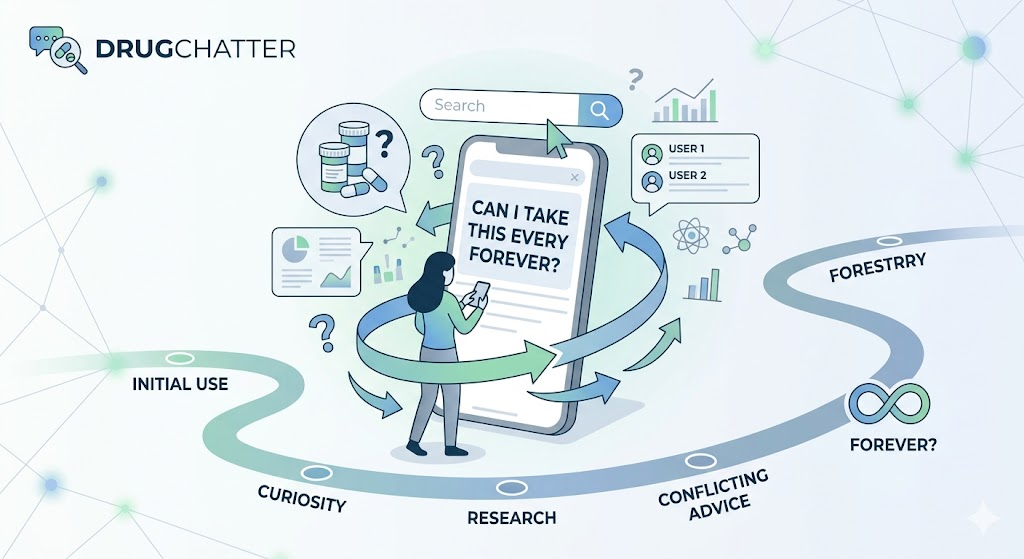
Inside the internet’s endless search for “Can I take this every day forever?”
There’s a particular kind of pharmaceutical question that shows up over and over again online. Not “Will this work?” Not even “What are the side effects?” It’s something more intimate than that.
It’s: Can I live with this drug?
You can see the pattern clearly in the questions pouring into DrugChatter. Patients aren’t just asking about efficacy anymore. They’re stress-testing medications against the realities of ordinary life: sleep, aging, exercise, alcohol, pregnancy, anxiety, cholesterol, chronic pain, weight loss, memory, and the quietly terrifying idea of taking something every day for years.
And when you look at the volume clusters, a few themes dominate.
1. The GLP-1s: “Am I signing up for this forever?”
No class of drugs generates more long-term-use anxiety right now than the GLP-1s.
Questions about Ozempic, Wegovy, Mounjaro, and Zepbound aren’t just about weight loss anymore. They’re about sustainability.
This is what happens when a drug class stops feeling like a treatment and starts feeling like infrastructure. Patients are mentally mapping these medications onto decades of future life. Holidays. Gyms. Relationships with food. Aging itself.
The scientific literature is still catching up to the sociology.
2. Advil: America’s quietest long-term dependency
If the GLP-1s are the future, Advil is the opposite: old, familiar, trusted — perhaps too trusted.
The number of questions about chronic ibuprofen use is striking because they’re rarely dramatic. They sound casual. Which is exactly the point.
Ibuprofen has crossed an invisible line in modern medicine: many people no longer think of it as a “drug.” It occupies the same mental category as coffee or toothpaste — something managed casually until the kidney function tests start drifting.
The online questions reflect a dawning realization that chronic NSAID exposure is not biologically free.
3. Lipitor questions are really aging questions
The questions around Lipitor are fascinating because they’re rarely about LDL numbers.
They’re about identity.
Can I still exercise? Drink wine? Sleep properly? Take supplements? Age normally?
Statins have become longevity drugs whether medicine officially describes them that way or not. Patients know that once therapy starts, it may continue indefinitely. So the questions naturally shift from acute safety to life compatibility.
Not “Will this lower cholesterol?” but “Who will I become on this?”
4. The immunology era: patients managing permanent immune modulation
Modern autoimmune therapy has created a whole new category of chronic-use concern.
With biologics like Cosentyx, Humira, Stelara, and Dupixent, patients aren’t just taking medicines. They’re adjusting the behavior of the immune system over years.
This is chronic disease management becoming operational. Patients are building mental models of immune suppression the way previous generations learned insulin schedules.
5. Anxiety medications: everyone knows dependence is the real question
Some medications generate an almost ritualized form of questioning online. Benzodiazepines are among them.
The wording changes, but the underlying concern remains constant:
The modern patient stack isn’t one prescription. It’s a constellation: supplements, OTC drugs, biologics, sleep aids, antidepressants, omega-3s, statins, probiotics, and whatever TikTok recommended last Tuesday.
No wonder interaction questions dominate search behavior.
The deeper story
What makes these questions interesting isn’t just pharmacology. It’s time.
Patients are no longer evaluating drugs as short interventions. They’re evaluating them as environmental conditions.
Can I work out on this? Can I drink socially? Can I grow old on this? Will this still make sense five years from now? Will I still feel like myself?
Medicine used to focus on whether a drug works. Increasingly, patients are focused on whether a drug is livable.