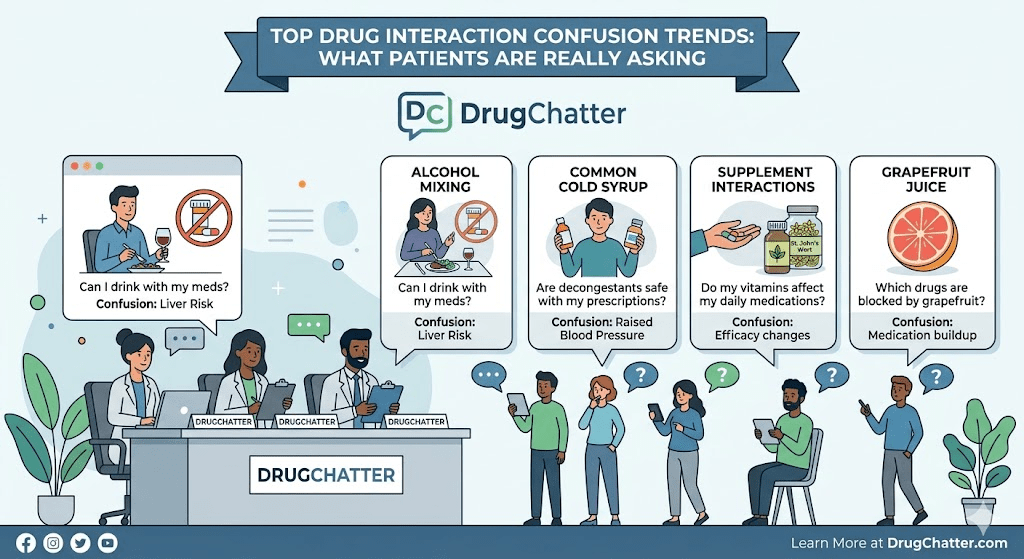
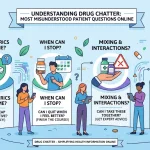
A scan of hundreds of real-world questions on DrugChatter reveals a consistent pattern: patients are not just asking what a drug does—they’re trying to understand how it behaves in the messy reality of daily life. Food, supplements, vaccines, alcohol, exercise, and polypharmacy are where confusion peaks.
Below is a structured look at the dominant interaction confusion trends, with direct links to representative patient questions and answers.
1) Statins + Everything: The Lipitor Interaction Economy
No drug in this dataset generates more interaction uncertainty than Lipitor. The confusion spans three main categories:
Food & Beverage Interactions
Patients consistently overestimate or misinterpret dietary risks:
Trend: Patients blur the line between pharmacokinetic interactions (e.g., CYP3A4 inhibition) and general dietary advice.
Supplements & “Natural” Products
A major gray zone:
Trend: “Natural” is perceived as both safer and unpredictably interactive.
Polypharmacy Risks
Classic but still misunderstood:
Trend: Patients recognize that interactions exist, but not which ones matter clinically.
2) Immunomodulators + Vaccines: Timing Anxiety Around Cosentyx
Biologics introduce a different kind of uncertainty—timing and immune response.
Vaccine Timing & Safety
Immune System Concerns
Trend: Patients are trying to reconcile immunosuppression with preventive care, often without clear guidance on timing windows.
3) Blood Thinners + OTC Drugs: Persistent Risk Blind Spots
The combination of common OTCs and anticoagulants remains a major source of confusion.
NSAIDs + Antiplatelets
Additive Bleeding Risk
Trend: Patients underestimate additive risk when combining “common” medications.
4) Cardiometabolic Stack Confusion: Vascepa, Entresto, and Beyond
As combination therapy becomes standard, patients struggle with overlapping effects.
Lipid + Cardiovascular Combinations
Blood Pressure & Kidney Effects
Trend: Patients lack a framework for understanding mechanism overlap versus true interaction risk.
5) Alcohol + CNS or Chronic Meds: Behavioral Interactions
Alcohol remains a wildcard across multiple drug classes:
Trend: Patients are asking about real-life behavior scenarios, not just clinical contraindications.
6) Oncology & Specialty Drug Interactions: Mechanism-Level Curiosity
A smaller but more technically sophisticated cluster:
- Azacitidine altering ruxolitinib toxicity
- Tigecycline enzyme interactions
- Lurbinectedin delayed side effects
Trend: These users are probing mechanistic pharmacology, often beyond typical patient education materials.
7) Timing, Spacing, and Sequencing: The Hidden Layer
Across all categories, one meta-pattern stands out: patients want to know when, not just whether.
Trend: Interaction anxiety is often about temporal control—patients believe timing can mitigate risk, but lack clear rules.
Bottom Line
Drug interaction confusion is not random—it clusters around predictable fault lines:
- Everyday context (food, alcohol, supplements)
- Polypharmacy stacking
- Immune modulation + vaccines
- Timing and sequencing uncertainty
The implication is clear: traditional drug labeling and physician counseling are not addressing the situational complexity patients face.
DrugChatter’s data shows that patients are building their own mental models of interactions—often incomplete, sometimes incorrect, but consistently pragmatic.
That gap is where the next generation of patient education—and decision support—will be won.