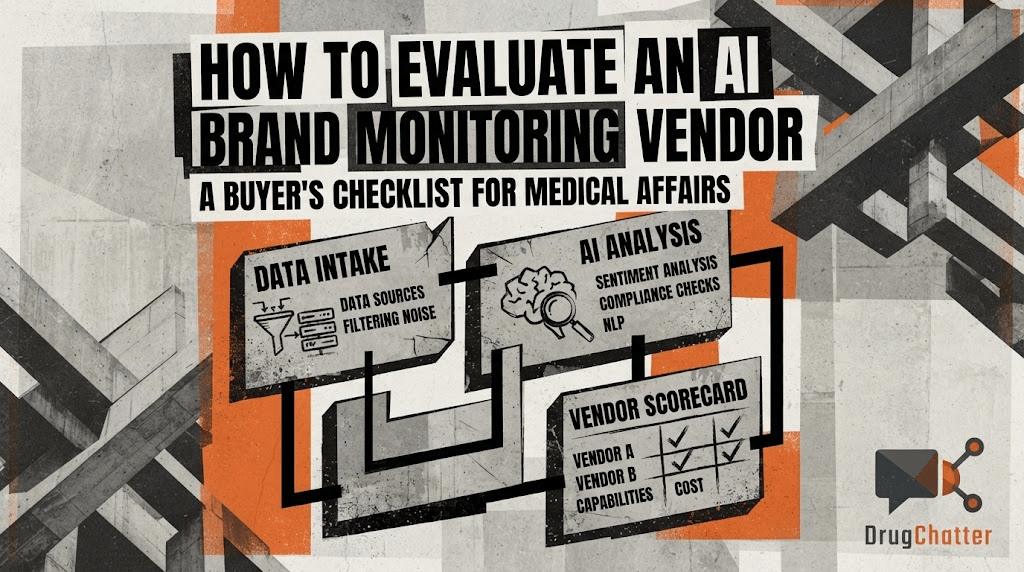
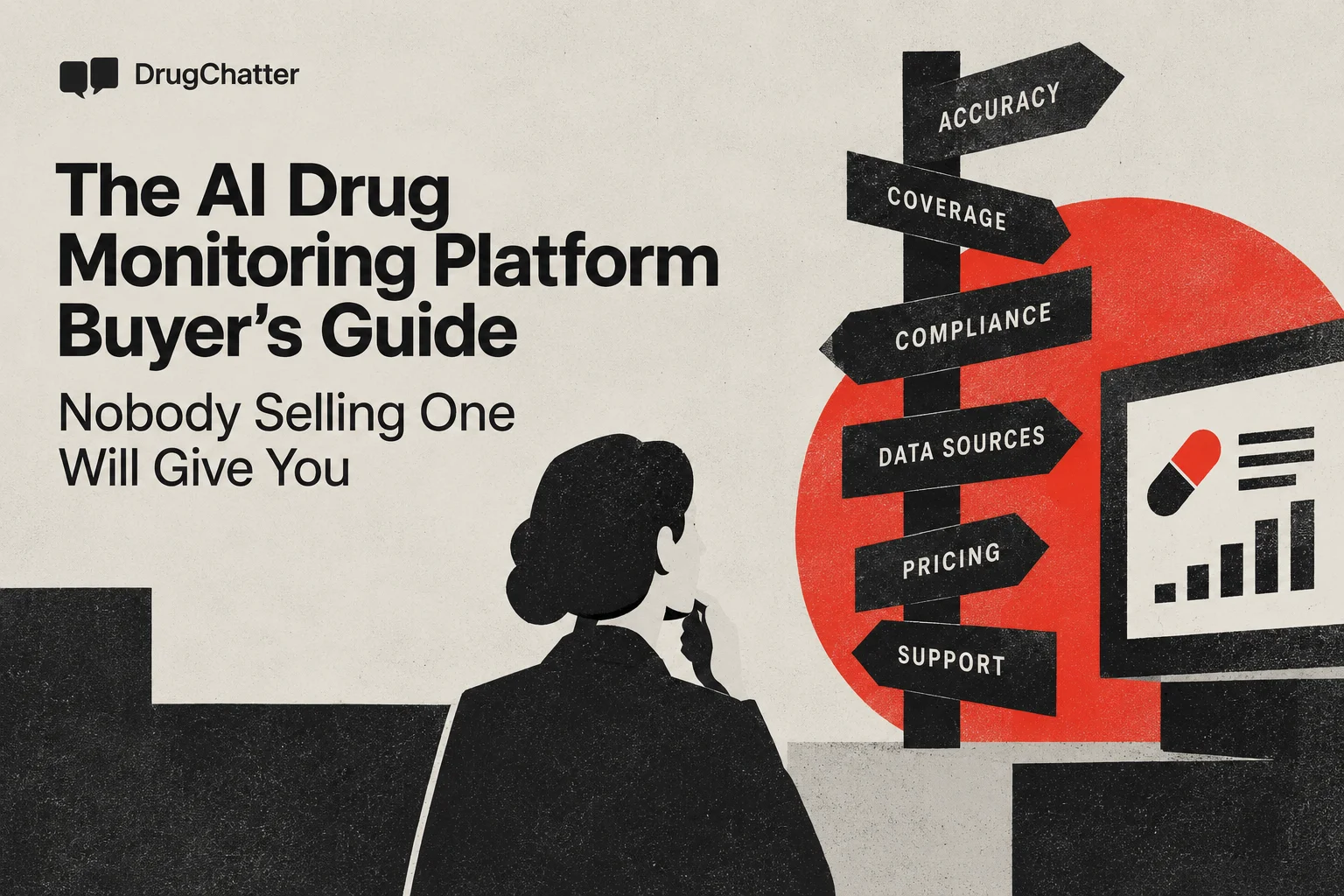
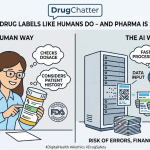
The short answer: An AI brand monitoring RFP for a pharma organization needs to test a vendor on eight things: which AI engines it actually queries, how it classifies a mention versus a citation versus a discrepancy, how often it refreshes results, whether it can show the raw prompt and response behind every data point, what format Legal and Regulatory can act on, how it calculates share of voice, what security certifications it holds, and what it does with categories it wasn’t built for, like label alignment. None of the four platforms referenced in this article is being recommended over the others. They are used here as illustrations of feature categories, so a Medical Affairs, Regulatory, or Competitive Intelligence team can turn this checklist into a scored RFP without starting from a blank page.
Why Medical Affairs Is Writing RFPs for AI Monitoring Now
Two changes made this a procurement category instead of a marketing nice-to-have. First, physician use of AI in clinical practice more than doubled in three years. The American Medical Association’s 2026 Physician Survey on Augmented Intelligence, based on 1,692 respondents surveyed in January and February 2026, found that 81% of physicians now use AI professionally, up from 38% in 2023 [1]. Summarizing medical research and standards of care was the fastest-growing use case, rising to 39% of physicians in 2026 [1]. Patients are asking the same tools about drugs before they ask a prescriber.
Second, regulators have started writing AI into the rulebook. On January 14, 2026, the FDA’s Center for Drug Evaluation and Research and Center for Biologics Evaluation and Research, working with the European Medicines Agency, published ten Guiding Principles of Good AI Practice in Drug Development [2]. The principles cover data governance and documentation, risk-based performance assessment, and life-cycle management of AI systems used to generate or analyze evidence across the drug product life cycle [2]. They are not chatbot-specific and they are not a monitoring mandate. But they establish that regulators expect AI-related risk to be tracked with the same documentation discipline as any other quality system, and that expectation extends to how a company knows what AI systems are telling patients and prescribers about its products.
LLM Visibility Is a Different Discipline Than Social Listening or Pharmacovigilance Monitoring
Traditional social listening tracks what people say about a brand. Pharmacovigilance monitoring tracks adverse event signals in that same content. AI brand monitoring, sometimes called Generative Engine Optimization (GEO) or Answer Engine Optimization (AEO) monitoring, tracks something different: what a language model says when a person asks it a question about a brand. The distinction matters procurementally, because a vendor built for social listening or PV signal detection is not automatically equipped to sample ChatGPT, Gemini, Claude, and Perplexity on a schedule and classify what comes back against a current FDA label.
Who Should Own the Buying Decision
In practice, the RFP usually gets built by whichever function feels the pain first, which is often Brand Marketing or Competitive Intelligence chasing share-of-voice data. But the requirements in this checklist assume Medical Affairs, Regulatory Affairs, Pharmacovigilance, and Legal all have a seat, because the same tool that tracks competitive mentions is the tool that will surface a hallucinated contraindication or an off-label claim an AI model invented on its own.
The Eight-Criteria Framework, at a Glance
Criterion
What it tests
Who cares most
Model and engine coverage
Which AI platforms are actually sampled, and how
Brand, Competitive Intelligence
Classification methodology
How a “mention” becomes a scored, categorized data point
Medical Affairs, Regulatory
Hallucination and accuracy detection
Whether findings are checked against the current label or guideline
Medical Affairs, PV
Refresh cadence
How often, and how reproducibly, prompts are re-run
Brand, Digital
Data provenance
Whether every score traces back to a raw prompt, response, and timestamp
Regulatory, Legal
Export formats and workflow
What Legal and Regulatory can actually do with a finding
Legal, Regulatory
Share of voice methodology
How competitive presence is defined and calculated
Brand, Market Access
Security and data handling
Where prompts and responses live, and under what certifications
IT, Procurement, Legal
Criterion 1: Model and Engine Coverage
The first RFP question is the simplest and the most commonly glossed over in a sales demo: which AI systems does the platform actually query, and how. Coverage claims vary widely across the category. AthenaHQ, for example, publicly lists tracking across eight large language models simultaneously, including ChatGPT, Perplexity, Google AI Overviews, Google AI Mode, Gemini, Claude, Copilot, and Grok [3]. Authoritas positions itself around a narrower but deeper combination, tracking brand and competitor presence inside ChatGPT, Perplexity, Gemini, and Claude alongside classical search-engine rank data in one dashboard [4]. Mentionova covers up to six engines, including ChatGPT, Perplexity, Claude, Gemini, Google AI Overviews, and Reddit, with the number of engines available depending on plan tier [5].
None of that tells a buyer how the sampling actually happens, which is the more important question.
Consumer Interface Versus API Sampling
A vendor that queries a model’s public consumer interface is seeing something closer to what an average patient or physician would see, including any web-search grounding, personalization, or regional variation the consumer product applies. A vendor that queries the underlying API is often seeing a cleaner, more reproducible signal, but one that can diverge from what the public-facing chatbot actually returns. Ask which method the vendor uses for each engine, because some platforms use different methods for different models depending on what each vendor’s terms of service and technical access allow.
Regional and Language Coverage
A drug’s label, indication, and even brand name can differ by country. If the organization operates across multiple regulatory jurisdictions, the RFP should ask whether monitoring can be geo-fenced or language-specific, and whether the vendor accounts for the fact that the same prompt can return different answers depending on the assumed location of the user.
RFP Question Set: Model and Engine Coverage
List every AI engine tracked today, and the method (consumer interface, API, or both) used for each.
How often is engine coverage added or removed, and how are customers notified?
Can prompts be run against a specific country, language, or regional version of a model?
What happens to historical data and trend lines when an engine’s underlying model version changes?
Criterion 2: Classification Methodology
“We track mentions” is not a methodology. A useful vendor should be able to explain, in writing, how it distinguishes at minimum four different things: a brand mention, a citation of a specific source, a recommendation or comparative ranking, and a sentiment classification. This matters more in pharma than in most categories, because a mention with an incorrect dosing statement and a mention with a warm sentiment score are not the same finding, and a dashboard that collapses both into a single “visibility” number hides the one a Medical Affairs team actually needs to see.
An Original Taxonomy: Four Tiers of AI Monitoring Findings
For RFP scoring purposes, it helps to require vendors to map their own classification scheme onto a common structure. One useful four-tier framework:
Tier 1, Presence: the brand or drug name appears in the response at all.
Tier 2, Attribution: the response cites a specific source, and that source can be identified and checked.
Tier 3, Characterization: the response makes a factual claim about the drug, such as an indication, a dosing range, or a safety statement, that can be checked against the current label or clinical evidence.
Tier 4, Discrepancy severity: where a Tier 3 claim diverges from the label or evidence, the divergence is classified by severity, for example a missing boxed warning versus a stale but not dangerous dosing note.
A vendor that can only speak to Tier 1 and Tier 2 is a visibility tool. A vendor that reaches Tier 3 and Tier 4 with a documented severity scale is a monitoring tool that Medical Affairs and Pharmacovigilance can actually build a workflow around.
Human Review Versus Fully Automated Classification
Ask directly whether classification is fully automated, automated with human spot-checking, or automated with mandatory human review before a finding is surfaced as high-severity. Fully automated classification scales cheaply but can itself hallucinate a discrepancy that isn’t real. A workflow-first platform such as Mentionova, for instance, publicly describes its Reddit engagement feature as generating a draft response that a human on the customer’s team must approve or skip before anything posts [6], which is the kind of human-in-the-loop control an RFP should be asking about for the classification step generally, not only for content that gets published back out.
RFP Question Set: Classification Methodology
Provide a written definition of every classification category the platform uses (mention, citation, recommendation, sentiment, discrepancy, or equivalent).
Does classification reach the level of a specific factual claim (dosing, indication, safety), or does it stop at mention and sentiment?
Is there a documented severity scale for discrepancies, and can we see a sample?
What percentage of classifications involve human review before being reported, and at what severity threshold?
Criterion 3: AI Hallucination and Accuracy Detection Criteria
The case for this category rests on published evidence, not assumption. In a study presented at the American Society of Health-System Pharmacists’ 2023 Midyear Clinical Meeting, researchers from Long Island University’s College of Pharmacy asked the free, public version of ChatGPT 39 real medication questions previously submitted to the university’s drug information service, then compared the answers against pharmacist-reviewed benchmark responses [7].
Of the 39 questions, ChatGPT’s answers were judged satisfactory for only 10. Where the model provided references at all, in eight of its responses, every one of those references was fabricated [7].
That finding is nearly three years old and reflects an early, freely available model, not the current generation of AI systems patients now use, so it should not be read as a current accuracy rate. But a separate, more recent study of hospital pharmacists’ real-world drug information questions found a similar pattern in kind, if not exact magnitude: full accuracy in roughly a quarter of responses, partial accuracy or partial error in about a third, and complete inaccuracy in about a fifth, with reproducibility poor enough that regenerating the same question produced a consistent answer only about 10% of the time [8]. The reproducibility finding is arguably the more operationally important one for a monitoring vendor to address, because it means a single spot-check of an AI answer proves very little; only repeated sampling over time reveals whether an error is a one-off or a pattern.
What “Verified Against the Label” Should Actually Mean
Ask a vendor exactly which document it checks a claim against, and how current that document is. Verifying against a general web search result is not the same as verifying against the current FDA-approved prescribing information, and a platform that cannot name its reference source for a given drug should not be scored highly on this criterion. Goodie, a comparable pharma-focused AI visibility platform, positions its own accuracy work around tracking how AI describes branded treatments, approved indications, and safety profiles against what it calls authoritative sources, which is the right framing for an RFP answer, whatever vendor is providing it [9].
Source Documentation the Vendor Should Be Able to Produce
For any discrepancy flagged as high severity, the vendor should be able to produce: the exact prompt used, the full raw response, the model and version queried, the timestamp, and the specific label section or clinical source the claim was checked against. If a vendor can only produce a dashboard score without that underlying chain, the finding is not yet usable by Regulatory or Legal.
RFP Question Set: Hallucination and Accuracy Detection
What specific document or database is a factual claim checked against (current label, a named clinical guideline, a specific database), and how is that reference source kept current?
How does the platform handle drugs with recent label changes, where a stale reference document would produce a false negative?
Can the vendor produce the full evidence chain (prompt, response, model version, timestamp, reference source) for any flagged discrepancy on request?
How does the platform account for AI response non-determinism, where the same prompt can return a different answer on a second run?
Criterion 4: Refresh Cadence and Monitoring Frequency
Because AI systems are non-deterministic, a brand can appear in one response and not the next, seconds apart, for the exact same prompt. That means monitoring frequency is not just a convenience setting, it is a measurement-validity issue. A platform that samples a prompt once a week and reports a single score is measuring one draw from a distribution, not a stable state. Vendors in this category advertise a range of cadences: Mentionova lists configurable refresh cycles as fast as every two hours [10], while more general-purpose platforms often default to daily or weekly cycles depending on plan tier [3].
Prompt Volume and Sample Size
Refresh frequency and prompt volume are related but separate questions. A platform running 50 prompts daily is sampling more of the answer space than one running 50 prompts weekly, even at the same refresh cadence, if it varies phrasing. Ask how many distinct prompt variants are run per brand per category, and whether the vendor generates those variants automatically from real buyer-language patterns or requires the customer to write them manually.
RFP Question Set: Refresh Cadence
What is the minimum and maximum refresh interval available, and at what plan tier does each apply?
How many distinct prompt variants are run per tracked brand or drug, and how are they generated?
How does the platform distinguish a genuine trend from single-run noise, given AI response variability?
Is there a rate at which we can request an on-demand, immediate re-run outside the standard schedule, for example after a label change or safety communication?
Criterion 5: Data Provenance and Auditability
This is the criterion most likely to separate a marketing-oriented visibility tool from something Regulatory Affairs or Legal can rely on. A pharma organization needs to be able to show, if ever asked, exactly what an AI system said about its product on a given date, in response to a specific question, and how that was verified.
What “Show Your Work” Means in Practice
At minimum, ask whether the platform retains and can export, for any data point on a dashboard: the literal prompt text, the full unedited response, the model name and version, the date and time queried, and the geographic or account context used. A vendor that only retains an aggregated score, discarding the underlying prompt-response pairs after some retention window, cannot support a regulatory inquiry or a legal hold months later.
Independent Verification of Methodology
Some vendors describe technical measures meant to reduce the risk of the monitoring data itself being unreliable. AthenaHQ, for example, publicly describes using techniques intended to simulate real user sessions rather than relying solely on simple API calls, positioned as a way to reduce the risk of what the industry sometimes calls hallucinated monitoring data, meaning data that doesn’t reflect what a real user session would actually return [11]. Whether or not that specific approach fits a given buyer’s needs, the RFP should ask every vendor the same underlying question: how do you know your own monitoring data reflects reality, and can you show your methodology to an outside auditor?
RFP Question Set: Data Provenance
For any dashboard metric, can we drill down to the exact prompt and response that produced it?
What is the data retention period for raw prompt-response pairs, and can it be extended for legal hold purposes?
Has the platform’s monitoring methodology been reviewed or validated by an independent third party, and can documentation be shared under NDA?
In the event of a discrepancy between what the dashboard reports and what we independently observe by querying the same model ourselves, what is the vendor’s process for investigating and resolving it?
Criterion 6: Export Formats and Workflow Handoffs to Legal and Regulatory
A finding that lives only inside a proprietary dashboard is not yet actionable for a compliance function. Legal and Regulatory teams typically need three things a pure marketing dashboard was not built to provide: a static, timestamped record suitable for a file, a format their existing systems can ingest, and a workflow that routes a high-severity finding to the right reviewer without someone having to notice it on a dashboard first.
What “Export” Should Actually Include
A CSV of scores is not sufficient on its own. The export should be able to include the full evidence chain described under Criterion 5, in a format that can be attached to an MLR (Medical, Legal, Regulatory) review record or a pharmacovigilance case file without manual reformatting. Ask whether exports are available as PDF (for a static, presentable record), CSV or API (for ingestion into an existing business intelligence or case management system), and whether the API supports the specific fields Legal and Regulatory would need, not just the fields Marketing dashboards typically expose.
RFP Question Set: Exports and Workflow
What export formats are available (PDF, CSV, API), and does each include the full prompt-response evidence chain or only summary scores?
Can a finding be automatically routed to a named reviewer or distribution list based on severity or category, without requiring someone to check a dashboard?
Does the platform integrate with, or export in a format compatible with, our existing MLR review system and PV case management system?
Who at the vendor can serve as a point of contact if a finding needs to be discussed with our Legal or Regulatory team directly, on short notice?
Criterion 7: Share of Voice and Competitive Benchmarking
Share of voice sounds like a single, comparable metric across vendors. It isn’t. Different platforms define the denominator differently, and a pharma buyer needs to understand which definition a vendor is using before comparing numbers across tools or over time.
Branded Versus Unbranded Query Flows
Authoritas is a useful illustration of one methodological approach: it separates queries into navigational, branded searches, where a user is already asking about a specific product by name, and informational, unbranded searches, where a user is asking a category-level question and the AI system chooses which brands to surface on its own [12]. Those two flows produce very different share-of-voice numbers and require different remediation strategies. A brand that dominates its own branded queries but disappears entirely from unbranded, category-level questions has a real visibility problem that a single blended score would hide.
Defining “Competitor” in a Therapeutic Category
In pharma, competitive share of voice can be sliced by exact brand name, by molecule or mechanism of action, or by therapeutic class, and each slice answers a different question. A GLP-1 brand competing against other named GLP-1 products is a different competitive set than the same brand competing against every weight-management option an AI system might mention, including non-pharmacological ones. Ask the vendor how it lets a customer define a competitive set, and whether that definition can be customized per therapeutic area rather than applied as a single, generic default.
RFP Question Set: Share of Voice Methodology
How is share of voice calculated, and does the platform separate branded from unbranded query performance?
Can the competitive set be defined at the brand, molecule, mechanism, or therapeutic-class level, and customized per product?
How does the platform handle a competitive set that changes, for example when a generic or biosimilar enters a category?
Is historical share-of-voice data comparable over time, or does it reset or shift when the vendor changes its underlying methodology or model coverage?
Criterion 8: Security, Compliance, and Data Handling
Health-tech procurement carries security and compliance requirements most AI visibility vendors, built for retail or SaaS marketing teams, were not originally designed around. The RFP should treat this as a pass/fail gate before any of the other seven criteria are scored, not as a tiebreaker at the end.
Certifications to Ask About
As an illustration of what enterprise-grade security posture looks like in this category, AthenaHQ publicly lists SOC 2 Type II certification, GDPR compliance, NIST Cybersecurity Framework implementation, single sign-on, and role-based access controls among its enterprise features [3]. Whatever vendor a buyer evaluates, the RFP should ask for the equivalent list directly rather than assuming it, since certification status varies by vendor and can change.
Where Prompts and Responses Are Stored
Because the raw data behind this category of tool is a record of what an AI system said about a drug, including potentially sensitive competitive or safety-related content, ask specifically where that data is stored, for how long, whether it is used to train any of the vendor’s own models, and whether it is shared with the AI platforms being monitored (most legitimate vendors do not share it, but this should be confirmed contractually, not assumed).
RFP Question Set: Security and Compliance
What third-party security certifications does the vendor currently hold (SOC 2, ISO 27001, or equivalent), and can current audit reports be provided?
Where is customer data physically stored, and does the vendor support data residency requirements for specific jurisdictions?
Is any customer data, including monitored AI responses, used to train the vendor’s own models or shared with third parties?
What is the vendor’s incident notification timeline in the event of a data breach?
Feature Categories Currently on the Market
The four platforms below are used as illustrations of distinct feature categories a buyer is likely to encounter in an RFP process, based on each company’s own publicly listed features as of 2026. This is not a ranking, and inclusion or exclusion of any other vendor from this list is not a judgment on that vendor’s quality.
Up to 6 engines depending on plan tier (ChatGPT, Perplexity, Claude, Gemini, Google AI Overviews, Reddit) [5]
Automated daily brief with pre-drafted remediation content, and human-approved Reddit engagement [6][10]
DrugChatter
Pharma-specific monitoring built around label alignment
Multi-model chatmon query pipeline tracking brand and label-related responses across LLM vendors
Internal dashboards score AI-generated content against the current FDA label by category, alongside audience-specific weekly briefings (executive, medical affairs, pharmacovigilance, regulatory affairs, and others) built from the same underlying query data
Reading this table as a checklist rather than a scoreboard is the point. A general-purpose GEO platform will typically out-cover a pharma-specific tool on raw model count and enterprise security tooling, because it is built for a broader market with a bigger engineering budget behind those features. A pharma-specific tool will typically go deeper on the one thing a general-purpose platform usually can’t: checking a claim against the actual current FDA label rather than a general notion of brand sentiment. Depending on which of the eight criteria matter most to a given team, the right answer can be one platform, a combination, or a build against an existing SEO tool a company already owns.
Building the RFP: A Practical Scorecard
A simple weighted scorecard keeps a vendor evaluation from collapsing into “which sales demo looked best.” One approach: score each of the eight criteria from 0 to 3 (0 = not addressed, 1 = addressed with gaps, 2 = fully addressed, 3 = addressed with independent verification available), then apply a weight reflecting which function in the room cares most.
Criterion
Medical Affairs weight
Legal/Regulatory weight
Brand/Marketing weight
Model and engine coverage
Medium
Low
High
Classification methodology
High
High
Medium
Hallucination and accuracy detection
High
High
Low
Refresh cadence
Medium
Low
High
Data provenance
Medium
High
Low
Exports and workflow
Medium
High
Low
Share of voice methodology
Low
Low
High
Security and compliance
Medium
High
Medium
Running the same eight-question set past every vendor under evaluation, with every function’s weighting made explicit in advance, is what turns a set of sales demos into a defensible procurement decision, and it is what makes the resulting RFP document usable the next time the contract comes up for renewal, when engine coverage, pricing, and the competitive field will all likely have changed again.
What This Means for Medical Affairs
The classification methodology and hallucination-detection criteria matter more to Medical Affairs than any raw engine-count claim. A tool that tracks 8 models but cannot tell the difference between a brand mention and a factual claim about dosing is not a Medical Affairs tool, whatever else it does well. Insist on seeing the Tier 3 and Tier 4 classification output, not just the sales deck’s Tier 1 visibility chart, before signing.
What This Means for Pharmacovigilance
Refresh cadence and reproducibility are the PV-relevant criteria most likely to get underweighted in a marketing-led RFP process. A single flagged discrepancy from a one-time query is a data point, not a signal. Ask specifically how the platform distinguishes a persistent AI-generated safety misstatement from a one-off, non-reproducible response, since that distinction determines whether a finding warrants escalation at all.
What This Means for Regulatory Affairs and Legal
Data provenance and export format are the two criteria that most directly determine whether this tool’s output is usable outside the vendor’s own dashboard. Before signing a contract, request a sample export for a real or hypothetical finding and confirm, in writing, that Legal’s evidentiary and retention requirements can actually be met with what the platform produces today, not with a roadmap feature promised for a future release.
What This Means for Brand and Marketing Teams
Model coverage, refresh cadence, and share-of-voice methodology are the criteria brand teams will feel day to day. But a platform chosen purely on those three criteria, without the Medical Affairs and Legal criteria also passing, creates organizational risk: a tool built to chase competitive visibility scores is not the same tool that protects the organization when an AI system hallucinates a safety claim, and buying only the former can leave the latter gap unaddressed until it becomes a problem.
Key Takeaways
Physician use of AI in clinical practice reached 81% in the AMA’s 2026 survey, up from 38% in 2023, which is the underlying reason this has become a procurement category [1].
The FDA and EMA’s January 2026 joint AI principles are not a monitoring mandate, but they establish a documentation-discipline expectation that extends to how a company tracks AI-related risk to its products [2].
A 2023 ASHP-presented study found ChatGPT’s free public version answered only 10 of 39 real drug-information questions satisfactorily, and fabricated every citation it provided; a separate hospital-pharmacist study later found response reproducibility as low as 10% on repeated identical queries, which is why refresh cadence and repeated sampling matter more than a single accuracy snapshot [7][8].
Share of voice is not a standardized metric across vendors; branded-query performance and unbranded, category-level performance should be scored separately.
Data provenance, meaning the ability to produce the exact prompt, response, model version, and timestamp behind any finding, is the criterion most likely to separate a marketing visibility tool from something Regulatory and Legal can actually use.
No vendor evaluated here is being recommended over another; each represents a different category (general-purpose GEO, SEO-plus-AI-visibility, workflow-first remediation, and pharma-specific label alignment), and the right choice depends on which of the eight criteria matter most for a given organization.
FAQ
What is the difference between AI brand monitoring and traditional social media monitoring?
Traditional social listening tracks what people say about a brand across social platforms, forums, and news. AI brand monitoring tracks what a language model itself says when asked a question about a brand, which is a fundamentally different data source and requires different sampling, classification, and verification methods.
How many AI models should a monitoring platform cover?
There is no fixed number that fits every organization; coverage should match where the target audience actually goes. Publicly listed coverage in this category ranges from around six engines to eight [3][5], and the more important question is whether the sampling method for each engine (consumer interface versus API) matches what real users of that engine would actually see.
Can AI monitoring tools detect when an AI hallucinates a drug’s safety information?
Some can, if their classification methodology reaches the level of checking a specific factual claim against a current reference source, such as the FDA label. Many general-purpose visibility platforms stop at mention and sentiment tracking and do not reach this level, which is why the classification-methodology criterion in an RFP needs to be tested directly rather than assumed from a feature list.
How often should AI brand monitoring run for a pharma product?
Because AI responses are non-deterministic, a single weekly or monthly snapshot understates variability. Vendors in this category offer refresh cycles ranging from as often as every two hours to weekly, depending on plan tier [10]. The right cadence depends on how sensitive the category is to overnight change and how much internal capacity exists to act on findings.
What is “share of voice” in the context of AI-generated answers?
It is a measure of how often a brand appears, and how it is positioned, relative to competitors, when an AI system answers relevant questions. Methodologies differ across vendors, particularly in whether branded queries (where the user already names the product) and unbranded, category-level queries are measured and reported separately [12].
Do AI brand monitoring vendors need to be HIPAA compliant?
Monitoring what a public AI system says about a drug brand does not typically involve protected health information, so HIPAA compliance is not usually the relevant framework. The more relevant certifications to request are SOC 2, GDPR compliance if operating in the EU, and documented data-handling policies for the prompts and responses collected [3].
What should go in an RFP for an AI monitoring vendor besides pricing?
At minimum: model and engine coverage and sampling method, classification methodology down to the level of a specific factual claim, hallucination and accuracy detection process, refresh cadence, data provenance and exportability, share-of-voice methodology, and security certifications. Pricing should be evaluated last, once a vendor has cleared these functional gates.
Can one platform serve Medical Affairs, Brand, and Legal at the same time?
It depends on whether the platform’s classification methodology reaches the factual-claim level Medical Affairs and Legal need, not just the mention-and-sentiment level Brand teams often find sufficient on its own. A single tool can serve all three functions if it is evaluated against the full eight-criteria scorecard rather than against Brand’s requirements alone.
How is AI monitoring different from AI content optimization (sometimes called GEO)?
Monitoring measures what AI systems currently say. Content optimization or GEO work tries to change what they say by improving the underlying content those systems draw from. Some vendors, such as Mentionova, explicitly combine both in one workflow [6][10]; others, more narrowly focused on measurement, leave optimization to the customer’s own content team.
Is a lower-priced AI visibility tool ever the right choice over a pharma-specific one?
It can be, for organizations whose primary need is competitive share-of-voice tracking rather than label-alignment or safety-claim verification. The RFP scorecard in this article is designed to make that trade-off explicit and function-specific, rather than leaving it as an implicit assumption baked into whichever vendor sends the most polished sales deck.
This article discusses AI brand monitoring vendor evaluation criteria for informational purposes and does not constitute an endorsement of any named vendor. Feature descriptions reflect information those companies had publicly listed as of 2026 and are subject to change; buyers should confirm current features and pricing directly with each vendor.
References
American Medical Association. (2026, March 12). More than 80% of physicians use AI professionally: AMA survey. https://www.ama-assn.org/practice-management/digital-health/more-80-physicians-use-ai-professionally-ama-survey
U.S. Food and Drug Administration. (2026, January). Guiding Principles of Good AI Practice in Drug Development. https://www.fda.gov/about-fda/artificial-intelligence-drug-development/guiding-principles-good-ai-practice-drug-development
ecommerceguide.com. (2026). Authoritas: Complete AI Search + SEO Visibility Platform for Brands. https://ecommerceguide.com/apps/authoritas/
Mentionova. (2026). Top Knowatoa Alternatives for AI Visibility Monitoring in 2026. https://mentionova.com/blog/knowatoa-alternatives
Mentionova. (2026). Reddit Engagement for AI Citations. https://mentionova.com/product/reddit-engagement
HealthDay. (2023, December 12). ChatGPT Shows Poor Performance in Answering Drug-Related Questions. https://www.healthday.com/healthpro-news/general-health/chatgpt-shows-poor-performance-in-answering-drug-related-questions
PMC (National Library of Medicine). (2024). Study on ChatGPT accuracy and reproducibility for hospital pharmacist drug information questions. https://pmc.ncbi.nlm.nih.gov/articles/PMC11267013
Goodie. (2026). Explore Goodie for Pharma. https://higoodie.com/use-case/pharma/
Mentionova. (2026). AirOps Alternatives for AI Visibility Tracking and Workflows. https://mentionova.com/blog/airops-alternatives