ChatGPT now fields a healthcare question from roughly one in four of its more than 800 million weekly users, according to a report OpenAI released in January 2026. Nearly 40 million people used it to ask about their own health in a single four-week window at the end of 2025. Some of those questions are about symptoms. A large share are about drugs: what a medication does, whether it interacts with something else the patient is taking, whether a side effect is normal, whether a cheaper generic works the same way.
Most pharmaceutical brand and medical affairs teams have looked at this exactly once. Someone opened ChatGPT, typed in the brand name, read the answer, took a screenshot, and moved on. That single check tells you almost nothing, because the answer you read that day is not the answer a patient reads tomorrow.
This is a guide to doing it properly: what continuous AI monitoring for prescription drug information actually involves, why the one-time prompt test fails, and how Medical Affairs and Pharmacovigilance teams can build a workflow that catches a materially different answer before a regulator, a plaintiff’s attorney, or a patient forum finds it first.
Why a Single Prompt Test Tells You Almost Nothing
A prompt test is a snapshot. The problem is that the thing you’re photographing doesn’t hold still.
Large language models get updated on schedules the public doesn’t see. OpenAI, Google, and Anthropic ship new model versions, quietly adjust system prompts, and retrain on fresh data throughout the year. None of that requires a press release. A model can answer a drug interaction question correctly in March and answer the same question differently in July, not because anything about the drug changed, but because the model changed.
Search-grounded AI systems add a second layer of instability. Perplexity, Google’s AI Overviews, and ChatGPT’s browsing mode pull from live web sources at the moment of the query. If a patient forum post, a news article about a lawsuit, or a stale blog post gets crawled and cited, the answer shifts, sometimes for a few hours, sometimes for months, until the index refreshes again.
How Often Do LLM Answers About the Same Drug Actually Change?
Nobody has published a definitive number for how often a given drug’s AI answer changes week over week, because almost nobody is running the same query set repeatedly and archiving the results. That absence of data is itself the finding. The industry that depends most on stable, accurate information about its products has the least visibility into whether that information is stable.
What the academic literature does show is that accuracy varies by model version in ways that would surprise most brand teams. A 2025 study in the Journal of the American College of Clinical Pharmacy compared ChatGPT-3.5 and ChatGPT-4 against a standard drug information resource and found meaningful gaps in both accuracy and reproducibility between the two versions of the same product. A separate study published in the British Journal of Clinical Pharmacology in late 2024 tested ChatGPT-4o’s ability to flag drug-drug interactions in real hospitalized patient data and found it identified the most clinically relevant interaction reliably in some cases but not others. Neither study is an indictment of AI as a category. Both are evidence that the answer depends on which version you happened to query, and when.
Model and Version Drift You Can’t See From the Outside
A pharmacology-focused study published in late 2025 tested four models, ChatGPT-4o, ChatGPT-3.5, Gemini Advanced 2.0, and DeepSeek, against the same set of clinical pharmacology and drug interaction questions and found accuracy differed by model and by how the question was phrased. A November 2025 study on antiretroviral drug interactions tested a single model, ChatGPT-4o-mini, on 94 real interaction pairs and scored its answers against two clinical references. These are not fringe findings buried in obscure journals. They’re a steady stream of peer-reviewed evidence, published almost monthly through 2024 and 2025, that LLM answers about drugs move around based on model choice, model version, and even the language the question is asked in.
Why ChatGPT Gets Drug Side Effects Wrong Sometimes and Right Other Times
A Frontiers in Artificial Intelligence case study from March 2025 had pharmacists and pharmacy interns compare ChatGPT-generated patient instructions for three drugs, tirzepatide, citalopram, and apixaban, against a licensed clinical reference tool. The reviewers rated the ChatGPT reports as generally correct but incomplete, and flagged that the gaps had the potential to affect medication adherence. Correct but incomplete is a hard failure mode to catch with a single check, because the answer doesn’t read as wrong. It reads as fine. It just leaves out the detail that would have changed a patient’s behavior.
A study out of Nepal published in January 2025 found ChatGPT-4 reliably identified whether a drug interaction existed in a discharge prescription, but was far less reliable at predicting the severity or timing of that interaction. That distinction, between detecting a problem and correctly characterizing it, is exactly the kind of nuance a one-time spot check misses.
What Continuous AI Monitoring Actually Means
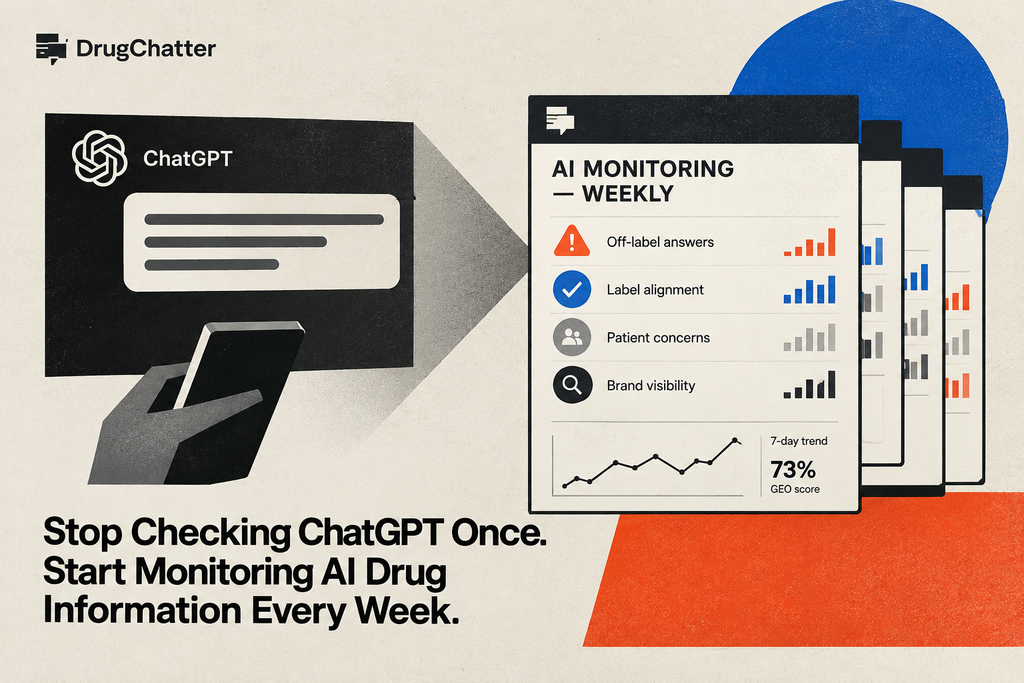
Continuous monitoring is not “check ChatGPT more often.” It’s a system with four parts: a recurring prompt set, model and version context attached to every response, an archive you can produce later, and a human reviewer who decides what matters. Drop any one of the four and the system stops being defensible.
Recurring Prompts: Building a Query Set That Reflects Real Searches
Start from what patients and physicians actually type, not what your brand team wishes they typed. That means pulling from real search query data, patient forum language, and the fan-out of related questions a person asks after the first one: dosing, interactions, generic alternatives, off-label use, cost, side effects specific to a comorbidity. A monitoring program that only tests “what is [brand name]” misses almost everything that matters, because that’s not the query where hallucination risk concentrates. The risk concentrates in the second and third follow-up question, where the model has less structured data to draw from and starts filling gaps.
Model and Version Context: Why “ChatGPT Said X” Isn’t Enough
Every archived response needs to record which model, which version, which date, and whether the system was browsing the live web or answering from its training data alone. “ChatGPT said our drug causes X” is not an actionable finding. “GPT-4o, browsing enabled, cited a 2021 forum post, on this date” is. The second version tells you whether the fix is a prompt engineering problem, a content gap on your own site, or a stale source that needs to be addressed at its origin.
Response Archiving: Building a Record You Can Actually Use Later
If an AI-generated answer becomes relevant to a safety signal, a regulatory inquiry, or litigation, “we’re pretty sure it said something like that” will not hold up. Archiving means timestamped, full-text captures of the prompt, the model’s complete response, the model identifier, and any cited sources, stored in a system that Medical, Legal, and Regulatory can all pull from without asking IT to dig through screenshots on someone’s laptop. This is the same discipline pharmacovigilance already applies to adverse event case files. AI monitoring needs the same rigor, because it is, functionally, a new channel generating the same kind of reportable signal.
Human Review: Where Automation Stops and Judgment Starts
Automated diffing can flag that this week’s answer differs from last week’s. It cannot tell you whether the difference matters. A model that swaps “may cause drowsiness” for “can cause drowsiness” changed nothing. A model that drops a boxed warning, states an off-label use as approved, or claims a generic is bioequivalent when it isn’t, changed something that needs a person with clinical and regulatory training to see it within hours, not at the next monthly review.
How Often Claude Mentions Ozempic vs. Wegovy (and Why Brand Pairs Diverge)
Semaglutide is sold under two brand names by the same manufacturer, Novo Nordisk: Ozempic for type 2 diabetes and Wegovy for chronic weight management. Ask an AI model about semaglutide broadly and it will often default to whichever brand shows up more often in its training data and in the sources it’s citing at query time, which is not necessarily the brand relevant to the person asking. A patient asking about weight loss who gets an Ozempic-heavy answer, or a patient managing diabetes who gets steered toward Wegovy language, is getting an answer that’s technically about the right molecule and practically about the wrong product, with different approved indications, different dosing, and different insurance pathways attached.
The same dynamic plays out with tirzepatide, sold by Eli Lilly as Mounjaro for diabetes and Zepbound for weight management. Brand-pair confusion is not a hypothetical AI failure mode. It’s a structural one, built into how these companies chose to market a single molecule under two names for two indications, and it is exactly the kind of thing a recurring, brand-specific query set catches that a single “tell me about semaglutide” prompt does not.
Which Drugs Are Most Frequently Mentioned by AI Right Now
There’s no independently audited leaderboard of “most AI-mentioned drugs,” but the directional evidence is not subtle. GLP-1 receptor agonists, Ozempic, Wegovy, Mounjaro, Zepbound, dominate search interest, patient forum activity, and by extension the training and retrieval data that AI systems draw on. A drug category with this much public attention, this much price sensitivity, this much compounding-pharmacy controversy, and this much celebrity-adjacent cultural conversation is going to be the category where AI monitoring programs find the highest volume of both useful signal and outright noise.
Do LLMs Recommend Generic Drugs More Often Than Branded Ones?
This depends heavily on the query. Ask a model a cost-conscious question, “cheaper alternative to,” “generic version of,” and it tends to surface generic substitution information readily, often more readily than a branded manufacturer’s own site does, because generic-comparison content is exactly the kind of structured, comparative content that ranks well and gets cited well. That’s a genuine risk surface for branded drug teams: if your own content doesn’t clearly and compliantly address when a generic is and isn’t an appropriate substitute, generic-focused third-party content fills that gap in the AI answer instead, and you have no editorial control over how it frames the comparison. This is one of the areas DrugPatentWatch’s patent and exclusivity data becomes directly useful to a monitoring program, because knowing exactly when a generic substitution claim is accurate, and when it’s premature, is what lets a brand team correct a wrong AI answer with a specific, citable fact instead of a general objection.
Can AI Hallucinations Trigger FDA Risk?
Yes, and the agency has already shown its hand on how it thinks about this.
The FDA’s AI-Powered Crackdown on Deceptive Drug Promotion
On September 9, 2025, FDA’s Office of Prescription Drug Promotion announced a targeted initiative against deceptive drug advertising and, within days, sent roughly 40 untitled letters to drug companies, followed about a week later by close to 80 additional warning letters. FDA’s own announcement stated it had already deployed AI and other technology-enabled tools to help surveil drug advertising at scale, which is a detail worth sitting with: the same technology category that’s generating hallucinated drug claims in patient-facing chat interfaces is also the technology FDA is now using to find and flag misleading promotion faster than it used to. Separately, industry compliance tracking found FDA issued 303 total drug warning letters across 2025, an increase of 59 percent over the prior year.
The Purolea Warning Letter: FDA’s First “Inappropriate Use of AI” Citation
On April 2, 2026, FDA issued a warning letter to Purolea Cosmetics Lab, a Michigan-based manufacturer of homeopathic drug products, following an October 2025 facility inspection. The letter included a section headed “Inappropriate Use of Artificial Intelligence in Pharmaceutical Manufacturing,” the first time that heading has appeared in an FDA warning letter. The company had told investigators it used AI agents to generate drug product specifications, procedures, and master production and control records intended to satisfy FDA requirements. FDA’s citation wasn’t that using AI was itself the violation. It was that nobody at the company adequately reviewed or validated what the AI produced, and that the firm over-relied on the tool in place of basic quality-system understanding. The company has since stopped drug production. Regulatory attorneys who reviewed the letter noted it’s best read as a familiar cGMP enforcement action wearing a new label, not evidence that FDA opposes AI use outright. The distinction that matters for monitoring purposes is the one FDA drew explicitly: responsibility for AI output sits with the company that deployed it, full stop, regardless of who or what generated the underlying text.
What Air Canada’s Chatbot Case Means for Pharma Legal Teams
The clearest legal precedent for AI-generated misinformation liability so far didn’t come from healthcare at all. In February 2024, a British Columbia Civil Resolution Tribunal ruled against Air Canada after its website chatbot gave a customer incorrect information about bereavement fare policy. Air Canada’s defense was that the chatbot should be treated as a separate entity responsible for its own output. The tribunal rejected that argument outright, calling it remarkable, and held that a company is responsible for all information on its website, whether it comes from a static page or an interactive chatbot. Air Canada paid roughly $812 in damages, a trivial sum, attached to a non-trivial legal principle: courts are treating AI-generated statements as statements of the company that deployed the AI, not statements of some autonomous third party. For a pharmaceutical company, where a hallucinated dosing claim or interaction claim carries more consequence than a $200 airfare dispute, that principle is the whole ballgame.
Fair Balance Rules Don’t Bend for AI-Generated Copy
FDA has been explicit that a drug communication has to meet the same fair balance, non-misleading, and major-risk-disclosure standards whether a marketing team wrote it, an agency wrote it, or an AI model wrote it. Legal analyses of the 2025 enforcement wave describe FDA extending its existing oversight logic to newer content formats, influencer posts, AI-generated health content, chatbot interactions, rather than writing a separate AI-specific rulebook. That’s a practical relief for compliance teams in one sense: you don’t need to learn an entirely new regulatory framework. It’s also a warning, because it means every AI-generated or AI-influenced piece of content your brand touches, including a third-party chatbot summarizing your drug to a patient, is being judged against a standard your team already knows and has presumably already missed at least once if you’ve never audited it.
Off-Label Use Claims and AI: The Same Rule, a New Channel
Restrictions on promoting off-label use didn’t get suspended because a model, rather than a sales rep, is the one describing the use. If a patient asks an AI system whether a diabetes drug also helps with weight loss before that use is approved for the specific product in question, or whether a psychiatric medication can be used for an unapproved pediatric indication, the model’s answer is not a promotional statement your company made, but it is information about your drug shaping a patient’s or physician’s decision, sourced in part from whatever content is publicly available about your product. If your own published content is thin on an off-label question that patients are actually asking, third-party content, some of it accurate, some of it not, fills the gap in the AI’s answer instead. A monitoring program that flags off-label-adjacent queries as a distinct, high-attention category gives Regulatory a chance to see how the model is currently framing the boundary between approved and unapproved use, well before that framing shows up in a patient’s question to a physician or in a published news story about your drug.
Tracking Share of Voice Across ChatGPT, Gemini, and Claude
Search engine optimization spent two decades teaching brand teams to think in terms of ranking position. That model is breaking down. According to Similarweb’s 2026 Generative AI Brand Visibility Index, 35 percent of U.S. consumers now use AI tools at the product discovery stage, compared with 13.6 percent who start with a traditional search engine. If a model answers a category question and never names your brand, ranking well on Google buys you nothing in that interaction, because there’s no list of blue links for the patient to scroll through. There’s one answer, and you’re either in it or you aren’t.
ChatGPT alone fields an estimated 230 million health-related questions every week, according to public commentary from the healthcare communications firm Spectrum Science.
Why Your Google Ranking No Longer Predicts Your AI Citation
A public benchmarking effort called the PharmaGEO index, published in May 2026, measured Answer Rate and Share of Voice for named pharmaceutical brands across four therapeutic areas, atopic dermatitis, obesity, psoriasis, and lung cancer, on three AI engines and three languages. The findings show why a single “we’re visible in AI” claim is close to meaningless. In the atopic dermatitis category, Adbry (lebrikizumab) had a 41.4 percent Answer Rate on OpenAI’s models, a strong top-tier position. On Perplexity, measuring the exact same brand, the exact same week, the exact same query set, that number was 8.2 percent. A 33-percentage-point gap between two engines, for one drug, is the kind of finding that makes a single-platform check worse than useless: it actively misleads a brand team into thinking they’ve solved a problem they’ve only solved on one-third of the relevant surface.
Answer Rate vs. Share of Voice: Different Metrics, Different Actions
Answer Rate tells you how often your brand shows up at all when a relevant question gets asked. Share of Voice tells you how you compare to competitors within the answers where the category gets discussed. A brand can have a healthy Answer Rate and a weak Share of Voice if it consistently gets a passing mention while a competitor gets the detailed, recommended-first treatment. Brand teams that track only one of these two metrics will consistently misjudge their actual position.
Each AI Engine Cites Differently, and That Changes Your Content Strategy
The engines don’t source their answers the same way. ChatGPT tends to use two to four citations per answer and leans toward Wikipedia and established news outlets. Perplexity generates far more footnotes per answer, five to twelve, and draws more heavily on Reddit, product review sites, and academic papers. Gemini leans on Google’s existing organic search signals and its own ecosystem. Claude typically cites two to three sources and favors long-form editorial writing. A content strategy built only around what ranks on Google will systematically under-serve Perplexity’s appetite for forum-style, first-person patient content and over-index on the kind of polished brand copy that ChatGPT and Claude are more likely to summarize than to cite directly.
Can AI Outputs Be Used for Pharmacovigilance?
Traditional adverse event reporting has a well-documented blind spot: multiple independent studies estimate that more than 90 percent of adverse events patients actually experience never get reported to a formal pharmacovigilance system like FDA’s FAERS. Social media monitoring has been used to partially close that gap for over a decade, since Boston Children’s Hospital and FDA launched the MedWatcher Social system in 2012. AI-generated chat interactions are, in one sense, a natural extension of the same idea: another channel where patients describe symptoms and drug experiences in their own words, often before they’d ever think to file a formal report.
What Regulators Already Allow With Social Media Signal Detection
EMA has been building AI tooling directly into its own regulatory workflow. In March 2024, it introduced Scientific Explorer, an AI-enabled knowledge mining tool that helps EU assessors search regulatory and scientific literature faster. FDA followed in January 2025 with draft guidance, “Considerations for the Use of Artificial Intelligence to Support Regulatory Decision-Making for Drug and Biological Products,” laying out a risk-based credibility assessment framework tied to the specific context in which a given AI model is used. Neither document treats AI-derived signals as equivalent to a formal FAERS report. Both treat them as a legitimate input that has to be validated before it drives a decision, which is precisely the standard a well-run continuous monitoring program should hold itself to.
The Case for Treating AI Chat Logs Like Patient Forums
If your monitoring program is querying AI systems and archiving what comes back, you are, by definition, generating a dataset that looks a great deal like the patient forum content pharmacovigilance teams already mine for safety signals. The difference is that a forum post is the patient’s own words, and an AI response is the model’s synthesis, which may or may not accurately reflect what real patients are experiencing. That distinction matters enormously for how the output gets used. An AI response describing an unexpected side effect pattern is a prompt for your Pharmacovigilance team to go look for corroborating evidence elsewhere, not a standalone signal to act on.
Where AI-Sourced Signals Fall Short of FAERS-Grade Evidence
A model’s answer reflects whatever combination of training data and retrieved sources it happened to draw on for that specific query, at that specific moment. It carries no patient identifier, no verifiable causality assessment, and no guarantee the underlying claim is even true rather than a hallucination dressed up in confident, clinical-sounding language. Treating an AI hallucination as a pharmacovigilance signal without independent verification risks manufacturing a false signal out of thin air. Treating a genuinely recurring pattern across dozens of AI queries, that consistently traces back to real underlying forum or literature content, as a prompt for further investigation is a defensible and increasingly standard use of the data.
How Patients Ask About Drug Interactions in AI Search
The volume here is no longer a fringe phenomenon. A SingleCare survey of 1,000 U.S. adults conducted in March 2026 found 46 percent had used AI to answer a medication-related question, and of those users, 49 percent said the AI’s guidance changed how they actually took a medication. Seventy-eight percent believed AI-generated medication information was at least somewhat accurate. Separately, a TechTarget-reported survey found that about a quarter of patients specifically use AI chatbots to ask about medication side effects or dosage, and that 90 percent of patients say they cross-check what the AI told them against another source before acting on it, which is the one genuinely reassuring number in this entire dataset.
What the Survey Data Says About Patient Reliance on AI
The American Medical Association reported that 66 percent of physicians had adopted AI for at least one clinical use case by 2024, up from 38 percent the year before, and separate reporting put weekly AI use among nurses at 46 percent. Patients are moving at least as fast: OpenAI’s own data shows 55 percent of U.S. adults using AI to manage their health in the past three months used it to check or explore symptoms, and 44 percent used it specifically to understand their treatment options. Interaction questions, “can I take this with that,” sit squarely inside that treatment-options category, which is exactly the query type where an incomplete or outdated answer does the most damage.
The Vanishing Medical Disclaimer
A study comparing chatbot health answers found that in 2022, roughly 26 percent of AI responses to health questions included some form of disclaimer noting the model isn’t a doctor or medical professional. By 2025, across models from OpenAI, Anthropic, Google, DeepSeek, and xAI, fewer than one percent of comparable responses carried any such disclaimer. That trend line runs in exactly the wrong direction for patient safety at the same moment usage is climbing, and it’s a strong argument for why brand-side monitoring can’t assume the AI platforms themselves will keep flagging their own uncertainty to the patient.
How Regulators Around the World Are Approaching AI-Generated Health Information
FDA and EMA are not building their AI oversight frameworks in isolation from each other, and neither is the broader safety science community. The Council for International Organizations of Medical Sciences runs a working group, WG XIV, dedicated specifically to how AI applications should be governed within pharmacovigilance, feeding into the same set of principles FDA and EMA are separately drafting. The direction all of this is converging on is consistent even where the specific mechanics differ by jurisdiction: AI tools are treated as acceptable to use in regulated pharmaceutical work, provided their outputs are validated, their limitations are documented, and a human remains accountable for the final decision. The EU’s broader AI Act adds another layer specific to European operations, classifying certain health-related AI applications as higher-risk systems subject to their own documentation and oversight obligations.
None of these frameworks currently require a company to monitor what public AI chatbots say about its drugs. That’s worth stating plainly, because it means a continuous AI monitoring program is, for now, a voluntary risk-management practice rather than a regulatory mandate. Voluntary is not the same as optional in any practical sense. FDA’s own use of AI to help surveil drug advertising, its willingness to name AI misuse explicitly in a warning letter, and the sheer volume of patients now getting drug information from AI chat interfaces all point toward a gap that a company can choose to monitor itself, or leave for a regulator, a journalist, or opposing counsel to find first.
What Pharma Brand Teams Can Learn From Reddit AI Citations
Perplexity’s heavy reliance on Reddit and forum content as a citation source is not an accident of one platform’s design choice. It reflects something AI systems generally learn to trust: unfiltered, first-person, specific patient language reads as more credible than polished marketing copy, because it is. A patient forum thread describing exactly how a side effect felt, on exactly what day, at exactly what dose, contains the kind of granular detail that a promotional label summary never will. Brand teams that treat Reddit and patient forums purely as a reputational risk to be monitored defensively are missing half the picture. They’re also a live, continuously updated signal for what real patients are actually confused about, worried about, or getting wrong, all of which is exactly the input a content team needs to close the gaps that AI systems are otherwise filling with less reliable material.
How Eli Lilly and Novo Nordisk Are Fighting a Different Kind of AI Problem
The most aggressive brand-protection litigation in pharmaceuticals right now doesn’t involve AI hallucination directly, but it’s inseparable from the same underlying dynamic: unauthorized third parties using digital channels, increasingly including AI-driven telehealth intake and marketing, to make claims about a drug that the manufacturer didn’t approve and can’t control.
The GLP-1 Compounding Lawsuits, Explained
Eli Lilly has sued Strive Pharmacy and Empower Pharmacy over compounded tirzepatide, and separately sued four telehealth companies, Mochi Health, Fella Health, Willow Health, and Henry Meds, alleging they marketed and sold compounded versions of Zepbound and Mounjaro after FDA removed tirzepatide from its drug shortage list. Novo Nordisk filed suit against twelve defendants in August 2025, including Axtell’s Rite-Value Pharmacy and Link Pharmacy, alleging false and misleading marketing of non-FDA-approved products claiming to contain semaglutide, and separately filed a patent infringement suit against Hims & Hers Health over compounded semaglutide. In a further twist, Novo Nordisk sued Eli Lilly directly in mid-2026 over advertising that compared tirzepatide to semaglutide without referencing the most recently approved formulations, and a compounding pharmacy, Strive, countersued both manufacturers in January 2026 alleging antitrust violations.
Why This Matters for AI Monitoring Even Though It Isn’t About AI
Every one of these disputes turns on the same question a good AI monitoring program is built to answer: who is saying what about this drug, through what channel, and is it accurate. Telehealth companies market heavily through AI-optimized content and AI-assisted patient intake. When a model gets asked about a cheaper alternative to Zepbound, the compounded-product marketing these lawsuits target is often exactly the kind of source material a search-grounded AI system will surface and summarize, without any awareness that the underlying claims are the subject of active federal litigation. A brand team that’s already monitoring what AI systems say about generic and compounded alternatives to its own drug is positioned to catch that kind of misinformation months before it becomes a headline, rather than reading about it in a trade publication after the fact.
A Workflow for Medical Affairs and Pharmacovigilance Teams to Triage AI Answers
None of the monitoring described above is useful without a triage process that turns “the answer changed” into a decision. This is a starting methodology, not a guaranteed formula, and it should be adapted to your organization’s existing safety and regulatory review structures rather than bolted on as a separate process.
Step 1: Tier Your Query Set by Risk
Not every query carries equal risk. Dosing, contraindications, interactions with common comedications, pregnancy and lactation guidance, and boxed warning content belong in a high-priority tier that gets checked most frequently. General mechanism-of-action or cost questions can sit in a lower tier checked less often. This tiering is what makes a large recurring query set operationally sustainable instead of an unmanageable firehose.
Step 2: Set a Materiality Threshold for “What Changed”
Define, in writing, before you start, what counts as a material change worth escalating versus normal linguistic variation. A model rephrasing a sentence is not material. A model adding, dropping, or contradicting a safety statement, a dosing range, or an approved indication is material. Writing this threshold down in advance keeps the review process consistent across whoever is doing the reviewing that week, and gives you a defensible standard if the process is ever questioned externally.
Step 3: Route by Severity, Not by Volume
A high volume of trivial phrasing differences should not consume the same review bandwidth as one instance of a dropped contraindication. Build routing so that anything touching safety information goes straight to a Pharmacovigilance and Medical Affairs joint review, on a same-week basis at minimum, while lower-severity findings can batch into a regular cadence review. Marketing and brand teams should see the Share of Voice and competitive findings; Medical Affairs and Regulatory should own anything touching clinical accuracy or safety.
Step 4: Close the Loop With Documentation
Every finding needs a documented resolution: what was found, what tier it was assigned, who reviewed it, what action was taken, and when. If the action is “correct our own published content so the underlying source material improves,” track whether the AI answer actually changed afterward. If the action is “escalate to Regulatory for a compliance assessment,” that escalation needs the same paper trail any other regulatory matter gets. This is the piece most monitoring efforts skip, and it’s the piece that turns a monitoring habit into something an auditor, a regulator, or opposing counsel would recognize as a real program.
Building the Monitoring Stack: Tools, Cadence, and Ownership
How Often Should You Re-Run Your Prompts?
High-tier safety queries deserve at minimum a weekly check; some organizations run these daily during periods of known model updates or active litigation exposure. Lower-tier competitive and Share of Voice queries can run on a monthly cadence. The right cadence is the one that would let you say, credibly, that you’d have caught a material change within days rather than months.
Who Owns AI Monitoring: Marketing, Medical Affairs, or Regulatory?
All three, with different responsibilities. Marketing owns competitive Share of Voice and brand visibility. Medical Affairs owns clinical accuracy review. Regulatory and Pharmacovigilance own anything that touches safety information or looks like it could constitute a reportable signal. Splitting ownership cleanly, in writing, before an incident happens is what keeps a real finding from getting stuck in an inbox because three teams each assumed someone else was watching it.
Where DrugChatter Fits Into This
DrugChatter is built around exactly this problem: it runs recurring queries across major AI platforms, tracks brand mentions and label alignment over time, and gives brand, medical affairs, and pharmacovigilance teams a shared, archived view of what AI systems are actually saying about a drug, instead of relying on whoever last happened to check manually. Used alongside DrugPatentWatch’s patent and exclusivity data, a brand team gets both halves of the picture: what AI is currently saying about a drug and its generics, and whether that claim is even accurate given the product’s actual regulatory and patent status.
Key Takeaways
- A single prompt check is a snapshot of a system that changes on schedules you can’t see. Treat it as a starting point, not a monitoring program.
- FDA has already shown it will hold companies responsible for AI-generated or AI-influenced content under the same fair balance and non-misleading standards that apply to any other promotional material.
- The Air Canada chatbot ruling and the Purolea warning letter both establish the same principle from different directions: the company deploying the AI owns the output, regardless of who or what generated it.
- AI Share of Voice varies enormously by platform. A strong Answer Rate on one engine can mask a near-total absence on another.
- AI-generated chat responses can be a useful input for spotting potential pharmacovigilance signals, but they are not FAERS-grade evidence and need independent verification before they drive any safety decision.
- A workable triage workflow tiers queries by risk, defines materiality in advance, routes by severity, and documents every resolution.
FAQ
- How often should pharma teams re-check AI answers about their drugs?
- High-risk queries touching dosing, contraindications, and safety information should be checked at least weekly, with daily checks during known model updates or active litigation exposure. Lower-risk competitive and visibility queries can run monthly. The goal is catching a material change within days, not discovering it months later.
- Can ChatGPT’s answers about a drug change without any update to the drug’s label?
- Yes. Model updates, retraining, and shifts in which web sources a search-grounded AI system retrieves at query time can all change an answer with no change to the underlying label, prescribing information, or regulatory status of the drug itself.
- Is monitoring AI outputs for adverse events considered pharmacovigilance?
- It can be a useful input to pharmacovigilance, similar to how social media monitoring has been used for over a decade, but regulators treat it as a signal requiring independent verification rather than a standalone reportable event. FDA’s January 2025 draft AI guidance and EMA’s Scientific Explorer tool both frame AI-derived information as an input to validate, not a final answer.
- Who is legally responsible when an AI chatbot gives incorrect drug information?
- Based on the precedent set in Moffatt v. Air Canada, courts have rejected the argument that a chatbot is a separate entity from the company that deployed it. The company deploying the AI is responsible for its output, the same as it would be for any other content it publishes.
- Does ranking well on Google guarantee a drug brand appears in AI answers?
- No. AI platforms cite sources differently from one another, and a 2026 pharma benchmarking index found the same brand’s visibility varying by more than 30 percentage points between OpenAI and Perplexity for the same query set in the same week. Strong Google rankings do not reliably predict AI citation.