Fifty-one percent of US adults now say they use an AI chatbot such as ChatGPT, Gemini, or Copilot, up from 49% in February 2026, according to Pew Research Center’s June 2026 American Trends Panel wave on AI and health.[1] A separate Rock Health survey of roughly 8,000 US adults found that 32% had used an AI chatbot for health information by late 2025, double the share from a year earlier, and that 55% of those users had asked a chatbot to fact-check a prescription drug or its side effects.[2] Almost none of that question volume shows up in a traditional keyword report, a share-of-voice dashboard, or a competitor’s press release.
That gap is the subject of this article. Most pharma competitive intelligence programs still start from an inferred query: an analyst’s best guess at what a physician, caregiver, or patient might type, built from search-volume tools, sales-rep anecdotes, or a competitor’s own content calendar. A smaller, newer category of tools starts somewhere else entirely: the literal text of the questions people are putting into AI systems, and the literal text of the answers those systems give back, model by model, week by week. DrugChatter is one of the tools built on that second approach, and its underlying data set, internally called chatmon, is built from AI-monitoring queries and the responses returned across multiple vendor models, indexed by brand.
The Short Answer
Inferred keyword data tells you what people probably searched for. Logged AI-query data tells you what they actually asked, in their own words, and what the model told them in reply. For a pharma brand team, the difference matters because the AI-visibility category has largely built its measurement layer on synthetic prompt panels — researchers or vendors writing a fixed list of test questions and running them across models — rather than on questions patients and clinicians generated themselves. A monitoring approach anchored in real, logged questions surfaces phrasing, sequencing, and follow-up patterns that a hand-written prompt list cannot.
The Keyword-Data Blackout: A Precedent From “Not Provided”
Pharma marketing has lived through a version of this problem before. Google began encrypting signed-in search traffic in 2011, and by September 23, 2013, it had moved all searches to HTTPS by default, which meant the actual search terms a visitor typed no longer passed through to the website they clicked on.[3] Google’s own team originally estimated the effect at a single-digit percentage of traffic. Within two years the practical impact was total: the UK government’s digital service reported that 79% of Google-driven visits to GOV.UK on September 24, 2013 carried no keyword data at all, and independent analysis at the time found the “(not provided)” line item in Google Analytics converging around 46% across a large sample of US and UK sites even before the full HTTPS rollout.[4][5]
Marketers adapted by inferring intent from what remained visible: rankings, click-through curves, backlink profiles, and competitor content gaps. That workaround became the entire discipline of modern SEO. It worked because a ranking position and a landing page were still directly observable, even when the query that produced them was not.
Why the AI Chat Blackout Is a Harder Problem
AI chat answers do not leave the same trail. There is no results page to screenshot, no ranking position to track, and in most consumer chat interfaces no persistent, brand-visible log of what was asked or answered. A brand team can see its own website’s search-console queries. It cannot see the question a patient typed into ChatGPT last Tuesday about switching from one GLP-1 agonist to another, nor the answer the model gave, nor whether that answer named a competitor’s brand instead. The 2013 blackout removed one input — the query — while leaving the output (the page, the ranking) visible. The AI-chat blackout removes both, unless something is built specifically to capture them.
How Much of the Patient and Clinician Journey Has Already Moved Into a Chatbox
The volume behind this gap is not marginal. Across four independent 2025-2026 surveys, a consistent pattern emerges: AI chat use for health questions is rising fast, it is increasingly weekly or daily rather than occasional, and a meaningful share of users act on what the chatbot tells them without first consulting a clinician.
Survey
Population
Key finding
Source
Pew Research, Wave 195
3,488 US adults, fielded June 2026
51% use an AI chatbot at all, up from 49% in February 2026
[1]
Rock Health
~8,000 US Census-matched adults, Dec 2025
32% have used AI for health info (double YoY); 64% of those use it weekly or more; 19% daily
[2]
Phreesia / NarrativeScience panel
Recurring post-check-in survey
21% of patients use AI chatbots for health info, up from 18%; ChatGPT share fell from 80% to 75% as Claude rose 4% to 12% and Gemini 39% to 44% in four months
[6]
SingleCare
US consumer survey
46% have used AI to answer medication-related questions; parents of 2+ children highest at 62%
[7]
The Rock Health data also breaks down what people are actually asking about once they open a chatbot: 59% seek treatment options for a known diagnosis, 56% research symptoms, 55% fact-check a prescription drug or its side effects, 46% ask about general lifestyle and prevention, and 28% ask about insurance, cost, or visit preparation.[2] Among users who received an answer, 81% took a subsequent action — 42% searched elsewhere to verify it, 40% consulted a healthcare provider, and 22% booked or changed an appointment.[2]
“55% of surveyed AI-chatbot health users have used the tool to fact-check a prescription drug or its side effects.” — Rock Health, December 2025 consumer survey[2]
The Model Mix Is Shifting Underneath the Data
Any monitoring approach also has to track more than one model. Similarweb data cited by Superlines shows ChatGPT’s share of AI chatbot traffic falling from 86.7% in January 2025 to 64.5% in January 2026, while Gemini’s share nearly quadrupled from 5.7% to 21.5% over the same period.[8] Seer Interactive’s tracking of 82,000 Gemini responses across 20 brands between mid-February and early March 2026 found the platform’s overall citation rate swinging from 99% down to 76% in a matter of weeks, with one brand’s citation presence collapsing from 96% of responses to 3.7% inside a single week.[9] A single-model snapshot, however well built, is a snapshot of a moving target.
What Most “AI Visibility” Platforms Actually Measure
The AI-visibility and generative-engine-optimization (GEO) category that has grown up around this shift is built, almost without exception, on a synthetic prompt panel: an analyst or a research team writes a fixed set of representative questions, runs them across ChatGPT, Claude, Gemini, and Perplexity on a schedule, and reports how often a brand is named, cited, or ranked in the responses. 5W’s AI Visibility Index, for example, tracked more than 60 patient and consumer prompts across six pharma sub-categories, run five times per engine across five platforms in Q2 2026.[10] Its companion May 2026 release scaled that to 125 brands across five industries and more than 300 queries.[11] That method is useful, and it is the industry standard for a reason: it is repeatable, comparable across brands, and does not require access to anyone’s private query logs.
It is also, definitionally, a set of questions someone else decided to ask. It cannot tell a brand team what an actual patient asked when weighing a GLP-1 switch against cost concerns, what an actual physician asked when comparing a boxed-warning label against a competitor’s, or what an actual caregiver asked at 11 p.m. after reading a side-effect list. Those are the questions a logged-query approach can see and a synthetic panel cannot generate on its own.
Generated by actual users of a target system, captured as asked
Phrasing
Normalized, comparable across brands
Idiosyncratic, colloquial, includes typos and follow-ups
Coverage
Broad, brand-agnostic categories
Deep on the specific brands and drug classes being tracked
Comparability
High — same prompt across every brand
Lower across brands, higher within a brand over time
Reveals emerging concerns
Only if the panel is rewritten to anticipate them
Directly, as soon as the question pattern appears
What a Real Query Log Actually Captures
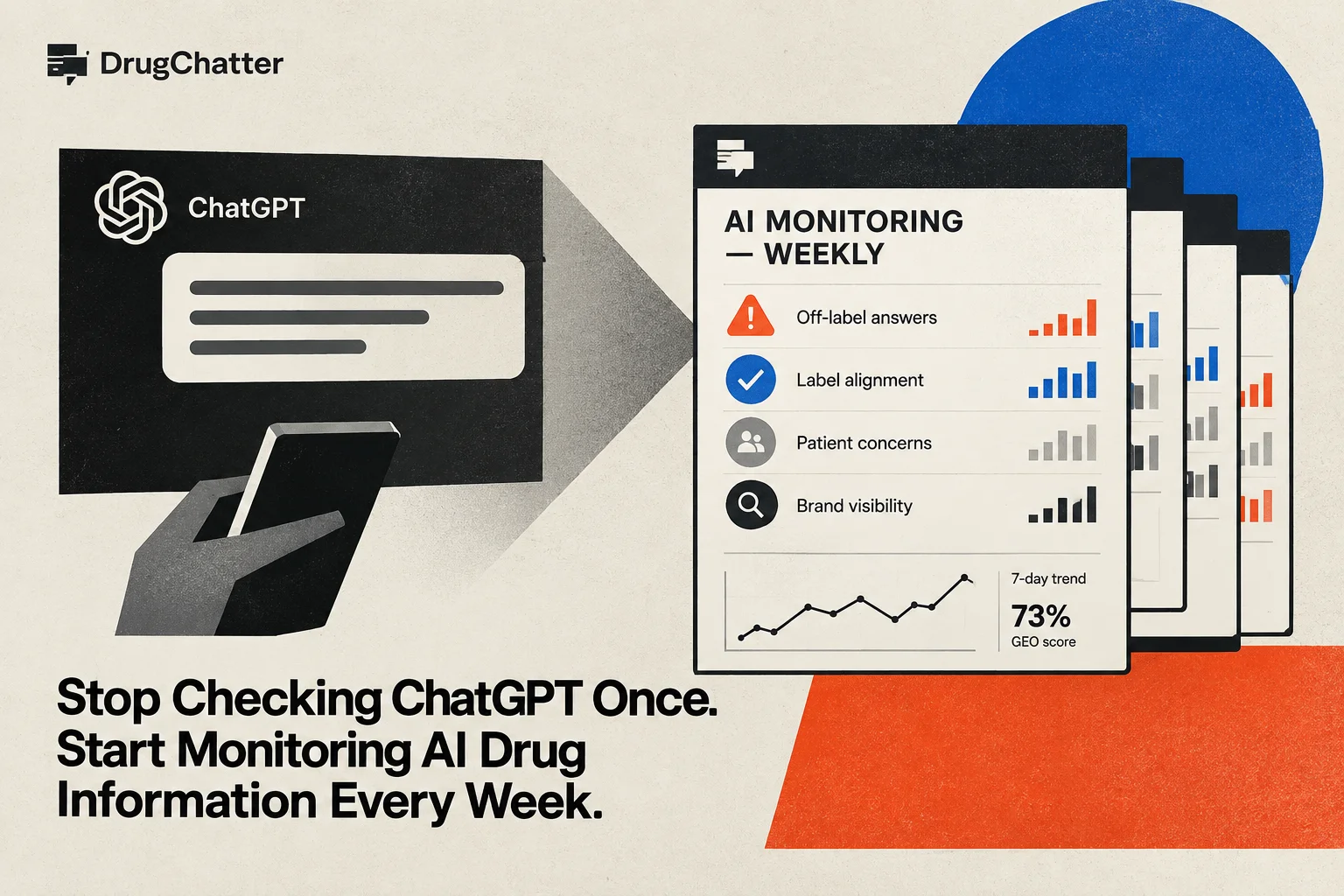
DrugChatter’s chatmon system is built around a different unit of record: the individual question-and-response pair, tagged by brand, by the AI vendor that produced the answer, and by the date it was captured, then aggregated on a rolling weekly basis into audience-specific briefings for functions including marketing, medical affairs, pharmacovigilance, regulatory affairs, and medical information. Rather than a fixed prompt list re-run on a schedule, the underlying question set reflects what has actually been asked about a given brand, which means the phrasing, the sequencing of follow-up questions, and the presence of comparison questions against named competitors are all part of the record rather than something a researcher has to anticipate in advance.
Why the Vendor-Level Field Matters
A brand’s answer on ChatGPT and its answer on Gemini are not the same answer. Superlines’ analysis of 454,847 AI responses across ten platforms found citation rates ranging from 23.45% on Grok down to roughly 4% on the platforms with the lowest brand-mention behavior, with Perplexity, Mistral, and DeepSeek all landing in a middle band with meaningfully different citation and brand-mention rates from one another.[8] Any monitoring record that does not separately tag which model produced an answer collapses that variation into a single, misleading average. Capturing the model alongside the question and answer — rather than treating “AI” as one undifferentiated source — is what makes a cross-model comparison possible rather than assumed.
Where AI Gets It Wrong: What the Accuracy Literature Shows
The case for watching this closely is not hypothetical. A 2024 study in the Journal of the American Pharmacists Association prompted ChatGPT-3.5 with the questions patients should ask before starting each of the top 20 most-prescribed US medications; 97% of responses were rated completely or mostly accurate, and 81% were rated comprehensively complete.[12] That is a reasonably strong baseline, and it is also not the same as safe in every instance. A separate study published in BMJ Quality & Safety, testing chatbot answers to patient medication questions across the 50 most frequently prescribed US outpatient drugs, found that experts judged a substantial share of the tested answers to be potentially harmful if followed: 42% carried a risk of mild to moderate harm and 22% carried a risk of severe harm or death.[13] The two findings are not contradictory — they describe different studies, different prompts, and different scoring rubrics — but together they establish that AI-generated drug information is neither reliably safe nor reliably dangerous as a category. It has to be checked against the current label, brand by brand and question by question, because accuracy varies by exactly the kind of question someone actually asks.
A Working Taxonomy: Three Kinds of “Something Is Wrong”
Not every AI answer that diverges from the label is the same kind of problem, and treating them identically wastes escalation resources. A useful three-way split:
Outdated-but-once-correct: the answer reflects a prior label, dosing regimen, or indication that has since changed — a freshness problem, not a fabrication.
Unsupported claim: the answer states something the current prescribing information, a regulatory communication, or peer-reviewed evidence does not support — a factual-accuracy problem.
Missing safety context: the answer is technically accurate but omits a boxed warning, contraindication, or interaction that a patient asking that specific question needed to see — a completeness problem, and often the most consequential of the three, since it is the one most likely to influence a real decision without the patient realizing anything was left out.
What This Means for Competitive Intelligence Teams
Traditional pharma CI has relied on public filings, congress presentations, formulary decisions, and the competitor’s own published content to reconstruct what the market is asking. Real query data adds a channel that none of those sources can replace: the question itself, asked by someone with no stake in how it gets answered. A spike in comparison questions between a brand and a specific competitor, a new phrasing pattern tied to a formulary change, or a cluster of cost-and-access questions ahead of a launch are all CI signals that show up in query volume before they show up in a competitor’s press release.
What This Means for Brand and Marketing Teams
Content strategy built on inferred keywords optimizes for what a tool predicts someone might search. Content built on logged AI questions can instead target the actual phrasing and actual follow-up sequence a real user produced, which is closer to how generative engine optimization research says AI systems select and cite sources in the first place. A Princeton/Georgia Tech/IIT Delhi study presented at KDD 2024 found that adding statistics and external citations to a page increased its visibility in generative answers by 41% and 115% respectively, with the largest gains accruing to pages that started out lower-ranked in traditional search.[14] Knowing the real question a page needs to answer is a precondition for writing the kind of specific, citable content that study describes.
What This Means for Medical Affairs and Pharmacovigilance
Medical affairs teams triaging AI-answer accuracy need the actual clinical question, not a paraphrase of it, because the specific wording of a dosing or interaction question often determines whether the model’s answer is safe. Pharmacovigilance teams face a related but distinct question: an inaccurate AI answer about an already-labeled risk is a communications and compliance problem, not automatically a reportable adverse event, unless a documented clinical outcome ties back to it. Keeping that distinction clear — and keeping the underlying question text available for review — is what lets each function route findings to the right owner instead of over- or under-escalating.
Building or Buying a Question-Level Monitoring Program
Teams evaluating this category, whether building internally or evaluating a vendor, should look for five capabilities regardless of which tool they choose:
Model attribution on every record. An answer without a tagged vendor cannot support a cross-model comparison later.
A rolling capture cadence frequent enough to catch the kind of week-over-week volatility Seer Interactive documented on Gemini, rather than a quarterly snapshot.
Label-alignment scoring that checks answers against the current prescribing information, not a cached or remembered version of it.
Audience-specific output — a regulatory affairs team and a sales-enablement team need different summaries of the same underlying data.
A clear boundary against overclaiming that the tool substitutes for formal pharmacovigilance case-processing systems, which operate under 21 CFR 314.80 and GVP Module IX reporting obligations that an AI-answer monitor does not touch.
Key Takeaways
51% of US adults now use an AI chatbot at all, and 32% have used one specifically for health information as of survey data collected through mid-2026.[1][2]
Among AI-chatbot health users, 55% have fact-checked a prescription drug or its side effects, and 81% of users take a follow-up action after getting an answer.[2]
The 2011-2013 loss of Google keyword data to “(not provided)” is a direct historical precedent for today’s AI-chat query blackout, except the current version hides both the question and the answer rather than just the question.[3][4][5]
Most AI-visibility tools measure brand presence against a written, synthetic prompt list rather than against questions real users generated.[10][11]
Chatbot accuracy on drug questions is inconsistent enough to require ongoing, question-level checking: one 2024 study found 97% of tested answers accurate, while a separate study found up to 22% of tested answers carried a risk of severe harm.[12][13]
Citation and brand-mention behavior differ meaningfully by AI platform, and platform market share itself is shifting quickly, which makes vendor-level tagging in any monitoring record a requirement, not a nice-to-have.[8][9]
FAQ
What is the difference between AI visibility monitoring and AI-generated drug information monitoring?
AI visibility monitoring tracks whether and how often a brand is mentioned or cited across AI platforms, usually against a written prompt panel. AI drug-information monitoring checks whether what the AI actually says about that brand matches the current FDA label, which requires reviewing the substance of the answer, not just counting mentions.
Can a brand see the real questions patients ask ChatGPT about its drug?
Not directly through ChatGPT itself, since consumer chat platforms do not expose brand-level query logs to outside companies. Monitoring tools address this by running scheduled queries of their own or, in DrugChatter’s case, aggregating a logged set of AI-monitoring questions and responses collected specifically for that purpose.
Why did chatbot accuracy studies find such different results for the same category of question?
The 2024 JAPhA study and the BMJ Quality & Safety study used different models, different prompt sets, and different scoring criteria for what counted as harmful versus merely incomplete.[12][13] Neither number generalizes to “AI drug information” as a whole; both point to the same conclusion, that accuracy has to be checked question by question rather than assumed at a category level.
Is an inaccurate AI answer about a drug a pharmacovigilance event?
Only in the rare case where a documented clinical outcome can be traced back to it. Most AI-answer inaccuracies are communications and compliance issues, distinct from the case-based adverse-event reporting that pharmacovigilance software handles under FDA and EMA reporting rules.
Why does it matter which AI model produced an answer?
Because citation behavior, brand-mention rates, and source selection vary substantially by platform, and platform market share is shifting quickly enough that a model-agnostic report can be stale within months.[8][9]
How often should a brand check its AI answers?
Frequently enough to catch platform-level volatility: Seer Interactive documented a single brand’s Gemini citation rate falling from 96% to 3.7% of responses within one week, which a quarterly check would miss entirely.[9]
Does more consumer AI-chatbot usage mean fewer people are talking to their doctor?
The available data suggests the opposite in most cases: 40% of Rock Health’s surveyed AI-chatbot health users consulted a provider after getting an AI answer, and 42% searched for additional verification elsewhere.[2] AI use appears to be adding a research step rather than replacing the clinical conversation for most users.
What is generative engine optimization (GEO) and how is it different from SEO?
GEO is the practice of structuring content so AI systems are more likely to cite or summarize it in a generated answer, as distinct from ranking it in a traditional results list. Research presented at KDD 2024 found that adding statistics and citations measurably increased a page’s visibility inside generative answers.[14]
Do synthetic prompt panels have any advantage over real query logs?
Yes: they are directly comparable across brands and competitors, since every brand is tested against the identical question set, and they do not depend on having access to any one company’s proprietary query data.
What should a brand team ask a vendor before buying an AI-monitoring tool?
Whether each response record is tagged by AI vendor, how frequently the monitoring runs, whether findings are checked against the current label rather than a cached version, and whether outputs are tailored by function or delivered as one undifferentiated report.
References
Pew Research Center. (2026, August 25). Wave 195: AI and health – Topline. American Trends Panel. https://www.pewresearch.org/wp-content/uploads/sites/20/2026/08/PS_2026.8.25_AI-chatbots-health_topline.pdf
eMarketer. (2025, December). Consumer use of AI for health questions doubles, and most users act on AI responses. Rock Health survey data. https://www.emarketer.com/content/consumer-use-of-ai-health-questions-doubles–most-users-act-on-ai-responses
Search Engine Watch. (2013, September 23). Goodbye, keyword data: Google moves entirely to secure search. https://www.searchenginewatch.com/2013/09/23/goodbye-keyword-data-google-moves-entirely-to-secure-search/
Inside GOV.UK Blog. (2013, September 25). Lost for words: Google stops providing keywords. https://insidegovuk.blog.gov.uk/2013/09/25/lost-for-words-google-stops-providing-keywords
Clifton, B. (2013, July). (Not provided) benchmarks. https://brianclifton.com/?p=4805
NarrativeScience / Phreesia. How AI chatbots are reshaping patient health behavior. https://engage.phreesia.com/rs/867-GML-252/images/NS_Whitepaper_AIChatbot.pdf
SingleCare. AI and medication-related questions survey. https://www.singlecare.com/blog/wp-json/wp/v2/posts/635918
Parse. (2026, May 23). Gemini AI visibility: what brands should measure. Seer Interactive data. https://www.parse.gl/blog/gemini-ai-visibility
eMarketer. (2026, June). AI citations reward pharma brands with stronger consumer visibility, name recognition. 5W AI Visibility Index. https://www.emarketer.com/content/ai-citations-reward-pharma-brands-with-stronger-consumer-visibility–name-recognition
5W. (2026, May). AI Visibility Index Series – May 2026 Release. https://www.5wpr.com/ai-visibility-index/may-2026-release/
Cornelison, B. R., Erstad, B. L., & Edwards, C. (2024). Accuracy of a chatbot in answering questions that patients should ask before taking a new medication. Journal of the American Pharmacists Association, 64(4), 102110. https://doi.org/10.1016/j.japh.2024.102110
BMJ Quality & Safety. Chatbot accuracy and potential harm in patient drug information. https://qualitysafety.bmj.com/content/34/2/100.full.pdf
Aggarwal, P., et al. (2024). GEO: Generative Engine Optimization. Princeton University / Georgia Institute of Technology / IIT Delhi. Presented at KDD 2024.