For twenty years, pharmaceutical brand teams had a reliable map of how patients found their drugs. A television ad for Humira ran during the evening news. The patient searched Google the next morning. They landed on AbbVie’s site or WebMD. Prescriptions followed. The funnel was boring, predictable, and worth defending with hundreds of millions of dollars in DTC spend annually.
That map stopped working.
Gartner forecast in early 2024 that traditional search engine volume would fall 25 percent by 2026 because of AI chatbots and virtual agents. By mid-2025, ChatGPT served roughly 5.8 billion monthly visits, putting it inside the top ten most-visited sites on the internet. Perplexity crossed 100 million monthly visits in Q4 2024. Google’s AI Overviews now appear in an estimated 84 percent of informational queries, and health-related questions sit among the most heavily affected categories.
Patients are asking ChatGPT about Ozempic side effects. Physicians are prompting Perplexity for dosing guidance on Keytruda. Caregivers are using Gemini to compare Eliquis against Xarelto. None of those answers originate from your medical affairs team. None of them include FDA-approved label language. They come from probabilistic language models trained on whatever web content mentioned your drug most often – and that content may be years old, taken out of context, or factually wrong.
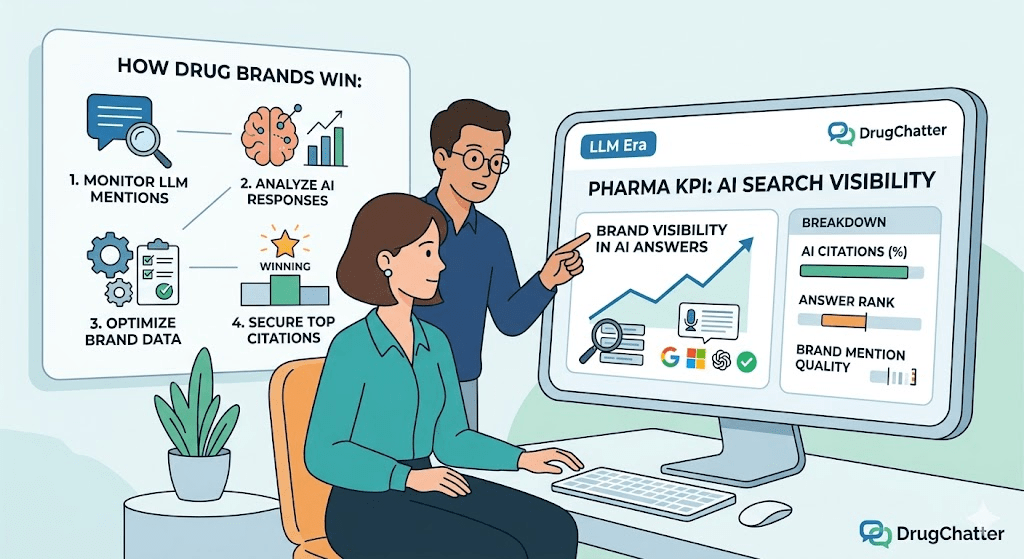
A new performance metric is forming inside the more forward-looking pharmaceutical companies: AI search visibility. It measures how often a drug brand appears accurately in AI-generated responses, which AI platforms cite it, what sentiment accompanies those mentions, and how that share of voice compares to competitors. It sits alongside traditional KPIs like branded search volume, DTC recall rates, and share of new-to-brand prescriptions.
This article examines what AI search visibility means for pharma brand teams in practice, why it carries regulatory implications that go well beyond marketing, and how companies are beginning to build monitoring programs before the stakes become unavoidable.
Why Pharmaceutical Search Is Breaking: The New Patient Information Funnel
The pharmaceutical DTC machine was built on a channel that is structurally shrinking. When 32 percent of U.S. consumers have already used an AI chatbot for health-related questions – double the rate from a year prior according to Rock Health’s 2025 Consumer Adoption Survey – and when 58 percent of Americans say they would use AI for initial health information before calling a doctor according to Accenture Digital Health data, the logical conclusion is that the information layer between a drug brand and its patients is no longer controlled by the brand.
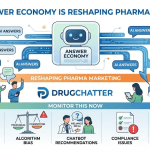
The pharmaceutical DTC budget in the United States tops $8 billion annually. That spend drives patients to Google and from Google to brand websites. When the search step is replaced by an AI answer, the brand website never appears. There is no sponsored placement inside a ChatGPT response. No keyword bidding in Perplexity. No guaranteed presence in a Gemini AI Overview. The only currency that determines AI visibility is earned authority: the quality, accuracy, and distribution of third-party content that mentions a drug across the web.
How Patients Now Ask About Drugs in AI Search
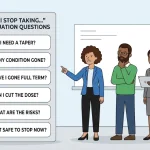
The question structure has changed. Traditional Google searches were short and keyword-driven: ‘Ozempic side effects’ or ‘Humira dosing.’ AI search queries are conversational and context-dependent: ‘I’ve been on Ozempic for three months and I’m losing less weight, should I switch to Wegovy or ask my doctor about Mounjaro?’ That single query requires an AI system to synthesize drug comparison data, label information, clinical trial outcomes, and off-label use history simultaneously. The chance of an error in any one of those domains is non-trivial.
The content that shapes AI answers about drugs comes from sources the drug company rarely controls: medical journals, patient forums, Reddit threads, WebMD, insurance formulary databases, news coverage, and regulatory filings. A brand team that produces technically precise prescribing information on its own website but neglects its footprint in these third-party sources will find that AI systems largely ignore the official version of events.
Which AI Platforms Pharma Teams Should Track (and Why They Differ)
ChatGPT, Gemini, Perplexity, and Claude behave differently enough to require platform-specific analysis. A study from German healthcare communications agency komm.passion, using OtterlyAI’s citation tracking platform, analyzed AI responses about the five highest-grossing pharmaceutical products globally – Keytruda, Ozempic, Dupixent, Biktarvy, and Eliquis – across ChatGPT, Gemini, Google AI Overview, and Perplexity, using 30 healthcare queries per product across Germany, Austria, and Switzerland.
The findings expose meaningful platform variation. Some platforms favored regulatory sources in their citations. Others pulled more heavily from commercial content. The top ten cited websites captured roughly 50 percent of all AI citations across the study – meaning a small cluster of domains has outsized influence over what AI systems say about any given drug.
For pharma teams, this matters because a monitoring strategy that only checks ChatGPT misses significant divergence in what Gemini or Perplexity say about the same product. A brand can dominate AI mentions in one model and be effectively invisible in another.
What AI Search Visibility Actually Measures as a Pharma KPI
AI search visibility as a pharma KPI is not a single number. It is a cluster of four measurable dimensions that together tell a brand team whether AI is working for or against their drug.
The Four Dimensions of Pharmaceutical AI Search Visibility
Mention Rate: How frequently the drug brand appears in AI responses to relevant queries, expressed as a percentage of prompted questions that include the brand name in the output.
Citation Sources: Which third-party domains AI models pull from when answering drug-related questions, and whether those sources reflect accurate, current clinical information.
Sentiment and Framing: Whether AI characterizes the drug as a first-line, second-line, or last-resort option; how it describes side effects relative to benefits; and whether competitor comparisons favor or disfavor the brand.
Accuracy Rate: Whether the dosing, indication, contraindication, and safety information in AI outputs matches the current FDA-approved prescribing information.
Each dimension feeds a different internal stakeholder. Brand teams care about mention rate and sentiment. Regulatory and medical affairs care about accuracy. Pharmacovigilance teams care about whether AI outputs include adverse event signals not yet formally reported. Legal cares about all four.
How to Track Share of Voice Across ChatGPT, Gemini, and Claude
Share of voice in AI search works differently than traditional branded search SOV. In Google, share of voice measures how often a brand appears in the top positions of a search engine results page relative to competitors, weighted by impression share. In AI search, the equivalent metric is mention share: out of all AI responses to queries in a given therapeutic category, how often does your brand appear versus a competitor, and with what degree of prominence?
In the GLP-1 category, for example, a team monitoring mention share across platforms might find that Ozempic has higher spontaneous mention rates than Wegovy even for weight-loss queries – because Ozempic has denser third-party content coverage despite Wegovy being the FDA-approved indication for obesity. This creates a compliance exposure. When patients ask AI what drug to take for weight loss and AI recommends Ozempic rather than Wegovy, it may be recommending the drug in a context that does not match its labeled indication, without the manufacturer having done anything to cause it.
Can Branded Drug Visibility in AI Be Optimized? What Generative Engine Optimization (GEO) Means for Pharma
Generative Engine Optimization, or GEO, is the practice of structuring content and distribution so that AI systems are more likely to surface it accurately and favorably. In non-regulated industries, this means writing content in a format AI models prefer to cite: clear, structured, authoritative, and accessible. In pharmaceuticals, it collides immediately with FDA promotional review requirements.
A press release that improves a drug’s GEO footprint might simultaneously require MLR review. A disease-awareness piece structured to rank well in AI citations cannot contain promotional claims. The medical, legal, and regulatory review process was designed for static content in controlled channels. AI search moves faster than MLR committees, and the content AI cites is predominantly not content the brand controls.
The companies making the most progress on GEO in pharma are focusing on what they can influence: ensuring their FDA-approved prescribing information is structured for machine readability, making sure disease-awareness content on third-party sites is accurate and updated, and correcting outdated clinical data on domains that AI systems preferentially cite. This is a defensive strategy more than a growth one, and that framing matters for internal budget justification.
Why ChatGPT Gets Drug Side Effects Wrong: The Accuracy Problem
The research on AI pharmacology accuracy is not reassuring. A JAMA Network Open study in late 2023 tested GPT-3.5 and GPT-4 on 100 standardized pharmacology questions from board examination banks and clinical practice scenarios. GPT-4 achieved approximately 68 percent accuracy on dosing questions and 71 percent on drug interaction questions. Those numbers would fail a medical licensing exam.
For pharmaceutical companies, these accuracy gaps have two distinct risk profiles. The first is reputational: an AI that overstates a drug’s side effects can depress patient adherence and prescriber confidence even when the output is wrong. The second is regulatory: an AI that understates risks or misrepresents contraindications may contribute to adverse events that would otherwise have been avoided.
‘In contexts where inaccuracies can result in severe consequences, particularly in decision-making processes affecting patient safety, the issue of LLM hallucinations and omission of key information becomes acutely significant. One critical domain is drug safety, also known as pharmacovigilance, which involves the ongoing surveillance for adverse events linked to pharmaceutical medicines and vaccines.’— The Need for Guardrails with Large Language Models in Medical Safety-Critical Settings, arXiv preprint (2024)
How AI Hallucinations in Drug Information Differ From Other Content Categories
AI hallucinations in pharmaceutical contexts are uniquely dangerous for a structural reason: the space between the correct answer and a plausible-sounding wrong answer is often invisible to the patient or caregiver reading it. A hallucinated capital city is obvious to anyone who knows basic geography. A hallucinated drug interaction is not obvious to a patient managing polypharmacy. The confidence with which language models state incorrect clinical information is indistinguishable from the confidence with which they state accurate information.
CNN reported in July 2025 that the FDA’s own AI system, an internal tool called Elsa deployed to accelerate drug reviews, had fabricated nonexistent studies and misrepresented research findings, according to three current FDA employees. If an AI system built by the regulatory body responsible for drug safety produces hallucinated citations about drugs, it clarifies the scope of the problem facing commercial pharmaceutical companies monitoring third-party AI outputs.
GLP-1 Drugs and the Off-Label AI Confusion Problem: Ozempic vs. Wegovy
The semaglutide off-label use situation demonstrates what happens when AI systems lack regulatory precision. Ozempic is FDA-approved for type 2 diabetes at doses up to 2 mg weekly. Wegovy contains the same active ingredient at a higher dose and is approved for chronic weight management. The pharmacological similarity is real. The regulatory distinction is legally material.
AI models trained on clinical literature rather than regulatory documents consistently fail to maintain that distinction. When a patient asks an AI whether they can use Ozempic for weight loss, many models answer based on pharmacology rather than indication status – effectively recommending off-label use without flagging it as such. By 2023, this AI-assisted prescriber confusion had contributed to drug shortages severe enough that the FDA placed both Ozempic and Wegovy on its drug shortage list.
Novo Nordisk has no direct control over the training data, system prompts, or retrieval architecture of any major commercial AI model. That is the fundamental challenge. A company can invest hundreds of millions in DTC advertising to position Wegovy correctly, and a single ChatGPT response can silently undermine that positioning for a patient who never clicks through to the brand site.
Do LLMs Recommend Generic Drugs More Often Than Branded Products?
There is a cost-driven skew visible in AI outputs about branded versus generic drugs, particularly in therapeutic categories with established generics. When patients ask AI about treatment options for conditions like hypertension, anxiety, or Type 2 diabetes, models frequently lead with generic options – partly because generic drugs have larger bodies of academic literature, partly because AI training data over-represents medical publications relative to branded promotional content, and partly because AI systems have been trained to avoid appearing to advertise specific brands.
This creates a systematic disadvantage for branded products competing against generics in AI-answered queries. The concern is acute for drugs approaching patent expiry: even before a generic becomes available, AI systems may be priming patients and physicians to think generically. For drugs like Humira, which saw biosimilar competition drive it from second to fourteenth on global best-seller lists in 2024, the AI mention trajectory likely preceded the prescription trajectory. Monitoring that signal could give brand teams earlier warning of competitive erosion.
The AI generic bias also affects how physicians use AI for clinical decision support. Research presented at NeurIPS 2025 found systematic disparities in how LLMs predict adverse events based on socio-demographic patient characteristics – meaning AI is not just biased toward generics but is biased in who it recommends specific drugs for, in ways that do not reflect clinical evidence.
Can AI Outputs Be Used for Pharmacovigilance? What the FDA and EMA Are Saying
The pharmacovigilance question is where AI search monitoring moves from a brand marketing concern to a regulatory compliance obligation. Pharmacovigilance – the ongoing surveillance of adverse events linked to marketed drugs – has been a legal requirement for pharmaceutical companies since the 1960s. The FDA’s Adverse Event Reporting System (FAERS) received more than two million adverse event reports in 2023 alone. Most of those reports originated from healthcare professionals, patients, and manufacturers directly.
AI-generated content now represents a new category of data source that sits outside the traditional spontaneous reporting framework. When a patient describes an adverse event experience in a conversation with ChatGPT, that information does not automatically enter the pharmacovigilance pipeline. When Perplexity aggregates Reddit posts about a drug’s side effects and synthesizes them into an answer, the resulting summary contains signals that may have pharmacovigilance relevance – but no mechanism currently exists to route those signals to drug safety teams.
How Adverse Event Signals Hide in AI Search Conversations
The adversarial nature of this problem is subtle. Patient queries to AI about drug side effects frequently contain implicit adverse event reports: ‘I’ve been taking Keytruda and I’ve noticed my joints are swelling, is that normal?’ That query contains a potential immune-related adverse event signal. Under current FDA regulations, manufacturers who become aware of adverse events through any source – including social media monitoring – have reporting obligations depending on whether the event is labeled or unlabeled, serious or non-serious.
The FDA has not yet issued specific guidance on whether AI conversation monitoring triggers adverse event reporting obligations. The EMA moved faster: in 2024, it published tools and guidelines for incorporating AI into pharmacovigilance processes, emphasizing transparency, validation, and monitoring of AI systems. The FDA followed in January 2025 with draft guidance titled ‘Considerations for the Use of Artificial Intelligence to Support Regulatory Decision-Making for Drug and Biological Products,’ which established a risk-based credibility assessment framework but did not directly address manufacturer obligations around AI-generated patient content.
What Pharma Companies Can Do With AI-Derived Pharmacovigilance Signals
Even in the absence of formal FDA guidance, forward-looking pharmacovigilance teams are treating AI-derived signals as part of their social listening infrastructure. The logic is straightforward: if regulatory bodies currently require monitoring of patient forums, Reddit, and social media for adverse event signals, AI-generated content that aggregates and synthesizes those same forums is a secondary signal source that compounds the original one.
A drug safety team monitoring AI outputs for their product would be looking for patterns rather than individual reports: AI responses that consistently associate a drug with a specific adverse event not prominently in the prescribing information, responses that recommend discontinuation for reasons not documented in the label, or responses that suggest drug interactions not captured in current FDA labeling. These patterns, logged over time, constitute a signal dataset that deserves clinical review regardless of its regulatory status.
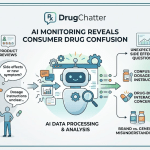
Platforms built specifically for pharmaceutical AI monitoring, including DrugChatter, are designed to track exactly this kind of AI-generated signal across multiple LLM platforms simultaneously, creating audit trails that can inform both brand strategy and safety surveillance.
FDA Warning Letters, Off-Label AI Promotion, and Where Liability Sits
The question of manufacturer liability for AI outputs about their drugs is unresolved law. The FDA has statutory authority under Section 301 of the Federal Food, Drug, and Cosmetic Act to prohibit false or misleading labeling – but that authority runs to labeling the manufacturer controls or disseminates. Third-party AI outputs are not manufacturer labeling in the traditional sense.
However, an underdiscussed scenario creates real exposure: if a manufacturer has a licensed data relationship with an AI platform and that platform uses the manufacturer’s information in ways the manufacturer knows to be inaccurate, regulatory counsel have flagged the possibility that continued participation in that relationship could theoretically be characterized as contributing to misbranding. No FDA warning letter has yet tested that theory, but it shapes how risk-conscious legal teams are advising their medical affairs counterparts on AI partnerships and data licensing agreements.
How Often Does Claude Mention Ozempic vs. Wegovy? Measuring AI Brand Share in Real Drug Categories
AI mention share analysis in pharmaceutical categories produces counterintuitive results. In the GLP-1 space, the brand with the heaviest media coverage – Ozempic – consistently outperforms its indication-specific sibling Wegovy in spontaneous AI mentions for weight-loss queries, even though Wegovy is the correct branded recommendation for obesity management. This is not a marketing failure by Novo Nordisk; it is a structural artifact of how language models weight content volume over regulatory precision.
Keytruda (pembrolizumab) provides a different case study. As the best-selling drug globally in 2024 with roughly $29.5 billion in revenue and approximately 40 approved indications across oncology, Keytruda has massive content density across PubMed, FDA documents, news coverage, and institutional oncology resources. When physicians ask AI about first-line cancer treatments in numerous tumor types, Keytruda appears with high frequency and generally with accurate clinical context. Merck’s decade of building clinical evidence and publishing clinical trial data has – as a secondary effect – built an AI visibility footprint that competitors with thinner publication records cannot easily match.
The Keytruda vs. Opdivo Example: How Clinical Trial Density Shapes AI Answers
Bristol Myers Squibb’s Opdivo (nivolumab) generated $9.3 billion in 2024 revenue against Keytruda’s $29.5 billion – roughly a third of its rival’s sales. That gap traces directly to clinical trial strategy and approval breadth. Keytruda’s more aggressive pursuit of indications, and its pivotal role in defining first-line PD-1 therapy in non-small cell lung cancer, generated disproportionately large bodies of published evidence that AI models draw from. When an AI answers a question about first-line immunotherapy for lung cancer, Keytruda dominates not because Merck has optimized AI content but because Merck has published more relevant peer-reviewed data that AI systems weight as credible.
This means pharmaceutical companies that have historically under-published in disease awareness content, patient-focused educational resources, and clinical trial registries will find themselves structurally disadvantaged in AI search visibility – even for drugs with strong efficacy profiles. The fix is not primarily a marketing intervention; it is a medical affairs and publication strategy intervention.
What Physician Queries to AI Look Like Compared to Patient Queries
Physician and patient queries about drugs in AI systems differ enough that they require separate monitoring frameworks. Physician queries tend toward clinical specificity: dosing in renal impairment, drug-drug interactions, biomarker testing requirements before initiation, retreatment criteria. Patient queries center on experience and access: cost, side effect expectation, insurance coverage, how the drug compares to alternatives patients have heard about.
The komm.passion / Team Farner study found that even for prescription-only medications where queries were framed from a healthcare professional perspective, patient information websites received significant AI citations. Patient advocacy organizations, patient information services, and disease foundations consistently appeared in top-tier citation lists across Keytruda, Dupixent, and Eliquis queries. AI systems, it turns out, prefer accessible language over technical precision – which means dense prescribing information formatted for physicians may receive fewer citations than plain-language patient guides that say essentially the same thing.
Tracking AI Brand Sentiment: What ‘Patient Voice’ Looks Like in LLM Outputs
Social listening for pharmaceutical brands has existed since at least 2009, when regulatory teams began monitoring patient forums and disease communities for adverse event signals. The emergence of AI search changes the social listening calculus in a specific way: AI systems synthesize patient sentiment from multiple forums simultaneously and present it as a unified answer, which amplifies some patient voices while erasing others.
When a patient forum thread from 2021 contains 50 comments about nausea associated with Dupixent, and a Reddit thread from 2024 contains 200 comments about improved quality of life, an AI system may weight the newer, larger thread more heavily – or it may not, depending on its training data cutoff and retrieval architecture. The brand team tracking only traditional forum sentiment will see both threads as data points. A team monitoring AI outputs will see which narrative the AI synthesizes and presents to the next patient who asks the same question.
How Patients Ask About Drug Interactions in AI Search: The Safety Monitoring Angle
Drug interaction queries in AI search represent a specific pharmacovigilance monitoring target. Patients frequently ask AI systems about combinations their physicians may not know they’re considering: ‘Can I take Eliquis with ibuprofen?’ ‘Is it safe to take Ozempic and metformin together?’ ‘What happens if I drink alcohol on Keytruda?’
The accuracy of AI responses to these queries is inconsistent. For well-documented interactions in large pharmacological databases, AI models perform reasonably well. For interactions that emerged post-market or were identified through FAERS rather than clinical trials, AI models often don’t have the data. Monitoring which drug interaction queries AI is answering incorrectly – and which drugs are being implicated in fabricated or outdated interaction data – is a practical pharmacovigilance function that pharmaceutical safety teams can perform with systematic AI monitoring.
What Pharma Brand Teams Can Learn From Reddit AI Citations
Reddit occupies a disproportionate position in AI citation hierarchies for pharmaceutical content. Several factors explain this: Reddit discussions are indexed by search engines, structured in ways that machine learning models parse easily, updated continuously with patient experience data, and often more candid about side effects than any commercially produced content. When AI systems are asked about real-world patient experience with a drug, Reddit threads frequently appear in the source list.
For brand teams, this creates a monitoring obligation that overlaps with but differs from traditional social listening. The question is not only what patients are saying on Reddit, but which Reddit discussions AI models are specifically choosing to cite in their answers. A subreddit thread with 15 comments that an AI model cites heavily in response to ‘what are the real side effects of [drug]?’ has more AI search influence than a brand-produced patient testimonial on the official website that AI ignores entirely.
DrugPatentWatch tracks patent expiry and competitive dynamics across pharmaceutical markets. Integrated with AI mention monitoring, patent cliff data from DrugPatentWatch can signal when a drug’s AI visibility pattern is likely to shift – as generics enter the market, as biosimilars erode branded search authority, and as patient forums shift their discussion from branded to generic options.
How Eli Lilly and Novo Nordisk Are Navigating AI in the GLP-1 Brand War
The Ozempic / Wegovy versus Mounjaro / Zepbound competition is the pharmaceutical industry’s most visible ongoing commercial conflict. As of early 2026, Novo Nordisk’s suite of GLP-1 products – Ozempic, Wegovy, and Rybelsus – generated approximately $29 billion in 2024 revenue, while Eli Lilly’s tirzepatide franchise (Mounjaro and Zepbound) reached roughly $16.5 billion. Lilly is gaining ground rapidly, and some of that competitive momentum is now playing out in AI search.
Both companies have moved to deepen their AI partnerships. In April 2026, Novo Nordisk and OpenAI announced a partnership aimed at transforming drug discovery and delivery. This relationship has obvious R&D applications, but it also creates proximity to the infrastructure that shapes what ChatGPT says about Novo Nordisk’s drugs – a strategic adjacency that pharma companies without similar partnerships lack.
How Lilly’s Zepbound Is Winning AI Mentions in the Obesity Category
Tirzepatide’s efficacy advantage over semaglutide – demonstrated in head-to-head data showing greater average weight loss – has generated substantial clinical literature, news coverage, and physician discussion that AI models draw from when answering obesity treatment questions. When a patient asks Perplexity ‘which is more effective for weight loss, Ozempic or Mounjaro?’, the AI answer is increasingly informed by comparative effectiveness data that favors Lilly’s compound, regardless of Novo’s larger marketing budget or longer market presence.
This is the counter-intuitive feature of AI search visibility: clinical reality, as reflected in published literature, can override commercial investment. A drug with better published efficacy data will tend to receive more favorable AI mentions than a drug with equivalent marketing spend but thinner clinical evidence. For pharmaceutical companies evaluating clinical development strategy, the AI visibility implication of data publication choices is now a real variable in the calculation.
What Happens to AI Visibility When a Drug Loses Patent Protection: The Humira Case
AbbVie’s Humira (adalimumab) declined from the second to the fourteenth best-selling drug globally after biosimilar competition intensified. That commercial trajectory is reflected in AI search visibility in measurable ways. Before biosimilar entry, AI responses to rheumatology treatment questions prominently featured Humira by name. As biosimilars captured market share and clinical discussion shifted toward biosimilar interchangeability, AI responses began using the generic name adalimumab more frequently, listing multiple biosimilar options, and positioning Humira as one option among many rather than the default choice.
Monitoring this AI mention shift in real time could have given AbbVie’s brand team advance signal of market perception change – separate from and potentially earlier than prescription data. The point at which AI systems stop treating a brand as the category default and start treating it as one competitive option is a leading indicator of broader market transition worth tracking.
Building a Pharmaceutical AI Monitoring Program: Workflow and Infrastructure
A functional pharmaceutical AI monitoring program requires four components that most brand teams do not currently have: a systematic query library, platform coverage across multiple AI models, a baseline measurement protocol, and a routing mechanism that sends different findings to the right internal stakeholders.
Building Your AI Query Library for Drug Monitoring
The query library is the foundation. It should contain queries that mirror how actual patients and physicians ask AI systems about a drug – not the idealized questions a medical affairs team would write, but the messy, partial, colloquial questions that real users type. ‘What does Keytruda do and how long do I take it?’ ‘Is Wegovy the same as Ozempic?’ ‘Can Eliquis cause brain bleeds?’ ‘What’s better for RA, Humira or Rinvoq?’
Query libraries should be updated quarterly at minimum, informed by actual search query data, patient forum topic analysis, and medical affairs knowledge of emerging clinical questions. Weekly monitoring runs on a fixed query set are the practical standard: daily monitoring generates too much noise given LLM output variability, and monthly monitoring is too slow to catch emerging patterns.
Platform Coverage: Why Monitoring Only ChatGPT Leaves Gaps
ChatGPT, with 400 million weekly active users as of February 2025 and over 5.8 billion monthly visits by mid-2025, is the obvious starting point. But monitoring only ChatGPT leaves significant coverage gaps. Google’s AI Overviews appear in an estimated 84 percent of informational queries and reach an audience that skews older and less tech-forward than dedicated AI tool users – precisely the demographic most likely to be managing chronic conditions. Perplexity’s source-citation architecture makes it a particularly useful monitoring target because it explicitly surfaces which websites it draws from when answering drug questions.
Claude’s approach to medical information differs meaningfully from ChatGPT’s. Gemini’s integration with Google Search creates a feedback loop between traditional SEO authority and AI visibility that other platforms don’t replicate. Enterprise AI monitoring programs need coverage across at least four platforms to capture the full range of where patients and physicians are getting AI-mediated drug information.
Routing Findings: Who Gets What From AI Monitoring Data
The organizational routing of AI monitoring findings is where most programs stall. A brand team receives sentiment data about AI characterizing their drug unfavorably against a competitor. Medical affairs receives a finding that AI is describing a contraindication incorrectly. Pharmacovigilance receives a pattern of AI responses that may contain unlabeled adverse event signals. Legal receives a flag that AI is discussing off-label use in a context that could have manufacturer exposure implications.
These four audiences need different data formats, different cadences, and different escalation protocols. Brand teams want trend dashboards with competitive comparison. Medical affairs wants specific inaccuracy citations with source attribution. Pharmacovigilance wants signal pattern data with clinical context. Legal wants documented evidence of specific AI outputs, timestamped, for potential regulatory response. Building the routing infrastructure before the data starts flowing is the difference between a monitoring program and a monitoring experiment.
What Does an AI Brand Monitoring Dashboard Look Like for a Drug Company?
The practical dashboard components for pharmaceutical AI monitoring include mention rate by platform and therapeutic query cluster, accuracy score relative to current prescribing information, competitive mention share against named competitors, sentiment distribution (favorable, neutral, unfavorable framing), off-label mention frequency and context, citation source breakdown by domain type, and week-over-week trend for each metric.
Platforms designed for pharmaceutical AI visibility – including DrugChatter – combine AI output monitoring with the clinical and regulatory data infrastructure needed to assess accuracy and flag pharmacovigilance signals. Generic LLM visibility tools built for consumer brands lack the pharmaceutical-specific data layers needed to distinguish an inaccurate dosing claim from an accurate one, or to route a potential adverse event signal to the right internal team.
The Regulatory Horizon: FDA, FTC, and the Coming AI Disclosure Questions
As of mid-2026, neither the FDA nor the FTC has issued specific guidance on pharmaceutical company obligations around third-party AI mentions of their drugs. That regulatory silence will not persist indefinitely. Several pressure vectors are converging on formal rulemaking.
FDA Draft Guidance on AI and Regulatory Decision-Making: What It Signals
The FDA’s January 2025 draft guidance on ‘Considerations for the Use of Artificial Intelligence to Support Regulatory Decision-Making for Drug and Biological Products’ established a risk-based credibility assessment framework for AI used in drug development and regulatory submissions. It did not directly address patient-facing AI systems that generate drug information. But the analytical framework it introduced – assessing AI outputs against defined contexts of use, with documented performance monitoring and bias evaluation – provides a template for how FDA might eventually approach manufacturer obligations around third-party AI content.
The EMA’s 2024 pharmacovigilance AI guidelines went further than FDA’s 2025 draft in specifying transparency and monitoring requirements for AI in drug safety contexts. European pharmaceutical companies operating under EMA jurisdiction arguably face earlier pressure to document their AI monitoring activities than their U.S. counterparts, though the direction of FDA’s regulatory posture makes that a narrowing gap.
FTC and Off-Label AI Discussions: Where Commercial Risk Sits
The FTC has authority over deceptive commercial practices. If a pharmaceutical company were shown to have deliberately shaped AI training data or AI retrieval systems to generate responses favorable to off-label use of their products, FTC jurisdiction alongside FDA action would be a plausible regulatory outcome. The inverse question – whether a manufacturer’s failure to correct known AI inaccuracies about its drug could constitute a form of complicit endorsement – has not been tested but is under discussion in pharmaceutical regulatory legal circles.
The FDA’s Digital Health Advisory Committee flagged in November 2025 that risks from AI medical tools include hallucinations, model drift, and off-label use – and called for robust adverse event definitions and reporting pathways. The DHAC’s framing was specifically around AI therapy tools, but the definitional work it is doing will shape the broader regulatory landscape for AI-generated pharmaceutical content.
What MLR Review Teams Need to Know About AI-Generated Drug Content
Medical, Legal, and Regulatory review processes were designed for content that manufacturers create and distribute. They were not designed for third-party AI outputs that exist in a distributed, continuously updated, non-static form across dozens of AI platforms. Pharmaceutical companies that believe MLR review is sufficient protection against AI-generated misinformation about their drugs are operating on a category error.
The practical MLR implication of AI monitoring is different from traditional review: it is about detecting rather than approving. When AI monitoring flags that a specific AI platform is describing a drug’s mechanism of action incorrectly, or associating it with an adverse event not in its label, the MLR response is to document the finding, assess whether any manufacturer-controlled data relationship with that platform could create liability, and consider whether correction through third-party channels is possible and appropriate.
AI Search Visibility Benchmarks: What Good Looks Like for a Pharmaceutical Brand
Pharma brand teams building AI monitoring programs for the first time have no established benchmarks to compare against. The field is new enough that most companies are establishing baselines rather than comparing against industry norms. But some directional reference points are emerging.
What Mention Rate Looks Like for Blockbuster vs. Niche Drugs
Blockbuster drugs – Keytruda, Ozempic, Eliquis – appear in AI responses at high rates for therapeutic category queries because they have dense third-party content coverage across authoritative domains. A drug generating $10 billion or more annually will typically have extensive PubMed literature, major news coverage, formulary listing documentation, and patient community discussion that AI systems draw from. Their challenge is accuracy and sentiment management, not visibility per se.
Niche drugs serving rare diseases or small patient populations face a different problem. Low content density means AI systems either don’t mention them or, when prompted, generate responses with higher error rates. A drug for a rare condition may have excellent efficacy data but limited third-party content coverage, resulting in AI responses that either ignore it or fall back on older, less accurate sources. For rare disease teams, visibility itself is the primary AI monitoring concern.
Accuracy Benchmarks: When AI Gets Your Drug Right and When It Doesn’t
Accuracy rates for AI drug information vary significantly by query type. Indication and mechanism queries tend toward higher accuracy for well-documented drugs. Dosing queries – especially for subpopulations with hepatic or renal impairment – show meaningful error rates. Drug interaction queries are inconsistent enough that medical affairs teams should treat AI drug interaction information as systematically unreliable and monitor accordingly. Safety and contraindication queries show the widest variation: AI systems that correctly describe a drug’s primary safety signals may simultaneously omit post-market safety updates added to the label after training data collection closed.
The practical implication is that accuracy monitoring cannot be conducted with a single representative query. A rigorous accuracy audit requires queries across indication, dosing, interaction, contraindication, and off-label domains, run across multiple platforms, with outputs scored against the current prescribing information by someone with clinical and regulatory expertise.
Adjacent Signals: What AI Search Visibility Reveals About Competitor Strategy
AI monitoring data carries competitive intelligence value beyond a brand’s own drugs. When a competitor’s drug begins appearing more frequently in AI responses to queries where your drug was previously dominant, that shift precedes traditional competitive intelligence signals by weeks or months. It reflects changes in published literature, media coverage, payer policy coverage, and physician discussion before those changes show up in prescription data.
How to Detect Emerging Off-Label Discussion Before It Trends in Patient Communities
AI systems aggregate off-label discussions from patient forums, clinical case reports, conference presentations, and news coverage before those discussions coalesce into visible trends on Reddit or Twitter. When AI monitoring shows a drug being discussed in an off-label context across multiple AI platforms, the signal often predates the trend appearing in traditional social listening dashboards. This gives pharmaceutical companies a genuine early warning capability for off-label use patterns – which matters both for lifecycle management strategy and for pharmacovigilance obligations.
What Generic Substitution Recommendations in AI Mean for Branded Drug Teams
When AI systems begin spontaneously recommending generic alternatives to a branded drug in response to cost and access queries, the branded drug team has real commercial exposure. This shift can happen years before patent expiry if generic manufacturers have begun building clinical and commercial presence and generating the third-party content that AI models learn from.
Monitoring AI for generic substitution recommendations provides brand teams with an early indicator of competitive erosion. The appropriate response may range from content strategy adjustments to payer advocacy to lifecycle management investments – but the response requires knowing the shift is occurring in real time, not months later when prescription data confirms what AI signals had already detected.
Key Takeaways
AI search visibility – measured by mention rate, citation sources, sentiment, and accuracy – is becoming a measurable pharmaceutical KPI as AI platforms replace traditional search for a growing share of patient and physician drug queries.
There is no paid placement in AI search. The only currency is earned authority built through clinical publication, third-party content quality, and regulatory database presence.
AI models consistently fail to distinguish between drugs that share an active ingredient but differ in regulatory indication – creating off-label exposure that no manufacturer controls but every manufacturer should monitor.
GPT-4 accuracy rates of approximately 68 percent for dosing questions and 71 percent for drug interaction questions represent a real patient safety concern, and pharma companies bear reputational and potentially regulatory exposure when AI gets their drugs wrong.
Pharmacovigilance teams have a legitimate stake in AI monitoring programs, not just brand teams. AI outputs about drugs can contain unlabeled adverse event signals that pre-date formal reporting.
Different AI platforms – ChatGPT, Gemini, Perplexity, Claude, Google AI Overviews – behave differently enough in pharmaceutical queries that monitoring only one platform leaves significant blind spots.
AI monitoring data is a leading indicator of competitive dynamics, off-label use trends, and generic substitution patterns that precede those signals appearing in traditional market research.
Pharmaceutical-specific monitoring platforms like DrugChatter provide the clinical and regulatory data infrastructure needed to assess AI accuracy and route signals to the appropriate internal teams.
Frequently Asked Questions
What is AI search visibility for pharmaceutical brands, and why does it matter now?
AI search visibility measures how frequently and accurately a drug brand appears in responses from AI platforms like ChatGPT, Gemini, Perplexity, and Claude when patients and physicians ask health-related questions. It matters now because AI platforms are replacing traditional search for a fast-growing share of health queries: 32 percent of U.S. consumers used AI chatbots for health questions in 2025, double the prior year rate according to Rock Health, and Gartner forecast that traditional search volume will fall 25 percent by 2026. Brands that dominate traditional Google search but are invisible or inaccurate in AI responses are losing the information layer between their product and its users without knowing it.
Can pharmaceutical companies improve how AI talks about their drugs without violating FDA promotional regulations?
Yes, but the path is narrow. Companies cannot directly control what AI systems say about their drugs in third-party platforms. What they can do is influence the ecosystem of content that AI models draw from: ensuring their FDA-approved label is structured for machine readability, maintaining accurate and current disease-awareness content on high-authority third-party sites, correcting factual errors in Wikipedia articles about their drugs (a frequently cited AI source), ensuring clinical trial registrations and results are complete and accurately described in ClinicalTrials.gov, and engaging medical communications agencies on publication strategies that improve their third-party content footprint. None of this requires MLR review because none of it is promotional content.
Do AI outputs about drugs trigger pharmaceutical adverse event reporting obligations?
The FDA has not yet issued guidance specifically addressing AI outputs as a trigger for pharmacovigilance obligations. Current FDA regulations require manufacturers to report adverse events they become aware of through any source, including social media monitoring. Whether AI-generated content that synthesizes patient forum discussions constitutes manufacturer awareness of an adverse event is legally unresolved. The prudent regulatory position, as EMA guidelines from 2024 suggest, is to treat AI outputs as a signal source that feeds into existing social listening and pharmacovigilance infrastructure – and to document that treatment in pharmacovigilance system master files to demonstrate proactive surveillance.
Which drugs are mentioned most frequently by AI systems, and why?
Drugs with the highest AI mention rates tend to share three characteristics: high commercial volume generating extensive news and market coverage, broad clinical trial publication records creating authoritative academic content density, and significant patient community discussion in indexed forums. Keytruda leads in oncology AI visibility due to its 40-plus FDA approvals and vast clinical publication record. Ozempic leads in metabolic disease visibility due to cultural saturation from media coverage. Eliquis and Xarelto compete for anticoagulation visibility with platform-specific variation. Drugs with thin third-party content coverage – particularly those serving rare diseases or recently approved molecules – are structurally disadvantaged in AI visibility regardless of their efficacy profile.
What is the difference between generative engine optimization (GEO) for pharma and traditional SEO?
Traditional SEO optimizes for algorithmic ranking signals: keyword density, backlink authority, page load speed, structured data markup, and domain authority metrics that determine position in a search engine results page. GEO optimizes for inclusion and accurate citation in AI-generated answers, which is governed by different factors: content clarity and accessibility, breadth of third-party citation, alignment with how AI models structure medical knowledge, and representation across the specific domains that AI systems preferentially cite (regulatory databases, peer-reviewed journals, patient advocacy organizations, authoritative news outlets). In pharmaceutical GEO, the most important variable may be publication strategy in medical journals and clinical trial registries – a medical affairs function – rather than anything the marketing team controls directly.