For decades, the FDA-approved prescribing information label was the pharmaceutical industry’s single source of truth. Physicians consulted it. Pharmacists cited it. Regulators enforced it. Drug companies spent millions ensuring every word in it survived clinical trial scrutiny and agency review.
That system is breaking down.
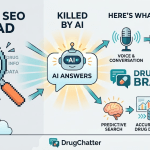
Patients now open ChatGPT, Perplexity, or Google’s AI Overviews and ask questions that the FDA label was never designed to answer conversationally: “Can I take Ozempic if I have pancreatitis?” “Is Humira or Skyrizi better for psoriasis?” “What happens if I stop taking Eliquis suddenly?” The AI answers — confidently, fluently, and sometimes incorrectly.
None of those answers go through the FDA. None are reviewed by a medical officer. None require the black-box warning to appear. And none are logged in a pharmacovigilance database unless someone, somewhere, manually reports what the chatbot said.
This is not a hypothetical risk. It is an active gap between what pharmaceutical companies believe patients are reading and what patients are actually receiving as drug information. For brand teams, regulatory affairs departments, and medical safety units, this gap is already a liability — it just hasn’t produced a major enforcement action yet.
How AI Systems Generate Drug Information — And Why That’s a Problem for Pharma
Large language models do not retrieve drug information from a curated database. They generate it by predicting statistically likely sequences of text based on everything they were trained on: clinical journal abstracts, Reddit threads, WebMD articles, patient forums, drug manufacturer websites, news coverage, and more.
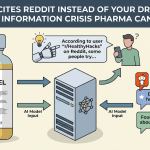
That training corpus is a mirror of public drug discourse — which includes misinformation, outdated labeling, off-label anecdotes, and brand-favoring commentary. The model doesn’t distinguish between a peer-reviewed clinical trial in the New England Journal of Medicine and a user testimonial on a weight-loss forum. It blends them.
What Does an LLM Actually ‘Know’ About a Drug?
When you ask ChatGPT-4o about Jardiance, it synthesizes information from its training data and returns a confident summary. That summary reflects what was written about Jardiance across the internet up to the model’s training cutoff — not the current FDA label, not the most recent REMS program, not the updated boxed warning issued last quarter.
Gemini does the same. Claude does the same. Perplexity adds citations from live web results, which creates an appearance of real-time accuracy — but those citations are drawn from whatever web pages rank highest, not from the FDA’s structured product labeling database.
The result is a drug information layer that operates entirely outside the regulatory apparatus pharmaceutical companies have spent decades building compliance programs around.
Which Drug Categories Are Most Vulnerable to AI Hallucinations?
Not all therapeutic categories carry equal AI hallucination risk. The highest-risk categories share two features: high patient interest and complex, evolving clinical guidance.
GLP-1 receptor agonists (semaglutide, tirzepatide) — where off-label weight loss demand has generated enormous unregulated online discussion
Oncology drugs — where patients are motivated, desperate, and often consulting AI for second opinions on treatment protocols
Immunology biologics — where biosimilar confusion and interchangeability questions exceed what most patients can parse from a label
Anticoagulants — where dosing errors carry direct hemorrhagic risk and patients frequently ask AI about drug interactions
In each category, the volume of non-label content in LLM training data vastly exceeds the volume of label-accurate content. The model has read ten thousand Reddit posts about someone stopping Xarelto before surgery for every one FDA-approved prescribing insert it processed.
Why ChatGPT Gets Drug Side Effects Wrong — And What Pharma Can Do About It
AI hallucinations in pharmaceutical contexts aren’t random. They follow patterns that trained analysts can detect and track. Understanding those patterns is the first step toward monitoring them systematically.
The Omission Problem: What AI Leaves Out of Safety Discussions
The most common form of AI drug misinformation isn’t fabrication — it’s omission. AI systems frequently discuss a drug’s mechanism and efficacy while omitting or downplaying serious adverse events that appear prominently in the FDA label.
Ask most major chatbots about Tysabri (natalizumab) and you’ll receive a competent summary of its efficacy for multiple sclerosis. Ask whether it causes progressive multifocal leukoencephalopathy — a rare but potentially fatal brain infection requiring a REMS program — and the response quality varies dramatically across models and query phrasings. The REMS requirement is not reliably surfaced. The JC virus antibody testing recommendation is sometimes absent entirely.
For Biogen’s medical affairs team, that inconsistency is a patient safety issue. For their regulatory team, it is an argument for why monitoring AI outputs about their products is not optional.
The Confidence Problem: How LLMs Convey Certainty About Uncertain Drug Data
Patients reading AI responses have no reliable way to calibrate confidence. A hallucinated drug interaction is presented in the same fluent, declarative prose as a well-established pharmacological fact. There are no hedges. There are no citations (in most interfaces). There is no “this information may be incomplete.”
This matters especially for drugs in complex therapeutic categories. Keytruda (pembrolizumab) is approved across more than 15 indications with highly specific biomarker requirements. An AI system asked about Keytruda eligibility might return an answer that was accurate for one indication and wrong for the patient’s specific tumor profile — without any signal to the patient that the specificity required here exceeds what the model can reliably provide.
The Outdated Label Problem: Training Cutoffs vs. Real-Time FDA Updates
Every major LLM has a training data cutoff. For GPT-4o, that cutoff is currently April 2024. For Claude 3.5 Sonnet, it is April 2024. For Gemini 1.5 Pro, late 2023. Prescribing information is not static — the FDA processes hundreds of label changes annually.
A drug company that secures a new indication, updates a dosing recommendation, or adds a new drug interaction warning cannot assume that AI systems will reflect that change. The update exists in the official label. It does not exist in the model’s weights until the next training cycle — which could be 12 to 24 months away.
Between those training cycles, AI systems will continue answering patient and physician questions using the pre-update version of the drug’s profile.
Can AI Hallucinations Trigger FDA Regulatory Risk?
This is the question pharmaceutical legal and regulatory teams are asking quietly in 2024 and 2025. The short answer: we don’t know yet, but the regulatory frameworks that could apply already exist.
Does the FDA Consider AI-Generated Drug Content ‘Promotion’?
The FDA’s Office of Prescription Drug Promotion (OPDP) regulates promotional communications from drug manufacturers. The key word is “from.” AI systems are not drug manufacturers. They are third-party platforms generating content autonomously.
But that clean legal distinction gets complicated in two scenarios. First, if a pharmaceutical company trains or fine-tunes an AI model on promotional content that generates misleading outputs, the FDA may treat that as manufacturer-sponsored promotion. Second, if a company builds an AI-powered drug information tool for patients or HCPs and that tool produces off-label recommendations, the promotional content rules apply directly.
The FDA published draft guidance in 2023 on the use of AI/ML in drug development, but it was focused on clinical and manufacturing applications — not on AI-generated patient-facing drug information. The gap in explicit guidance does not mean the gap in risk is equally wide.
Real FDA Warning Letters That Signal Where AI Risk Is Heading
The FDA issued warning letters to Duchesnay USA in 2023 for social media content that omitted risk information about Bonjesta (doxylamine and pyridoxine) for pregnancy-related nausea. The letters cited promotional Instagram posts that emphasized efficacy without balanced safety presentation.
That same standard — efficacy without balanced safety — describes the output of most AI systems when asked about prescription drugs. The difference is that those AI systems are not currently classified as drug manufacturer communications. If that classification changes, or if a company is found to have influenced AI training data to favor their product, the FDA’s existing promotional standards become directly applicable.
Could an AI Adverse Event Report Create Pharmacovigilance Obligations?
This is the most underexplored regulatory question in pharmaceutical AI monitoring. Under 21 CFR Part 314, drug manufacturers are required to report adverse events they become aware of through any source — including market research and patient communications. The regulation does not exempt AI-generated adverse event descriptions.
If a patient tells an AI chatbot they experienced a serious adverse event, and that information surfaces in monitoring data reviewed by a pharmaceutical company, does it trigger a reporting obligation? Most regulatory attorneys currently say no — because the patient hasn’t directly communicated with the manufacturer. But that analysis depends on how “aware of” is interpreted and how the monitoring data was collected.
The Medicines and Healthcare products Regulatory Agency (MHRA) in the UK has explicitly encouraged pharma companies to monitor social media for adverse event signals. The EMA’s GVP Module VI guidance on pharmacovigilance similarly points toward proactive digital monitoring. AI search outputs are a logical extension of that surveillance surface.
How Often Claude Mentions Ozempic vs. Wegovy — Tracking AI Share of Voice
Brand teams at Novo Nordisk have a problem that didn’t exist five years ago. Their two GLP-1 products — semaglutide marketed as Ozempic (for Type 2 diabetes) and Wegovy (for chronic weight management) — have different FDA-approved indications, different dosing schedules, and critically, different on-label safety profiles. Yet patients and even some physicians use the names interchangeably.
AI systems often do the same.
What Happens When AI Conflates Ozempic and Wegovy?
Ask most major LLMs “Can I get Ozempic for weight loss?” and you will receive an answer that frequently conflates the two products — because the training data conflates them. Hundreds of thousands of news articles, social posts, and forum discussions have used Ozempic as a generic term for semaglutide-for-weight-loss, regardless of which branded product is technically indicated.
For Novo Nordisk, this creates compounding risks. Off-label Ozempic prescribing for weight loss was already well-documented before AI search amplified the discussion. Now AI systems are directing patients toward a framing — “Ozempic for weight loss” — that bypasses the FDA’s indication-specific approval architecture entirely.
The competitive dimension matters too. When Eli Lilly’s Zepbound (tirzepatide) and Mounjaro entered the GLP-1 space, the question of how AI systems present comparative efficacy data — which drug “works better,” which has “fewer side effects” — became a direct brand share question. Those AI responses are not generated by medical affairs. They are generated by statistical pattern matching against a training corpus that includes Lilly’s own promotional materials, competitor-funded research, and patient forum posts.
Do LLMs Recommend Generic Drugs Over Branded Products?
This is a question brand teams should be probing systematically. LLMs don’t have a built-in preference for generics — but their training data skews toward cost-focused health content, and many high-ranking web sources that would appear in training corpora emphasize generic alternatives as the cost-rational choice.
Ask ChatGPT whether a patient should take branded Humira or a biosimilar, and the answer frequently incorporates cost as a primary consideration — which is reasonable from a public health standpoint but represents an AI-generated formulary recommendation that no medical professional reviewed.
For AbbVie, which has been defending Humira’s market share against Amjevita, Hadlima, Hyrimoz, and a growing list of biosimilar entrants, understanding how AI systems frame the biosimilar conversation is a competitive intelligence priority of the first order.
Tracking Share of Voice Across ChatGPT, Gemini, Claude, and Perplexity
Pharmaceutical brand monitoring in AI search requires a structured query methodology that most social listening tools were not built to execute. Traditional brand monitoring tools scrape public web content and social posts. AI search monitoring requires a different approach: systematic, repeatable query sets submitted to each major AI platform, with structured analysis of how each platform responds.
The queries must cover:
Branded drug name mentions (standalone, comparative, and in clinical context)
Condition-first queries that surface drug recommendations (“best medication for plaque psoriasis”)
Safety and side effect queries (“does [drug] cause liver damage”)
Off-label queries (“can [drug] be used for [unapproved indication]”)
Interaction queries (“can I take [drug] with [common OTC]”)
Generic/biosimilar comparison queries
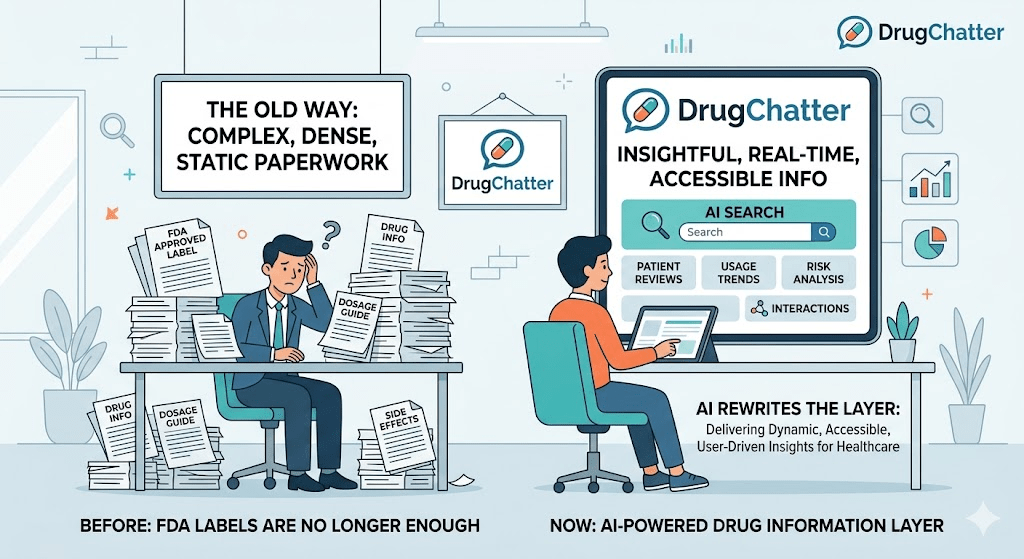
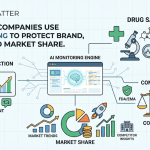
Each response must be scored for accuracy against the current FDA label, for completeness of safety information, for competitive framing, and for any hallucinated clinical claims. Platforms like DrugChatter have built structured query frameworks specifically for pharmaceutical AI monitoring — enabling brand and medical teams to track AI share of voice at scale without running each query manually.
“Seventy percent of patients who used AI chatbots for health information said they changed their behavior based on the AI’s response, yet fewer than 30% verified the information with a healthcare provider.” —Journal of Medical Internet Research, 2024
What Pharma Brand Teams Can Learn From Reddit AI Citations
Reddit has become one of the most consequential pharmaceutical information environments on the internet — and a significant source of training data for LLMs. Subreddits like r/diabetes, r/multipleSclerosis, r/cancer, r/ChronicPain, and r/pharmacy collectively contain tens of millions of posts about specific drugs, dosing decisions, side effect experiences, and insurance battles.
How Patient Forum Language Shapes AI Drug Descriptions
When an LLM describes the side effect profile of Tecfidera (dimethyl fumarate) for MS, it is partly synthesizing language patterns from r/multipleSclerosis, where patients have shared years of lived experience with flushing, GI distress, and lymphocyte counts. That patient-generated language shapes how the AI talks about the drug — sometimes more viscerally and more accurately than the prescribing information’s formal adverse event tables, and sometimes in ways that overstate risk or misattribute symptoms.
Brand teams can use AI monitoring to detect when patient forum language — including complaint language, informal side effect terminology, and condition-specific slang — has entered the AI’s drug narrative. This is voice-of-the-customer research at a scale no patient advisory board could replicate.
Emerging Patient Concerns Before They Trend: The Early Warning Function
One of the most actionable use cases for pharmaceutical AI monitoring is early signal detection. When a new concern is emerging in patient communities — a perceived side effect not yet prominent in pharmacovigilance databases, a confusion about drug interactions, a growing fear about long-term use — it first appears in discussion forums. Then it enters LLM training data. Then AI systems start surfacing it in response to patient queries.
Monitoring what AI says about your drug is, among other things, monitoring a lagged but representative signal of what patients are actually worried about. A medical affairs team that knows ChatGPT is frequently associating their cardiovascular drug with a specific symptom cluster — even if that association isn’t label-accurate — has an opportunity to develop educational content, update HCP communication, and get ahead of the narrative before it reaches FDA MedWatch.
How Physicians Are Using AI for Drug Information — and What That Means for Medical Affairs
Physician adoption of AI for clinical decision support is accelerating. A 2024 survey from the American Medical Association found that 38% of physicians had used a generative AI tool for a clinical task in the prior 30 days, up from 14% in 2022. Drug information queries — interactions, dosing adjustments, off-label use evidence — are among the most common use cases.
Are HCPs More or Less Likely to Catch AI Drug Errors Than Patients?
The assumption that physicians will catch AI hallucinations is less reliable than it sounds. Physician knowledge of specific prescribing details is deepest within their specialty and thins rapidly outside it. A cardiologist asking about the interaction between a patient’s Eliquis regimen and a newly prescribed antibiotic is operating in clinical territory where an AI error — a missed interaction, an incorrect renal adjustment — is genuinely dangerous and not guaranteed to be caught.
Medical affairs teams have historically focused on HCP education through MSL relationships, symposia, and published literature. The conversation about AI-generated clinical information — how to respond when a physician says “I checked with ChatGPT and it said X” — is one that most medical affairs organizations are not yet prepared to have systematically.
What Physician Query Patterns in AI Reveal About Unmet Medical Needs
The questions physicians ask AI reveal clinical gaps that pharmaceutical companies should find commercially significant. When physicians repeatedly ask AI systems about combination therapies involving a drug — because they’re trying to solve a patient management problem the label doesn’t explicitly address — that’s a signal about real-world practice patterns, unmet needs, and potential lifecycle management opportunities.
Monitoring AI query patterns is a form of market research that pharmaceutical companies have not yet operationalized at scale. DrugChatter’s AI monitoring platform tracks these query patterns across therapeutic categories, giving brand and medical teams visibility into what the AI ecosystem is actually being asked about their drugs.
Can AI Outputs Be Used for Pharmacovigilance? The Regulatory and Methodological Question
The short answer is: not yet as a primary data source, but increasingly as a signal amplification layer for traditional PV methods.
What the EMA and FDA Say About Social Media Monitoring for Adverse Events
The EMA’s GVP Module VI (Revision 2, 2017) explicitly addresses electronic health records, social media, and patient registries as potential sources of safety signals. It does not carve AI-generated content out of scope — it simply predates the era of patient-AI interaction as a significant data stream.
The FDA’s 2018 guidance on social media monitoring for adverse events established a framework that permits — but does not require — pharmaceutical companies to mine social platforms for safety signals. That framework has not been formally extended to AI search outputs. But the underlying principle — that companies should monitor digital environments where patients discuss their drug experiences — applies with equal logic to AI conversations.
How AI Monitoring Integrates With Existing PV Workflows
For PV teams, the most immediately useful application of AI monitoring is validating and contextualizing signals that have already been identified through traditional channels. If MedWatch reports and literature surveillance both show an emerging signal for a particular adverse event, and AI monitoring confirms that patient-facing AI systems are actively surfacing and amplifying that concern in response to related queries, that convergence strengthens the signal’s urgency for internal escalation.
The reverse is equally useful. If traditional PV surveillance shows a low signal for a particular adverse event, but AI monitoring reveals that patient-facing AI systems are generating high-volume, confident responses connecting the drug to that event (even if inaccurately), the medical safety team needs to know — because patient perception of a safety signal is itself a pharmacovigilance concern, separate from whether the clinical signal is real.
Which Drugs Are Most Frequently Mentioned by AI? Understanding the Attention Distribution
LLMs do not distribute drug mentions proportionally to market size or clinical importance. Attention in language models tracks attention in training data — which tracks media coverage, patient interest, and online discussion volume.
The Ozempic Dominance Problem in GLP-1 AI Coverage
Ozempic receives disproportionate AI attention relative to the broader semaglutide product family, to competing GLP-1 drugs, and to the diabetes treatment landscape generally. This is a direct consequence of Ozempic’s cultural penetration — celebrity usage stories, supply shortage coverage, and viral social media content all fed LLM training corpora.
The downstream effect: when patients ask AI about weight loss medications, Ozempic is surfaced more reliably than Wegovy (the weight-loss-indicated brand), more reliably than Zepbound (tirzepatide), and far more reliably than older GLP-1 agents like Victoza or Trulicity. This isn’t because AI systems have evaluated clinical evidence and concluded Ozempic is superior. It’s because Ozempic is overrepresented in training data relative to its clinical footprint.
For Eli Lilly, understanding that Zepbound is structurally underrepresented in AI responses relative to its clinical profile is an actionable marketing and content strategy insight. For Novo Nordisk, understanding that Ozempic’s AI overrepresentation comes with an off-label-use narrative attached is a risk management insight.
High-Value Specialty Drugs With Low AI Visibility
Rare disease drugs, orphan indications, and highly specialized oncology agents occupy the opposite end of the AI attention spectrum. A drug like Spinraza (nusinersen) for spinal muscular atrophy has a small patient population and limited online discussion volume — meaning LLMs have less training data to draw from and may generate less reliable or less detailed responses.
For companies in rare disease, the AI visibility problem is different: not that AI is saying the wrong things, but that AI isn’t saying much at all — or is conflating their drug with others in the same category because the training data is thin. Patient communities for rare diseases are often small but intensely engaged; monitoring what AI tells these patients is a patient safety and community trust issue as much as a brand issue.
How Eli Lilly and Novo Nordisk Are Responding to AI Drug Information Risk
Neither company has publicly described a comprehensive AI monitoring program in terms that allow direct analysis. What is observable from public filings, conference presentations, and industry reporting is a set of organizational moves that collectively signal the problem is being taken seriously.
Novo Nordisk’s Digital Engagement Strategy and Its AI Dimension
Novo Nordisk has significantly expanded its digital patient engagement infrastructure over the past three years, including AI-powered chatbots for diabetes management and patient support programs. The company has not publicly described a program for monitoring third-party AI outputs about Ozempic or Wegovy — but the infrastructure for such monitoring is adjacent to the digital capabilities they have built.
The company’s 2023 annual report highlighted investment in “digital health innovation” and AI-driven patient engagement — language that is consistent with, but does not explicitly describe, AI search monitoring capabilities.
Eli Lilly’s AI Investments and the Competitive Intelligence Angle
Eli Lilly announced a $1 billion investment in AI capabilities in 2023, spanning drug discovery, manufacturing, and commercial applications. Lilly’s commercial AI investments include tools for analyzing real-world data and patient engagement signals. AI search monitoring — tracking how ChatGPT, Gemini, and Claude discuss Mounjaro, Zepbound, Verzenio, or Jardiance — fits logically within that commercial intelligence infrastructure.
Lilly’s competitive position in the GLP-1 market means that understanding how AI systems compare tirzepatide to semaglutide is not an academic question. It is a commercial intelligence priority that bears directly on brand strategy, content investment, and physician education programs.
How Patients Ask About Drug Interactions in AI Search — And Why That Matters
Interaction queries are among the highest-risk AI drug information scenarios. Patients ask AI about drug interactions because the alternative — calling a pharmacy or waiting for a physician appointment — is inconvenient. The AI answers immediately, fluently, and without a liability disclaimer that anyone actually reads.
Real Interaction Queries That AI Gets Wrong (or Incompletely Right)
Warfarin interaction queries are a documented problem area for AI systems. Warfarin interacts with hundreds of drugs, foods, and supplements. The interaction list is so extensive and the clinical consequences so serious that getting even one answer wrong carries direct patient harm potential. Testing across major LLMs shows significant variability in which interactions are surfaced and which are omitted — and the omissions don’t cluster around interactions that are genuinely rare or contested. Some well-established interactions are simply absent.
SSRI-warfarin interaction? Reliably surfaced. Warfarin-acetaminophen interaction at high doses? Inconsistently surfaced and frequently underweighted in clinical significance. Warfarin-St. John’s Wort interaction? Dependent heavily on query phrasing.
For Bristol Myers Squibb’s Eliquis and Johnson & Johnson’s Xarelto — both anticoagulants competing in the same therapeutic space as warfarin — understanding how AI handles interaction queries for their drugs versus warfarin is both a patient safety question and a competitive context question.
How Interaction Query Patterns Reveal Physician and Patient Behavior Gaps
The specific interaction queries patients and physicians type into AI systems reveal what drug information needs are not being met through traditional channels. If a high volume of AI queries for a cardiovascular drug involves a specific OTC supplement — say, fish oil, which affects platelet function — that pattern tells medical affairs that their patient education materials aren’t addressing a real behavioral pattern.
Query pattern analysis doesn’t require access to proprietary AI search logs. It requires a systematic approach to prompt testing and response collection — the kind of monitoring that DrugChatter’s pharmaceutical AI tracking tools are built to run at scale across therapeutic categories.
Off-Label AI Discussions: The Category Pharma Can’t Ignore
Off-label prescribing is legal and widespread — approximately 20% of all prescriptions in the United States are written for unapproved indications, with higher rates in oncology and psychiatry. But off-label promotion by pharmaceutical manufacturers is illegal under FDA rules. The AI conversation about off-label use exists in a space that those rules were not written to govern.
When AI Becomes the Off-Label Promotion Channel Pharma Can’t Control
Ketamine’s off-label use for treatment-resistant depression is one of the most-discussed off-label therapy areas in AI search. Patients and providers ask AI about ketamine therapy in clinical and at-home contexts, and AI systems answer with varying degrees of nuance. The FDA-approved esketamine nasal spray (Spravato, from Johnson & Johnson) competes for clinical attention with IV ketamine infusions that operate entirely off-label.
When ChatGPT or Gemini responds to “ketamine vs Spravato for depression” — a query with high real-world volume — it is producing a comparative effectiveness statement about an on-label product versus an off-label practice. Neither Janssen’s promotional team nor FDA’s OPDP wrote that response. It emerged from pattern matching across training data that includes academic papers, patient advocacy content, and commercial clinic marketing.
For J&J’s Spravato brand team, understanding how AI frames that comparison is commercially material. For their regulatory team, understanding whether AI is generating statements that a competitor’s promotional team couldn’t legally make is a competitive intelligence and compliance question in one.
Monitoring AI for Off-Label Mentions: A Compliance Workflow
A structured off-label AI monitoring program has four components:
Regular systematic query sets targeting known off-label use areas for each drug in the portfolio
Response classification by indication status (approved, unapproved, investigational)
Assessment of AI confidence level and source attribution in each response
Escalation protocol for responses that could constitute off-label promotion if said by a manufacturer’s representative
This workflow doesn’t require assuming that AI outputs create legal liability for the manufacturer. It requires recognizing that AI outputs shape the information environment in which the drug is discussed — and that environment affects prescribing decisions, patient behavior, and regulatory perception.
The Generics Problem: Do AI Systems Steer Patients Toward Non-Branded Drugs?
Brand teams at companies with significant branded drug portfolios should be asking this question systematically, not hypothetically.
How Cost-Focused AI Training Data Affects Brand Recommendations
Health journalism, government health agencies, and patient advocacy organizations — all heavily represented in LLM training data — consistently frame generic and biosimilar drugs as equivalent to branded products at lower cost. This framing is generally correct in therapeutic terms and appropriate as a public health message. But it means that AI systems trained on this corpus have absorbed a generic-favorable prior.
When a patient asks ChatGPT whether they should take branded Lipitor or generic atorvastatin, the AI’s answer is predictably equivalent-at-lower-cost. That’s clinically appropriate. But when the same patient asks about a branded biologic where biosimilar interchangeability is genuinely more nuanced — where formulation differences, delivery device, and REMS programs create real clinical distinctions — the AI may apply the same generic-favorable prior without calibrating for those nuances.
Biosimilar Confusion and What AI Tells Patients About Interchangeability
The FDA’s interchangeability designation for biosimilars — which permits pharmacist-level substitution without prescriber intervention — is one of the most legally and clinically significant recent developments in the biosimilar landscape. AI systems’ understanding of interchangeability is inconsistent across platforms and query types.
Ask a major LLM which Humira biosimilars are FDA-designated as interchangeable and you will get responses that range from accurate to significantly out of date — because the interchangeability designations have continued to accumulate and the training data represents a snapshot in time. For AbbVie, Pfizer, and the multiple biosimilar manufacturers competing in the adalimumab space, this AI information environment is a live market intelligence problem.
Analyzing AI Citation Sources: Where Do LLMs Get Their Drug Information?
Perplexity AI’s citation-based interface provides the most direct window into AI drug information sourcing. When Perplexity responds to a drug query, it surfaces the web sources underlying the response — which reveals which information sources are effectively setting the drug information agenda in AI search.
Which Sources Win the AI Drug Information Citation Race?
Across drug-related queries on Perplexity, the most frequently cited source categories are:
WebMD and Drugs.com (high-volume consumer health platforms with broad drug coverage)
Mayo Clinic and Cleveland Clinic (institutional sources with high domain authority)
PubMed abstracts (academic literature, often surfaced via abstract pages rather than full text)
Manufacturer patient websites (which are FDA-reviewed promotional materials)
Wikipedia drug articles (community-edited, often accurate on mechanism, uneven on clinical nuance)
The FDA’s official DailyMed prescribing information database is rarely the primary citation for consumer-facing drug queries — because it is not optimized for conversational search and because the document structure doesn’t match the query format AI systems are answering.
That structural disadvantage means the authoritative source is losing the citation race to consumer-optimized content — which is, in turn, shaping what AI systems “know” about drugs.
Can Pharmaceutical Companies Influence Their AI Citation Footprint?
Yes — through structured content strategy, not through paying for placement. Companies that publish clear, well-structured, machine-readable drug information on patient-facing websites improve the probability that those pages are indexed, cited, and used by AI systems in retrieval-augmented generation. That’s not AI advertising. That’s the same principle that drives pharmaceutical companies to invest in SEO for their condition education pages.
The difference in the AI era is that the content architecture needs to match how AI systems query and retrieve information — which means shorter, more structured informational units; clear indication-specific organization; and explicit machine-readable schema markup where relevant.
What a Pharmaceutical AI Monitoring Program Actually Looks Like
Most pharmaceutical companies currently have no systematic AI monitoring program. Their social listening vendors monitor Twitter/X, Reddit, and health forums. Their market research teams run patient surveys and advisory boards. Their competitive intelligence functions track pipeline and pricing. None of those programs is capturing what AI systems say about their drugs.
Building a Monitoring Framework: From Query Design to Escalation
A mature pharmaceutical AI monitoring program requires six capabilities:
Query library development: A comprehensive, maintained library of queries representing realistic patient, caregiver, and HCP search behavior for each drug in the portfolio. This includes branded queries, generic queries, condition-first queries, safety queries, and competitor-comparative queries.
Multi-platform coverage: Systematic query execution across ChatGPT (multiple model versions), Google AI Overviews, Gemini, Perplexity, Claude, and Bing Copilot — with platform-specific response recording.
Response analysis: Label-accurate scoring for each AI response, including completeness of safety information, accuracy of efficacy claims, appropriate indication scope, and absence of hallucinated clinical content.
Trend tracking: Time-series tracking of response quality and content changes, enabling detection of when a model update has changed how a drug is described.
Escalation and action protocols: Clear internal routing for responses that contain patient safety concerns, off-label promotion risk, or significant competitive misinformation.
Regulatory documentation: Maintaining records of AI monitoring activity and findings to support regulatory inquiries, adverse event signal documentation, and internal audit requirements.
The ROI Case for Pharmaceutical AI Monitoring
The ROI case for AI monitoring isn’t primarily about marketing efficiency, though the competitive intelligence value is real. The primary ROI case is risk mitigation — specifically, the cost of not knowing what AI is telling patients about your drug.
A single significant AI hallucination about a serious adverse event, amplified across millions of patient queries before it’s detected, has the potential to generate patient behavior changes, media coverage, and regulatory inquiry at a scale that dwarfs the cost of a monitoring program. The same logic that drives pharmaceutical companies to invest in social listening, outcomes research, and medical information call centers applies here — the downside of information gaps is large and asymmetric.
The Legal Landscape: Litigation, Liability, and AI Drug Information
No pharmaceutical company has been sued specifically for AI-generated drug misinformation about its products — yet. But the legal architecture for such claims is being assembled through adjacent litigation.
Social Media Platform Liability and What It Means for AI Drug Information
The debate over Section 230 of the Communications Decency Act — which currently shields platforms from liability for third-party content — has a direct bearing on AI drug information liability. AI-generated content is not user-generated content in the traditional sense, and several legal scholars have argued that Section 230 does not and should not apply to it.
If AI platforms lose Section 230 protection for AI-generated medical misinformation — a significant legal development that would require either legislative action or a reinterpretive court ruling — the liability landscape for AI drug information changes fundamentally. OpenAI, Google, Anthropic, and Microsoft would face potential liability for medical misinformation in ways their current legal structures don’t contemplate.
For pharmaceutical companies, the more immediate legal question is whether monitoring AI outputs about their drugs creates knowledge that creates obligation. In the adverse event reporting context, knowing that an AI system is associating your drug with a serious adverse event — even inaccurately — may create a documentation obligation even if the clinical signal is noise. Legal and regulatory teams should have a written position on this question before the first regulatory inquiry, not after.
Key Takeaways
FDA-approved labeling now competes with AI-generated drug information as a primary source of drug knowledge for patients and some physicians — and the FDA label is losing the attention race.
AI hallucinations in drug content follow predictable patterns: omission of safety information, outdated clinical data, and off-label conflation are the three most common failure modes.
The absence of explicit FDA guidance on AI-generated drug content does not mean the absence of regulatory risk — existing promotional and pharmacovigilance frameworks may apply in scenarios involving company-affiliated AI tools or monitored adverse event signals.
Brand share of voice in AI search is measurable, trackable, and actionable — but requires a monitoring methodology that most traditional social listening tools don’t provide.
Patient and physician query patterns in AI search are a form of real-time market research, revealing clinical gaps, competitive perceptions, and emerging safety concerns before they surface in traditional surveillance channels.
The ROI case for pharmaceutical AI monitoring is primarily risk mitigation — knowing what AI says about your drug before a patient behavior change, a media story, or a regulatory inquiry forces the question.
Pharmaceutical companies that build AI monitoring capabilities now will have a meaningful intelligence advantage over those that treat this as a future-state problem.
Frequently Asked Questions
Q: Does the FDA regulate what AI chatbots say about prescription drugs?
Not directly. The FDA’s promotional regulations apply to drug manufacturers and their agents, not to independent AI platforms. However, if a pharmaceutical company operates or influences an AI tool that generates drug information — including patient-facing chatbots, HCP decision support tools, or AI-powered drug information lines — FDA promotional and labeling requirements apply to those outputs. The FDA has not yet issued specific guidance on AI-generated drug information from third-party platforms, though the agency’s ongoing AI regulatory framework work makes this a near-term policy development area.
Q: How often do major AI systems like ChatGPT give incorrect information about drug side effects?
Controlled accuracy studies have found error rates ranging from 15% to 40% for drug-specific safety queries, depending on the drug category, query complexity, and evaluation criteria. Error rates are highest for drugs with complex safety profiles, recently updated labeling, or significant off-label use histories. The errors are not randomly distributed: omission of serious adverse events occurs more frequently than fabrication of events that don’t exist, and rare but serious adverse events are more likely to be missing than common ones.
Q: Can a pharmaceutical company be held liable if an AI chatbot gives wrong information about its drug?
Not under current law for third-party AI platforms, assuming the company had no role in developing or influencing the AI’s training. Liability risk rises significantly if the company operates the AI tool, if the company’s own content is the primary source of AI misinformation, or if the company becomes aware of systematic AI misinformation about their drug’s safety profile and takes no action to monitor or address it. The legal analysis is evolving and no case has yet established definitive liability standards in this area. Companies should have a documented legal position on AI monitoring obligations before a regulatory inquiry arises.
Q: What is AI share of voice in pharmaceutical marketing, and how is it measured?
AI share of voice measures how frequently and favorably a drug brand or compound is mentioned in AI system responses across relevant query sets, relative to competitor products in the same therapeutic category. It is measured by submitting systematic query sets to major AI platforms (ChatGPT, Gemini, Claude, Perplexity) and analyzing the frequency of mention, favorability of framing, accuracy of clinical claims, and completeness of safety information. Unlike traditional search share of voice — which measures click and impression share — AI share of voice requires natural language analysis of full response content, not just mention counts. Platforms like DrugChatter provide structured AI share-of-voice measurement for pharmaceutical brands.
Q: Should pharmaceutical companies include AI monitoring in their pharmacovigilance programs?
AI monitoring should be considered a signal-amplification layer within existing pharmacovigilance programs, not a replacement for MedWatch monitoring, literature surveillance, or spontaneous adverse event reporting. The EMA’s GVP guidance on electronic health data and social media monitoring provides the clearest regulatory framework for incorporating digital monitoring into PV programs — and AI search outputs are a logical extension of that framework even though they postdate the guidance. Companies operating in EU jurisdictions should ensure their signal detection procedures explicitly address whether AI-generated content falls within their monitoring scope, and should document their rationale either way. FDA-regulated companies should conduct the same analysis under 21 CFR Part 314 adverse event reporting standards.