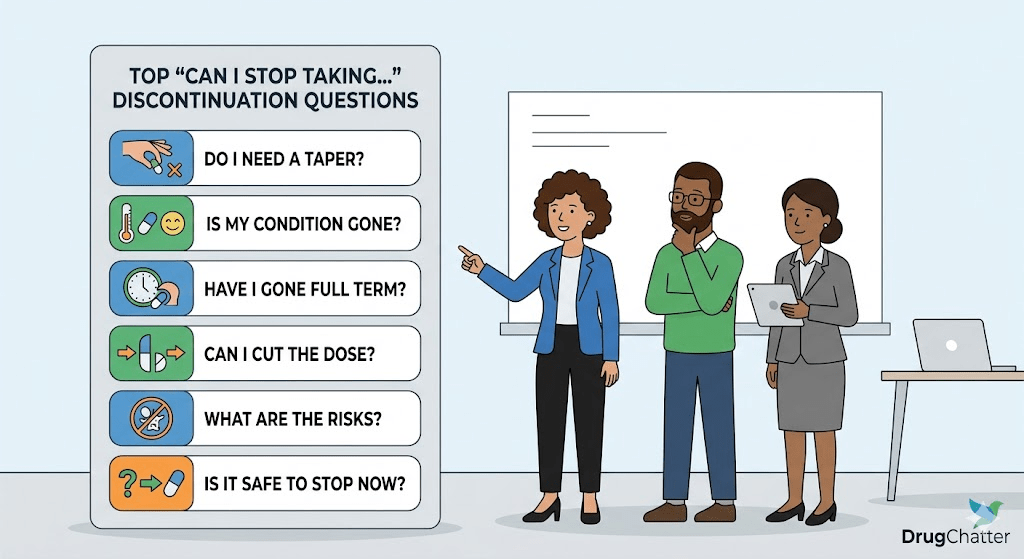
There are two kinds of medication questions: the ones you ask because you’re curious, and the ones you ask because you’re already thinking about stopping. The second category tends to cluster around the same anxious phrase—“Can I stop taking…?”—and then, inevitably, around the same practical follow-ups: what happens if you stop, what happens if you miss a dose, and whether you can safely “replace” the drug with something else.
Below are some of the most common discontinuation-adjacent questions, gathered from DrugChatter threads. They’re not all literally “stop taking” questions, but they orbit the same gravity: the fear that the drug is optional, temporary, or negotiable.
1) “Can I stop taking Lipitor?” (Or at least, can I swap it out?)
Statins are the poster child for the “I feel fine—so maybe I don’t need it” impulse. The DrugChatter threads around Lipitor often start with lifestyle substitutions—alcohol, dairy, red wine, supplements—and end up at the same place: the medication is doing something specific, and your body doesn’t treat “mostly” as “enough.”
2) “Can I stop taking Ozempic?” (Or: can I just change the schedule?)
GLP-1 drugs have a special kind of discontinuation anxiety: people don’t just worry about side effects—they worry about weight regain and appetite returning. Even when the question isn’t phrased as “stop,” the underlying thought is the same: if I tweak timing, do I get to tweak outcomes?
3) “Can I stop taking prednisone?” (Or: will it stop me from sleeping?)
Prednisone is often treated like a short-term tool—until it isn’t. The discontinuation question here is less about “withdrawal” and more about the lived reality of steroid side effects: if it’s keeping you awake, you start bargaining with the plan.
4) “Can I stop taking the patch?” (Discontinued products and the fear of interruption)
Sometimes the discontinuation question isn’t about choice—it’s about supply. When a product is discontinued, the question becomes: what now, and how abrupt is the change?
5) “Can I stop taking something because it’s expensive?” (The cost-driven cliff)
Cost is a silent driver of discontinuation. People don’t always say it out loud, but the subtext is: if I can’t afford it, I’ll have to stop—so what’s the safest way? DrugChatter threads reflect that reality across many drugs.
6) “Can I stop taking it because I’m worried about side effects?”
Side effects are the other big discontinuation trigger. Sometimes the question is direct; sometimes it’s a proxy—mood, sleep, interactions—anything that makes the drug feel less tolerable than the condition it’s treating.
7) “Can I stop taking it because I’m not sure how it works?”
When people don’t understand the mechanism, they’re more likely to treat the medication as optional. That’s why “how it works” questions—especially about newer or less familiar drugs—show up alongside discontinuation anxiety.
8) The “discontinuation” question that isn’t about stopping at all: interactions
Sometimes the safest move isn’t stopping—it’s adjusting. But the mind still frames it as discontinuation: if this other thing changes the drug, do I need to stop the drug? DrugChatter threads repeatedly circle the same theme: don’t freestyle.
The discontinuation instinct is understandable: nobody wants to take a drug forever, and nobody wants to feel side effects or uncertainty. But the pattern across these questions is that the “stop” impulse is usually the wrong first step. The better first step is to ask what stopping would actually mean for your specific situation—whether it’s a gradual taper, a substitution, a timing change, or simply a misunderstanding about what foods, drinks, supplements, or other meds do to the drug.
If you’re asking “Can I stop taking…?”, treat it like a planning problem, not a vibe check. The right answer depends on the drug, the dose, how long you’ve been on it, and what it’s treating.