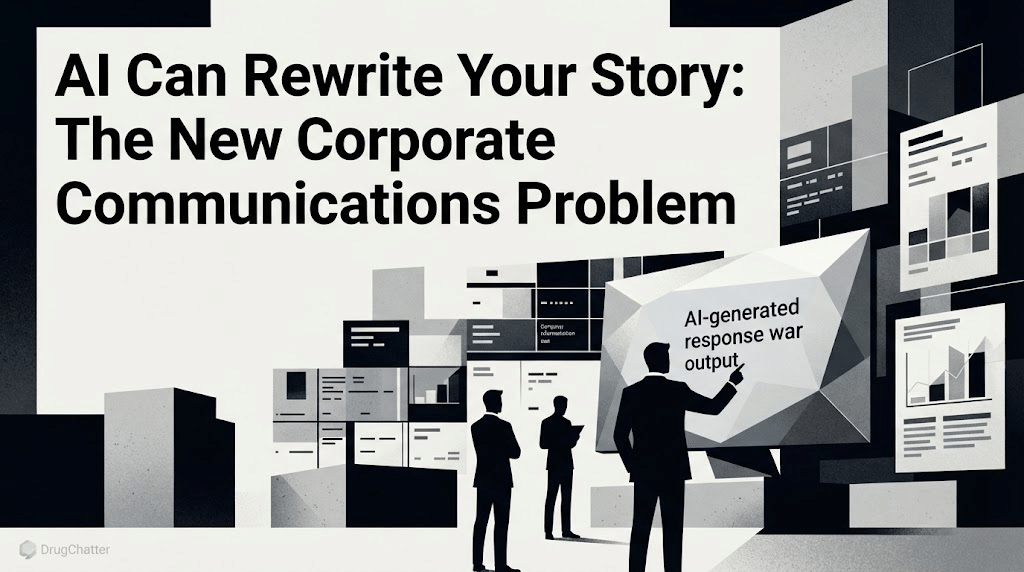
In April 2026, Sullivan & Cromwell — one of the most prestigious law firms on Wall Street — apologized to a federal bankruptcy judge for a court filing built on AI-fabricated citations [1]. Two months later, KPMG pulled a flagship report on agentic AI after an outside investigator found that only five of its 45 citations pointed to real sources, and that the companies KPMG had named as case studies — UBS, the UK’s National Health Service, Swiss Federal Railways — said the claims about their own AI use were false [2][3]. In both cases, the institutions did not lose control of their story to a competitor, a journalist, or an activist. They lost control of it to a tool they had authorized to write on their behalf.
This is the shape of the new corporate communications problem. It is not that AI systems occasionally get facts about a company wrong. It is that AI-generated text — inside the company, describing the company, or citing the company — now moves through the same channels that carry a company’s official narrative, often with no clear seam between the two. For a pharmaceutical, med-comms, or health-tech organization, where every public claim about a product carries regulatory exposure, that seam matters more than in almost any other industry.
The Short Answer
Large language models increasingly generate, summarize, and cite information about companies without a human editor in the loop, and 2025-2026 produced a run of documented cases — at Deloitte, EY, KPMG, and Sullivan & Cromwell — in which AI-fabricated content reached clients, courts, and the public before anyone caught it [1][2][4][5]. Communications teams face this risk from two directions at once: outbound (their own teams or vendors using AI to draft materials that go out under the company’s name) and inbound (AI answer engines summarizing, and sometimes distorting, what already exists about the company across the web). Both directions now fall inside the job description of corporate communications, not just IT risk or legal.
What Changed: From Search Results to Synthesized Answers
Through most of the search-engine era, a corporate communications team’s job was to get accurate information published somewhere a person could find it — a press release, a newsroom page, a media placement — and trust that a search engine would surface it as a link. The reader did the synthesis.
Generative AI collapses that division of labor. When someone asks ChatGPT, Claude, Gemini, or Perplexity what a company does, whether it’s involved in a lawsuit, or what its leadership has said about a product, the system does the synthesis itself and presents a single answer, often without the reader ever visiting a source page. GlobeNewswire’s analysis of more than 8,000 press releases published in 2026 found that 99.3% were cited at least once by ChatGPT or Claude, and that releases built with clear structure and explicit sourcing generated roughly twice as many AI citations as releases that weren’t [6]. The newswire has effectively become a data-feed for language models as much as a distribution channel for journalists.
That shift cuts two ways. It rewards companies that publish clean, well-sourced, unambiguous material — the GlobeNewswire finding suggests structure is now a communications asset, not just a formatting preference. But it also means a company’s “story,” as AI tells it, is assembled from whatever mix of press releases, SEC filings, media coverage, employee reviews, forum posts, and outdated cached pages the model happens to weight most heavily at query time. Nobody in corporate communications approved that mix, and in most organizations nobody is checking it.
What the 2025-2026 Record Shows: AI Didn’t Just Get Facts Wrong, It Got Company Facts Wrong
Four incidents from the past year illustrate the problem at different points in the communications pipeline — drafting, distribution, citation, and legal record.
Deloitte Australia: A Government Report Cited Research That Didn’t Exist
Deloitte Australia was commissioned by the Department of Employment and Workplace Relations to review the “Targeted Compliance Framework,” the government’s automated welfare-penalty system, for a fee of roughly AUD 440,000 [4]. After the report published in July 2025, University of Sydney researcher Chris Rudge found citations to studies that had never been written, including several attributed to a real University of Sydney law professor who confirmed she had never authored them [7]. Deloitte subsequently disclosed that it had used Azure OpenAI’s GPT-4o to help fill “traceability and documentation gaps,” republished a corrected version with the fabricated citations removed, and agreed to refund the government’s final invoice installment [4][7].
KPMG: A Report About AI Adoption Became a Demonstration of AI’s Failure Mode
KPMG’s October 2025 report, “Total Experience: Redefining Excellence in the Age of Agentic AI,” named UBS, Swiss Federal Railways, and Transport for London as examples of enterprise agentic-AI deployments. AI-detection firm GPTZero conducted a forensic citation check in June 2026 and found that only five of the report’s 45 references correctly matched a real source; the rest were fabricated, mismatched, or paraphrased beyond recognition [2][3]. UBS told the Financial Times the claims about its own AI use were “factually incorrect” [3]. GPTZero also flagged an internal contradiction: the report cited a figure claiming 55% of CEOs rank AI as a top investment priority, while KPMG’s own concurrently published CEO Outlook survey put the number at 71% [8]. GPTZero CEO Edward Tian described the risk in blunt terms: fabrications from a firm of KPMG’s stature
“poison the well of information,” increasing “the risk of second-hand hallucinations.”
[3] KPMG withdrew the report and opened an internal review [2].
Sullivan & Cromwell: The Narrative Reached a Federal Court
In April 2026, Sullivan & Cromwell partner Andrew Dietderich wrote to Chief Bankruptcy Judge Martin Glenn of the Southern District of New York disclosing that an emergency motion the firm filed in the Chapter 15 case of Prince Global Holdings Limited contained roughly 40 inaccurate citations, misquoted authorities, and other AI-generated errors [1][9]. Opposing counsel, Boies Schiller Flexner, caught the problem. Dietderich confirmed the firm’s internal AI-verification policy existed but “was not followed” on that filing [9][10]. The episode shows that hallucinated corporate content is not confined to marketing collateral; it can enter the legal record a company’s own outside counsel produces on its behalf, with a federal judge as the immediate audience.
EY Canada: A Client-Facing Report Was Pulled After a Second GPTZero Review
A companion GPTZero investigation into an EY Canada report on retail loyalty-program safeguards found that a majority of its citations were hallucinated, prompting EY to withdraw the report [5][11]. Taken together with KPMG and Deloitte, three of the professional-services firms enterprises routinely hire to evaluate AI risk on their behalf were themselves caught publishing AI-fabricated content in the space of roughly a year.
Organization
Date
What Went Wrong
Outcome
Deloitte Australia
Published Jul. 2025; disclosed Sept.-Oct. 2025
Government welfare-review report cited nonexistent academic studies and a fabricated quote
Corrected version issued; partial refund of ~AUD 440,000 fee
KPMG International
Published Oct. 2025; investigation reported Jun. 2026
“Total Experience” report: 40 of 45 citations fabricated or mismatched; named client AI deployments disputed
Report withdrawn from KPMG websites; internal review opened
EY Canada
Reported 2026
Client-facing report on loyalty-program safeguards contained majority-hallucinated citations
Report withdrawn
Sullivan & Cromwell LLP
Filed Apr. 9, 2026; disclosed Apr. 18, 2026
Bankruptcy-court motion contained ~40 AI-hallucinated citations and misquoted authorities
Firm apologized to the court; corrected filing submitted
Sources: [1][2][3][4][5][7][9]
Why This Is a Sharper Problem for Pharma, Med Comms, and Health-Tech
None of the four cases above involve a drug claim, but the mechanism transfers directly to biopharma communications, and the stakes are higher there for a specific reason: FDA and comparable regulators already treat any promotional claim about a product as regulated speech, whether it appears in a detail-aid, a press release, or a tweet. A hallucinated citation in a consulting report is embarrassing. A hallucinated efficacy claim, an outdated boxed-warning omission, or a misattributed executive quote about a drug’s safety profile that an AI system serves up to a patient, investor, or journalist sits inside the same regulatory framework FDA already applies to sponsor-authored communications — even though the sponsor didn’t write it [12].
Communications-adjacent AI monitoring platforms in pharma have so far focused mainly on how AI systems answer product-specific questions — whether a chatbot’s dosing information matches the current label, for instance [13]. The corporate-communications version of the problem is broader: does AI describe the company itself accurately? Does it correctly attribute a statement to the CEO or Chief Medical Officer? Does it cite the company’s own most recent regulatory or clinical milestone, or a stale version from two label updates ago? DrugChatter’s chatmon monitoring approach — running a maintained library of real-world questions across multiple models on a recurring schedule and checking the answers against the current source of record — was built for the product-information version of this question, and the same architecture applies to the corporate-narrative version, without requiring a company to guess which AI platform a stakeholder happened to use.
Answer Engine Optimization Arrives in Pharma Communications
A parallel discipline has emerged to address the outbound half of the problem: getting a company’s own accurate content weighted more heavily by AI systems in the first place. Syneos Health has built this into a formal offering for pharma and biotech clients — an “AEO Pulse Check” and “SEO/AEO Scorecard and Optimization Blueprint” specifically aimed at whether a brand is being cited accurately in AI answers, distinct from traditional SEO [14]. Matthew Snodgrass, the firm’s AI Innovation Lead, frames Answer Engine Optimization (AEO) as a “sister discipline” to Generative Engine Optimization (GEO), the practice of structuring content for the longer, synthesized explanations AI systems generate rather than the ranked-link format of classic search [14].
The GlobeNewswire data on newswire-distributed releases supports the same conclusion from the distribution side: structured, timestamped, third-party-verified content earns more AI citations, and owned content — newsroom pages, executive commentary, blog posts — was about twice as likely to be cited by AI within its first 30 days when a corresponding newswire release backed it [6]. For a communications team, the practical implication is that AEO and GEO are becoming inputs to reputation management, not just SEO line items.
Dimension
Traditional Press-Release SEO
AEO/GEO for Corporate Communications
Primary goal
Rank in search results; earn clicks to owned pages
Be selected and cited inside an AI-generated answer
Success signal
Keyword rank, backlinks, organic traffic
Citation frequency and accuracy across ChatGPT, Claude, Gemini, Perplexity
Content structure
Headline, body, boilerplate
Clear entity definitions, explicit sourcing, consistent facts across releases, newsroom, and filings
Distribution channel
Wire service to journalists and aggregators
Wire service plus owned newsroom, treated as a machine-readable source of record
Monitoring cadence
Periodic media-coverage review
Recurring, scheduled multi-model querying against current facts
Sources: [6][14]
A Taxonomy of AI-Driven Corporate Narrative Failures
The documented cases above cluster into recognizable categories. Naming them gives a communications, legal, or IR team a shared vocabulary for triage.
Fabricated citation. The AI system invents a source — a study, a case, an authority — that does not exist, as in the KPMG and Deloitte reports [2][7].
Misattributed quote. A statement is presented as coming from a named executive, professor, or official who never said it, as in the Deloitte report’s invented quote attributed to a real academic [7].
Conflated case study. Real organizations are named in connection with capabilities or programs they don’t actually have, as with KPMG’s UBS, Swiss Federal Railways, and Transport for London examples [3].
Internal inconsistency. The AI-assisted output contradicts data the same organization has already published elsewhere, as with KPMG’s own 55%-versus-71% CEO-priority figures [8].
Stale-fact drift. An AI answer repeats an outdated version of a company fact — a former executive, a superseded regulatory status, a discontinued product — because the model’s training data or retrieval sources haven’t caught up to a recent change.
What This Means for Corporate Communications Teams
The record so far suggests three practical priorities, in rough order of urgency.
First, verify before it goes out under the company’s name. Sullivan & Cromwell had an AI-verification policy; the firm’s own account is that it wasn’t followed on the filing in question [9]. A policy that exists on paper but isn’t enforced at the point of publication offers no protection. Any communications, legal, or IR team using generative AI to draft press releases, executive remarks, regulatory correspondence, or client reports needs a mandatory citation and quote check before release — treated with the same rigor as MLR (medical, legal, regulatory) review already applied to promotional material in pharma.
Second, monitor what AI says about the company, not just what the company says about itself. The KPMG and Deloitte incidents were caught by outside parties — an AI-detection firm and an academic whose name had been misused — not by the organizations themselves [3][7]. A recurring, scheduled check of how major AI platforms describe the company, its leadership, its regulatory status, and its products closes that gap before a journalist, investor, or regulator finds the discrepancy first.
Third, treat structured, source-of-record content as a defensive asset. The GlobeNewswire and Syneos Health findings both point the same direction: AI systems cite what is clearly structured, consistently repeated, and traceable to an authoritative source [6][14]. A communications team that keeps its newsroom, press releases, and executive-quote archive internally consistent and explicitly sourced gives AI systems less room to fill gaps with a fabrication.
FAQ
Is an AI hallucination about a company the same thing as defamation? Not automatically. Defamation requires a false factual statement about an identifiable party that causes reputational harm, typically with some degree of fault. Courts and enforcement bodies are still working out how liability attaches when a large language model, rather than a person, generates the false statement, and outcomes to date have varied by jurisdiction and fact pattern. Companies affected by an inaccurate AI output should consult counsel about their specific situation rather than assume either automatic liability or automatic immunity.
Who is responsible when a vendor’s AI tool inserts an error into a client-facing deliverable? In the documented cases, the professional-services firm that published the work — not the AI vendor — bore the reputational and financial consequences: Deloitte refunded part of its fee, KPMG withdrew its report, and Sullivan & Cromwell apologized to the court [1][2][4]. Contractual allocation of AI-related risk between a company and its outside vendors is an emerging area of negotiation, not a settled standard.
Can a communications team simply ban AI drafting tools to avoid this risk? A ban addresses outbound risk but does nothing about inbound risk — AI systems will continue to generate answers about a company whether or not that company uses AI internally. The exposure exists independent of a company’s own tool choices.
How is this different from traditional press or social-media monitoring? Traditional monitoring tracks what has already been published by a human source. AI-narrative monitoring tracks what a model synthesizes on demand, which can change from query to query, model to model, and week to week, and which may not correspond to any single published source at all.
Do FDA and EMA have specific rules for AI-generated corporate communications? FDA and EMA jointly published guiding principles for AI use in regulatory contexts in January 2026, but these are framed around sponsor-controlled evidence generation rather than consumer-facing chatbot output, and neither agency has issued rules specific to AI-synthesized corporate narrative [12]. Existing promotional-claim and disclosure rules continue to apply to whatever a company publishes, regardless of whether AI assisted in drafting it.
What is Answer Engine Optimization (AEO), and is it different from SEO? AEO is the practice of structuring content so AI systems select and cite it accurately when generating an answer, as distinct from traditional SEO’s goal of ranking in a list of links a person then clicks through. Syneos Health markets a dedicated AEO offering to pharma and biotech clients built on this distinction [14].
Did the $67.4 billion figure widely cited for the global cost of AI hallucinations in 2024 come from a verifiable source? That figure traces back to a single marketing-research site (AllAboutAI) and has been repeated across dozens of blogs and agency pages without independent verification of the underlying methodology. It illustrates the article’s own point: an unverified number can be laundered into apparent consensus simply by being copied enough times, including by AI systems drawing on those same pages. Communications teams citing hallucination statistics should trace them to a primary survey or study rather than to secondary aggregation.
Should a company respond publicly every time an AI system gets a fact about it wrong? Not necessarily. A single stale or garbled AI answer is common and often self-corrects as models update. A public response makes more sense when the error is being repeated at scale, has reached a regulator or journalist, or involves a safety, financial, or legal claim serious enough that silence could be read as confirmation.
Does newswire distribution actually improve how AI systems describe a company? GlobeNewswire’s 2026 analysis of over 8,000 releases found 99.3% were cited at least once by ChatGPT or Claude, and that structured, clearly sourced releases earned roughly double the citations of releases that weren’t [6]. That is evidence of association between structure and citation frequency, not a guarantee for any individual release.
What’s the first step a communications team with no AI-monitoring process should take? Run a baseline check: ask several major AI platforms what they say about the company, its leadership, and its flagship products, and compare the answers against the company’s own current, authoritative facts. That single exercise typically surfaces whether the company has a stale-fact problem, a misattribution problem, or no problem at all — before deciding whether an ongoing monitoring process is worth building or buying.
Key Takeaways
In the past year, AI-fabricated content reached a government contract deliverable (Deloitte, refunded), a global consulting report (KPMG, withdrawn), a client report (EY Canada, withdrawn), and a federal bankruptcy filing (Sullivan & Cromwell, corrected after the court was notified) [1][2][4][5].
GPTZero’s review found only 5 of 45 citations in KPMG’s October 2025 agentic-AI report correctly matched a real source [2][3].
A GlobeNewswire study of over 8,000 press releases found 99.3% were cited by ChatGPT or Claude, with structured content generating roughly twice the citation rate of unstructured content [6].
Pharma-specific regulatory exposure makes this a sharper problem for biopharma communications than for most industries, because FDA and EMA already treat product claims as regulated speech regardless of whether AI or a human produced them [12].
Syneos Health has built a formal Answer Engine Optimization offering for pharma and biotech clients, treating AI-answer accuracy as a distinct discipline from traditional SEO [14].
The widely repeated “$67.4 billion” hallucination-cost figure traces to a single unverified marketing source, illustrating how easily an unverified number becomes apparent consensus through repetition.
References
Bar and Bench. (2026, April 22). Sullivan & Cromwell Apologises to US Court for Filing Errors Caused by AI Hallucinations. https://www.moneylife.in/article/sullivan-and-cromwell-apologises-to-us-court-for-filing-errors-caused-by-ai-hallucinations/80274.html
TechCrunch. (2026, June 13). KPMG pulls report on AI usage due to apparent hallucinations. https://techcrunch.com/2026/06/13/kpmg-pulls-report-on-ai-usage-due-to-apparent-hallucinations/
The Register. (2026, June 12). KPMG’s AI report turns into a demo of AI hallucinations. https://www.theregister.com/ai-and-ml/2026/06/12/kpmgs-ai-report-turns-into-a-demo-of-ai-hallucinations/5255029
Neowin. (2025, October). Deloitte agrees to refund Australian government after AI hallucinations found in report. https://www.neowin.net/news/deloitte-agrees-to-refund-australian-government-after-ai-hallucinations-found-in-report/
Medium (Creedtec). (2026, June 15). 40 Fake Citations: Why KPMG AI Report Hallucinations Should Terrify Every Enterprise Buyer. https://medium.com/@creed_1732/40-fake-citations-why-kpmg-ai-report-hallucinations-should-terrify-every-enterprise-buyer-ddc1b6858e83
PR News / O’Dwyer’s. (2026, August 26). The Press Release’s Role in the Age of AI Answers. https://www.odwyerpr.com/story/public/25227/2026-08-26/press-releases-role-age-ai-answers.html
TechSpot. (2025). Deloitte admits AI hallucinated quotes in government report, offers partial refund. https://www.techspot.com/community/topics/deloitte-admits-ai-hallucinated-quotes-in-government-report-offers-partial-refund.294974/
Technology.org. (2026, June 16). KPMG Pulls Its Agentic AI Report After Hallucinations Surface. https://www.technology.org/2026/06/16/kpmg-pulls-agentic-ai-report-hallucinations/
Law360. (2026, April 21). Sullivan & Cromwell Alerts SDNY To AI Errors In Ch. 15 Case. https://www.law360.com/fintech/articles/2468016
Legal Cheek. (2026, April). Sullivan & Cromwell apologises after AI hallucinations appear in court document. https://www.legalcheek.com/2026/04/sullivan-cromwell-apologises-after-ai-hallucinations-appear-in-court-document/
GPTZero. (2026, July 13). Chasing the Hallucinations: KPMG’s AI-Powered Attempt at “Redefining Excellence.” https://gptzero.me/news/investigations-kpmg/
U.S. Food and Drug Administration & European Medicines Agency. (2026, January). Joint FDA-EMA Guiding Principles on Artificial Intelligence.
MM+M (Partner Content). (2025, October 28). Answer Engine Optimization: Why it matters for pharma and biotech. https://www.mmm-online.com/partnercontent/answer-engine-optimization-why-it-matters-for-pharma-and-biotech/
MM+M (Partner Content). (2025, October 28). Answer Engine Optimization: Why it matters for pharma and biotech [Syneos Health AEO/GEO offering]. https://www.mmm-online.com/partnercontent/answer-engine-optimization-why-it-matters-for-pharma-and-biotech/