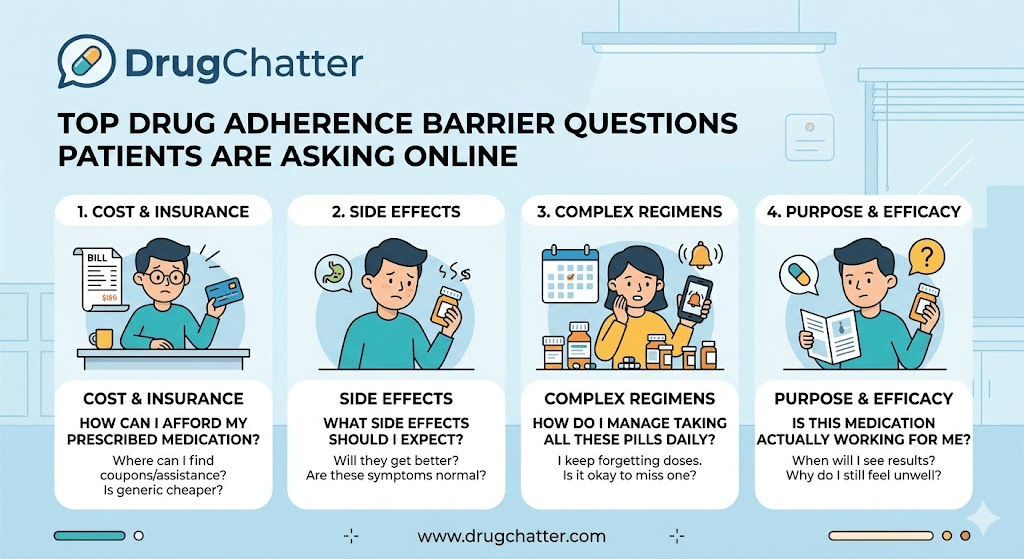
Medication adherence is less about willpower than friction—and patients feel that friction online.
Every day, people with chronic conditions go looking for small, practical answers: the right dose, what to do when they miss one, what to eat (or avoid), whether a lab test is coming, and whether the pharmacy will have the drug they were promised. The questions below are the ones most likely to derail a regimen—and the ones patients keep asking anyway.
1) “Is this the right version of my drug?”
If patients can’t even identify the drug they’re taking (or its generic equivalent), the rest becomes a guessing game.
- Cangrelor brand name?
- Cangrelor generic?
- Tenormin generic?
- Generic for sensipar?
- Generic for evista?
2) “Will it be available when I need it?”
Availability problems aren’t just inconvenient; they can reset treatment plans and increase the odds of missed doses.
3) “What do I do if I miss a dose?”
This is where patients—not headlines—make decisions in real time.
4) “When side effects show up, how long do they last?”
Uncertainty is a major adherence killer. If patients don’t know whether a reaction is transient or dangerous, they may stop the drug rather than wait for guidance.
- Hpw long does it take for the side effects to subside on lipitor?
- Do lipitor’s side effects include mood swings for you?
- Does opioid use intensify lipitor’s potential side effects?
5) “Do interactions mean I should stop?”
Patients often interpret “interaction” as “avoid entirely,” even when the correct answer is “talk to your clinician” or “schedule doses.”
- Can lipitor and red yeast rice supplements be taken together?
- Coincide or cause lipitor’s link to joint stiffness?
- How does aspirin interact with citrus in the stomach?
6) “What should I eat, and what should I avoid?”
Diet is one of the most common sources of “I thought it was okay” dosing errors.
- Foods to avoid whilst taking low dose aspirin hns
- Cosentyx and food?
- Can fiber impact lipitor’s medication efficiency?
- Does higher dietary fiber reduce lipitor’s effectiveness?
- Can certain fruits enhance lipitor’s lipid lowering action?
- Can avocado consumption enhance lipitor’s efficacy?
- Will taking fish oil affect lipitor’s effectiveness?
- Does ozempic’s effect change based on meal times?
7) “Does timing matter—before or after something?”
Even when patients know the dose, timing questions can decide whether a regimen actually works.
- What’s the recommended time gap between cosentyx and vaccines?
- How long until lipitor’s full effect before dose adjustment?
- What’s the recommended lipitor dose with warfarin?
8) “Do I need monitoring?”
Patients are more likely to stay the course when they understand what follow-up is normal—and how often it should happen.
9) “If it’s expensive, can I make it work?”
Cost pressures are adherence pressures. Patients look for generic substitutions, coupons, and pricing information because the math has to work.
- Evaluate the chronic myeloid leukemia company sprycel on medication cost?
- Kalbitor price?
- Rotigotine price?
- Myalept coupon?
- Osmoprep cost?
- Omlonti price?
- Berotralstat cost?
- Cost of lidoderm patch?
- What’s the process to verify authentic lipitor discount cards?
10) “Will a generic actually behave the same?”
Patients aren’t being fussy; they’re responding to real-world switches. If the effect changes, trust collapses.
- Does generic tigecycline’s potency match branded version s?
- Ivacaftor generic?
- Secuado generic?
- Revatio generic?
- Is there elrexfio biosimilars?
What these questions have in common
They’re all the same story in different costumes: patients want predictability. They want to know what happens if they’re delayed, if the drug looks different at the counter, if the side effects are brief or lasting, if the lab schedule is mandatory, if the food pairing matters, and if the regimen can survive a price increase.
If you’re asking any of these questions, you’re not “noncompliant”—you’re doing the sensible thing: asking for clarity before the plan breaks.