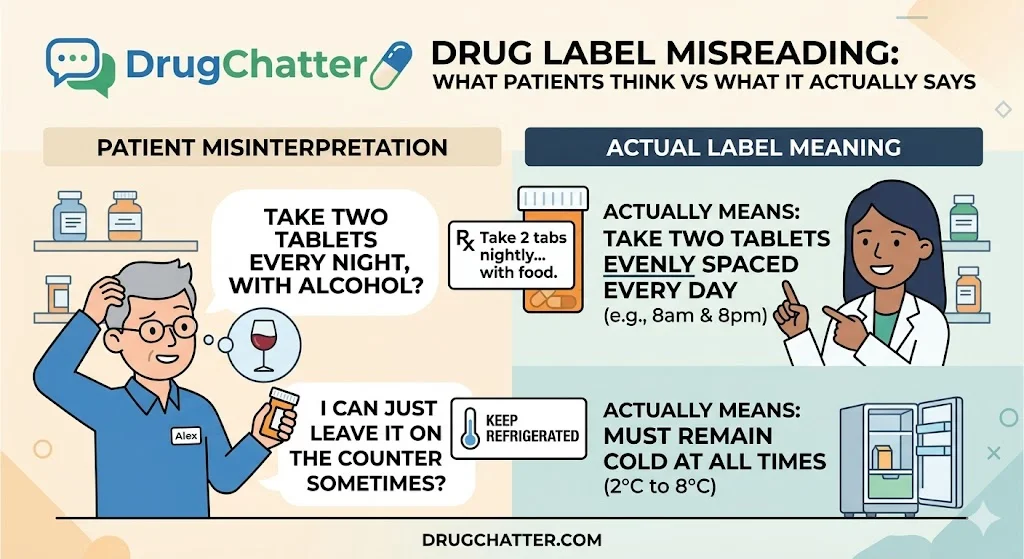
There are two kinds of medication label-reading. There’s the kind you do when you’re trying to get it right. And there’s the kind your brain does automatically—filling in the parts that aren’t there, smoothing over abbreviations, and translating “as written” into “as you remember.”
Patients do not misread because they’re careless. They misread because labels are dense, healthcare jargon is everywhere, and we all read under stress. Below are six recurring moments where what patients often think a label says can drift away from what it actually means—based on DrugChatter questions and answers.
1) “Patent expiry” doesn’t mean what the calendar on your mind thinks it means
When people see a headline about patent expiry, they often assume it will instantly convert a brand into a cheap generic. In reality, “loss of exclusivity” and “generic availability” are different steps in a messy process—timing, filings, approvals, and market entry all matter.
2) Generic = “the same dose,” right up until it isn’t
Another common drift: treating “generic” as a promise that the experience will match the brand in every meaningful way (timing, formulation, administration method). A patient may read “generic” and stop there, while the practical details are in the fine print.
Food instructions are where patients’ brains love to shortcut. “With food” doesn’t mean “no big deal.” Interactions can affect absorption and safety—sometimes quietly.
4) “Side effects” isn’t one bucket—your label may be warning about the wrong type of risk
Patients often read “side effects” as a generic list and miss which problems matter most for them: liver signals vs blood clotting vs neurologic warnings. The label can be accurate, but the patient’s mental sorting can fail.
5) “Dosing instructions” can be misread as “time-flexible”
Labels that mention timing often get interpreted as “close enough.” But many drugs punish timing slippage—especially when the label is trying to prevent overlap, trough issues, or missed windows.
6) The label’s “interactions” warning turns into a shopping list—then gets ignored
Patients may read interaction language and think it applies only to obvious drug-drug pairs. But labels can also be warning about supplements, blood thinners, alcohol-like exposures, or the sort of everyday foods that aren’t on anyone’s “medication interaction” radar.
What to do when you think the label might be lying to you (or just confusing you)
If anything above resonates, here’s the practical translation: re-read with a narrower question. Don’t ask “what does it say?” Ask:
What exactly is the timing? (hours, before/after meals, acceptable gaps)
What is the high-priority risk for me? (liver, bleeding, sleep, allergy, etc.)
What does “with food” mean in my kitchen?
Is this brand-to-generic change also a formulation change?
And if you’re not sure, don’t “guess through.” Ask your pharmacist to walk the label with you line by line. Most misreading isn’t stubbornness—it’s just unattended ambiguity.