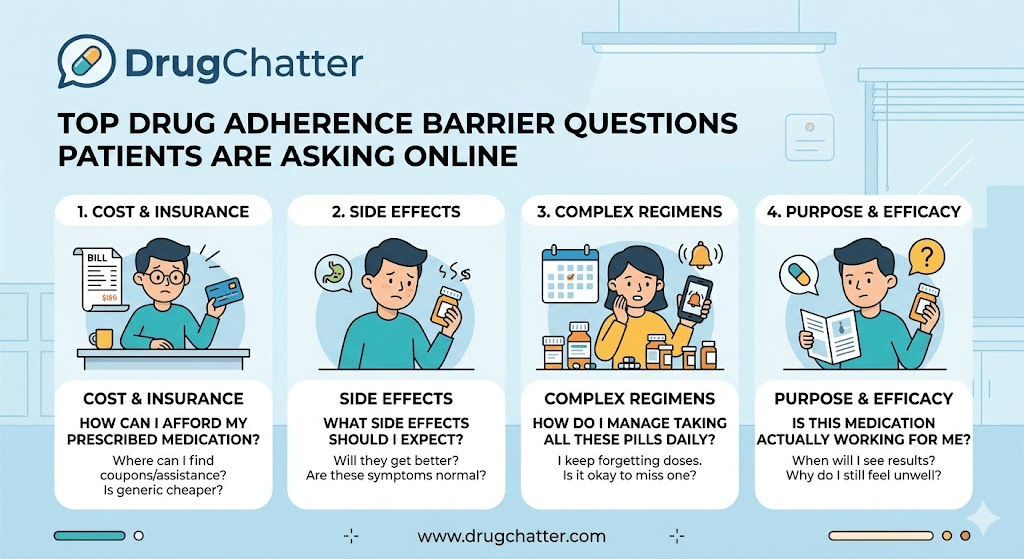
Drug adherence usually fails quietly: a missed dose here, an unexpected side effect there, a sudden price shock, or a confusing bit of timing advice that doesn’t match what someone read last week. Online, patients ask the same handful of questions again and again—questions that are less about pharmacology and more about real life.
1) “How much is this going to cost me?”
Cost is one of the most common adherence barriers, because it doesn’t wait for a doctor’s next appointment. Patients want a number, and they want it fast:
2) “Is there a cheaper substitute… and will it still work?”
When patients hit a wall with one brand, they search for generic names, equivalents, and “is this the same drug?” answers. That’s not stubbornness—it’s triage:
3) “What do I do if insurance (or Medicare) won’t play along?”
Coverage uncertainty creates a special kind of nonadherence: patients don’t just forget—they get blocked. They look up whether their plan will cover the medication at all:
If patients don’t feel anything right away, “not noticing” can become “it’s not working,” and then the pills quietly disappear. So they ask about timelines:
5) “Will this interfere with my life—food, alcohol, supplements, and timing?”
Adherence isn’t only about swallowing tablets; it’s about how they fit into routines. Patients want to know whether meals, alcohol, or “wellness” habits will blunt the medication:
Side effects are adherence’s loudest saboteur. Patients don’t just ask whether a side effect exists—they ask how it affects daily function and what they can realistically do about it:
7) “How do I take it—mechanisms, expectations, and reassurance?”
Some patients ask for the “why” because understanding can stabilize behavior. When they grasp what the drug is supposed to do, they’re more likely to stick with the plan while the body catches up:
9) “What’s the long game—patents, approvals, and continuity?”
Even though these questions aren’t always about day-to-day dosing, they’re about continuity of access. Uncertainty about approvals and exclusivity can produce a “what if I can’t refill later?” anxiety:
Most adherence “barriers” aren’t medical mysteries—they’re practical anxieties. People want clarity on cost, coverage, timing, interactions, and what to expect. When those answers are missing, pills become negotiable.
If you’re struggling with adherence, it helps to treat the first question you can’t answer—the one that keeps tugging your plan apart—as the priority. That’s how you turn confusion into a regimen you can actually sustain.