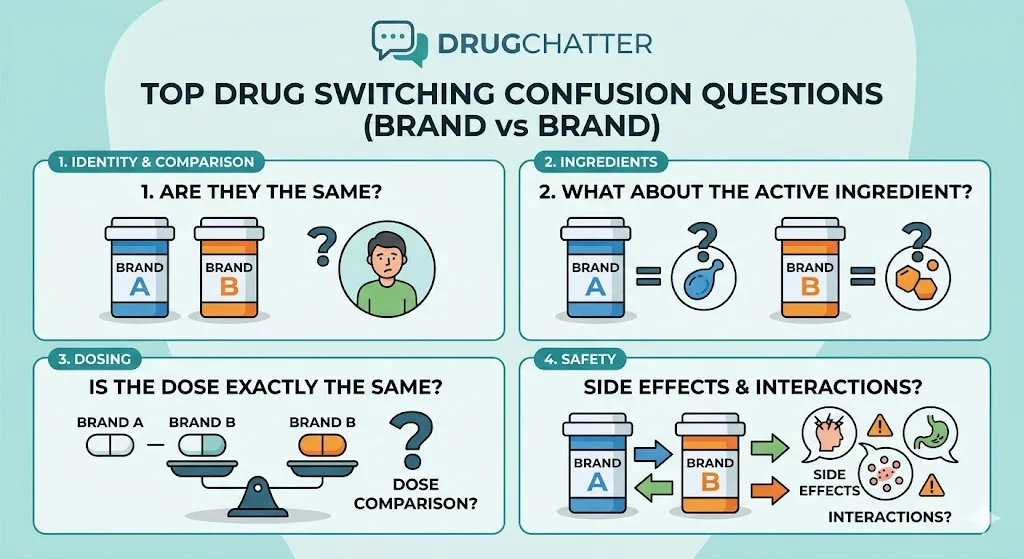
Every few weeks the same theme comes up on patient forums and pharmacy counter chats: the drugs look the same, the names sort of sound the same, the boxes are different colors—so surely the switch is trivial. But “brand vs brand” is a special kind of trap. It can be harmless, it can be neutral, and sometimes it’s the beginning of a long troubleshooting saga involving excipients, absorption quirks, dosing schedules, and plain old misunderstanding about what “equivalent” really means.
Here are some of the most common brand-versus-brand confusion questions—along with the answers to read when you’re trying to decide whether you’re actually changing therapy, or just changing packaging.
1) “Is this the same thing under a different name?”
Brand-to-brand switches often feel intuitive when people are really asking whether the active ingredient is the same. That’s the starting point. If the active ingredient differs—or if the formulation differs materially—your results may not.
2) “If it’s the same drug, will it behave the same in my body?”
Even when two products contain the same drug, differences in formulation can affect what happens next—sometimes in ways that matter more for some drugs than others.
3) “Does something like food timing change the switch question?”
Sometimes the issue isn’t the brand at all—it’s when you take it. But the practical effect feels like “the new brand is different,” especially once timing shifts during a busy schedule.
4) “Will side effects get better—or worse—after a switch?”
People commonly assume side effects track perfectly with “the drug,” but real life is messier: dose timing, metabolism differences, and product/formulation differences can all blur the story.
5) “Is it safe for me to take the ‘same’ drug from a different supplier?”
Safety questions tend to flare up when people hear “it’s the same medication” but notice that the look, packaging, or dispensing process differs. That’s not irrational—just incomplete.
6) “If the label changes, does the dosing schedule change?”
Brand switches sometimes travel with dispensing substitutions, insurance-driven changes, or simple misunderstandings. When you add timing sensitivity, it can look like “the medicine changed,” even if the underlying reason is schedule drift.
7) “Are there formulation-related reasons the brand matters?”
Some drugs are sensitive to distribution and permeability effects, and then “brand” becomes more than aesthetics. Here’s an example of how biological context can matter.
Bottom line: don’t treat brand differences like a coin flip
“Brand vs brand” is often discussed as if it’s just a marketing problem. But the real question is clinical: what exactly changed—active ingredient, dose, route, schedule, formulation, or just the packaging?
If you’re trying to reason through a switch, start by verifying the active ingredient and dose, then review how the therapy is actually used (timing, food interactions, and expected side effect patterns). And if anything feels off, ask for clarification rather than assuming the body will interpret your new box the same way it did the old one.