On March 11, 2026, the FDA retired the FDA Adverse Event Reporting System, the database that has anchored US drug safety surveillance since 1969, and replaced it with a unified platform called the Adverse Event Monitoring System (AEMS).[1] Every case-based pharmacovigilance system on the market, Oracle Argus, Veeva Vault Safety, ArisGlobal LifeSphere MultiVigilance, RxLogix, and others, depends on the data that flows through that infrastructure. None of them, and no AI answer-monitoring tool either, can do its job without it.
That single fact is a useful starting point for a category confusion that has gotten worse as vendors on both sides of the safety-communications divide have started using the same words. Pharmacovigilance teams now field questions from procurement and IT about whether a subscription that tracks what ChatGPT says about a drug is a substitute, a supplement, or a redundancy relative to their existing safety database. The honest answer is: neither. They measure different things, answer to different regulations, and fail in different ways. Confusing them creates two distinct risks: a pharmacovigilance team that treats an AI-monitoring alert as case intake, and a brand team that assumes the safety database will catch a stale-label problem it was never built to see.
The Short Answer
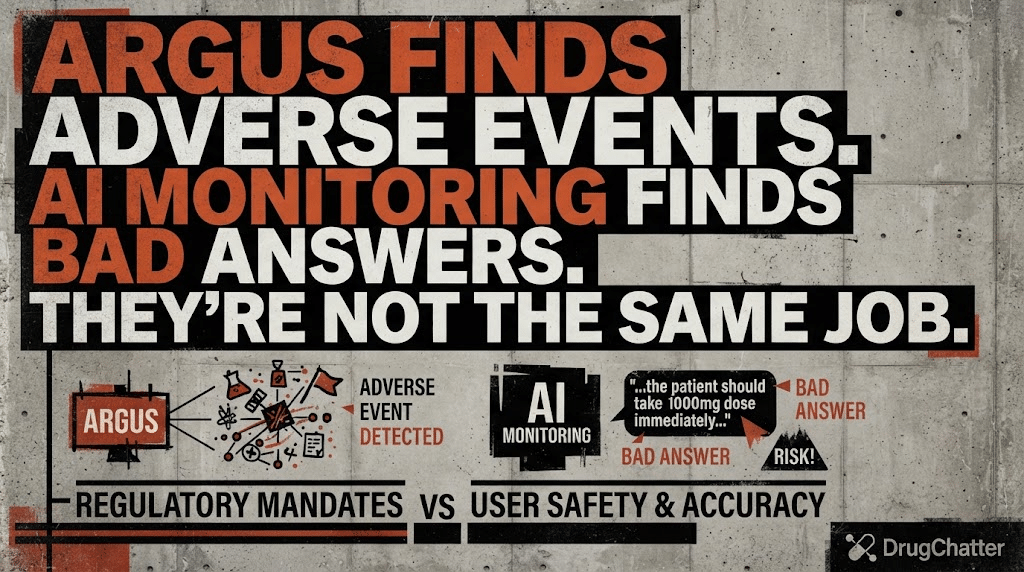
Case-based signal detection systems, Oracle Argus, Veeva Vault Safety, ArisGlobal LifeSphere MultiVigilance, RxLogix, and TriNetX EVIDEX, ingest individual case safety reports (ICSRs) and real-world patient data to find statistically disproportionate patterns between a drug and an adverse event. That is a safety-signal problem, governed by 21 CFR 314.80 in the US and Good Pharmacovigilance Practices (GVP) Module IX in the EU.[2] AI answer monitors, including DrugChatter, query large language models and score their responses against approved labeling and authoritative sources. That is a communications and compliance problem. No adverse event enters a spontaneous-reporting database because an AI monitor flagged a wrong answer, and no chatbot response has ever triggered a 15-day Alert Report. The two categories can inform each other, but one does not substitute for the other.
Why the Confusion Exists
The mix-up is not irrational. Four real overlaps create it.
Both Get Filed Under “PV Software” in Vendor Directories
Procurement teams building a technology stack for drug safety routinely lump case management, signal detection, and any tool with “safety” or “monitoring” in its name into a single RFP category. A tool that tracks AI-generated brand mentions and a tool that processes MedWatch reports end up on the same vendor shortlist because both sell into the same buying center, even though their outputs feed entirely different workflows.
Both Use the Word “Signal”
In classical pharmacovigilance, a signal is a statistically supported hypothesis of a causal relationship between a drug and an adverse event, arrived at through disproportionality analysis of spontaneous reports.[3] In AI monitoring, “signal” often means something closer to a detected change: a new discrepancy between what a chatbot says and what the label says, or a shift in which sources a model cites. Both are legitimate uses of the word. They are not the same kind of signal, and treating an AI-monitoring alert as a pharmacovigilance signal without the underlying disproportionality math is a category error.
Both Now Market Themselves as “AI-Powered”
Every case-based vendor in this comparison has shipped a generative-AI or agentic layer in the past three years. ArisGlobal’s LifeSphere Nava, launched in 2018 as a cognitive-computing engine for case intake, was superseded by LifeSphere NavaX in December 2023 to add large language models and generative AI to case processing and, notably, proactive signal detection using real-world data.[4] Oracle markets Argus Advanced Cloud with an AI-powered analytics layer for safety data and submission compliance.[5] RxLogix positions its entire platform as “AI-native.”[6] Veeva announced Falcon Safety, an agentic product for adverse event intake and case processing, on September 1, 2026.[7] None of that AI is doing what an AI answer monitor does. It is automating case intake, triage, and literature screening inside the existing ICSR pipeline, not evaluating chatbot output.
Procurement Often Routes Both Through the Same Budget Line
Because both categories touch drug safety and brand risk, budget for AI answer monitoring sometimes gets requested through the pharmacovigilance cost center rather than marketing or corporate communications, which reinforces the expectation that the tool should behave like a safety database. It should not, and it was never built to.
What Case-Based Signal Detection Systems Actually Do
The Regulatory Backbone: 21 CFR 314.80 and E2B(R3)
In the US, holders of an approved New Drug Application or Abbreviated New Drug Application must review all adverse drug experience information they receive, from clinical practice, literature, postmarketing studies, and unsolicited reports, and report each event that is both serious and unexpected to FDA within 15 calendar days as a “15-day Alert report.”[2] Non-serious and expected events roll into quarterly reports for the first three years after approval and annual reports thereafter.[8] This obligation is distinct from investigational-drug safety reporting under 21 CFR 312.32, which covers unapproved products in clinical trials, not marketed drugs.[9] Every case-based system in this comparison exists primarily to make that obligation operationally possible at scale, and every case exchanged between systems globally is structured to the ICH E2B(R3) standard so that a case built in one safety database can be transmitted to a regulator or partner company in a machine-readable format.[10]
The Individual Case Safety Report as the Atomic Unit
The ICSR, a structured description of an adverse drug experience tied to one patient, is the indivisible unit that case-based PV software processes.[11] A case-based system’s job is to take an ICSR from intake (a phone call, an email, a literature hit, a structured EHR feed) through medical coding in MedDRA and WHO Drug terminology, quality review, and expedited or periodic regulatory submission. Nothing in that chain resembles what happens when an AI monitor scores a ChatGPT response. There is no patient, no product-event pair, and no regulatory submission obligation attached to a chatbot’s wrong answer about a drug interaction.
Disproportionality Analysis: PRR, ROR, EBGM, and BCPNN/IC
Once enough ICSRs accumulate in a database like FAERS, signal detection becomes a statistical exercise: build a 2×2 contingency table for a drug-event pair against all other drugs and all other events in the database, then test whether that pair is reported more often than chance would predict.[12] Four methods dominate practice.
Reporting Odds Ratio (ROR)
A case-control-style odds ratio comparing the odds of a specific event being reported for the drug of interest against the odds of that event being reported for all other drugs in the database.
Proportional Reporting Ratio (PRR)
A simpler ratio of the proportion of reports for a drug that involve a given event, versus the proportion of reports for all other drugs that involve that event. PRR is easy to compute but produces more false positives at low report counts than Bayesian methods.
Empirical Bayes Geometric Mean (EBGM)
The output of the Multi-item Gamma Poisson Shrinker (MGPS) algorithm, which statistically shrinks spuriously high PRR-style values toward the overall reporting rate, reducing false-positive signals; FDA’s CDER, CBER, and CFSAN centers use MGPS for routine surveillance, and lower and upper 90 percent confidence bounds on the EBGM score are reported as EB05 and EB95.[13]
Information Component (IC / BCPNN)
A Bayesian Confidence Propagation Neural Network score used heavily by the WHO’s VigiBase and widely replicated in EU practice, expressed with a lower confidence bound (IC025) that regulators use to classify signal strength.
Worked Example: From a 2×2 Table to an EB05 Score
A published FAERS disproportionality study of efgartigimod alfa illustrates the mechanics: researchers pulled 3,040 reports naming the drug as primary suspect between Q1 2022 and Q2 2024, built contingency tables against the rest of the database, and computed ROR, PRR, IC, and EBGM for each reported event.[14] Nephrolithiasis surfaced with an ROR of 8.13, a PRR of 7.99, an IC of 2.99, and an EBGM of 7.95, a pattern strong enough across all four methods to warrant further clinical review.[14] That four-method convergence, not a single number, is what a case-based system’s signal-management workflow is built to surface and route to a human reviewer.
GVP Module IX and the EU Signal-Management Cycle
In the EU, Good Pharmacovigilance Practices Module IX sets the scientific and quality expectations for the signal-management process: detection, validation, confirmation, analysis and prioritization, assessment, and recommendation for action, all of which must be documented, tracked, and auditable.[15] Every vendor covered here markets GVP IX compliance as a core feature, because a signal-detection platform that cannot produce an audit trail of who reviewed a signal, when, and on what evidence is not usable for regulatory purposes regardless of how good its underlying statistics are.
The Vendor Landscape for Case-Based Pharmacovigilance Software
Oracle Argus / Argus Safety One and Empirica
Oracle Argus is the case-management backbone: intake, MedDRA and WHO Drug coding, medical and quality assessment, and expedited or periodic regulatory report generation for drugs, biologics, vaccines, devices, and combination products, across pre-market and post-market settings.[16] Oracle was named a Leader in IDC MarketScape’s Worldwide Life Science R&D Pharmacovigilance Technology Solutions and Consulting Services 2025 Vendor Assessment.[16] Signal detection sits in a companion product, Oracle Life Sciences Empirica, which mines safety data at scale for potential signals and integrates with Argus and external systems.[5] Argus Advanced Cloud layers Oracle Analytics, described by Oracle as AI-powered, on top for workflow metrics and submission-compliance insight.[17]
Veeva Vault Safety and the Falcon Safety Agentic Layer
Veeva Vault Safety is the case-processing and reporting application inside Veeva’s broader Vault platform. On September 1, 2026, Veeva announced Veeva Falcon Safety, an agentic product built to automate adverse event intake, case processing, and follow-up, explicitly designed to work not just with Veeva Safety but with any E2B-compliant safety system, including Oracle Argus and ArisGlobal LifeSphere MultiVigilance by name.[7] Falcon Safety is scheduled for early-adopter availability in November 2026, and Veeva’s vice president of product for Falcon, Marius Mortensen, framed it as an extension of work “closely with case processors, pharmacovigilance experts, and safety specialists globally to build Veeva Safety.”[7] Falcon Safety followed Veeva’s broader Falcon agentic platform, first announced May 27, 2026 for clinical, regulatory, and safety processes.[18] Trade coverage of the launch noted the interoperability design as a deliberate signal to the installed base that companies would not need to abandon an existing safety system to access the automation layer.[18]
ArisGlobal LifeSphere MultiVigilance and Advanced Signals
ArisGlobal launched LifeSphere MultiVigilance in October 2018 as a cloud-native ICSR intake platform powered by its Nava cognitive-computing engine, combining natural language processing, machine learning, and robotic process automation, and marketed at the time as the first platform unifying safety case intake with product quality complaints and medical information.[19] In December 2023, ArisGlobal introduced LifeSphere NavaX, adding large language models and generative AI, with proactive signal detection using real-world data named as one of the resulting capabilities.[4] The current Advanced Signals product uses pre-validated AI and machine-learning models to auto-classify ICSRs and drug event combinations and supports a range of quantitative and qualitative disproportionality methods within a single signal and risk-management ecosystem.[20]
RxLogix PV Signal, Including the FDA’s Own Deployment
RxLogix’s PV Signal module is a dedicated signal-detection and management product, positioned as GVP Module IX compliant, that ingests FAERS, EVDAS, VigiBase, literature, and safety-database feeds through APIs.[6] The most consequential fact about RxLogix is not a marketing claim: FDA itself went live on RxLogix solutions, including PV Signal and Reports, to support the first release of what the company described as FAERS II, spanning the Office of Surveillance and Epidemiology in the Office of Generic Drugs and the Center for Biologics Evaluation and Research.[21] That deployment, announced in November 2021, means RxLogix’s own signal-detection engine has been part of the infrastructure sitting behind FDA’s public-facing adverse event data. FDA’s March 2026 AEMS consolidation folds that FAERS-era infrastructure into the unified platform.[1]
TriNetX EVIDEX and Real-World-Data-Native Signal Detection
TriNetX EVIDEX takes a different starting point: rather than beginning with spontaneous ICSRs, it combines TriNetX’s federated network of more than 250 million de-identified patient records with public safety sources, including FAERS, VigiBase, EVDAS, ClinicalTrials.gov, and VAERS, inside a single signal detection and management platform.[22] TriNetX markets EVIDEX as enabling up to three times faster safety reviews than legacy systems by reducing duplicative manual review and false positives.[23] Because it is built on real-world clinical data rather than spontaneous reports alone, EVIDEX is positioned to support signal strengthening and evaluation with denominator data that pure spontaneous-reporting systems cannot supply on their own.
Table: Five Case-Based Systems at a Glance
| Vendor / Product | Core Function | Signal Method | 2026 AI Development | Primary Data Sources |
|---|---|---|---|---|
| Oracle Argus / Empirica | Case management + signal mining | Statistical data mining, configurable | Argus Advanced Cloud AI analytics layer | ICSRs, FAERS, internal safety database |
| Veeva Vault Safety / Falcon Safety | Case processing + agentic intake | N/A (case management layer) | Falcon Safety, agentic intake across E2B systems (Sept. 1, 2026) | ICSRs, cross-platform E2B feeds |
| ArisGlobal LifeSphere MultiVigilance | Case intake + Advanced Signals | Quantitative + qualitative, AI-assisted classification | LifeSphere NavaX (Dec. 2023), Advanced Signals | ICSRs, real-world data, literature |
| RxLogix PV Signal | Dedicated signal detection and management | Configurable statistical algorithms | “AI-native” platform positioning | FAERS, EVDAS, VigiBase, literature |
| TriNetX EVIDEX | RWD-integrated signal detection | Statistical + RWD-supported evaluation | AI and RWD-driven analytics | 250M+ patient EHRs, FAERS, VigiBase, EVDAS |
The pharmacovigilance software market was valued at roughly $207 million in 2023 and is projected to reach $372 million by 2032, a 6.76 percent compound annual growth rate that trade coverage of Veeva’s Falcon Safety launch characterized as reflecting steady regulatory pressure rather than explosive adoption.[18]
What AI Answer Monitoring Actually Does
The Unit of Analysis Is a Chatbot Response, Not an ICSR
An AI answer monitor sends a defined set of questions, branded, generic, comparison, and safety-related, to one or more large language models on a recurring schedule and captures the full response.[24] The atomic unit of the system is a question-answer-model triple, not a patient case. There is no MedDRA coding step because there is no adverse event to code.
No Adverse Event Enters a Spontaneous-Reporting Database This Way
This is the distinction that gets lost most often inside pharmacovigilance departments. If a chatbot’s answer describes a symptom or an outcome, that text is not, by itself, an adverse event report. FDA and EMA both define a reportable adverse event around a real patient exposure, and current pharmacovigilance regulation does not treat an AI system’s free-text output as a qualifying source document the way a healthcare professional’s spontaneous report is treated. An AI-monitoring tool that surfaces a chatbot claiming a drug “commonly causes” an unlabeled reaction has identified a communications problem worth medical review, not a case ready for 21 CFR 314.80 reporting.
What Gets Measured Instead
AI answer monitoring evaluates factual alignment with current approved labeling, completeness relative to what a labeled warning or contraindication requires, citation quality and whether a model names a verifiable source, and drift, whether the same question produces a different answer over time or across models as training data, retrieval systems, or the underlying label change. Some platforms extend this into brand-visibility measurement, tracking how often and how favorably a product is mentioned relative to competitors across models, a marketing and competitive-intelligence application distinct from the accuracy-auditing use case.
Where a Tool Like DrugChatter Fits Methodologically
DrugChatter’s approach sits inside this second category: it runs structured, repeatable queries against multiple LLMs and compares the resulting answers to current prescribing information and other authoritative sources, tracking how AI-generated answers about a drug change over time and across vendors. That output is useful evidence for Medical Affairs, Regulatory, and Brand teams assessing whether AI systems are presenting a drug’s labeled risk profile accurately. It is not a substitute for the disproportionality analysis, ICSR processing, or GVP Module IX documentation that Argus, Vault Safety, LifeSphere, RxLogix, or EVIDEX perform, and DrugChatter does not claim to replace that function.
The Core Distinction: A Safety Signal vs. a Communications Discrepancy
An Original Taxonomy: Three Types of “Something Is Wrong” Findings
Both categories exist to surface the sentence “something may be wrong with what people believe about this drug.” What differs is what kind of wrong, and what obligation follows.
Type 1: Undetected Real-World Adverse Event
A genuine, previously unrecognized association between a drug and a harm, surfaced through disproportionality analysis of real patient reports. This is case-based PV software’s job, and it is the only type of finding that can trigger a 21 CFR 314.80 Alert Report or a GVP Module IX signal-management workflow.
Type 2: Inaccurate AI-Generated Answer About a Labeled Risk
A chatbot states, omits, or misrepresents information that is already documented in the approved label, such as a boxed warning, a contraindication, or a dosing limit. This is AI answer monitoring’s job. No new safety information exists; the label already has it. The failure is in how faithfully an AI system reproduces what regulators and the company have already established.
Type 3: Overlap Zone, AI-Generated Content That Could Cause a Reportable Event
A narrow but real edge case: if a clinician or patient acts on an AI-generated dosing or interaction error and a resulting harm is subsequently reported through normal clinical channels, that harm becomes a Type 1 event once it reaches a case-based system through a healthcare professional or patient report. The AI monitor’s original finding does not itself become the ICSR; the downstream clinical event, if and when it is reported, does.
Why Overlap Is Rare But Not Impossible
The overlap matters precisely because it is rare. Most AI-answer discrepancies concern well-documented, already-labeled information, not novel safety findings, which is why AI monitoring should be read as a compliance and communications signal rather than a pharmacovigilance signal in the regulatory sense. Teams that build escalation paths assuming every AI-monitoring flag might be Type 3 will misallocate pharmacovigilance review capacity; teams that assume none of them ever could be will miss the rare case that matters.
What Changed in 2026: The Regulatory and Infrastructure Backdrop
FDA’s AEMS Consolidation (March 11, 2026)
FDA’s Adverse Event Monitoring System replaced FAERS, the Vaccine Adverse Event Reporting System, and the animal-drug and animal-food AERS databases on a single dashboard starting March 11, 2026, with the Manufacturer and User Facility Device Experience database, the Human Foods Complaint System, and the Center for Tobacco Products Adverse Event Reporting System migrating by the end of May 2026.[1] FDA framed the move as part of a broader data-modernization strategy meant to increase reporting frequency and help identify safety signals faster, and the legacy patchwork of seven separate databases had processed roughly six million reports a year at an estimated $37 million in annual operating cost, with FDA projecting about $120 million in savings over five years from the consolidation.[25] For every case-based vendor in this article, AEMS is not optional context. It is the underlying government infrastructure their systems ingest from and submit to, and none of the AI-monitoring vendors in this category have any structural relationship to it at all.
The FDA-EMA Joint AI Guiding Principles (January 14, 2026)
On January 14, 2026, FDA and EMA jointly published 10 Guiding Principles of Good AI Practice in Drug Development, covering AI use from early research through manufacturing and postmarket safety surveillance.[26] The principles call for AI that is human-centric by design, uses a risk-based approach calibrated to context of use, and adheres to relevant legal, scientific, and regulatory standards, and the agencies described them as a foundation for future AI-specific guidance in both jurisdictions rather than binding rules.[26] Notably, the document addresses AI used to generate and monitor evidence inside the regulated drug-development and pharmacovigilance process. It does not address, and was not written to address, AI chatbots answering consumer or clinician questions about an already-approved drug outside a sponsor’s own systems, leaving AI answer monitoring in a regulatory gap that neither this guidance nor GVP Module IX currently closes.
Veeva’s Two-Track Agentic Bet
Veeva’s 2026 roadmap is worth reading as two separate, deliberately distinct agentic programs rather than one. Falcon, announced broadly on May 27, 2026, targets agentic labor across Veeva’s own clinical, regulatory, and safety applications.[18] Falcon Safety, announced September 1, 2026, is explicitly cross-platform, built to automate intake and follow-up for any E2B-compliant system, naming Oracle Argus and ArisGlobal LifeSphere MultiVigilance as interoperability targets rather than treating them purely as competitors.[7] Both tracks automate case-based pharmacovigilance workflow. Neither one evaluates what a chatbot says about a drug to a patient.
Where Pharmacovigilance Teams Get This Wrong
Treating an AI-Monitoring Subscription as GVP Module IX Evidence
GVP Module IX requires that signal detection, validation, and assessment be built on a documented, auditable methodology tied to real safety data.[15] An AI-monitoring dashboard showing that three of five LLMs gave an incomplete answer about a drug interaction does not satisfy that requirement, however useful it is for a different purpose, because it contains no disproportionality statistic and no patient-level case.
Assuming an AI-Monitoring Alert Satisfies a 15-Day Alert Report Trigger
The 15-day clock under 21 CFR 314.80 starts when an applicant receives information about a serious, unexpected adverse drug experience, not when a chatbot’s answer is judged inaccurate.[2] A pharmacovigilance team that routes an AI-monitoring flag into its regulatory reporting queue as though it were a qualifying source document risks both wasted review capacity and, more seriously, confusion about what the actual reporting clock is tracking.
What Actually Happens When a Chatbot Answer Contains a Real Signal
The correct workflow, and the one worth building into a standard operating procedure, routes an AI-monitoring finding to medical review first. If the underlying concern reflects something not already in the label, and a real patient case can be identified or solicited, that case, once documented with a patient, a product, and an event, enters the case-based system exactly as any other spontaneously identified case would, coded, assessed, and reported on the normal 21 CFR 314.80 timeline. The AI-monitoring platform’s role ends at flagging the discrepancy for human review; it does not and should not attempt to originate an ICSR on its own.
Where Brand and Marketing Teams Get This Wrong
Assuming the Safety Database Will Catch a Stale-Label Problem
Case-based PV software has no mechanism for detecting that an AI model is describing a drug’s indication, dosing, or competitive position inaccurately, because that is not what it monitors. A boxed-warning update that has been fully implemented in Argus, Vault Safety, or LifeSphere’s regulatory workflow can still be missing from what ChatGPT or Gemini tells a patient, because those models draw on training data and retrieval sources with their own update cycles, entirely separate from a sponsor’s safety database.
The Lag Between a Label Change and What AI Systems Say
There is no regulatory requirement, and currently no reliable industry mechanism, forcing a general-purpose LLM to reflect a label change on any particular timeline. That lag is precisely the gap AI answer monitoring is built to measure, by re-querying models on a schedule and comparing responses against the current label rather than the label as it existed whenever a model’s training data was last updated.
What the Evidence Shows About AI-Generated Drug Answers
The LIU/ASHP Finding: 10 of 39 Questions Answered Satisfactorily
A study presented at the American Society of Health-System Pharmacists’ 2023 Midyear Clinical Meeting, conducted by drug information specialists at Long Island University, took 39 real questions a drug information service had received between January 2022 and April 2023, researched literature-based answers, and compared them to ChatGPT’s responses.[27] ChatGPT answered 10 of the 39 questions satisfactorily; among the 29 that were not, the model provided no substantive answer at all for 11, and it supplied references in only 8 of 28 direct responses, several of which investigators found did not correspond to real sources.[27]
The Iwate/Torrance Finding: 2 of 30 Side-Effect Answers Accurate
A companion study at the same conference, from Iwate Medical University in Japan and Torrance Memorial Medical Center in California, asked ChatGPT the same question, “what are the most common side effects,” for 30 drugs and compared the answers against Lexicomp, an evidence-based clinical reference.[28] Two of the 30 responses were accurate, two were partly accurate, and 26 were inaccurate.[28]
What These Numbers Do Not Imply
Neither study measured pharmacovigilance risk directly, and neither should be read as evidence that AI chatbots are generating undetected adverse events. Both measured something narrower and, for this article’s purposes, more relevant: how faithfully general-purpose AI systems reproduce information that already exists in authoritative sources. That is exactly the category of finding AI answer monitoring is designed to surface on an ongoing basis, and it is exactly the category of finding that case-based signal detection, built around real patient reports rather than chatbot transcripts, is not designed to see at all.
Case-Based PV Software vs. AI Answer Monitoring: A Side-by-Side Comparison
| Dimension | Case-Based PV Software (Argus, Vault Safety, LifeSphere, RxLogix, EVIDEX) | AI Answer Monitoring (DrugChatter and peers) |
|---|---|---|
| Unit of analysis | Individual case safety report (ICSR) | LLM question-and-answer transcript |
| Primary data source | Spontaneous reports, literature, EHR/RWD feeds, FAERS/AEMS, VigiBase, EVDAS | Live queries to ChatGPT, Claude, Gemini, and other LLMs |
| Governing framework | 21 CFR 314.80 (US); GVP Module IX (EU); ICH E2B(R3) | No dedicated pharmacovigilance regulation; falls under general promotional/compliance and medical information oversight |
| Core method | Disproportionality analysis (PRR, ROR, EBGM, IC/BCPNN) | Label-alignment scoring, citation-quality review, drift tracking |
| Typical output | A validated safety signal routed for medical assessment and, if warranted, regulatory reporting | A discrepancy flag routed for Medical Affairs, Regulatory, or Brand review |
| Can it trigger a 15-day Alert Report? | Yes, when a case meets the seriousness and expectedness criteria | No, absent a separately documented patient case |
| 2026 AI development | Agentic case intake and triage (Falcon Safety, NavaX, Argus Advanced Cloud) | Multi-model, scheduled querying and response scoring |
| Primary risk if treated as the other category | Missed pharmacovigilance obligations if AI-monitoring output is mistaken for case data | Missed AI-communications drift if safety-database compliance is mistaken for AI-answer accuracy |
Where the Two Categories Should Actually Connect
Feeding AI-Monitoring Findings Into Medical Information Response Libraries
The most durable use of AI-monitoring output is not pharmacovigilance escalation; it is feeding Medical Information’s standard response library and FAQ content with the specific questions and misstatements AI systems are actually generating for patients and clinicians, closing the gap between what people are being told and what the label says.
Using Labeled-Risk Data as Ground Truth for AI-Monitoring Accuracy Scoring
Case-based PV software’s most valuable contribution to AI answer monitoring is indirect: the current approved label, boxed warnings, contraindications, and dosing information that pharmacovigilance and regulatory teams maintain is the ground truth an AI-monitoring platform scores chatbot answers against. A label change processed correctly inside Argus, Vault Safety, or LifeSphere should be the trigger that updates what an AI-monitoring platform checks for next, closing the loop between the two systems without merging their regulatory obligations.
What This Means for Medical Affairs, Pharmacovigilance, and Brand Teams
For Pharmacovigilance, the practical guidance is narrow: keep AI-monitoring output entirely outside the 21 CFR 314.80 and GVP Module IX reporting chain unless a specific, patient-level case can be identified and documented through normal channels. Use AI-monitoring findings as a source of hypotheses for medical review, never as a substitute for disproportionality evidence.
For Medical Affairs, AI answer monitoring is closest to a natural fit, since the discrepancies it surfaces, incomplete label reproduction, missing warnings, outdated indications, map directly onto the kind of medical-accuracy review Medical Information teams already perform for other channels.
For Brand and Marketing teams, the finding to internalize is that a fully compliant, fully updated safety database provides no assurance about what AI systems are telling prospective patients right now. That gap requires its own monitoring discipline, on its own schedule, independent of the pharmacovigilance technology stack.
For Regulatory Affairs, both the AEMS consolidation and the FDA-EMA AI guiding principles are worth tracking closely in 2026, not because either directly governs AI answer monitoring today, but because both signal a regulatory environment actively reshaping how AI-adjacent evidence gets treated, and that environment could plausibly extend to chatbot-answer accuracy in future guidance.
Key Takeaways
- Case-based pharmacovigilance software (Oracle Argus, Veeva Vault Safety, ArisGlobal LifeSphere MultiVigilance, RxLogix, TriNetX EVIDEX) processes individual case safety reports and runs disproportionality analysis (PRR, ROR, EBGM, IC/BCPNN) to detect real safety signals under 21 CFR 314.80 and GVP Module IX.[2][3][12]
- AI answer monitoring tools, including DrugChatter, query LLMs on a schedule and score responses against approved labeling; no chatbot answer becomes an ICSR or triggers a 15-day Alert Report on its own.
- FDA replaced FAERS with the unified Adverse Event Monitoring System (AEMS) on March 11, 2026, the underlying infrastructure every case-based vendor in this comparison depends on.[1]
- FDA and EMA published 10 joint guiding principles for AI in drug development on January 14, 2026, covering AI used in evidence generation and postmarket surveillance, but not addressing consumer-facing chatbot accuracy.[26]
- Veeva’s Falcon Safety, announced September 1, 2026, automates case intake and follow-up across any E2B-compliant safety system, including competitors Oracle Argus and ArisGlobal LifeSphere MultiVigilance by name.[7]
- Two ASHP 2023 studies found ChatGPT answered 10 of 39 drug information questions satisfactorily and matched Lexicomp on just 2 of 30 side-effect questions, evidence of a communications accuracy problem, not a pharmacovigilance signal.[27][28]
- The pharmacovigilance software market was valued at roughly $207 million in 2023 and is projected to reach $372 million by 2032.[18]
Frequently Asked Questions
What is the core difference between AI answer monitoring and pharmacovigilance software?
Pharmacovigilance software processes individual case safety reports and runs statistical disproportionality analysis to detect real adverse-event signals under 21 CFR 314.80 and GVP Module IX. AI answer monitoring evaluates what large language models say about a drug against its approved label. One works with patient case data; the other works with chatbot transcripts.[2][15]
Does DrugChatter replace Oracle Argus, Veeva Vault Safety, or ArisGlobal LifeSphere?
No. DrugChatter and similar AI-monitoring platforms address a communications and compliance question, what AI systems say about a drug, not case processing, disproportionality analysis, or regulatory safety reporting, which remain the function of case-based systems like Argus, Vault Safety, and LifeSphere MultiVigilance.
Can an AI monitoring alert trigger an FDA 15-day Alert Report?
Not on its own. The 15-day Alert Report obligation under 21 CFR 314.80 is triggered by receipt of information about a serious, unexpected adverse drug experience tied to a real patient exposure.[2] An AI-monitoring flag about an inaccurate chatbot answer only becomes reportable if it leads to identification of an actual, documented patient case through normal channels.
What is an individual case safety report (ICSR)?
An ICSR is a structured description of an adverse drug experience tied to an individual patient or subject, the basic unit that case-based pharmacovigilance systems intake, code, assess, and, where required, submit to regulators.[11] It is exchanged globally using the ICH E2B(R3) data standard.[10]
What is disproportionality analysis in pharmacovigilance?
It is a set of statistical methods, including the Proportional Reporting Ratio (PRR), Reporting Odds Ratio (ROR), Empirical Bayes Geometric Mean (EBGM), and Information Component (IC/BCPNN), that identify drug-event pairs reported more often than chance would predict within a spontaneous-reporting database, generating hypotheses for further medical review rather than confirmed causal findings.[12][13]
What changed with FDA’s AEMS launch in March 2026?
FDA consolidated the FDA Adverse Event Reporting System (FAERS), the Vaccine Adverse Event Reporting System (VAERS), and the animal-drug and animal-food Adverse Event Reporting System (AERS) into a single unified platform, the Adverse Event Monitoring System (AEMS), on March 11, 2026, with additional legacy systems migrating by the end of May 2026.[1] Every case-based signal-detection vendor covered here ingests from or submits to this infrastructure.
Are Oracle, Veeva, ArisGlobal, RxLogix, and TriNetX building AI-monitoring tools too?
No, their 2026 AI investments target case-based pharmacovigilance workflow, agentic intake and triage (Veeva’s Falcon Safety), generative-AI-assisted case processing and proactive signal detection (ArisGlobal’s LifeSphere NavaX), and AI-powered safety analytics (Oracle’s Argus Advanced Cloud), not evaluation of AI chatbot answers to consumers or clinicians.[4][7][17]
How accurate is ChatGPT at answering drug information questions?
Evidence is limited but consistently shows meaningful gaps: a 2023 Long Island University study found ChatGPT answered 10 of 39 real drug information questions satisfactorily, and a companion study found ChatGPT matched Lexicomp on just 2 of 30 common side-effect questions.[27][28] These figures describe general-purpose consumer chatbot behavior at that time, not a specific AI-monitoring platform’s findings, and accuracy varies by model, prompt, and date.
Who should own AI answer monitoring inside a pharmaceutical company: PV, Medical Affairs, or Marketing?
Most organizations route it through Medical Affairs or a joint Medical Affairs/Regulatory/Brand governance structure, since the findings are medical-accuracy and compliance questions rather than safety-signal questions. Pharmacovigilance should receive escalations when a finding could plausibly involve a real patient case, but should not own primary triage of AI-monitoring output.
Does GVP Module IX apply to AI-generated chatbot answers about a drug?
Not directly. GVP Module IX governs the scientific and quality standards for signal management built on real safety data.[15] Current EU and US frameworks, including the January 2026 FDA-EMA joint AI guiding principles, address AI used inside sponsor-controlled evidence generation and drug development processes; neither currently extends GVP Module IX’s documentation requirements to third-party consumer chatbot output.[26]
References
- Al-Faruque, F. (2026, March 11). FDA consolidates adverse events reporting systems. Regulatory Affairs Professionals Society (RAPS). https://www.raps.org/news-and-articles/news-articles/2026/3/fda-consolidates-adverse-events-reporting-systems
- 21 CFR 314.80 – Postmarketing reporting of adverse drug experiences. Electronic Code of Federal Regulations. https://www.ecfr.gov/current/title-21/chapter-I/subchapter-D/part-314/subpart-B/section-314.80
- faers: A High-Fidelity Framework and R/Bioconductor Package for Precision Adverse Event Surveillance. (2026). medRxiv. https://www.medrxiv.org/content/10.64898/2026.03.26.26349444.full.pdf
- ArisGlobal introduces LifeSphere NavaX, the next-generation cognitive computing engine. (2023, December 14). PR Newswire. https://www.prnewswire.com/news-releases/expediting-rd-digitization-for-life-sciences-arisglobal-introduces-lifesphere-navax–the-next-generation-cognitive-computing-engine-302016009.html
- Pharmacovigilance. Oracle Life Sciences. https://www.oracle.com/life-sciences/pharmacovigilance/
- PV Signal: AI Signal Detection & Unified PV Management. RxLogix. https://rxlogix.com/platform/pv-signal/
- Veeva Falcon Safety to work with all E2B-compliant safety systems across any intake channels. (2026, September 1). Veeva Systems. https://www.veeva.com/?p=139796
- 21 CFR 314.80. CASRAI Dictionary. https://casrai.org/dictionary/term/21-cfr-314-80
- Ibid.
- The concept of smart ICSRs. ArisGlobal. https://www.arisglobal.com/blogs/building-critical-insight-into-smart-icsrs/
- 21 CFR 314.80(a). Cornell Law School Legal Information Institute. https://www.law.cornell.edu/cfr/text/21/314.80
- Detecting pharmacovigilance signals (disproportionality). Tessl Skill Registry. https://tessl.io/registry/skills/github/maziyarpanahi/openmed/detecting-pv-signals
- Data mining at FDA. U.S. Food and Drug Administration. https://www.fda.gov/ScienceResearch/DataMiningatFDA/ucm446239.htm
- Postmarketing safety of efgartigimod alfa: A disproportionality analysis based on FAERS. (2025). Frontiers in Pharmacology. https://www.frontiersin.org/articles/10.3389/fphar.2025.1510992/full
- EVIDEX Signal Detection and Management. TriNetX. https://trinetx.com/solutions/evidex/
- QPS selects Oracle Argus safety database to enhance pharmacovigilance in clinical trials. (2026, January 15). BusinessWire, via Yahoo Finance. https://finance.yahoo.com/news/qps-selects-oracle-argus-safety-125700284.html
- Oracle Argus Safety – software overview. IntuitionLabs.ai. https://intuitionlabs.ai/software/pdfs/oracle-argus-safety.pdf
- Falcon Safety and the interoperability bet: Veeva’s agentic pharmacovigilance play. (2026). Clinical Trial Vanguard. https://www.clinicaltrialvanguard.com/?p=32020
- ArisGlobal launches LifeSphere MultiVigilance platform powered with cognitive computing engine LifeSphere Nava. (2018, October 3). ArisGlobal. https://arisglobal.com/press-release/arisglobal-launches-lifesphere-multivigilance-platform-powered-with-cognitive-computing-engine-lifesphere-nava
- ArisGlobal Advanced Signals. ArisGlobal. https://www.arisglobal.com/lifesphere-advanced-signals/
- The FDA goes live on RxLogix Corporation solutions to support safety surveillance. (2021, November 10). RxLogix. https://rxlogix.com/the-fda-goes-live-on-rxlogix-corporation-solutions-to-support-safety-surveillance-2/
- TriNetX EVIDEX – software overview. IntuitionLabs.ai. https://intuitionlabs.ai/software/pdfs/trinetx-evidex.pdf
- EVIDEX Signal Detection. TriNetX. https://trinetx.com/drug-safety/evidex-signal-detection/
- How AI search is changing pharma marketing risk after launch. Resolver. https://www.resolver.com/resource/how-ai-search-changes-pharma-marketing-risk/
- U.S. FDA launches new Adverse Event Monitoring System. (2026, March). CIRS Group. https://www.cirs-group.com/en/cosmetics/fda-launches-new-adverse-event-monitoring-system
- Al-Faruque, F. (2026, January 14). EMA, FDA issue joint AI guiding principles for drug developers. Regulatory Affairs Professionals Society (RAPS). https://www.raps.org/resource/ema-fda-issue-joint-ai-guiding-principles-for-drug.html
- ChatGPT provides inaccurate responses to questions about drug information. (2023, December). Drug Topics. https://www.drugtopics.com/view/chatgpt-provides-inaccurate-responses-to-questions-about-drug-information
- Blum, K. Watch out for fake, AI-generated medical information. Association of Health Care Journalists. https://healthjournalism.org/blog/2023/12/watch-out-for-fake-ai-generated-medical-information/