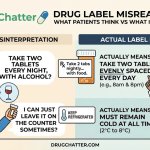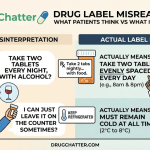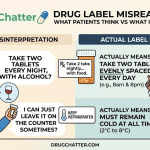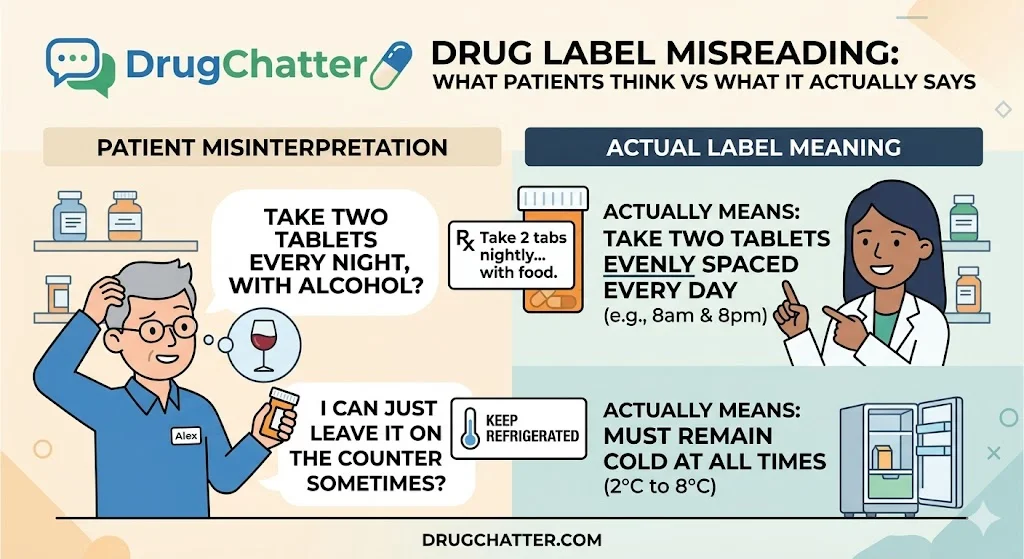
There is a particular kind of failure mode in medicine that doesn’t look dramatic from the outside. No needles in the wrong place. No obvious contraindication. Just language—manufacturers’ language, prescribers’ language, the label’s language—colliding with what people are primed to understand.
When patients misread drug labels, the consequences aren’t always the obvious kind. Sometimes it’s an incorrect dose, taken too often or not often enough. Sometimes it’s an instruction interpreted as a suggestion. Sometimes it’s a patient filling in blanks the way humans do: by assuming that the label is talking to someone like them. (It usually isn’t.)
Below are examples from real DrugChatter discussions—common questions that hint at a deeper issue: the label is not the same thing as the meaning patients extract from it. And when meaning drifts, therapy drifts too.
1) “Heavy patients” and the dose the label may (or may not) be trying to clarify
One of the most persistent reading failures is the belief that dose is governed by body weight in a simple, universal way. Labels often contain dose rules that are conditional, narrow, or phrased in a way that leaves room for assumptions.
Example: What is the maximum cosentyx dose for heavy patients.
2) Accelerating reviews: when timing is treated like a preference instead of a process
Another misreading pattern is “I can move this faster” — as if the clinical and regulatory timeline were a scheduling app rather than a set of governed steps. That’s not a literal label misread, but it’s the same cognitive move: taking an instruction or option as broader than it really is.
Example: Can i expedite vascepa’s application review process?
3) “Pen instructions”: when the delivery device is mistaken for the prescription itself
For injectables, people can read the drug name and miss that the device has its own choreography—steps, timing, and technique that matter as much as the milligrams. A label that assumes familiarity can become a guessing game.
Example: Cosentyx pen instructions for use?
4) St. John’s wort, “effectiveness,” and the label that doesn’t speak the patient’s language
Some label warnings are pharmacology; patients hear them as vibes. The result is a mismatch between the warning and what the patient believes it implies about day-to-day outcomes.
Example: Will taking lipitor and st john’s wort affect my cholesterol levels?
5) Food, meals, and the tyranny of “just take it”
There is a special confusion that shows up around “with food” and “after meals.” People treat these as optional context rather than pharmacokinetic intent. Labels that are wordy can still be misread because the patient is focused on the drug, not the timing mechanics.
Examples: Cosentyx and food? and What’s the best time to take lipitor before or after meals and tums?
6) Flu shots after biologics: “can I just do it?” versus “what does the label actually mean?”
Patients often read “may” as “usually” and “after” as “any time.” But immunology isn’t that cooperative. The label’s timing and risk language is easy to flatten into a yes/no answer.
Example: Does receiving cosentyx impact flu shot’s protective abilities?
7) “Supposed to be effective” and the patient’s missing variable: interactions
Sometimes the misreading is subtle: the patient reads the label as describing the drug in isolation. In real life, interactions are the rule, not the exception.
Examples: Can lipitor lower birth control pill’s efficacy? and Does lipitor interfere with garlic’s cholesterol lowering effect?
8) Dietary supplements and the belief that “natural” means “doesn’t count”
Labels sometimes warn about interactions with foods and supplements without the patient realizing that “over-the-counter” doesn’t mean “harmless.” Fish oil, garlic, vitamin C—patients often treat these as separate stories.
Examples: Will taking fish oil affect lipitor’s effectiveness? and How does vitamin c affect lipitor’s recommended dosage?
9) Exercise, timing, and the label’s missing context
People interpret labels through their own schedule: workouts, shifts, meal timing, and routines. If the label doesn’t mention those routines, the patient supplies them.
Examples: Lipitor and exercise endurance what’s the link? and What’s the typical lyrica dose while working out.
10) Coupons, discounts, and the “paperwork meaning” problem
Not every misread involves chemistry. Sometimes it’s the patient reading a program requirement as a guarantee. When language around discounts or patient support is ambiguous, people end up confused right where they’re under financial stress.
Examples: What are vascepa’s discount requirements and Sancuso coupon?
What to do when the label and the interpretation don’t match
Labels aren’t meant to be read in isolation. The safest move is to treat every prescription as a short conversation:
- Ask one clarifying question: “What does the label mean in practice for me—when do I take it, how often, and with what boundaries?”
- Repeat back the plan: even a sentence or two can reveal misunderstanding instantly.
- Don’t let device instructions blur: if it’s a pen, an inhaler, or anything with steps, the procedure is part of the dose.
- List your interactions: supplements, herbal products, meal timing changes, and alcohol habits—these can turn a correct label into the wrong outcome.
The label’s job is to be precise. The patient’s job is to understand that precision. Misreading happens in the gap between those two jobs—and the gap is where preventable harm lives.