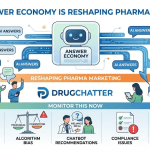
A patient asks ChatGPT whether they can take Eliquis with ibuprofen. The model answers confidently. The answer is wrong.
No adverse event report gets filed. No FDA reviewer sees it. The pharma company that makes Eliquis — Bristol Myers Squibb and Pfizer — has no idea it happened.
This is the compliance gap that no one in the pharmaceutical industry has fully closed, and it is widening every month as more patients, caregivers, and physicians route their drug questions through AI chat systems.
ChatGPT reached 400 million weekly active users by early 2025. Perplexity processes tens of millions of medical queries per month. Google’s AI Overviews now surface drug information directly on the search results page, often without a click to an approved label. The volume of AI-mediated drug interactions with the public now likely exceeds the combined reach of DTC advertising, pharmacist consultations, and patient call centers — and almost none of it is monitored.
For pharmaceutical brand teams, medical affairs departments, and compliance officers, the question is no longer whether to monitor AI outputs about their drugs. It is how to build that monitoring infrastructure before the first enforcement action makes it mandatory.
Why ChatGPT Gets Drug Safety Information Wrong — Systematically
The errors are not random. They follow patterns that any pharmacovigilance team would recognize as high-risk.
The Training Cutoff Problem and Drug Label Updates
Drug labels change. Boxed warnings get added. Contraindications expand. Dosing recommendations shift after post-market surveillance data comes in. ChatGPT’s training data has a cutoff, and even after a model is updated, its knowledge of specific label revisions is unreliable.
The FDA issued more than 150 drug safety communications in 2023 alone, covering everything from updated REMS requirements to new drug interaction warnings. A language model trained before those communications, or trained on a web corpus that underrepresented FDA.gov content relative to patient forums, will give outdated answers with full confidence.
The fluoroquinolone class is a concrete example. The FDA has repeatedly strengthened warnings about serious adverse effects — peripheral neuropathy, tendon rupture, aortic aneurysm — since 2016. Yet searches of AI systems frequently surface older, softer characterizations of these risks, reflecting the weight of earlier web content in training data.
How LLMs Confuse Brand Names, Generic Names, and Biosimilars
Ask ChatGPT about Humira and it may blend information about adalimumab biosimilars — Hadlima, Hyrimoz, Cyltezo — with the reference product, particularly on questions about interchangeability and immunogenicity. The distinctions matter clinically and legally.
The biosimilar space is especially prone to AI conflation errors because the products share an INN (International Nonproprietary Name) while differing in formulation, approved indications, and switching data. A physician asking an AI assistant about switching a patient from Humira to a biosimilar may receive information that blurs which biosimilar is interchangeable in which state — a question with real liability implications.
Off-Label Recommendations: What AI Says vs. What’s Approved
LLMs frequently discuss off-label uses of drugs in ways that a regulated drug company’s own medical team could never do. Ask ChatGPT about low-dose naltrexone for autoimmune conditions, or about metformin for longevity, and you will receive detailed, often enthusiastic summaries of off-label evidence that would trigger an FDA warning letter if a pharma company’s sales rep said them to a doctor.
The irony is sharp. The company that makes the drug is legally prohibited from proactively discussing off-label evidence with prescribers. An AI system trained on the same published literature has no such restriction, and patients are consuming that information at scale.
For compliance teams, the risk runs in both directions. If patients act on AI-generated off-label use information and experience adverse events, those events may never be reported through the formal pharmacovigilance system. They disappear into the noise.
Can AI Hallucinations About Drugs Trigger FDA Regulatory Action?
This is the question pharmaceutical legal teams are quietly working through, and the answer is: possibly, through several distinct pathways.
Adverse Event Reporting Gaps Created by AI-Mediated Drug Information
Under 21 CFR 314.81 and the FDA’s 2023 draft guidance on electronic submissions of adverse event reports, MAH (Marketing Authorization Holders) are required to report adverse events they become aware of. “Become aware of” has traditionally meant reports from healthcare professionals, patients, or published literature.
The FDA has not yet formally addressed whether an MAH’s awareness of AI-generated misinformation about their drug — information that could cause or mask adverse events — creates a reporting or corrective obligation. But the agency’s history of expanding “awareness” standards suggests this is a live regulatory question.
The European Medicines Agency has moved further here. The EMA’s Good Pharmacovigilance Practices (GVP) Module VI explicitly requires MAHs to monitor information from “all sources,” including digital channels. As AI-generated content becomes a dominant digital channel, EMA-regulated companies may face earlier pressure to demonstrate AI monitoring as part of their PSMF (Pharmacovigilance System Master File).
FDA Warning Letters and Promotion Regulations: The AI Amplification Risk
The FDA’s Office of Prescription Drug Promotion (OPDP) has issued warning letters for a range of digital promotion violations — Twitter posts that omit risk information, websites with misleading efficacy claims, social media influencer content with inadequate fair balance. In 2022 and 2023, OPDP warning letters specifically addressed Instagram and Facebook content.
The next frontier is whether OPDP could view an AI system’s response about a drug — particularly if that response sounds promotional and lacks fair balance — as implicating the MAH. The theory would require arguing that an MAH somehow influenced the AI output, which is difficult. But the inverse risk is easier to see: if an MAH knows that AI systems are telling patients their drug is safe in contraindicated populations and does nothing, they may face questions about their post-market safety surveillance obligations.
REMS Programs and AI: A Compliance Gap No One Is Monitoring
Risk Evaluation and Mitigation Strategies (REMS) exist for drugs where the FDA has determined that routine risk management is insufficient. Isotretinoin (iPLEDGE), clozapine (CLOZAPINE REMS), and sodium oxybate (XYREM REMS) all carry REMS requirements that restrict prescribing, dispensing, and patient access.
AI systems do not enforce REMS. A patient asking ChatGPT how to obtain isotretinoin online, or asking about clozapine dosing without the required monitoring, may receive technically accurate pharmacological information stripped of any REMS context. There is no mechanism for the REMS program sponsor to monitor these interactions or correct them.
How Often Do ChatGPT and Claude Mention Ozempic vs. Wegovy — and Why It Matters for Share of Voice
Semaglutide exists in two branded forms in the US market: Ozempic (approved for Type 2 diabetes) and Wegovy (approved for chronic weight management). They contain the same active ingredient at different doses and with different approved indications. The distinction matters enormously for regulatory compliance, payer coverage, and prescriber behavior.
Measuring AI Brand Share of Voice Across GPT-4, Gemini, and Claude
When patients type “best medication for weight loss” into ChatGPT, Gemini, Perplexity, or Claude, which drug names appear? How often? In what context? With what safety framing?
This is the new share-of-voice battlefield. Traditional pharmaceutical market research measures brand awareness through surveys, prescription data, and social media listening. None of those methods captures AI-mediated drug mentions — which are now, for many patients, the first touchpoint in a treatment decision pathway.
Novo Nordisk, which markets both Ozempic and Wegovy, faces a specific challenge: AI systems frequently use the names interchangeably, or recommend Ozempic for weight loss despite that being an off-label use. Eli Lilly faces the same issue with tirzepatide — Mounjaro (diabetes) vs. Zepbound (obesity). When ChatGPT recommends Mounjaro for weight loss in a patient without diabetes, it is generating off-label use guidance at scale.
Tracking Competitive Drug Mentions in AI Search Results
The share-of-voice question extends to competitive dynamics. In the GLP-1 market, semaglutide (Novo Nordisk), tirzepatide (Eli Lilly), and the emerging oral GLP-1 class are competing for prescriber mindshare and patient preference. If Gemini consistently positions tirzepatide as more effective than semaglutide without citing the specific SURMOUNT vs. SUSTAIN trial data, that framing shapes perception regardless of clinical nuance.
Pharmaceutical brand teams that track AI share-of-voice systematically — running the same queries across multiple LLMs on a regular cadence — are building a competitive intelligence advantage their peers do not have. They can see when their drug’s positioning shifts, when competitor mentions increase, and when AI systems begin recommending generic alternatives ahead of branded options.
Tools like DrugChatter are specifically designed to query multiple AI systems simultaneously and track how drugs are discussed, compared, and recommended across LLM outputs over time.
Do LLMs Recommend Generic Drugs More Often Than Branded Ones?
The evidence suggests yes, particularly for query types that reference cost or affordability. Ask ChatGPT “what’s a cheaper alternative to Humira” and the model will enumerate biosimilars and generic TNF inhibitors. Ask about “best statin for high cholesterol” and you are more likely to receive atorvastatin (generic) than Lipitor (branded) — even though the branded product still has FDA-approved labeling.
For branded drug manufacturers, this default toward generics in AI outputs represents a form of share erosion that is invisible in traditional market research. A patient who encounters an AI recommendation for generic atorvastatin three times before speaking with their doctor is not the same patient as one who encountered no AI advice at all.
What Pharma Brand Teams Can Learn From How Patients Ask AI About Drug Interactions
Patient queries to AI systems reveal intent and concern that traditional market research cannot easily capture. When patients type “can I take Jardiance and Farxiga together” or “what happens if I drink alcohol on methotrexate,” they are showing their hand on concerns that may never surface in a patient survey or a physician visit.
Conversational AI Query Patterns as a Voice-of-Customer Data Source
The query patterns matter as much as the answers. If “Xeljanz blood clot risk” is a high-volume AI query, that tells a brand team something about patient anxiety that may predate any formal signal in the adverse event reporting system. It may reflect news coverage, social media discussion, or a litigation story that patients are researching independently.
In 2021, the FDA issued a black box warning for Xeljanz (tofacitinib) related to increased risk of serious heart-related events, blood clots, and death. Pfizer, the manufacturer, was required to update its label and communication materials. But the patient questions that likely drove that investigation — and that continue to circulate — live in search engines, patient forums, and now AI chat systems.
Tracking which drug-related questions are being asked of AI systems gives pharmaceutical companies an early warning system for emerging safety concerns, patient confusion, and competitive pressure points. The query is the signal.
What Reddit AI Citations Tell Brand Teams About Patient Information Sources
AI systems are not generating drug information from nothing. They are synthesizing it from training data that includes Reddit’s r/diabetes, r/ChronicPain, r/lupus, and dozens of other patient communities where real adverse experiences, off-label use reports, and drug comparisons are shared daily.
When a patient posts on r/rheumatoid that they switched from Enbrel to a biosimilar and experienced a flare, that anecdote enters the web corpus. When it accumulates enough similar posts, it can influence how an LLM responds to questions about Enbrel biosimilar switches — potentially in ways that conflict with FDA-approved labeling on interchangeability.
Pharmaceutical companies already monitor social media for pharmacovigilance signals under FDA guidance. Extending that monitoring to the AI-generated summaries of those social conversations is the logical next step.
Can AI Outputs Be Used for Pharmacovigilance? The Regulatory Debate
The question has moved from theoretical to operational. FDA’s 2020 guidance on monitoring internet sites for adverse events, and subsequent updates, establish that MAHs must monitor “solicited” and “unsolicited” reports from digital sources. AI-generated content occupies an ambiguous regulatory category — it is neither a patient report nor a published study, but it may synthesize both.
Mining LLM Outputs for Adverse Event Signals
A practical application is signal detection. If Claude, ChatGPT, and Gemini all respond to queries about a specific drug with mentions of a particular adverse event not prominently featured in labeling, that pattern may reflect a genuine accumulation of adverse event reports in training data. The AI output becomes a proxy for signal aggregation.
This is not a substitute for formal disproportionality analysis in a pharmacovigilance database. But it is a supplementary signal source that currently goes untapped by most pharmaceutical companies.
“Fewer than 10% of pharmaceutical companies currently have any systematic process for monitoring AI-generated content about their drugs.” — Industry estimate cited in the Drug Information Association’s 2024 Annual Meeting proceedings on AI and pharmacovigilance surveillance.
How AI Monitoring Fits Into a Pharmacovigilance System Master File
For companies operating under EMA jurisdiction, the PSMF must document the organizational structures, responsibilities, and procedures for pharmacovigilance. As regulators increasingly expect digital channel monitoring, AI monitoring protocols will need documented procedures, responsible personnel, and evidence of systematic execution.
The practical question is how to structure it. Options include manual sampling on a scheduled cadence, automated query systems that run standardized prompts across multiple LLMs and log responses, and integration with signal detection platforms that already handle social media and literature monitoring.
The infrastructure for AI pharmacovigilance monitoring is nascent but buildable. What most companies lack is not the technology — it is the regulatory justification to prioritize the investment. The FDA’s eventual guidance on AI-generated health content will likely provide that justification. Companies that build the infrastructure before it is required will be better positioned than those who build it reactively.
Which Drugs Are Most Frequently Mentioned by AI — and What That Frequency Means for Brand Strategy
Frequency of AI mention correlates with several factors: the drug’s volume in web training data, its cultural visibility (Ozempic’s media saturation is unusually high), the complexity of patient questions around it, and the degree to which it is discussed on the patient forums and health sites that constitute a large share of LLM training corpora.
High-Volume AI Drug Mentions: GLP-1s, Statins, SSRIs, and Immunologics
The drugs most frequently discussed in AI outputs broadly mirror the drugs most discussed in patient forums and health media. GLP-1 receptor agonists dominate current query volumes. SSRIs and SNRIs generate consistent volume around discontinuation syndrome, switching protocols, and sexual side effects — all areas where LLM answers often understate FDA-labeled risks. Immunologics (TNF inhibitors, IL-17 inhibitors, JAK inhibitors) generate complex queries around infection risk, biosimilar switching, and prior authorization — areas where AI answers frequently oversimplify.
Drugs Where AI Misinformation Poses the Highest Safety Risk
Not all AI drug misinformation carries equal risk. The highest-risk categories are:
- Anticoagulants (warfarin, apixaban, rivaroxaban) — dosing errors and interaction misinformation have direct hemorrhagic risk
- Immunosuppressants (tacrolimus, mycophenolate) — narrow therapeutic index drugs where AI dosing guidance is dangerous
- Oncology drugs — where AI systems frequently conflate clinical trial eligibility criteria with approved indications
- REMS drugs — where the absence of AI-communicated risk management requirements creates the most direct gap between AI guidance and clinical reality
For pharmaceutical companies in these categories, the monitoring imperative is not primarily about brand share. It is about patient safety and the liability exposure that accompanies demonstrable knowledge of unsafe AI guidance without corrective action.
How Eli Lilly and Novo Nordisk Are Approaching AI Brand Monitoring
Neither Eli Lilly nor Novo Nordisk has publicly disclosed a formal AI brand monitoring program in regulatory filings or investor communications. What is visible from industry conference presentations, job postings, and agency briefings suggests that both companies are investing in digital intelligence infrastructure that includes AI output monitoring as a component.
What Internal Pharma Digital Teams Are Building for LLM Surveillance
Job postings from major pharmaceutical companies in 2023 and 2024 show a pattern: roles with titles like “Digital Intelligence Analyst,” “AI Monitoring Specialist,” and “Competitive Digital Insights Manager” are appearing in medical affairs, regulatory affairs, and commercial strategy teams. The skill sets requested consistently include natural language processing, AI/ML familiarity, and experience with pharmaceutical compliance.
The operational approach varies. Some companies are building internal prompt libraries — standardized questions run against major LLMs on a weekly or monthly cadence — and feeding the outputs into their medical information and pharmacovigilance review workflows. Others are partnering with specialized vendors who aggregate AI outputs at scale.
The challenge is reproducibility. LLM outputs are non-deterministic: the same query may produce different answers across sessions, model versions, and geographic deployments. A rigorous monitoring program needs a methodology that accounts for this variability — running multiple query variants, logging outputs with timestamps and model version data, and establishing statistical thresholds for when a change in AI response patterns warrants escalation.
Agency and Consulting Recommendations for AI Share-of-Voice Tracking
Healthcare marketing agencies are beginning to formalize AI share-of-voice offerings alongside their traditional social listening and media tracking services. The analytical framework they are building on is familiar from search engine optimization — query clustering, entity tracking, response sentiment analysis — but applied to LLM outputs rather than SERP positions.
The strategic insight being sold to pharmaceutical clients is straightforward: if your drug appears in AI responses to treatment-category queries at a lower frequency than competitors, or with weaker safety-to-efficacy framing, you have a brand equity problem that traditional marketing cannot diagnose and cannot fix through traditional channels.
Platforms like DrugChatter are purpose-built for this analysis — providing pharmaceutical teams with systematic, repeatable tracking of how specific drugs are positioned across ChatGPT, Claude, Gemini, and Perplexity, with historical trend data that shows how AI drug perceptions shift over time.
The Patient Sentiment Gap: What AI Conversations Reveal That Surveys Miss
Traditional pharmaceutical market research relies on patient surveys, focus groups, and claims data. These methods capture stated preference and documented behavior, but they miss the reasoning patients bring to those preferences — the concerns they researched, the comparisons they made, the fears they could not articulate to their doctor.
How AI Query Analysis Reveals Pre-Consultation Patient Concerns
When a patient with newly diagnosed rheumatoid arthritis asks ChatGPT “will methotrexate make my hair fall out” before their first rheumatology appointment, that query reveals an anxiety that may never surface in a physician consult or a patient-reported outcome measure. If that patient then asks “what’s a safer alternative to methotrexate for RA,” the sequence reveals a decision pathway that starts with AI consultation and ends with a physician conversation shaped by AI-generated framing.
Pharmaceutical companies whose drugs are positioned as “safer alternatives” in AI outputs — accurately or not — gain patient-driven prescriber pressure that their competitors lack. This is the commercial implication of AI share-of-voice that brand teams are beginning to quantify.
Physician Perception and AI: What Doctors Ask LLMs About Drugs
Physicians are also using AI systems for clinical decision support, and the implications are distinct from patient use. A physician asking ChatGPT about dosing a drug in renal impairment, or about the evidence base for a combination regimen, is operating in a professional clinical context. AI errors in that context have direct patient care implications.
A 2023 JAMA Internal Medicine study found that ChatGPT provided accurate medication dosing recommendations in 57% of cases tested — meaning 43% of responses were inaccurate in some dimension. For pharmaceutical companies, physician reliance on AI for prescribing decisions represents both a risk (errors could create adverse event signals attributable to AI guidance) and an opportunity (accurate, well-framed AI responses to clinical queries are a form of medical education reach that dwarfs traditional rep detailing).
Medical affairs teams are beginning to recognize that the clinical narrative in their medical information letters, AMCP dossiers, and publication plans needs to be constructed with AI training data in mind. If the clinical evidence base for a drug is rich and well-represented in peer-reviewed literature, that evidence is more likely to appear accurately in LLM responses. Publication strategy is, in this sense, also AI positioning strategy.
Tracking AI Citation Sources: Where Do LLMs Get Their Drug Information?
When an AI system makes a claim about a drug, it is synthesizing from training data that includes FDA labels, package inserts, published clinical trials, review articles, patient forums, news coverage, and drug information databases. The relative weight of each source type varies by model and is not fully disclosed by any major LLM provider.
Are AI Systems Citing FDA-Approved Labels or Third-Party Sources?
When AI systems surface drug information, they rarely cite FDA.gov directly. The content may be accurate — package insert information is widely reproduced across medical databases, drug information sites, and health portals — but the chain of provenance matters for reliability. A model that has ingested the FDA label via Drugs.com, WebMD, and a dozen other aggregators may have accurate information. But if those aggregators had cached an earlier version of the label before a safety update, the AI’s confident answer will reflect the outdated information.
Perplexity, which operates more as an AI-powered search engine than a pure LLM, does cite sources — and those citations are traceable. Analyzing the sources Perplexity cites for drug information queries gives pharmaceutical teams visibility into which information intermediaries are most influential in AI-mediated drug information. That intelligence has value for content strategy, SEO investment, and medical affairs outreach.
How LLM Optimization Differs From Traditional SEO for Pharmaceutical Content
Traditional pharmaceutical SEO targets Google’s search algorithm with keyword optimization, structured data markup, and domain authority signals. LLM optimization — sometimes called GEO (Generative Engine Optimization) or LLMO — operates differently.
LLMs are not indexing pages in real time (with some exceptions). They are synthesizing from training data, and the most influential content is that which appears repeatedly across multiple high-authority sources, is structured clearly enough to be extracted accurately, and is consistent across appearances.
For pharmaceutical companies, this means that clinical data published in multiple high-impact journals, summarized in medical society guidelines, and described consistently in FDA labeling has stronger LLM representation than clinical data published once in a mid-tier journal. The publication strategy implications are significant: repetition, consistency, and source authority matter more for LLM positioning than for traditional SEO.
DailyMed — the FDA’s official drug labeling database — is one source that LLMs do appear to draw on heavily for approved indication and dosing information. Ensuring that a drug’s DailyMed listing is current, complete, and well-structured is a baseline LLM optimization step that costs nothing and requires no external vendor.
Building a Pharmaceutical AI Monitoring Program: From Concept to Operations
The practical question for pharmaceutical compliance, medical affairs, and brand teams is how to build a sustainable AI monitoring capability without creating a compliance burden that exceeds the risk it manages.
What a Minimal Viable AI Monitoring Protocol Looks Like
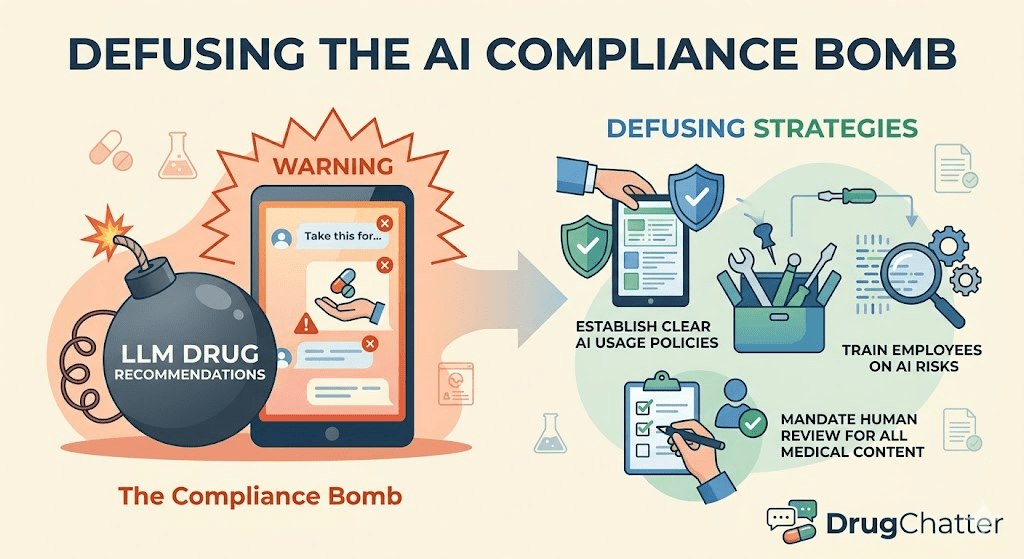
A minimal viable AI monitoring program for a pharmaceutical brand has four components:
- A standardized query library covering: approved indications, key safety topics, common drug interactions, off-label use questions, patient-facing dosing questions, and competitive comparison queries
- A regular cadence of query execution across the major LLMs (ChatGPT GPT-4, Gemini, Claude, Perplexity), with outputs logged in a reviewable format
- A clinical review process that flags responses with safety misinformation, off-label promotion, or significant inaccuracy for escalation
- Integration with pharmacovigilance workflows so that AI-sourced signals are evaluated against the adverse event database and labeled safety information
This does not require a large team or a bespoke technology build. It requires process design and consistent execution — both areas where pharmaceutical companies have demonstrated operational discipline in other compliance contexts.
Integrating AI Output Monitoring Into Medical Affairs Workflows
Medical affairs teams already own the interface between scientific evidence and its communication across multiple channels. Extending that ownership to AI-generated representations of the scientific evidence is a natural fit.
In practice, this means medical information teams reviewing AI query outputs with the same rigor they apply to reviewing third-party disease education content or patient advocacy organization materials. When an AI system misrepresents efficacy data or omits a contraindication, the medical information team is best positioned to assess the clinical significance and recommend a response strategy.
What “response strategy” means in the AI context is still being defined. Companies cannot directly correct an LLM’s training data. But they can ensure their own published content — FDA labels, medical information letters, clinical publication abstracts, disease education materials — is accurate, current, and widely indexed, which indirectly influences future model outputs.
Detecting AI Hallucinations About Your Drug: A Step-by-Step Approach
Hallucinations about drugs are not random. They cluster around:
- Drugs with complex dosing regimens where training data contains multiple conflicting figures
- Drugs that share names or abbreviations with other drugs
- Drugs with recent label changes that are underrepresented in post-update training data
- Drugs with high social media discussion volume where anecdotal reports may outweigh clinical literature in training data weight
A detection approach starts with running queries in the high-risk categories above and comparing AI outputs against the current FDA-approved labeling, not against general clinical knowledge. The standard for accuracy in a pharmacovigilance context is the label, not the consensus of published literature.
When a hallucination is detected, it needs to be documented with sufficient specificity — the exact query, the exact response, the model and version, the date, and the specific inaccuracy — to support any future regulatory discussion about the company’s awareness of AI misinformation about its product.
The Emerging Regulatory Landscape for AI Drug Information
Regulators in the US and Europe are beginning to grapple with AI-generated health information, but the frameworks are early and incomplete.
FDA’s Current Position on AI Health Information and LLMs
The FDA’s Digital Health Center of Excellence has published guidance on AI/ML-based Software as a Medical Device (SaMD) and on clinical decision support software. Neither framework directly addresses consumer-facing LLM outputs about drugs.
In March 2024, the FDA released its action plan for AI in drug development and regulatory review — focused primarily on drug sponsors using AI in clinical trial design and manufacturing. Consumer AI health information was notably absent from that framework.
The FTC has been more active on the consumer side. Its 2023 guidance on AI endorsements and its ongoing investigation into AI companies’ consumer-facing health claims both signal regulatory interest in AI-generated health content that is inaccurate or misleading. Whether that regulatory interest eventually reaches pharmaceutical companies whose products are misrepresented by AI — rather than the AI companies themselves — is an open legal question.
How the EU AI Act Affects Pharmaceutical AI Monitoring Obligations
The EU AI Act, which entered into force in August 2024, classifies certain AI systems used in healthcare as high-risk. Consumer-facing AI systems that provide medical information occupy a regulatory grey zone under the Act — they are not clearly classified as high-risk medical devices, but they are not clearly exempt either.
For pharmaceutical companies operating in EU markets, the more immediate implication is the AI Act’s requirements on providers of general-purpose AI systems to maintain transparency about training data and model capabilities. As those transparency requirements are implemented, pharmaceutical companies may gain access to information about how major LLMs have trained on drug information — which would substantially improve the reliability of AI monitoring programs.
What a Future FDA Warning Letter About AI Drug Misinformation Could Look Like
There is no precedent yet. But regulatory history suggests the pathway would likely involve a demonstrable patient harm event, an investigation that traces the patient’s treatment decision to an AI-generated drug recommendation, and evidence that the drug manufacturer was aware of the AI misinformation and took no corrective action.
That enforcement pathway is not imminent. But it is foreseeable. Drug companies that have documented monitoring programs and good-faith corrective actions — even if those actions are limited to updating their own published content — are in a substantially different position than companies with no monitoring at all.
AI Search and Patient Drug Decision-Making: The Data Behind the Risk
Understanding the scale of AI-mediated drug information requires quantifying the behavioral shift underway in patient information seeking.
How Patients Now Research Medications Before Doctor Visits
A 2024 survey by the Alliance for Health Policy found that 43% of US adults had used an AI chatbot to research a health question in the prior 12 months — up from 23% in 2022. Among adults aged 25-44, the rate exceeded 55%. The drugs most commonly researched via AI aligned with the most-prescribed categories: antidepressants, antihypertensives, GLP-1 agonists, and statins.
This behavioral pattern has a known clinical correlate. When patients arrive at a physician consultation with AI-generated drug information, they bring specific framings, concerns, and sometimes specific drug requests that reflect the AI’s output rather than the prescriber’s assessment. Physicians are increasingly reporting AI-influenced patient requests — for Ozempic when they do not have diabetes, for antibiotics after AI chatbots suggested bacterial infection, for opioid dose adjustments after AI systems provided dosing information without clinical context.
AI-Influenced Drug Demand: What Prescribers Are Seeing
The phenomenon of AI-influenced prescribing pressure is not systematically measured anywhere. But its occurrence is well-documented anecdotally in physician communities, and its direction mirrors exactly what AI share-of-voice analysis would predict: highly AI-visible drugs (Ozempic, Zoloft, Adderall) are generating demand signals that outpace traditional DTC advertising, while lower-AI-visibility drugs are seeing the reverse.
For pharmaceutical brand teams, this is both an opportunity and a risk. If your drug is generating high AI visibility for the right clinical questions — with accurate safety and efficacy framing — you are gaining prescriber influence through a channel that costs nothing directly. If your drug is generating high AI visibility for the wrong reasons — off-label queries, safety concerns, cost comparison — that visibility is working against you.
Measuring ROI on Pharmaceutical AI Monitoring Investments
The compliance case for AI monitoring is clear, but pharmaceutical budget processes require a commercial ROI framework that compliance arguments alone rarely satisfy.
Calculating the Value of AI Share-of-Voice Intelligence
The commercial value of AI monitoring intelligence maps to several quantifiable outcomes. Brand teams that know their drug is underrepresented in AI responses to key treatment-category queries can adjust their content strategy — publication planning, patient education materials, HCP outreach — in ways that improve AI representation over time. The value of that improved representation is measurable in prescription volume, patient adherence, and competitive displacement.
A drug that appears in AI responses to “best treatment for type 2 diabetes with weight loss benefit” at a 60% frequency versus a competitor’s 40% is effectively running a continuous, zero-marginal-cost media impression against every patient and physician who asks that question. The impression value is real even if it is hard to attribute in a standard media mix model.
Risk-Adjusted ROI: What AI Monitoring Prevents
The risk-adjusted ROI calculation includes avoided costs: regulatory response costs when AI misinformation creates adverse event patterns, legal costs if AI-influenced patient harm is traced to a manufacturer’s documented lack of monitoring, and brand damage costs if AI systems consistently misrepresent a drug’s safety profile and that misrepresentation influences physician and patient perception over time.
The financial magnitude of pharmaceutical regulatory actions ranges from warning letters with limited direct cost to consent decrees that impose operational oversight costing hundreds of millions of dollars annually. The relevant precedent for an AI-related enforcement action does not yet exist, but the risk-adjusted expected value calculation — probability of enforcement times magnitude of consequence — supports a meaningful monitoring investment for any major pharmaceutical brand.
Key Takeaways
- AI systems including ChatGPT, Gemini, Claude, and Perplexity are providing drug information to hundreds of millions of patients and clinicians, with no systematic oversight from pharmaceutical manufacturers or regulators.
- LLM drug information errors are not random — they cluster around label updates, biosimilar confusion, off-label use, and REMS drugs, creating predictable high-risk zones.
- The regulatory framework for AI drug information is early. FDA and EMA have not yet mandated AI monitoring, but existing pharmacovigilance obligations around “all sources” may already apply in certain jurisdictions.
- AI share-of-voice — how often and how accurately a drug is mentioned in AI responses to relevant queries — is now a commercially meaningful brand metric that traditional market research does not capture.
- GLP-1 drugs (semaglutide, tirzepatide) are the most acute current case: AI systems routinely confuse approved indications, enabling off-label demand at scale.
- A minimal viable AI monitoring program requires a standardized query library, regular multi-LLM execution, clinical review, and pharmacovigilance integration — achievable with existing team structures.
- Pharmaceutical companies cannot directly correct LLM training data, but they can improve AI accuracy indirectly through publication strategy, accurate DailyMed listings, and widely distributed patient education materials.
- Platforms built specifically for pharmaceutical AI monitoring, such as DrugChatter, provide the systematic, historical, multi-model tracking that manual monitoring cannot deliver at scale.
Frequently Asked Questions
Does FDA require pharmaceutical companies to monitor AI-generated drug information?
There is no FDA guidance specifically requiring pharmaceutical manufacturers to monitor AI-generated drug information as of 2025. However, existing FDA pharmacovigilance regulations under 21 CFR 314.81 require manufacturers to monitor all sources for adverse event reports, including digital channels. The EMA’s GVP Module VI, which applies to companies marketing drugs in Europe, similarly requires monitoring of all information sources. Companies with significant EU exposure face an earlier practical obligation to include AI monitoring in their pharmacovigilance system documentation. Formal FDA guidance on AI health information monitoring is widely anticipated within the next two to three years, and companies that have built monitoring infrastructure before its issuance will face less compliance disruption than those building reactively.
How do I measure my drug’s share of voice across ChatGPT, Gemini, and Claude?
AI share-of-voice measurement requires running standardized queries across each LLM on a consistent cadence and logging whether and how your drug is mentioned in each response. The methodology involves query categories covering treatment-category questions, head-to-head comparisons with competitors, patient-facing safety questions, and HCP-facing clinical questions. Because LLM outputs are non-deterministic — the same query can return different answers — a rigorous measurement approach requires multiple query variants per category and statistical aggregation of results. Specialist platforms like DrugChatter automate this process and provide the historical trend data needed to identify meaningful shifts in AI drug positioning over time.
Can an AI hallucination about a drug create liability for the pharmaceutical manufacturer?
Direct manufacturer liability for a third-party AI system’s hallucination about their drug is legally untested and faces significant hurdles under current product liability and learned intermediary doctrines. The more immediate liability exposure is indirect: if a manufacturer is demonstrably aware that an AI system is providing unsafe information about their drug and takes no corrective action, that knowledge and inaction could be relevant in an adverse event litigation context. The corrective actions available to manufacturers — publishing accurate clinical content, updating DailyMed listings, issuing corrections to major health information platforms — are limited but meaningful. Companies that document good-faith monitoring and corrective efforts are in a stronger position than those that have no record of AI monitoring activity at all.
Why do LLMs recommend generic drugs more often than branded drugs?
Several factors drive this pattern. Generic drug information is more uniformly represented across the web corpus LLMs train on, because it appears in drug information databases, pharmacy websites, and patient forums without the brand loyalty variability of branded drug content. LLMs trained on cost-related health queries — which make up a significant portion of patient drug questions — learn an association between patient cost concerns and generic drug recommendations. Branded drugs also carry promotional restriction contexts in training data (FDA warning letters about branded drug promotion are themselves in the corpus), which may create implicit model caution around making branded drug recommendations. For branded drug manufacturers, this pattern is a commercial headwind that AI share-of-voice monitoring can quantify and publication strategy can partially counteract.
What is the difference between AI pharmacovigilance monitoring and social media monitoring for drug safety?
Social media monitoring for drug safety — required under FDA’s 2014 guidance on adverse event reporting from internet sources — focuses on capturing individual patient-reported adverse event accounts from identifiable sources, assessing their reportability under standard pharmacovigilance criteria, and submitting qualified reports to the adverse event database. AI pharmacovigilance monitoring is functionally different: it focuses on the accuracy and safety framing of AI-generated drug information, which synthesizes from training data that includes social media but is not itself a patient report. AI monitoring identifies where AI systems are providing unsafe or inaccurate drug information, which may or may not correlate with adverse events. The two disciplines complement each other — social media monitoring captures individual adverse event signals; AI monitoring captures systemic misinformation patterns that could generate adverse events at population scale.