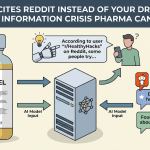
A physician in Phoenix opens ChatGPT and types: “What’s the best GLP-1 for weight loss in a patient with type 2 diabetes?” A patient in Baltimore asks Perplexity: “Does Ozempic cause pancreatitis?” A hospital formulary manager queries Gemini: “Compare semaglutide versus tirzepatide for cardiovascular outcomes.”
None of these interactions pass through a pharma sales rep. None involve a medical information hotline. None are captured by traditional social listening tools. And none are reviewed by a pharmacovigilance team before the answer goes out.
The AI systems answering these questions are operating at a scale that dwarfs any human-led detailing effort. ChatGPT alone processes more than 100 million queries per day. Perplexity reached 15 million monthly active users in 2024. Gemini is embedded in Google Search for hundreds of millions of users. These platforms have become, functionally, the first point of contact for drug information across every stakeholder segment — patients, caregivers, physicians, payers, and pharmacists.
What pharma companies know about those answers is, at the moment, close to nothing.
That is a problem. Not an abstract, future-oriented problem — a live compliance, brand, and patient-safety problem that is growing every quarter as AI search adoption accelerates. The pharmaceutical industry spent decades building systems to monitor what a sales rep said in a doctor’s office, what a KOL posted on a conference slide, and what a patient wrote on a drug review forum. It has no equivalent system for what ChatGPT tells a patient about its drug’s side-effect profile at 2 a.m.
This article covers what pharma brand and regulatory teams need to know about AI-driven drug information flows: how to monitor them, what risks they create, how competitors are approaching the problem, and what a functional AI monitoring program looks like in practice.
Why LLMs Are Now the Default Drug Information Channel
How patients actually research drugs in 2025
The shift started before the current AI boom. Google’s dominance in health search had already eroded trust in traditional physician-directed information: a 2019 Pew Research study found 77 percent of American adults sought health information online before or instead of consulting a doctor. What changed after late 2022 was the format of that information seeking. Instead of scanning ten blue links, patients now get a single synthesized answer from an AI system that presents itself as authoritative, neutral, and comprehensive.
The psychological effect is different. A Google results page is visibly a list of sources; the user understands they are browsing. An AI answer reads like a consultation. It uses first-person framing, responds to follow-up questions, and does not visually signal uncertainty the way a ranked list of competing articles does. Patients treat it accordingly.
Drug-related queries are among the highest-volume categories in AI search. Patients ask about dosing, interactions, side effects, alternatives, cost, and insurance coverage. Caregivers ask about pediatric dosing and contraindications. People without a diagnosis ask whether their symptoms match a drug’s indicated condition. The full range of questions a drug rep might field over a week of physician visits — plus the questions reps are never asked — now flow through AI systems continuously.
Which AI platforms dominate drug information queries?
ChatGPT, Gemini, Claude, and Perplexity handle the largest volumes of health queries among general AI platforms. Their behaviors differ in ways that matter for pharma monitoring.
ChatGPT (GPT-4o and later models) tends to be comprehensive but hedged, often appending disclaimers about consulting a healthcare professional. It draws on its training data and, in browsing-enabled mode, on live web sources. Its drug information quality varies significantly by drug class and recency of training data.
Gemini is deeply integrated with Google Search and Google’s Health Knowledge Graph. Its answers on approved drugs tend to be more structured and source-linked, but it can blend current web content with model-generated synthesis in ways that are not always transparent.
Perplexity cites sources directly and often references medical databases, PubMed, and formulary resources. Physicians and medically literate patients use it at higher rates than general consumer platforms. Its citation behavior means misinformation can be traced — but also that a single low-quality source can propagate widely if Perplexity weights it highly.
Claude (Anthropic) is more conservative on medical recommendations than ChatGPT and typically declines to give specific dosing advice. However, it engages extensively with pharmacological mechanism, clinical trial comparisons, and drug class discussions — exactly the territory where brand positioning and competitive differentiation live.
Microsoft Copilot, embedded in Bing and Microsoft 365, surfaces drug information to enterprise users, including hospital administrators and payer analysts, who may not think of themselves as using a “health AI.”
Do physicians use AI for clinical drug decisions?
Yes, and at rates that surprised early observers. A 2024 survey by the American Medical Association found that 38 percent of physicians reported using AI tools at least weekly for clinical information tasks, including drug selection, interaction checking, and guideline interpretation. Residents and younger attendings skew higher. Dermatologists, oncologists, and internists — the highest-value prescriber segments for most branded drugs — are among the most active AI users in clinical settings.
Physician use of AI is qualitatively different from patient use. Physicians are less likely to accept a hallucinated claim without scrutiny, but they are also less likely to re-query if an answer seems plausible. If an LLM consistently positions a competitor’s drug as first-line for a given indication, a physician who queries multiple times and gets the same pattern will absorb that framing as background knowledge — even if no individual query produces a prescribing decision.
The Hallucination Risk: When AI Gets Drug Safety Wrong
Can AI hallucinations trigger FDA adverse event obligations?
This is the question pharma regulatory teams are debating actively, and the answer is not settled. FDA’s current pharmacovigilance framework was written for a world where adverse event reports come from patients, physicians, and clinical trial investigators — not from AI-generated text that a patient reads and acts on.
The relevant regulatory tension is this: if a patient asks an AI whether their drug causes a particular side effect, the AI hallucinates an affirmative answer that is not in the approved labeling, the patient stops taking the drug, and experiences harm from discontinuation — is that a reportable adverse event? The manufacturer was not the source of the misinformation. But the manufacturer’s drug is involved, and FDA’s pharmacovigilance obligations do not currently carve out AI-generated information.
FDA has not issued formal guidance on AI-generated drug misinformation as of mid-2025, but the agency’s 2023 discussion paper on AI in drug development signaled that it is watching this space. The EMA’s 2024 reflection paper on AI went further, noting that AI-generated patient-facing content about medicines falls within the scope of medicines information regulation in EU member states.
Practically, the risk is asymmetric: a manufacturer that discovers an AI system is hallucinating adverse events for its drug, and does not act, faces greater regulatory exposure than one that documents the discovery, reports it to FDA’s MedWatch program as a potential safety signal, and takes steps to correct the record through official channels.
Real examples of AI drug misinformation in the wild
Documented cases of AI drug misinformation are accumulating faster than they are being publicly reported. Several patterns recur:
Dosing errors: LLMs trained on older data may cite discontinued dosing regimens. A 2024 study published in JAMA Network Open found that ChatGPT provided incorrect dosing information for chemotherapy agents in 12.7 percent of queries, with some errors in the potentially harmful range.
Contraindication omissions: AI systems frequently fail to flag contraindications that appear in FDA-approved labeling but are underrepresented in general web text. Drugs with black box warnings are particularly vulnerable to this pattern.
Off-label promotion (by AI): LLMs trained on social media, patient forums, and journalistic coverage of off-label uses will reproduce those uses in response to patient queries — creating an AI-driven off-label information channel that no manufacturer controls or requested.
Generic substitution errors: AI systems sometimes recommend generic substitution for drugs where bioequivalence is clinically contested (narrow therapeutic index drugs, complex formulations) without flagging the clinical distinction.
Competitor misattribution: Side effects documented for one drug in a class are sometimes attributed to another drug in the same class. This can damage a brand’s safety profile or, conversely, minimize documented risks.
What happens when ChatGPT cites a retracted study about your drug?
Several pharmaceutical manufacturers have discovered, through informal monitoring, that AI systems cite retracted or low-quality studies about their products. The problem is structural: LLMs do not have a real-time retraction database. A study retracted in 2022 may still be heavily represented in training data if it was widely cited before retraction. The AI will cite it as evidence without flagging its retraction status.
For drugs with a history of contested safety literature — Vioxx-class cardiovascular signals, SSRI pediatric safety debates, or more recently the GLP-1 thyroid cancer concerns — the presence of retracted or low-quality studies in AI training data creates a specific, tractable monitoring and correction task.
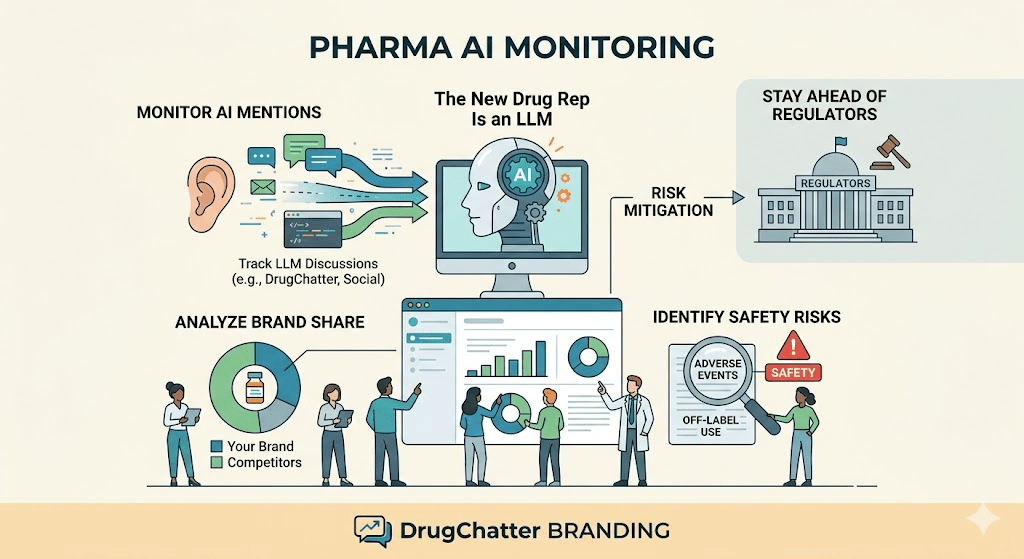
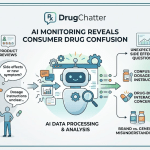
Tools like DrugChatter are designed to surface exactly this kind of AI-generated content about specific drugs, allowing brand and regulatory teams to audit what the major LLMs are saying about their products in near real time.
How Often Do LLMs Mention Ozempic, Wegovy, and Mounjaro?
Measuring AI share of voice for GLP-1 drugs
The GLP-1 class is the most instructive case study in pharmaceutical AI visibility, because it combines massive consumer interest, intense brand competition, and a fast-moving evidence base that regularly outpaces AI training data.
Semaglutide (Ozempic, Wegovy) and tirzepatide (Mounjaro, Zepbound) are among the most-queried drug terms across every AI platform. The brand split matters: Ozempic and Wegovy are the same molecule at different doses for different indications, but their AI share of voice differs substantially because “Ozempic” entered popular culture as a generic term for GLP-1 weight-loss drugs — a brand problem Novo Nordisk did not anticipate and cannot fully correct.
When users query AI systems for “best drug for weight loss,” ChatGPT and Gemini responses in mid-2025 consistently mention semaglutide and tirzepatide, but the brand names used, the comparative framing (which is positioned as more effective, which as safer), and the side-effect profiles cited vary significantly between platforms and between query sessions on the same platform. This variability is itself a competitive intelligence signal: it means no single brand has achieved consistent, accurate representation in AI answers.
Do LLMs recommend generics more often than branded drugs?
The evidence suggests yes, with important caveats. LLMs trained on health economics content, patient advocacy writing, and formulary guidance naturally absorb cost-conscious framing. When a user asks about a drug class without specifying brand preference, AI systems tend to frame the generic or lowest-cost option positively unless there is strong clinical evidence favoring a specific branded formulation.
For off-patent drug classes, this creates a systematic brand share-of-voice deficit. Branded statins, branded ACE inhibitors, and branded proton pump inhibitors receive less AI recommendation than their generics — which is roughly consistent with clinical evidence, but not always with current formulary positioning or payer-preferred brand arrangements that manufacturers have negotiated.
The more concerning pattern is for drugs where compounding or unauthorized generics have entered the market. During the semaglutide shortage period of 2023-2024, AI systems began recommending compounded semaglutide in response to patient queries about cost and availability — a recommendation that was not only off-brand but, in FDA’s view, potentially unsafe. Neither Novo Nordisk nor FDA had a mechanism to correct those AI recommendations in real time.
How competitive is AI search for diabetes and obesity drug queries?
Extremely. In test query sets run against the major AI platforms, drug-class queries like “GLP-1 medications list” or “insulin alternatives for type 2 diabetes” produce answers that effectively rank drug options by AI-inferred clinical preference. The ranking is not paid, not disclosed, not regulated, and not consistent. A brand that appears third in ChatGPT’s synthesized answer list and first in Perplexity’s is getting different brand exposure across two platforms used by overlapping but non-identical physician and patient populations.
Traditional pharma share-of-voice measurement (detailing calls, journal ads, conference symposia, digital media impressions) does not capture this. AI share of voice is a new metric category that pharma has not yet standardized.
What Pharma Brand Teams Can Learn From Patient AI Queries
How patients phrase drug questions in conversational AI
Conversational AI has changed the vocabulary patients use for drug information. In traditional search, patients typed keyword fragments: “ozempic side effects nausea.” In conversational AI, they write full questions or describe situations: “I’ve been on Ozempic for three months and I’m still having nausea every morning — is that normal or should I talk to my doctor about switching?”
That shift from keyword to natural language is a gift for pharma brand researchers, because natural-language queries reveal what patients actually think and fear — not what they have been taught to ask. They reveal misconceptions (patients frequently conflate different GLP-1 mechanisms), adherence barriers (nausea, injection anxiety, cost), competitive consideration sets (patients who describe considering a switch name the alternatives they are weighing), and emerging safety concerns (patients who have seen TikTok content about a drug often phrase their AI queries in terms drawn from that content).
A systematic program to monitor what patients and physicians ask AI systems about a drug class — not just what AI systems answer — is effectively a continuous, unmediated voice-of-customer research stream. It is cheaper than primary market research and more ecologically valid because patients are not performing for a survey instrument.
Patient sentiment analysis in AI search: what the data shows
Sentiment analysis of AI-mediated drug discussions differs from social media sentiment analysis in two key ways. First, the AI’s response shapes subsequent patient sentiment; a patient who receives a reassuring AI answer about a side effect may express less concern in follow-up queries than one who receives an alarming answer, regardless of the underlying clinical reality. Second, the AI’s framing can amplify or suppress safety signals that would otherwise emerge organically.
Platforms like DrugChatter aggregate AI-generated drug discussions to surface sentiment patterns at scale, enabling brand teams to distinguish between AI-amplified concerns (where the AI is generating or inflating patient worry) and genuine safety signals (where the AI is reflecting underlying patient experience that warrants pharmacovigilance attention).
Tracking physician query patterns in AI platforms
Physician query patterns in AI search tend to cluster around three categories: mechanism and pharmacology queries, clinical trial data queries, and comparative effectiveness queries. For brand teams, the comparative effectiveness queries are most commercially relevant: they reveal which competitor drugs physicians are actively weighing against a brand, which endpoint comparisons physicians consider most important, and which clinical scenarios (comorbidities, renal function, age groups) drive switching consideration.
A brand that monitors physician AI query patterns will see its competitive positioning through the eyes of the prescriber — unfiltered by what the rep said, what the conference symposium emphasized, or what the medical affairs team wants physicians to know.
The Regulatory Exposure: FDA Warning Letters, Off-Label AI, and the Compliance Gap
Can AI outputs be considered drug promotion under FDA rules?
FDA’s current promotional regulations apply to manufacturers, their agents, and their contractors. An LLM is none of these — unless a manufacturer has trained, fine-tuned, or specifically deployed that LLM to promote its drug. General-purpose AI systems (ChatGPT, Gemini, Claude) are not the manufacturer’s agents and are not covered by FDCA promotional restrictions when they answer questions about drugs.
The regulatory gap this creates is significant: AI systems can make implicit therapeutic recommendations, suggest drugs for off-label uses, and present comparative efficacy claims that would trigger FDA enforcement if a sales rep made them — and no one is currently accountable for those statements under existing law.
The flip side is also true: if a manufacturer creates a branded AI assistant, trains it on promotional content, or uses it to generate content that effectively promotes a drug, that AI output falls within FDA’s promotional framework. FDA’s Office of Prescription Drug Promotion has not yet issued specific guidance on AI-generated promotional content, but the agency’s general position — that promotional rules apply regardless of the medium — is clear from its 2014 social media guidance and subsequent enforcement letters.
What FDA warning letters reveal about digital drug promotion
FDA’s warning letter database is the most useful public source for understanding where the agency draws the line on digital drug promotion. Several patterns are directly relevant to AI:
FDA has consistently cited manufacturers for promotional content that omits required risk information, regardless of the format. A chatbot that describes a drug’s efficacy without presenting its black-box warning in a contextually prominent way would almost certainly fall within this violation category.
FDA has also cited manufacturers for user-generated content that the manufacturer “adopted or endorsed” by sharing, liking, or leaving unmodified on a platform it controlled. The application to AI-generated content the manufacturer does not control is legally untested, but manufacturers who are aware of persistent AI misinformation about their drugs and take no corrective action may face questions about implicit endorsement.
Off-label drug use discussions in AI: who is responsible?
Off-label use represents a particular compliance vulnerability. LLMs trained on medical literature, patient forums, and clinical commentary absorb extensive off-label use information for many drugs. Queries about off-label uses produce detailed AI answers that may be more comprehensive than anything a manufacturer is permitted to communicate to a physician unprompted.
Consider the off-label use of semaglutide for non-diabetic obesity before Wegovy’s approval, or the off-label use of metformin for anti-aging, or the off-label prescribing of low-dose naltrexone for autoimmune conditions. AI systems discuss all of these freely, drawing on the same medical literature and patient advocacy content that informs clinical practice. Manufacturers cannot control these answers. What they can do is monitor them — to understand how off-label use patterns are evolving, which patient populations are driving off-label AI queries, and whether AI-generated off-label information is accurate or dangerous.
The EMA and EU AI Act: implications for pharmaceutical AI monitoring in Europe
The EU AI Act, which came into force in stages beginning in 2024, classifies certain medical AI applications as high-risk. General-purpose AI systems used for drug information do not automatically fall into the high-risk category, but AI systems used to assist in clinical decisions, recommend treatments, or provide individualized medical advice may. The EMA is developing specific guidance on AI in medicines regulation, and several EU member states have already begun applying existing pharmacovigilance obligations to AI-generated adverse event reports.
For European pharma operations, the practical implication is that AI monitoring is not merely a brand or competitive intelligence function — it is becoming a regulatory compliance function with specific documentation and reporting requirements that differ from those in the United States.
Tracking Share of Voice Across ChatGPT, Gemini, Perplexity, and Claude
What is AI share of voice and how do you measure it?
AI share of voice, for pharmaceutical purposes, measures how often and how prominently a drug brand appears in AI-generated responses to a defined universe of queries — compared to competitor drugs, generic alternatives, and the drug class overall.
The measurement methodology differs from traditional share-of-voice tracking because AI responses are not stable. The same query asked to the same AI platform on different days, or asked by different users, may produce different answers. LLMs are not deterministic at standard temperature settings, and their retrieval behavior (which sources they draw on, which they weight) changes with model updates.
A defensible AI share-of-voice measurement program requires:
A standardized query set covering patient queries, physician queries, and payer queries for the relevant drug class
Systematic sampling across AI platforms (ChatGPT, Gemini, Claude, Perplexity, Copilot) on a regular cadence
Structured coding of responses for brand mentions (first mention, total mentions, comparative framing)
Longitudinal tracking to detect changes following model updates, news events, or competitive launches
DrugChatter provides this kind of structured AI monitoring specifically for pharmaceutical brands, automating query execution and response coding across the major platforms.
How Eli Lilly and Novo Nordisk approach AI monitoring
Neither company has published detailed methodology for AI monitoring programs, but industry presentations and job postings give a partial picture. Novo Nordisk’s digital commercial team has publicly discussed monitoring AI-generated content as part of its broader digital listening infrastructure. Eli Lilly, which has been more vocal about AI investment generally, has integrated AI search monitoring into its competitive intelligence function for the GLP-1 franchise.
Both companies employ medical affairs digital teams whose mandates have expanded to include AI-generated medical information monitoring — a function that sits at the intersection of pharmacovigilance, medical affairs, and competitive intelligence, and that did not exist as a defined role five years ago.
The companies that are ahead on this are not necessarily the largest — they are the ones that recognized earliest that AI search was not just another digital channel but a fundamentally different information architecture requiring different monitoring tools and different regulatory thinking.
How does AI brand visibility differ from SEO and paid search?
SEO and paid search operate on transparent, auditable mechanisms. A website either ranks for a keyword or it does not. A paid ad either runs or it does not. The variables are known and controllable, within Google’s published rules.
AI search visibility is none of these things. The factors that determine whether an LLM mentions your drug, how it frames your drug, and how favorably it presents your clinical evidence are not published, not auditable, and not directly controllable. They emerge from the interaction of training data, model architecture, retrieval mechanisms, and query context — a system of sufficient complexity that even the AI developers cannot fully predict which sources will influence which answers.
This opacity cuts both ways. It means pharma cannot buy AI visibility the way it buys paid search. But it also means that organic actions — publishing high-quality, well-indexed clinical content, correcting misinformation in authoritative sources, and ensuring accurate drug information appears in the databases AI systems preferentially retrieve — have a real but delayed effect on AI answers.
Pharmacovigilance in the Age of AI Search: Can LLM Outputs Feed Drug Safety Surveillance?
Can AI-generated drug discussions be used for adverse event detection?
The pharmacovigilance community has been cautiously optimistic about this question for several years, and the early evidence is promising. Social media pharmacovigilance — using platforms like Twitter/X, Reddit, and patient forums for adverse event signal detection — has been validated in several academic studies as a complement to traditional spontaneous reporting. AI-generated drug discussions represent an extension of this approach.
The specific value of AI-generated content for pharmacovigilance is that it aggregates and synthesizes patient-reported experience from multiple sources, potentially surfacing signal patterns that are not yet visible in any single source. When patients ask AI systems about unusual drug experiences, the AI’s response draws on a broader base of similar experiences than any individual patient has access to. Monitoring what patients ask — not just what AI answers — captures a real-time stream of drug experience reports from patients who may never file a MedWatch report.
FDA has funded research into social media pharmacovigilance and has indicated interest in novel data sources for safety surveillance. The application to AI-generated content is a natural extension, and several academic medical centers have begun publishing on methodologies for extracting adverse event signals from AI query patterns.
What Reddit AI citations reveal about drug safety perception
Reddit has become a significant source for AI training data and AI retrieval because its forum structure produces dense, searchable, categorized discussions that AI systems can parse effectively. Subreddits like r/diabetes, r/loseit, r/ChronicPain, and r/pharmacy contain millions of posts about drug experiences, many of which describe adverse events, treatment failures, drug interactions, and adherence patterns in clinical detail.
AI systems that retrieve Reddit content can surface drug experiences that are not yet represented in clinical literature — which is useful for safety signal detection but also creates misinformation risks when anecdotal Reddit discussions of unverified drug effects get incorporated into AI answers as if they represented consensus medical knowledge.
For pharma brand teams, monitoring what Reddit content about their drugs is being cited by AI systems — and how that content is being framed — provides early warning of both legitimate safety concerns and misinformation patterns that require correction.
Building an AI pharmacovigilance workflow: what does it actually look like?
A functional AI pharmacovigilance workflow has five components:
Query monitoring: Systematic tracking of patient and physician queries about a drug across major AI platforms, coded for adverse event mentions, safety concerns, and discontinuation discussions.
Response auditing: Regular review of AI-generated answers for accuracy against current FDA-approved labeling, with particular attention to black box warnings, contraindications, and drug interactions.
Signal triage: Classification of AI-surfaced concerns by novelty (known vs. emerging signal), severity (minor vs. serious vs. life-threatening), and source quality (AI synthesis vs. clinical literature vs. patient forum).
Regulatory reporting: Documentation of identified signals and escalation to the pharmacovigilance team for assessment under existing adverse event reporting obligations.
Correction strategy: Where AI misinformation is identified, a documented approach to correcting the underlying sources — updating official drug information in authoritative databases, publishing accurate clinical content, and engaging AI platform developers where safety-critical misinformation is identified.
Competitive Intelligence: What Your Competitor’s AI Mentions Tell You
How to detect AI-generated competitor positioning
AI systems develop implicit competitive rankings for drug classes based on the weight of clinical evidence, prescribing guideline citations, and patient experience content in their training data. These implicit rankings are not the result of any company’s promotional effort — they are emergent from the totality of published and user-generated content about a drug class.
Monitoring competitor positioning in AI answers provides intelligence that traditional competitive research cannot capture: how the evidence base for your drug and your competitors’ drugs is perceived in aggregate by systems that are processing the full scientific literature, not just the literature your medical affairs team has curated for field teams.
If a competitor’s drug is consistently positioned by AI systems as “preferred” for a particular patient subgroup, that is either an accurate reflection of the clinical literature (in which case it is a genuine competitive threat your brand team should address) or a reflection of misinformation (in which case it requires correction). Distinguishing between these cases requires human clinical review — but identifying the pattern requires AI monitoring.
Tracking generic substitution recommendations by AI
Generic substitution recommendations from AI systems are a growing concern for branded drug manufacturers. When a patient asks an AI “is there a cheaper version of [brand name]?” or “is the generic the same as the brand?”, the AI’s answer directly influences brand loyalty and may affect adherence if the patient self-substitutes based on an AI answer that is clinically inaccurate.
For narrow therapeutic index drugs — warfarin, levothyroxine, certain antiepileptics — AI answers about generic substitution can be genuinely dangerous if they fail to communicate the clinical considerations that make substitution non-trivial. Monitoring AI generic substitution discussions for these drug classes is a patient safety imperative, not just a brand protection exercise.
AI citation analysis: which clinical sources are shaping drug answers?
AI systems that cite sources (Perplexity, Gemini with Search, ChatGPT in browsing mode) reveal which clinical sources are most influential in shaping drug answers. For pharma competitive intelligence, this citation analysis identifies:
Which clinical trials are most frequently cited in AI answers about your drug and competitors’ drugs
Which treatment guidelines are most influential in AI clinical recommendations
Which patient advocacy organizations’ content is being retrieved and how it frames drug options
Whether your own clinical publications are being retrieved and cited accurately
A brand whose pivotal clinical trial is consistently cited in AI answers has a form of persistent clinical visibility that no amount of promotional spend can buy. A brand whose trial data is poorly indexed, inaccurately summarized in secondary sources, or simply underrepresented in the sources AI systems prefer will be disadvantaged in AI answers regardless of its promotional investment.
Building a Pharmaceutical AI Monitoring Program: Practical Infrastructure
What tools and platforms does pharma AI monitoring require?
The technology stack for pharmaceutical AI monitoring is still forming, but several categories of tool are clear:
Dedicated pharmaceutical AI monitoring platforms like DrugChatter are purpose-built for this use case, offering systematic query execution across AI platforms, response coding for drug mentions and sentiment, and longitudinal tracking against competitor drugs.
General AI monitoring tools (Brandwatch, Sprinklr, and similar platforms that have added AI monitoring capabilities) can track brand mentions in AI-generated content at scale but lack the pharmaceutical-specific coding (adverse event classification, off-label detection, safety claim accuracy) that a pharma program requires.
Internal LLM deployments allow pharma companies to run controlled monitoring experiments — systematically querying AI platforms with standardized query sets and analyzing results at scale. This requires technical resources but provides flexibility for custom query design.
Drug information database integrations (DrugPatentWatch, Micromedex, Lexicomp) are useful for validating AI-generated drug information against authoritative sources. Some AI monitoring programs use these databases as reference standards against which AI answers are scored for accuracy.
What does an AI monitoring team look like inside a pharma company?
The organizational design for pharmaceutical AI monitoring is converging on a cross-functional model. Effective programs involve:
Medical affairs leadership for clinical accuracy review and pharmacovigilance interface
Regulatory affairs for compliance assessment and FDA reporting decisions
Brand/commercial team for share-of-voice tracking and competitive intelligence
Digital/technology team for platform infrastructure and query automation
Legal for liability assessment and correction strategy
The function sits most naturally in medical affairs in companies where it has been established, because medical accuracy is the non-negotiable foundation. But the commercial intelligence component requires brand team involvement that many medical affairs organizations have not historically managed.
How often should pharma companies audit AI-generated drug content?
Audit frequency should match the rate of change in both the drug’s risk profile and the AI platforms’ behavior. For high-risk drugs (black box warnings, recent safety communications, active litigation), monthly audits are a reasonable floor. For stable drugs in mature classes, quarterly may be sufficient.
Model update events require triggered audits. When a major AI platform releases a model update (GPT-5, Gemini 2.x, Claude 4), drug information quality can shift substantially because the new model draws on different training data or applies different retrieval logic. An audit immediately following a model update is standard practice in organizations that have formalized AI monitoring.
“We are at the very beginning of understanding how AI search changes the information environment for patients and physicians. The question is not whether AI is becoming a primary channel for drug information — it already is. The question is whether the pharmaceutical industry will build the monitoring infrastructure to understand and respond to what that channel is saying.” — Industry analyst, Digital Health Coalition, 2024
The Emerging Market for Pharmaceutical AI Monitoring Services
Which companies are building pharma AI monitoring tools?
The vendor landscape is early but active. Several categories of company are competing:
Purpose-built pharma AI monitoring platforms like DrugChatter have been designed specifically for pharmaceutical AI monitoring, with workflows optimized for brand monitoring, adverse event detection, and competitive intelligence across AI platforms.
Established pharma technology vendors (Veeva, IQVIA, ZS Associates) are adding AI monitoring capabilities to existing data products, leveraging their relationships with pharma commercial teams and their existing data infrastructure.
AI testing and red-teaming companies that specialize in evaluating AI system outputs for accuracy and safety have pharma as an emerging vertical, offering systematic auditing of AI drug information quality.
Social listening platforms (Brandwatch, Sprinklr, Talkwalker) are extending social media monitoring capabilities to AI-generated content, with varying degrees of pharmaceutical-specific functionality.
The market will consolidate, but the companies that survive will be those that can combine technical AI monitoring capability with pharmaceutical regulatory knowledge — a combination that is genuinely rare in either the technology or the pharma services industry.
What is the ROI for pharma AI monitoring?
ROI is most clearly quantifiable in three scenarios. First, catching a safety hallucination before it proliferates: if an AI platform is consistently stating a drug causes a side effect it does not cause (or omitting a side effect it does cause), the cost of correcting that misinformation through a combination of authoritative content publication and AI platform engagement is likely orders of magnitude less than the cost of managing patient harm or regulatory scrutiny from uncorrected misinformation.
Second, competitive intelligence value: understanding AI-driven shifts in physician and patient drug preferences before they are reflected in prescription data gives brand teams 60-90 days of lead time — roughly one sales cycle — to respond commercially.
Third, pharmacovigilance value: AI monitoring that surfaces genuine safety signals earlier than traditional spontaneous reporting reduces the regulatory risk from delayed signal detection — a risk that carries real financial consequences under FDA’s expanded postmarket surveillance authorities.
What Pharma Needs to Do Now: A Forward Agenda
Correcting the AI record on your drug: what actually works?
Direct correction is not possible with general-purpose AI platforms — you cannot submit a revision to ChatGPT’s training data. What you can do is influence the sources those platforms retrieve and weight.
Practical correction strategies include:
Publishing comprehensive, accurate, well-structured drug information on your own website in formats that AI retrieval systems can parse (structured data, clear headings, schema markup for medical content)
Ensuring your drug’s entry in authoritative databases (FDA’s DailyMed, WHO’s Drug Dictionary, Drugs.com’s professional database) is current and accurate
Publishing original clinical content that addresses the specific misinformation patterns you have identified in AI monitoring
Engaging AI platform developers directly when safety-critical misinformation is identified — all major AI platforms have mechanisms for reporting harmful or inaccurate content
AI search optimization for pharmaceutical brands: is it ethical?
The question of whether pharma should optimize content for AI retrieval — analogous to SEO, but for AI systems — raises ethical considerations that do not apply equally to traditional digital marketing. The purpose of pharmaceutical drug information is to be accurate, complete, and balanced; AI search optimization that amplifies positive drug information while suppressing risk information would violate both the spirit and the letter of FDA promotional regulations.
Ethical AI search optimization for pharma means ensuring that accurate, labeled, and balanced drug information is well-represented in the sources AI systems retrieve — not gaming AI systems to produce favorable promotional responses. The distinction is real and the line is clear, even if maintaining it requires deliberate institutional discipline.
Preparing for FDA guidance on AI-generated drug information
FDA will issue guidance on AI-generated drug information. The timing is uncertain — the agency’s rulemaking calendar is crowded and AI policy requires coordination across multiple centers — but the trajectory is clear. Companies that have built AI monitoring infrastructure before that guidance arrives will be better positioned to demonstrate compliance and to contribute constructively to the guidance development process.
The pharma companies that should be most attentive to incoming FDA guidance are those with drugs that have significant off-label use, complex risk profiles, high patient query volume, or active competitive dynamics in AI search — which describes most branded drugs in the top 50 by revenue.
Key Takeaways
LLMs are now a primary channel for drug information for patients, caregivers, and physicians. They operate outside current pharmaceutical promotional regulation and outside current pharmacovigilance infrastructure.
AI hallucinations about drug safety, dosing, and contraindications are documented and accumulating. The regulatory consequences of ignoring known AI misinformation about your drug are asymmetric.
AI share of voice is a new competitive metric. Brands that measure it will detect shifts in physician and patient preference before they appear in prescription data.
Patient and physician AI query patterns are an underutilized voice-of-customer research stream — richer, cheaper, and more ecologically valid than most primary market research.
Generic substitution recommendations from AI systems represent a specific brand-loyalty and patient-safety risk for narrow therapeutic index drugs and drugs with active compounding markets.
A functional pharma AI monitoring program requires cross-functional design (medical affairs, regulatory, commercial, digital, legal) and a technology infrastructure that includes purpose-built tools like DrugChatter.
Ethical AI search optimization means ensuring accurate, balanced drug information is well-indexed in authoritative sources — not gaming AI systems for favorable promotional outcomes.
FDA guidance on AI-generated drug information is coming. Companies that build monitoring infrastructure now will be ahead of the compliance curve when it arrives.
FAQ: Pharmaceutical AI Monitoring
Q: Is a pharma company required to report adverse events it discovers through AI monitoring?
The obligation to report under FDA’s IND and NDA adverse event reporting rules applies to information “received” by the manufacturer. Whether AI-monitored patient queries constitute “received” adverse event information under 21 CFR 312.32 and 314.81 is legally unsettled. However, the conservative and defensible position is to treat credible safety signals identified through AI monitoring the same way you would treat signals identified through social media monitoring — assess for reportability against your existing safety reporting criteria and document the decision. FDA’s social media pharmacovigilance guidance from 2013, while predating AI platforms, establishes the agency’s expectation that manufacturers monitor digital channels for safety information.
Q: How do LLMs decide which drug to recommend first in a class?
No single factor determines AI drug ranking. LLMs weight a combination of clinical trial evidence volume (drugs with more published RCTs tend to be more prominent), guideline citation frequency (drugs recommended by ADA, ACC, or similar societies appear frequently in guideline text that feeds AI training data), patient experience volume (drugs with large patient communities produce more user-generated content for AI training), and recency (drugs with recent approvals or label changes may be better or worse represented depending on model training cutoff). No manufacturer can directly influence this ranking, but all of its determinants can be affected by legitimate clinical communication activity.
Q: What is the biggest AI-generated misinformation risk for branded pharmaceutical drugs in 2025?
Based on documented cases and monitoring program data, the highest-risk category is safety omission — AI answers that correctly describe a drug’s efficacy but fail to present its risk profile with appropriate completeness. This pattern is particularly common for drugs with extensive positive media coverage (GLP-1s, Leqembi for Alzheimer’s, RSV vaccines), where the volume of positive clinical content in AI training data outweighs the volume of balanced risk-benefit content. A close second is competitive misattribution — side effects documented for one drug in a class attributed to another — which is most common in large drug classes with multiple agents and a history of class-level safety concerns.
Q: How can small and mid-size pharma companies monitor AI drug mentions without a large digital team?
Purpose-built platforms like DrugChatter are designed precisely for organizations without large internal digital infrastructure. They provide systematic AI monitoring across the major platforms with pharmaceutical-specific coding and reporting, without requiring a company to build or maintain its own query automation infrastructure. For companies with very limited resources, a minimum viable program involves quarterly manual audits of the top 20 patient and physician queries about your drug across ChatGPT, Gemini, and Perplexity, documented against current approved labeling, with a written risk assessment. That is not comprehensive but it is defensible as a starting point for regulatory purposes and will identify the most urgent correction priorities.
Q: Will AI platforms eventually be regulated as drug information sources?
Regulatory frameworks for AI as a drug information intermediary are developing in parallel across FDA, EMA, and national competent authorities. The EU AI Act’s high-risk classification for certain medical AI applications is the most advanced regulatory framework currently in effect. FDA has authority under the FDCA to regulate “labeling” — broadly defined to include any written drug information distributed in interstate commerce — and has used this authority expansively in the past. Whether AI-generated drug information constitutes “labeling” under FDCA is a live legal question. The most likely near-term regulatory development is FDA guidance on what drug manufacturers are expected to do when they identify AI-generated misinformation about their drugs — not direct regulation of AI platforms, which would require Congressional action.