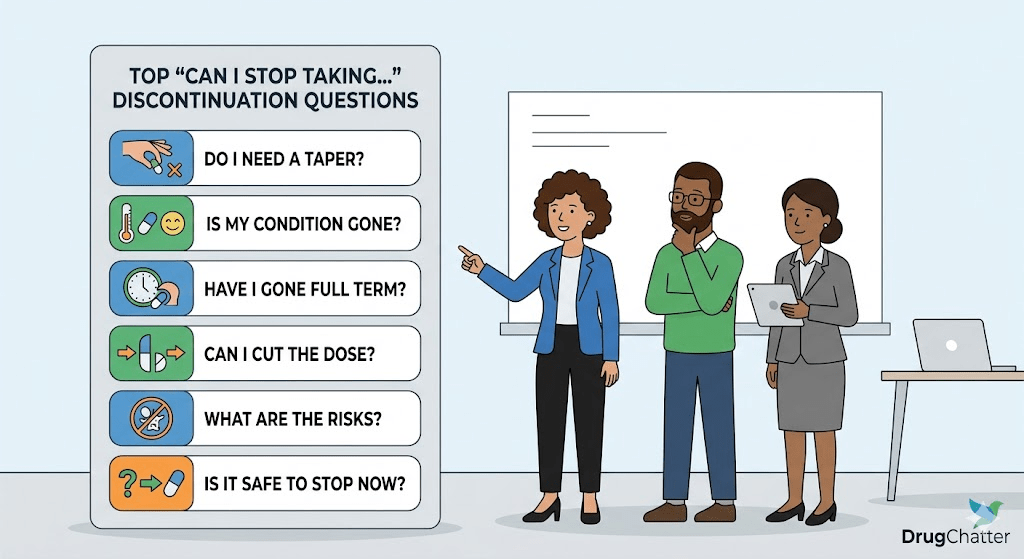
There are two kinds of medication questions: the ones people ask because they’re curious, and the ones people ask because they’re about to do something risky. The “can I stop taking…” category is firmly in the second camp—usually asked at 11:47 p.m., usually with a half-formed plan to “just see what happens,” and usually without the one thing that matters most: the reason the drug was started in the first place.
Below are some of the most common discontinuation-adjacent questions people bring to DrugChatter—each one a reminder that stopping isn’t a single act. It’s a decision with timing, physiology, and sometimes withdrawal or rebound effects baked in.
1) “Can I stop taking it because it’s not working anymore?”
Sometimes the real issue isn’t that the drug has failed—it’s that the patient is taking it alongside something that changes how it behaves. If you’re thinking about stopping, first check whether the medication’s effect is being blunted or redirected.
- Can lipitor supplements affect lipitor’s efficacy?
- Can fiber impact lipitor’s medication efficiency?
- Can lipitor’s effectiveness be affected by low sodium supplements?
2) “Can I stop taking it because I’m worried about side effects?”
Worry is reasonable. Panic is not a plan. The trick is distinguishing between side effects that should trigger a conversation versus side effects that should trigger an abrupt stop. In many cases, the safer move is to discuss risk and tapering rather than self-discontinuation.
- Have you brought up lipitor’s liver impact with your physician?
- Can lipitor cause changes in weight loss?
- Have you discussed aspirin’s potential side effects with your doctor?
3) “Can I stop taking it because I’m thinking about switching?”
Switching is not the same thing as stopping. But patients often treat them that way—especially when insurance, cost, or availability gets involved. If you’re considering a change, you want a transition strategy, not a gap.
- Maxitrol cost?
- Secuado cost?
- Rhapsido cost comparison alternatives?
- What’s the typical timeframe for vascepa’s financial support?
4) “Can I stop taking it because I’m done with the course?”
Some medications are meant to be time-limited; others are meant to be ongoing. The danger is assuming your situation matches someone else’s “course length.” If you’re unsure whether you’re in the “finite” or “lifelong” category, ask before you stop.
5) “Can I stop taking it because I have a supply problem?”
Supply issues are real. But “I can’t get it” is not the same as “it’s safe to stop.” If you’re facing interruptions, you want to know what happens if doses are missed and whether bridging is needed.
6) “Can I stop taking it because it’s expired?”
This is the discontinuation question in its most literal form. Expired medication is not a free trial of stopping—it’s a question about stability, potency, and safety. If you’re tempted to stretch or substitute, it’s worth checking what “expired” means for that specific drug.
7) “Can I stop taking it because I’m pregnant / planning pregnancy?”
Pregnancy changes the risk calculus. Sometimes the answer is “continue,” sometimes it’s “switch,” and sometimes it’s “stop”—but the decision should be made with the right specialist and the right timing.
8) “Can I stop taking it because I’m worried about interactions?”
Many discontinuation plans are actually interaction plans in disguise: “If this is interacting, maybe I should just stop.” But interactions can often be managed by adjusting timing, dose, or the interacting agent—rather than abandoning the original therapy.
- How does aspirin interact with citrus in the stomach?
- Tibsovo drug interactions?
- Can methotrexate cause issues with my current medications?
What to do instead of stopping
If you’re asking a “can I stop taking…” question, the safest next step is usually to ask a better one: “What happens if I stop, and what’s the safest taper or transition for my specific reason for taking it?” That’s the difference between a controlled plan and a medical cliff.
And if you’re not sure why you were prescribed the medication in the first place, that’s not a minor detail—it’s the starting point.