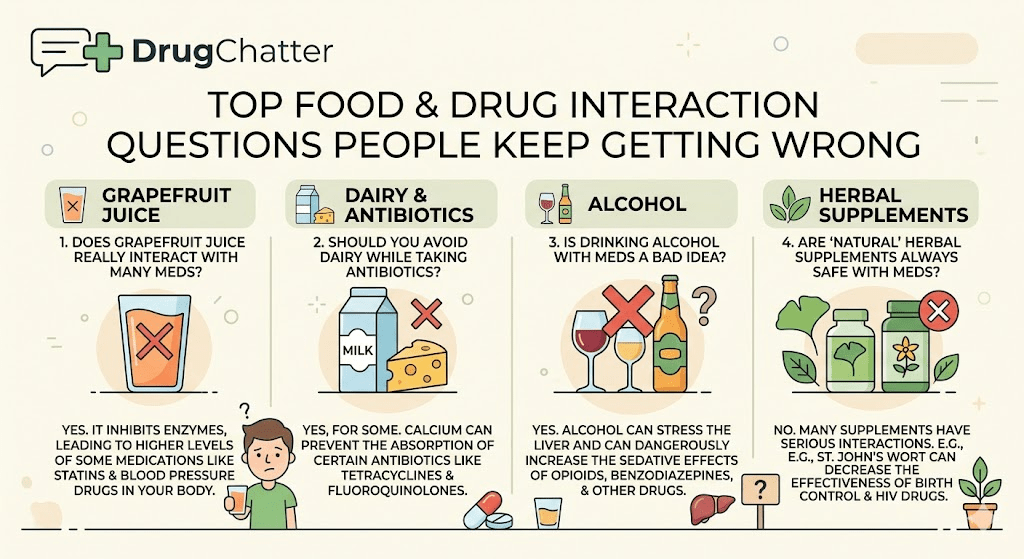
Top food and drug interaction questions people keep getting wrong
There’s a particular kind of question that shows up again and again when people are trying to stay safe with medications: the question that sounds specific, but misses the actual interaction risk. Sometimes it’s because the person is focused on the wrong ingredient (or the wrong “interaction” entirely). Sometimes it’s because the timing matters more than the ingredient. And sometimes it’s because the real issue isn’t food at all—it’s metabolism, dosing, or the specific drug form.
Below are some of the most common “interaction-adjacent” questions people ask, along with the DrugChatter answers they’re usually looking for.
1) “Does alcohol change how my statin works?” (Yes—but the real question is how much, how often, and what else you take)
People often ask whether alcohol will blunt a cholesterol drug’s effect, when the bigger concern is usually liver stress, overall risk, and how your body tolerates the combination. Start here:
- Will alcohol affect lipitor’s efficacy for high cholesterol?
- How often can alcohol be consumed with lipitor?
2) “Can I eat/drink X with my medication?” (Often the answer is about specific pathways—especially grapefruit)
Food interactions are real, but they’re not universal. The classic example is grapefruit, which can meaningfully change drug levels for certain medications. If you’re asking about food, make sure you’re asking about the right food and the right drug:
3) “Will supplements or ‘healthy foods’ boost my drug?” (Sometimes they do nothing; sometimes they change absorption or side effects)
People want a simple lever: eat berries, take fish oil, and get better outcomes. But “better” can mean different things—cholesterol numbers, cardiovascular risk, or side effects—and not every supplement behaves like a drug. For example:
- Can berries increase lipitor’s cardiovascular benefits?
- How does fish oil compare to lipitor’s statin effect?
- Can iron rich plant diet enhance or reduce lipitor’s potency?
4) “Is this interaction about effectiveness?” (Sometimes it’s about safety, sometimes it’s about timing, and sometimes it’s about a different drug altogether)
Many questions are framed as “will it work less,” when the real interaction risk is adverse effects or altered drug exposure. A good example is when people worry about statins interfering with other therapies:
- Can lipitor lower birth control pill’s efficacy?
- Can lipitor’s effectiveness be affected by ace inhibitors?
5) “What about drug-drug interactions?” (The question is usually incomplete unless you include your full medication list)
Drug interactions are rarely one-size-fits-all. The same medication can be safe with one regimen and problematic with another. If you’re asking whether a medication “causes issues with my current medications,” you’re already on the right track—just make sure the answer can actually account for what you’re taking:
6) “I’m having side effects—are they ‘interaction’ side effects?” (Sometimes they’re, sometimes they’re just the drug being the drug)
People often assume that new symptoms must be caused by an interaction. Sometimes that’s true; sometimes it’s the medication itself, or a dose/tolerance issue. If you’re trying to connect symptoms to a statin, these are the kinds of questions that come up:
- Can lipitor’s side effects include new joint pain?
- Can lipitor’s side effects include constant fatigue?
- How can i determine if lipitor’s side effects differ from alternatives?
7) “Can I take it with food?” (Sometimes the interaction is actually about administration—especially for biologics and immunomodulators)
Food can matter for some drugs, but for others the bigger “interaction” is timing around vaccines, immune effects, or administration instructions. For example:
8) “Is it safe to mix with common everyday things?” (The answer depends on the drug’s metabolism and your personal risk factors)
When people say “everyday things,” they usually mean alcohol, grapefruit, OTC meds, or supplements. The safest approach is to treat “interaction” as a question about exposure and risk—not just about whether the drugs are “compatible” in theory.
Bottom line
If you want the interaction answer you actually need, try to ask the question that includes: which drug (exact name and form), what you’re mixing it with (food/drink/supplement/another medication), and when. “Will it work?” is often less useful than “What changes in exposure or safety should I expect?”
Start with the links above—then bring your full medication list (and your typical diet/alcohol pattern) to your clinician or pharmacist for the final, personalized check.