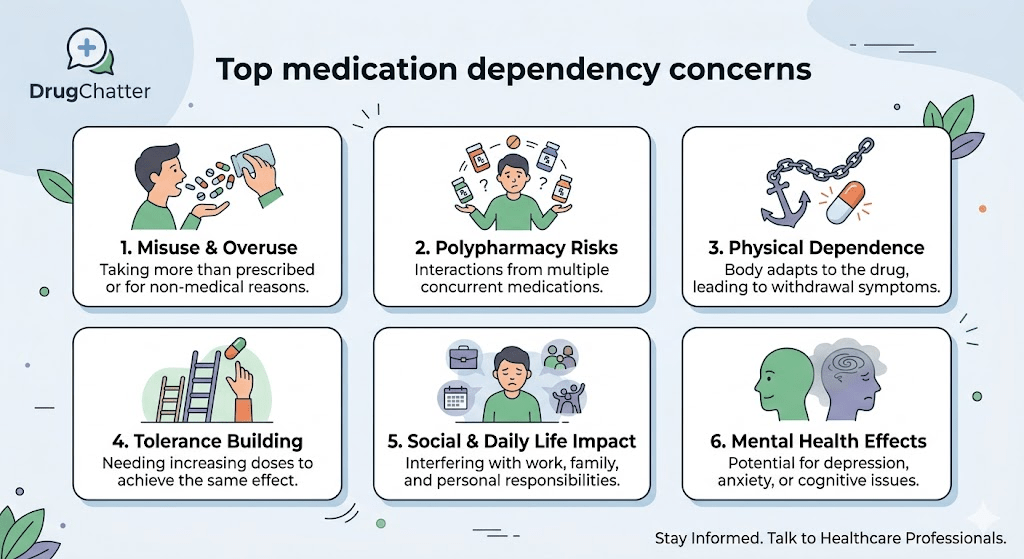
There are two kinds of “dependency” in medicine. One is the obvious sort—people miss a dose and feel terrible. The other is quieter and harder to catch: physiologic adaptation, rebound symptoms, sedation that limits function, and the gradual shift from “treating a condition” to “needing the drug to feel normal.” None of this means you should never take a medication. It does mean you should take the risk seriously, particularly when a drug is intended for ongoing use.
Below are the top medication dependency concerns, framed around the kinds of questions people ask when they’re already living with the tradeoffs.
1) Stopping risks: rebound and withdrawal sneaking up
The classic dependency concern is what happens when you try to stop. Even when a medication isn’t labeled “addictive,” the body can adapt—especially with drugs that affect the nervous system.
If you’re dealing with interruption risk in a real-world way, you can start by reading up on what might go wrong when therapy isn’t handled carefully—like the practical scenario of taking expired clonidine’.
2) Sedation that becomes “lifestyle support”
When a medication helps sleep or anxiety, it can also quietly become the thing that makes days manageable. That’s not automatically harmful—but it raises the question of whether you’re building tolerance, whether you’re compensating for symptoms the drug masked, and whether stopping is going to be hard.
Tolerance isn’t always dramatic, and it isn’t always obvious. But with long-term use, patients may find themselves needing higher doses, more frequent dosing, or new combinations to get the original effect.
Medication availability issues can worsen this (people switch formulations, chase supply, or end up restarting after gaps). When a drug’s continuity is uncertain—such as Minivelle patch discontinued?—the “dependency” concern becomes not chemical alone, but practical: interruption and re-start can amplify dependence-like patterns.
4) Pain and mood loops: using the drug to keep the symptom away
Another dependency concern is the symptom loop: the medication controls the problem, but then the problem feels like it returns—stronger—when the medication is reduced or removed.
Even common drugs can have unexpected interaction effects that complicate stable symptom control. If you’re trying to connect safety and long-term predictability—particularly around interactions and patient vulnerability—one example is how can lipitor’s interaction with ssris impact elderly’s health.
5) The “take it and forget it” trap: long-term use without a stopping plan
Dependency concerns grow fastest when long-term use is treated as default and not revisited. People don’t always ask the question that should come up early: “If this works, what’s the intended duration?”
Long-term therapy prompts its own set of questions—like methotrexate long term use?—and those discussions are the place to clarify monitoring, tapering expectations, and alternatives.
6) Risk is not just the molecule—sometimes it’s the system
Dependency concerns are also shaped by affordability, continuity, and access. If patients can’t reliably get their medication, they may experience “micro-withdrawals” from inconsistent dosing, even without intending to misuse anything.
7) Safety perceptions: when side effects drive compulsive re-dosing
Sometimes people re-dose or resist dose changes because side effects feel intolerable or confusing. That’s why it matters to understand the medication’s typical effects and rare warnings before you’re stuck in a feedback loop.
8) The “companion” issues: food, timing, interactions
For some drugs, dependency-like effects aren’t from the drug causing addiction; they’re from making the regimen feel mandatory—if timing or interactions change, the experience changes.
For example, meal timing can change how a drug behaves, as in what’s the impact of meal timing on ozempic. When stability depends on strict routine, patients can feel like they “can’t live without it,” even if the issue is pharmacology rather than compulsion.
What to do with all this
If you’re worried about dependency—chemical, physiologic, or behavioral—the best next move is to bring the concern to your prescriber early and ask three boring-but-critical questions:
“What happens if I miss a dose?”
“Is tapering expected, and what does a taper plan look like?”
“What are alternatives if this stops working or causes problems?”
Because the real goal isn’t to eliminate every risk. It’s to avoid being surprised by the kind you can’t see coming.