Top OTC vs prescription overlap mistakes (people accidentally doubling up)
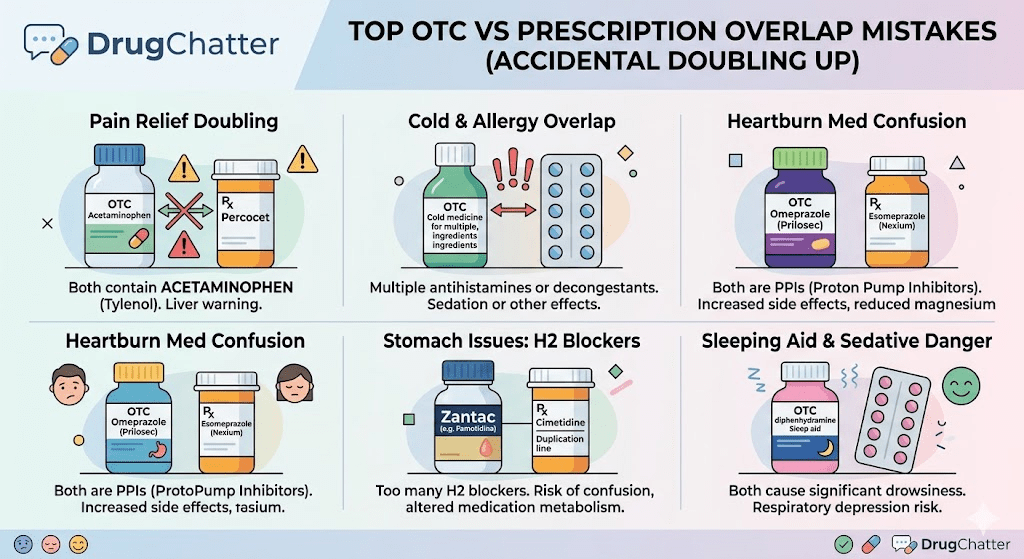
There are two kinds of medication problems: the ones you set out to cause, and the ones you stumble into because the bottles look (or sound) familiar. The overlap between over-the-counter (OTC) products and prescription drugs is full of small, human mistakes—especially when the label is vague, the ingredient list is buried, or the prescriber is using a brand name while the patient is thinking in “generic” terms.
Below are common overlap scenarios where people end up doubling up—sometimes with serious consequences. The links are to real DrugChatter Q&A threads that show the pattern: “Is this the same? Can I take both? Why is this dosage/ingredient question coming up now?”
1) “It’s just another version”—but it’s the same active drug
This is the classic mix-up: you take a prescription, then add an OTC product because it’s marketed as targeting the same condition. If both contain the same active ingredient (or tightly overlapping ones), you can unknowingly push the dose higher than intended.
People don’t double up because they want to. They double up because “brand name = new medication” in their head. Meanwhile, the pharmacy or the label is telling a different story: the same molecule with a different commercial name.
3) “Natural” supplements and OTCs that quietly change prescription drug effects
Doubling up isn’t always literal—sometimes it’s “effect doubling.” OTC supplements and OTC-seeming products can shift metabolism or interfere with how a prescription drug behaves. That can make you feel like the original dose is failing or behaving differently, which then tempts people to adjust (or add something) without checking.
Topicals, local anesthetic products, and pain relievers can be layered—sometimes intentionally, sometimes accidentally. People may not realize that a “numbing” product elsewhere is still giving part of the same functional effect (or shares similar ingredient classes), leading to overuse.
OTC “cold and flu” products often contain aspirin or NSAID components. If someone is already taking a prescription or daily OTC aspirin regimen, they may unintentionally stack additional NSAID activity from a multi-symptom product.
6) The “same condition” but different drug class… that still gets doubled
Sometimes the ingredients aren’t identical—but people still add OTC therapy because it feels redundant: “I’m treating inflammation / I’m treating heartburn / I’m treating cholesterol / I’m treating anxiety.” The trap is that multiple agents can overlap in effect or add side effects, even if the brand names differ.
7) If you recently missed a dose, you might “catch up” incorrectly
This one isn’t strictly OTC vs prescription overlap—but it’s the same human failure mode: people treat timing rules as flexible. When combined with adding OTC symptom relief, it can become a double-hit: both a correction and a new add-on.
How to avoid accidental doubling up (quick, practical checklist)
Read the active ingredients on the OTC box—don’t rely on the condition name alone.
Match by molecule, not by brand: if the active ingredient is the same, treat it as the same medication.
Be suspicious of “multi-symptom” products (cold/flu, allergy + congestion, pain + sleep): they often contain more than one active ingredient.
Keep one up-to-date medication list (including supplements and OTCs) and bring it to appointments.
When in doubt, ask the pharmacist before adding an OTC “just this once.”
OTC products are meant to help. But when they overlap with prescription drugs—by ingredient, by effect, or by timing—the margin for error disappears. The fastest way to protect yourself is to treat “sounds similar” as “check the label,” and “I already take something for that” as “confirm nothing else overlaps.”