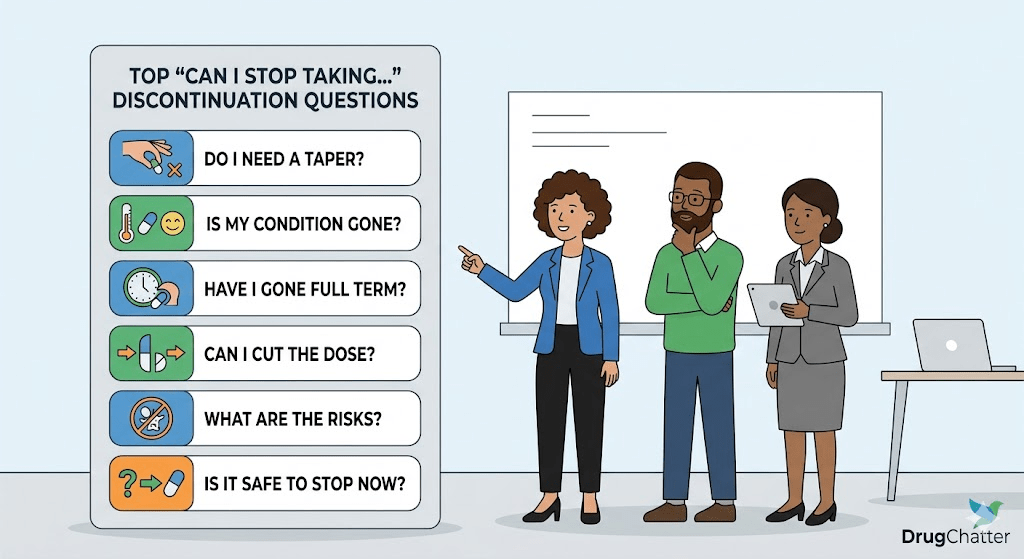
There’s a particular kind of optimism that shows up right when a prescription starts to feel like it’s working. Symptoms ease. Labs improve. Side effects fade. And then the question arrives—usually in the form of a quiet, practical thought: can I stop taking this?
Below are some of the most common “discontinuation-adjacent” questions people ask—because they’re really asking about stopping, pausing, or changing course. The answers linked here focus on what can go wrong when you treat a medication like a switch instead of a plan.
1) “Can I stop taking…?” is often really “Can I stop taking this part?”
Many drugs don’t just treat symptoms; they alter biology. When you stop, the underlying process doesn’t politely wait for you to feel better.
- Can I use Head & Shoulders for seborrheic dermatitis?
- Can I use Mupirocin ointment for an infected ear piercing?
2) Stopping can be the wrong move when effectiveness depends on timing, diet, or interactions
Sometimes the “stop” impulse comes from frustration: it’s not working like it used to. But the problem may be what you’re taking alongside it, or what you’re eating/drinking with it.
- Can grapefruit juice decrease lipitor’s benefits?
- How does st john’s wort alter lipitor’s effectiveness?
- In what ways does alcohol change liver’s drug processing?
- How might alcohol affect ozempic’s efficacy?
- Can alcohol decrease advil’s pain relieving effect?
3) “I feel better—so I’m done” can collide with long-term risk
Some medications are meant to be continued because the risk returns when treatment stops. Others require monitoring to keep side effects from becoming serious.
- How does regular monitoring minimize lipitor’s bleeding risk?
- What’s the suggested lipitor liver test frequency?
- What are the risks of long-term use of Protonix?
- What are the long-term effects of taking Ozempic for weight loss?
4) Stopping because of side effects is understandable—just don’t do it alone
Side effects are the most human reason to want out. But the right response is often not “stop,” but “adjust, switch, or manage.”
- Does drowsiness concern you taking lipitor?
- What measures can manage keytruda’s skin reactions?
- How are yervoy’s serious side effects typically managed?
- How can yervoy’s serious side effects be managed?
- How severe can yervoy’s skin reactions become?
5) “Can I stop taking it?” sometimes shows up as “Can I reverse the damage?”
People want reassurance that if something goes wrong, it can be undone. Sometimes it can—sometimes the best you can do is prevent worsening and recover as much as possible.
- Is there a way to reverse lipitor’s muscle effects?
- Can lipitor’s side effects be reversed after full recovery?
- Can lipitor’s side effects be reversed after full recovery?
6) The “stop” question can be hiding inside “is it safe to combine?”
When people feel uncertain, they sometimes try to simplify by stopping one thing and starting another. But combinations can matter—especially with supplements and other meds.
- Is it safe to take saw palmetto with my prostate medication?
- Are there specific probiotics that complement lipitor’s effectiveness?
- Can fish oil enhance or interfere with lipitor’s benefits?
- Can fish oil supplements enhance vascepa’s effectiveness?
7) Don’t confuse “generic” or “cheaper” with “interchangeable”
Sometimes the discontinuation impulse is really a cost impulse. If you’re thinking about stopping because of price, it’s worth checking whether there’s a safer alternative path than abrupt discontinuation.
- How does generic atorvastatin’s cost compare to lipitor?
- Xcopri be generic?
- Caplyta go generic?
- Does tigecycline’s patent protection impact its cost?
8) The “stop” question becomes urgent when vaccines, immune therapies, or biologics are involved
With immune-modulating treatments, timing matters. Stopping isn’t always the answer; sometimes the answer is coordination.
- What’s the recommended wait time for live flu vaccine after cosentyx?
- How effective is Stelara for Crohn’s disease?
- What factors affect cosentyx’s effectiveness?
- Is cosentyx efficacy tied to patient’s weight?
9) When the question is really “can I stop because I’m sick right now?”
Acute illness can make people want to pause everything. But some combinations are time-sensitive, and some are not.
- Can i take nyquil if i am already taking tamiflu?
- Can alcohol interfere with this antibiotic’s effectiveness?
10) The bottom line
If you’re asking “can I stop taking…,” the safest next step is to treat it like a decision, not a feeling. The right answer depends on the drug, your reason for taking it, how long you’ve been on it, and what you’d be risking by stopping.
Use the links above to get the specific context—then bring that context to your prescriber or pharmacist before you change anything.