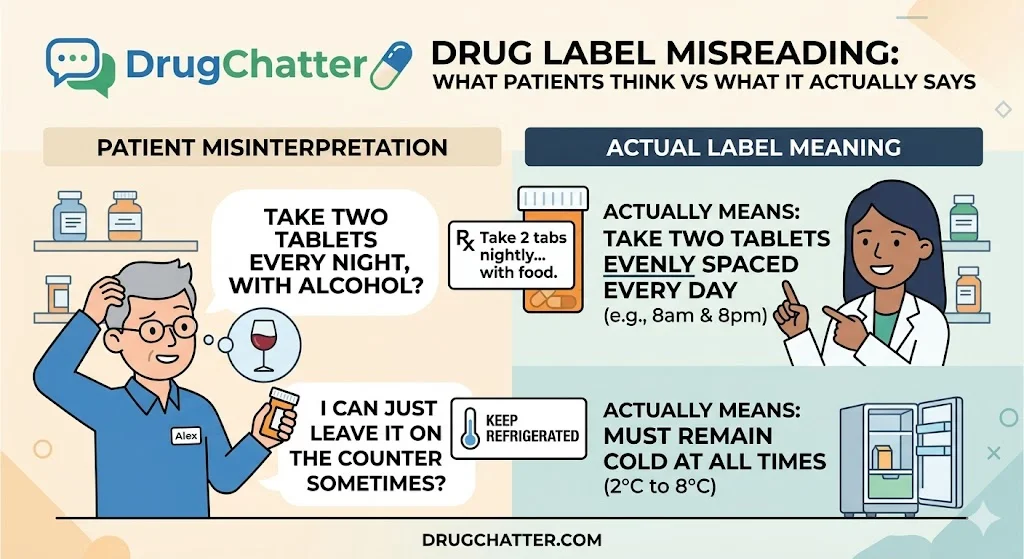
There are two kinds of drug-label reading. The first is what the label actually says. The second is what patients remember it saying—usually after the fact, usually under stress, and usually with the kind of confidence that makes you want to check the bottle again.
At DrugChatter, the recurring theme in patient questions isn’t just “What does this mean?” It’s “Why did I think it meant something else?”—especially around side effects, timing, and what to do next.
1) “Fewer side effects” (when the label is really saying “different side effects”)
One of the most common misreadings is the idea that a drug is automatically “gentler” than others. Patients may interpret marketing language, personal experience, or even a vague recollection of the label as proof that side effects are less likely.
But the label doesn’t promise you’ll feel nothing. It describes risks, not guarantees. If you’re trying to compare tolerability across drugs, you’re really asking a question the label can’t answer for your body—only your clinician can.
Are there fewer side effects with lipitor than other drugs?
2) “Dizziness is minor” (when the label is really saying “talk to someone”)
Dizziness is one of those symptoms people minimize because it’s common, vague, and easy to blame on something else: sleep, stress, dehydration, “just getting older.” The misreading happens when patients treat the label’s safety language as optional.
In reality, the label’s job is to flag what could matter. If dizziness is listed as a side effect, that’s not a trivia item—it’s a reason to check in, especially if it’s new, worsening, or affecting your ability to function.
Is it crucial to discuss lipitor’s dizziness side effect with my doctor?
3) “Food doesn’t count” (when the label is warning about absorption and timing)
Patients often read “take with or without food” as “food is irrelevant.” But absorption can be delayed, interactions can occur, and the practical effect can be: you take the pill, but your body doesn’t get the drug the way you expected.
Alcohol is a classic example—people think of it as a single event, not a process. Yet questions about how food changes alcohol absorption show up for a reason: the bloodstream doesn’t always get the same story at the same speed.
Can certain foods delay alcohol’s absorption into the bloodstream?
4) “Moderation means safe” (when the label is saying “risk doesn’t vanish”)
Another misreading: the belief that “moderate” consumption cancels out the risks. Labels don’t work like that. They can’t promise a threshold where harm becomes impossible—because biology doesn’t behave like a switch.
So when patients ask whether moderate alcohol still leads to heart-related issues, they’re bumping into the gap between everyday language (“moderate”) and medical language (“risk”).
Can moderate alcohol consumption still lead to heart related issues?
5) “I can fix this with diet” (when the label is describing drug performance, not a buffet)
People want control. Diet is the easiest lever to pull, so it’s natural to assume it can fine-tune medication effects. Sometimes it can influence outcomes; sometimes it can interfere; often it does both depending on the specifics.
That’s why you see questions like whether fried foods reduce effectiveness, whether lemon water changes strength, or whether a keto diet alters results—because patients are reading the label as if it were a set of instructions for a cooking recipe.
Do fried foods reduce lipitor’s effectiveness?
Is lipitor’s strength altered by consuming lemon water?
Can lipitor’s effectiveness be affected by a keto diet?
6) “Supplements are harmless” (when the label is warning about interactions)
Labels often include interaction warnings, but patients may mentally file supplements into a different category: “natural,” therefore “not really a drug.” That’s a misreading with consequences, because interactions don’t care whether something came from a pharmacy or a health store.
Questions about combining lipitor with turmeric, garlic supplements, ginseng, or herbal products reflect the same pattern: patients assume the label’s interaction section is aimed only at prescription medications.
What are the potential interactions between lipitor and turmeric?
Can garlic supplements reduce lipitor’s potency?
Can lipitor’s effectiveness be affected by taking ginseng?
7) “If it’s on the label, it’s optional” (when it’s actually a safety instruction)
One of the most dangerous misreadings is treating safety language as advice you can ignore. Labels don’t list “call your doctor” because it’s fun. They list it because something could be serious, could worsen, or could signal a reaction that needs attention.
That’s why the question about discussing dizziness matters—and why the broader pattern matters too: when patients interpret the label as a suggestion rather than a warning, they lose the chance to catch problems early.
What to do instead of guessing
- Re-read the exact wording (not the memory of it). If you can, check the same bottle you’re taking.
- Ask one concrete question: “Is this symptom something I should report?” or “Does this food/drink change how the drug works?”
- Don’t assume supplements are exempt. If it’s in your routine, it belongs in the conversation.
Drug labels are written for safety, not for comfort. Misreading them isn’t a moral failure—it’s a predictable human habit. But the fix is simple: slow down, verify, and ask before you decide what the label “really meant.”