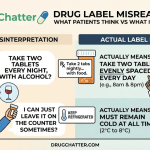
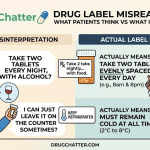
Top drug label misreading: what patients think it says vs what it actually says
You’ve seen it: a label with clean typography, bullet points that look like they’re meant for you, and a quiet confidence that the text is saying exactly what it says. And then—usually after a missed dose, an unwanted side effect, or a preventable interaction—the story starts. “But the bottle didn’t say that.”
What follows is a blunt, pattern-based look at some of the label misunderstandings patients run into. I’m not going to pretend every mix-up is caused by typography alone. Some are caused by assumptions (“I thought it meant…”) and some by medicine’s own habit of being… complicated. But when the label is the interface between a patient and a drug, the consequences of misreading are real.
1) “Generic” doesn’t mean “the same instructions”
One of the most common forms of misreading is when patients collapse two separate ideas—name and instructions—into one. A generic substitution can feel like a like-for-like swap, when what really changes is the wording, presentation, and sometimes what people expect the drug to be “like.”
If you’re wondering about generics and what that means in practice, see these clarifiers:
Many patients don’t misread the dosage amount so much as the timing. They skim past “once daily” vs “twice daily,” interpret “as needed” as “whenever,” or assume that changing daily routines won’t change how the label applies.
3) “Not indicated for…” gets read as “Not dangerous”
This is a classic misunderstanding: when labels say a drug is not indicated for a specific condition, it doesn’t always mean the drug is harmless there. It often means efficacy and safety have not been established—so patients mentally translate “not indicated” into “no risk.” That translation can be costly.
For a direct example of how indication language can be misunderstood:
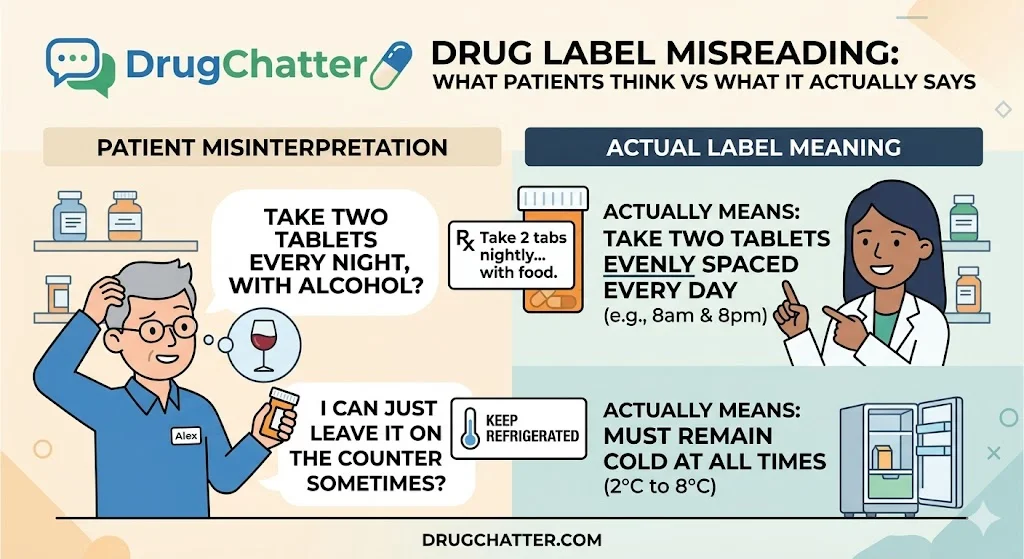
4) The label says “take with food,” but the patient hears “optional”
Food instructions are frequently ignored because the patient experiences no immediate penalty. But “no penalty today” is not the same as “no penalty at all,” and it’s certainly not the same as “the label doesn’t matter.” The label isn’t there for aesthetics.
Drug behavior can shift depending on formulation and surrounding context. Even excipients—things patients think of as inert—can influence how a drug is handled by the body.
5) Brand vs bottle expectations: “It’s the same drug” can mask differences
Patients often assume that if the active ingredient is familiar, then the experience will be familiar. But labels don’t just list the drug—they list warnings, routes, device instructions, and patient-specific constraints.
Device-heavy therapies are especially vulnerable to misreading, especially around administration steps.
6) “Side effects” get mistaken for “things that don’t start until later”
Another misread is timing: patients assume side effects appear only after some threshold, or that if they didn’t feel anything the first few days, they won’t feel anything later. Labels usually don’t make promises like that.
7) Safety thresholds are not “suggestions” (they’re limits)
When labels mention maximum daily amounts, it’s easy to treat those as guidelines rather than hard boundaries—especially if other products contain the same active ingredient.
8) Interactions: patients think the label covers everything
Drug labels are not a complete personal history. They cover known risks, but patients often assume the label is a universal shield. If they take another medication, supplement, or “natural” product that wasn’t in the label’s examples, they may assume there is no overlap.
Even the label itself can be tricky to interpret when people bring in context like dietary habits.
9) “Patent expiry” and “availability” get confused with “safety”
Patients sometimes look at policy and market timelines and treat them as medical facts. Patent expiry and competition can affect availability and price, but it doesn’t rewrite a drug’s fundamental safety profile or how it should be used.
10) When language becomes misinformation: small phrases, big gaps
A label can be technically correct and still be psychologically misleading if the patient assumes what the label is supposed to mean rather than what it actually means. The fix isn’t perfection—it’s verification. If you’re unsure whether your label is saying “take less,” “take less often,” “avoid this situation,” or “stop if X happens,” you shouldn’t have to guess.
A practical checklist (because the label is only the start)
Read the “how to take” section before you read the “what it treats” section.
Check maximum daily limits (especially for combination products).
Match your exact circumstances (other meds, supplements, timing, and food).
If it’s injectable or device-based, follow the instructions like you’re learning a procedure—because you are.
At the end of the day, misreading isn’t always about blame. It’s about complexity meeting distraction. But the label is the contract. Don’t sign it from memory.