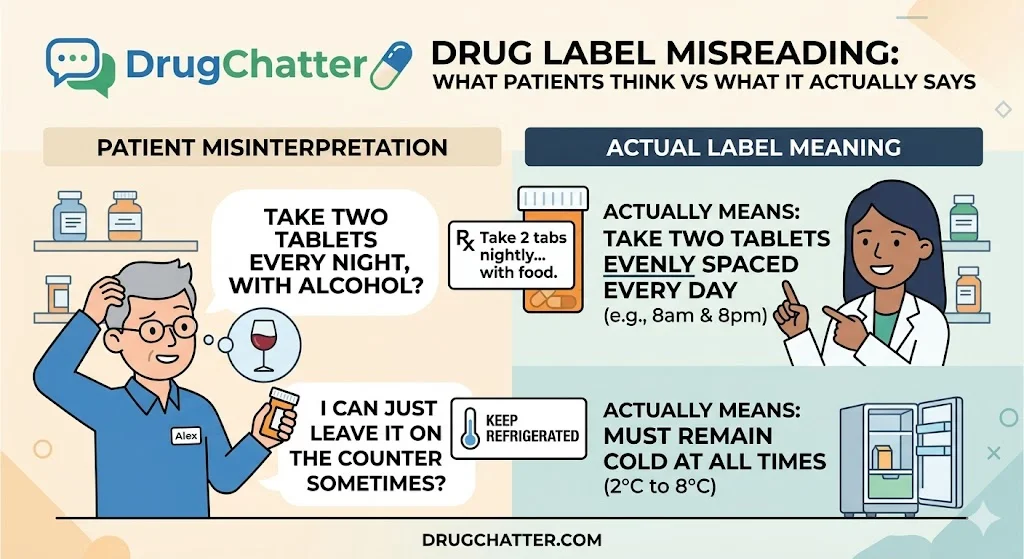
There are two kinds of medication confusion. The harmless kind—where someone mixes up a dose or forgets a detail. And the dangerous kind, where the patient’s brain “decodes” the label into the wrong meaning entirely. That second category is where the trouble starts: a misread name, a misread strength, a misread intent (pain relief vs anticoagulation vs cholesterol vs cancer therapy), or a misread program/coverage promise.
At DrugChatter, people ask questions that often sound like simple clarifications—but you can hear the underlying story: “I thought it was that.” Sometimes it’s a near-sound-alike. Sometimes it’s a brand-vs-generic mix-up. Sometimes it’s the price tag or assistance terms that are interpreted as something they never were.
Here are a few of the clearest “what patients think it says vs what it actually says” moments, pulled from label-reading-adjacent searches.
1) “Eliquis” — and then, somehow, “ibuprofen”
One of the most jarring misunderstandings is treating a prescription anticoagulant like a common painkiller—especially when the question effectively reads like: “Are these the same thing?”
2) Combination labels that look like a single number
Diabetes medications frequently arrive as combination tablets with multiple numbers that get mentally flattened into a single “dose.” When patients try to decode cost/strength, they can end up with the wrong product in mind.
Glipizide metformin 5 500 mg price?
3) “Patient status forms” that sound like paperwork you fill out… but aren’t
Some therapies come with enrollment or reporting forms that patients interpret as routine administrative steps. In reality, they may be tied to eligibility, access pathways, or ongoing requirements.
4) Nebulizer “price” searches that often mean “is this the same as my inhaler?”
Patients may read “nebulizer” and assume it’s just a form factor. But nebulized antibiotics are their own category—different from typical inhalers—and the label details matter.
5) Brand names that behave like aliases
Sometimes a patient hears a brand name once and then searches the label for the “real drug.” When the label doesn’t match the mental model, the question comes out like a straight ID check.
6) Cancer drugs and cost questions that hide a bigger confusion: “What exactly am I holding?”
When patients ask about cost, they’re often also confirming identity. A misread label here can mean misunderstanding the therapy, the regimen, and expectations of how the drug fits into the larger plan.
7) The label as a risk statement… that gets misread as a guarantee
Patients may interpret “approved” as “safe for everyone” or assume the side effects are optional. Risk questions frequently reveal that the label language was read as reassurance rather than warning.
8) When “cost” is actually a proxy for “is this the right medication?”
Generic availability, dosing formats, and regional pricing can shift—so cost queries become a reality check on the label’s identity and whether it matches the patient’s expectations.
9) Patent expiry searches that sound administrative—but affect access immediately
A patient may read the label and believe “if it’s old, it should be cheap.” But patent expiry is not a magic calendar that updates labels. It’s a market-and-approval sequence.
Obinutuzumab patent expiry germany?
10) “Nplate drug?”—identity confusion before the first dose
Sometimes the question is plainly: what is this medicine, really? When people don’t recognize the brand, they don’t just misread—they start from zero.
11) “So expensive” prompts a misread narrative about why
Patients read the price tag and assume something about their regimen or their coverage. But high costs often reflect manufacturing complexity, reimbursement structures, or patent dynamics—not what the label says.
Why is atorvastatin so expensive?
12) Coupons that look like they mean “free,” until you read the fine print
Coupon labels and program terms are a frequent source of misunderstanding: patients read “coupon” as unconditional coverage rather than a conditional discount mechanism.
13) Medicare coverage vs “it sounds like it should be covered”
Medicare coverage queries tend to reveal a mismatch between the expectation formed by a label, a website, or a recommendation—and the actual reimbursement reality.
14) Brand vs generic: the label says one thing, the patient searches another
Generic naming can be especially confusing when patients expect a certain brand-to-generic pairing. The “right” interpretation requires knowing what the label component is actually representing.
15) Muscle symptoms and sleep disruption: labels are read, but context is missed
Patients can read side effects as either unrelated to the drug or inevitable and untreatable. Sometimes they just need the timeframe and the “what it means” translation.
Is there a way to mitigate lipitor’s sleep disruption
What’s the typical onset of lipitor’s gastrointestinal effects?
16) “Mechanism” and “dosage” questions that show the label’s meaning isn’t being translated
Patients read “LDL” or “LDL-lowering” and still can’t map what’s happening inside the body. That gap between wording and meaning is another form of label misreading.
What’s the mechanism of ezetimibe on ldl?
17) Interactions you don’t expect because the label didn’t flag “supplement” territory
Some misunderstandings come from patients assuming supplements are “outside” the label’s warnings. Then the question appears: can two things compete for the same outcome?
Can probiotics interfere with lipitor’s cholesterol lowering effect?
18) Generics that sound different—until you look at the active ingredient
When a generic name is unclear, patients may carry the wrong assumption about equivalence or similarity.
19) “How supplied” questions: the label can be precise, but the reader isn’t
Some patients read supply instructions as “what kind of medicine this is” rather than “how the package is built.” That’s a subtle but real mismatch.
20) Programs and deadlines: the label implies time, but not timing
Assistance and program terms are especially vulnerable to misreading. A label might say “enroll,” but it won’t tell you whether you missed the window.
What is the deadline for vascepa’s patient assistance program?
The pattern behind all these questions: the label is a communication device, but it’s only as good as the decoding. Patients often arrive with partial information—some of it from memory, some from a quick glance, some from a conversation that didn’t land cleanly. When that decoding goes wrong, the next step is usually a search, a call, a forum post, and then—hopefully—clarification before harm.
If you want a simple defense against label misreading, it’s not complicated: double-check the name and the strength and the intended drug category (anticoagulant vs cholesterol vs antibiotic vs cancer therapy) every time you get a new bottle. And when something doesn’t make sense, ask—fast—before you trust the first interpretation.