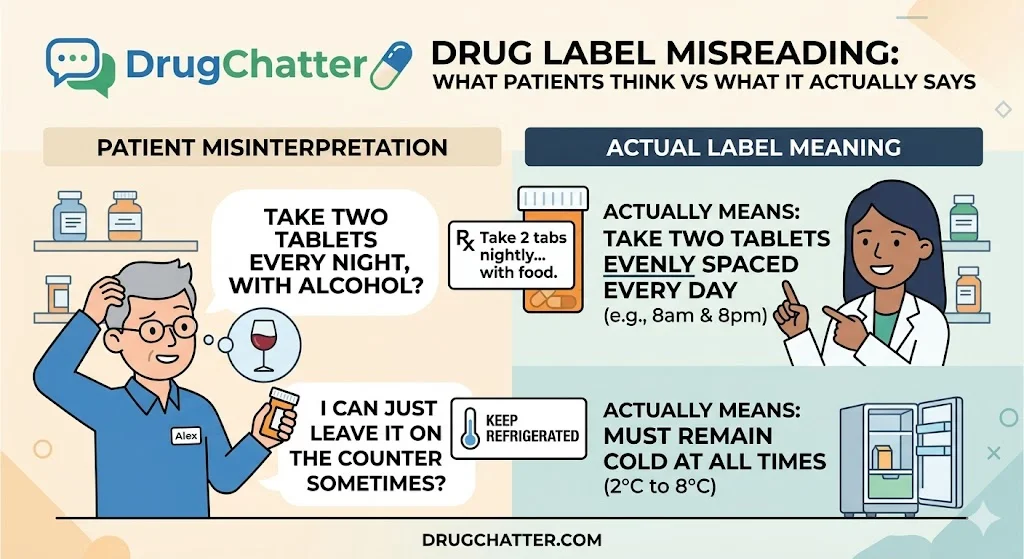
There are two kinds of medication confusion: the kind that comes from not knowing what a drug is, and the kind that comes from thinking you do—because the label looks familiar, the wording seems obvious, and the stakes feel distant until they don’t.
Drug labels are built for accuracy, but they’re also built for speed: quick scanning, short phrases, and abbreviations that make sense to clinicians and pharmacists. Patients, meanwhile, are doing something harder—translating a dense, regulated document into a daily routine. And when the translation goes wrong, it’s rarely because someone is careless. It’s usually because the label invites a plausible misreading.
Below are some of the most common “top label misread” themes—what patients often think it says versus what it actually means—using real questions people asked at DrugChatter.
1) “Take it whenever” (timing and dosing drift)
One of the most dangerous label misreads is the casual assumption that timing is flexible. Patients may read “once daily” as “whenever I remember,” or “every day” as “roughly.” But many drugs have narrow windows, and the label may be trying to prevent missed doses, double-dosing, or spacing errors.
Even a question as specific as scheduling can reveal the gap between what people assume and what the label intends:
2) “It’s the same for everyone” (age, weight, and eligibility)
Labels often include eligibility language—age limits, elderly considerations, weight-based dosing, or “not recommended” warnings. Patients may skim those sections and assume the drug is “for people like me,” especially when the brand is widely advertised or commonly prescribed.
- Cosentyx age limit?
- Are there any elderly restrictions for cosentyx?
- How does patient weight affect cosentyx dosing?
What patients often think: “If it’s prescribed, the label doesn’t matter much.”
What it actually says: “The label is the dosing logic—age and body size can change the plan.”
3) “Food is optional” (diet interactions and absorption)
Another classic misread: the label implies a food restriction, but patients interpret it as a preference. Or they interpret a “take with/without food” instruction as a general wellness suggestion rather than an absorption or tolerability rule.
- What’s the waiting time for dairy after lipitor?
- Can fiber impact lipitor’s medication efficiency?
- What’s the recommended fish oil intake alongside lipitor?
- Can red wine fully replace lipitor’s cholesterol lowering effects?
What patients often think: “If it’s not forbidden, it’s fine.”
What it actually says: “Some foods change how the drug behaves—timing and consistency matter.”
4) “Side effects are random” (and the label is more specific than it looks)
Patients read side-effect sections as a menu of possibilities. But labels often communicate risk patterns—which effects are common, which are rare, and which are dose- or patient-dependent. When people don’t notice that structure, they may assume the label is describing a single predictable experience.
- Why is lipitor’s side effect flexibility so variable among patients?
- How common are flexibility problems from lipitor use?
- Can lipitor affect yoga related muscle flexibility?
- Can lipitor cause changes in weight loss?
What patients often think: “If I don’t feel the side effect, the label must be wrong.”
What it actually says: “The label is describing probabilities and variability—not guarantees.”
5) “It’s safe with my other meds” (drug-drug and drug-condition interactions)
Labels frequently include interaction warnings, but patients may not connect them to their own medication list. The misread is subtle: “My doctor prescribed it, so it must be compatible.” Sometimes that’s true. Sometimes the label is warning about a specific combination that still needs monitoring.
- Should lipitor affect warfarin dose adjustments?
- Can lipitor’s effectiveness be affected by ace inhibitors?
- Monitorinf liver function after bosentan?
- Did you discuss lipitor’s potential impact on liver function with your doctor?
What patients often think: “Warnings are for other people.”
What it actually says: “Warnings are for the combination you’re actually taking.”
6) “Brand vs generic = the same thing” (and the label is not just a name)
Patients sometimes treat the label as a label—literally. If the drug name changes from brand to generic, they may assume the instructions are identical. But labels can differ in formulation, dosing instructions, and sometimes in how the drug is supplied.
- How do the effects of atorvastatin on hmg coa reductase compare to lipitor’s generic in terms of potency?
- Vilazodone generic available fda?
- Nplate generic?
What patients often think: “Same ingredient, same label meaning.”
What it actually says: “Same active ingredient doesn’t always mean identical instructions or expectations.”
7) “The label tells me what I can do” (but it’s really telling you what to avoid)
Some labels are written in a way that makes “avoid” instructions easy to miss. Patients may focus on the drug’s purpose and overlook the “do not” sections—especially when the “do not” is about lifestyle, timing, or monitoring.
- Can lipitor be used for alzheimer’s prevention?
- Is omeprazole safe to take long term?
- Trazodone and dreams?
What patients often think: “If it’s prescribed, it’s for that.”
What it actually says: “Indications and safety guidance are specific—labels don’t authorize off-label assumptions.”
8) “Cost questions are label questions” (supply, formulation, and what you actually receive)
It’s not just medical instructions that get misread. Patients also misinterpret what they’re being given—especially when cost, formulation, or supply changes. A label that says “tablet” versus “injection,” or “extended-release” versus “immediate-release,” can be the difference between correct use and a dosing mistake.
- Alprostadil suppository cost?
- Uroxatral how supplied?
- Cefoxitin and dextrose in duplex container?
- Praxbind price?
What patients often think: “If it’s the same drug, it’s the same product.”
What it actually says: “The label is also about the form you’re holding.”
The takeaway: treat the label like a map, not a slogan
Medication labels aren’t written to be poetic. They’re written to be precise. The trouble is that patients read them under time pressure, with incomplete context, and sometimes with the confidence that comes from having taken something similar before.
If you want a simple rule: when anything about timing, food, age/weight, or interactions feels even slightly ambiguous, don’t “interpret” it—ask. A pharmacist can translate the label into your routine in about the time it takes to make a mistake.
And if you’re ever unsure, start by comparing what you think the label says with what the drug’s instructions actually require—because the most common label misreading isn’t ignorance. It’s assumption.