There’s a quiet sorting mechanism in medicine that has little to do with pharmacology textbooks and everything to do with how messy a drug is to live with.
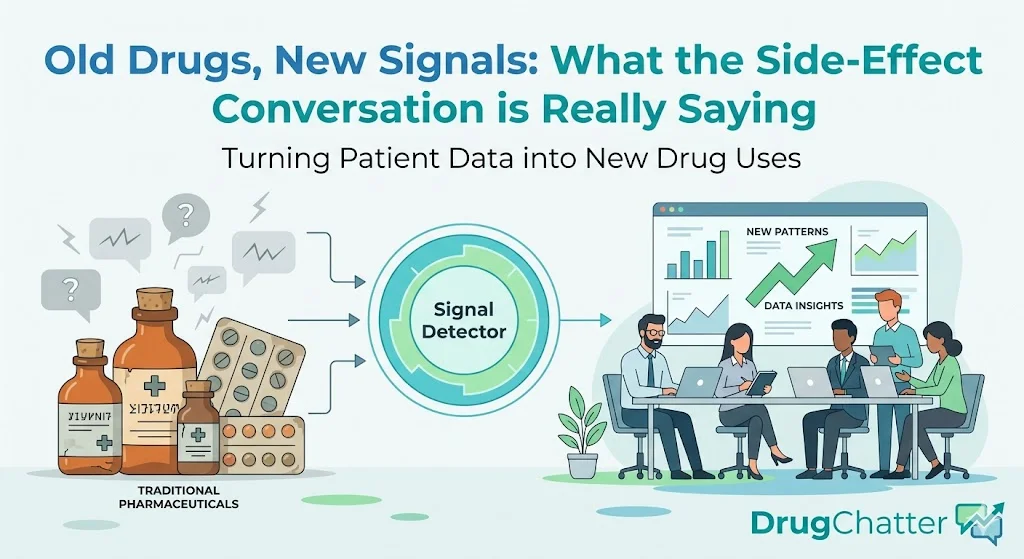
Old drugs tend to behave like tools. New drugs tend to behave like systems.
And that difference shows up clearly in what patients and clinicians ask about.
1. Old drugs: “Just tell me how to use it without breaking something”
With older, widely used drugs, the dominant signal is operational safety under imperfect use. People aren’t asking whether ibuprofen works. They’re asking how badly it might go wrong when reality gets involved.
So the questions cluster around combinations, timing, and edge-case harm:
The signal here is not uncertainty about efficacy. It’s normalization of efficacy plus anxiety about cumulative harm.
Old drugs are assumed to work. The question is whether you can survive them in the real world of polypharmacy, alcohol, supplements, and imperfect dosing.
2. New drugs: “What does monitoring even look like here?”
With newer therapies, the signal shifts. Efficacy is usually not in doubt. What’s uncertain is the behavioral contract between drug and patient.
This is a very different cognitive frame from ibuprofen. Nobody asks when to “stop taking aspirin immediately.” They ask whether they should take it at all.
Then there are biologics like Cosentyx, where dosing, infection risk, and vaccine timing become part of routine management:
New drugs don’t just treat disease. They require ongoing interpretation.
3. The real preference signal: control vs certainty
If you strip away branding, reimbursement, and clinical guidelines, a pattern emerges:
Older drugs are preferred when people want predictability. Even if risk exists, it is familiar, bounded, and socially normalized.
Newer drugs are preferred when people want control over outcomes that older drugs cannot touch. Even if that control comes with monitoring, ambiguity, and tradeoffs.
That’s why semaglutide gets discussed in terms of evolving side effects, while ibuprofen gets discussed in terms of what it breaks when combined with other things.
It’s also why oncology and immunology drugs sit in a different conversational universe entirely. With agents like Keytruda, the “preference” is not about convenience. It’s about whether the immune system can be redirected at all, and what collateral damage is acceptable if it can.
4. A quiet economic signal underneath all of this
One more pattern shows up indirectly: the more modern and specialized the drug, the more support infrastructure becomes part of the drug itself.
Patient assistance programs, rebates, insurance constraints—these become as relevant as pharmacokinetics in practice decisions: