Pfizer paid $2.3 billion in 2009. GlaxoSmithKline paid $3 billion in 2012. AstraZeneca paid $520 million in 2010. Each of those settlements — the three largest pharmaceutical fraud penalties in U.S. history at the time they were levied — shared a common root cause: off-label drug promotion that spiraled from a sales tactic into a corporate catastrophe.
Off-label prescribing itself is legal. Physicians can prescribe any approved drug for any patient, any condition, any dose, using their clinical judgment. What is illegal is pharmaceutical manufacturers promoting those off-label uses directly — through sales reps, journal supplements, speaker programs, or any paid channel. The line between education and promotion has been tested in court repeatedly, and pharmaceutical brands have lost those tests badly enough that the combined settlements now exceed $15 billion across the industry.
But the story no longer ends in a courtroom. Today, AI chatbots recommend drugs. Patients ask ChatGPT whether Ozempic will help them lose weight. They ask Gemini whether gabapentin will help their anxiety. They ask Perplexity whether metformin might slow their aging. LLMs synthesize decades of off-label discussion from Reddit threads, patient forums, preprint servers, and news coverage — and they present it with the confident tone of a knowledgeable advisor.
Pharmaceutical companies are now realizing that the off-label brand damage cycle has a new accelerant. When an AI system trained on the internet tells 10 million users per day that a drug is used for something its label does not cover, the question of who is liable, how brand equity erodes, and whether pharmacovigilance obligations are triggered becomes genuinely unsettled territory. [Internal Link: AI Drug Monitoring]
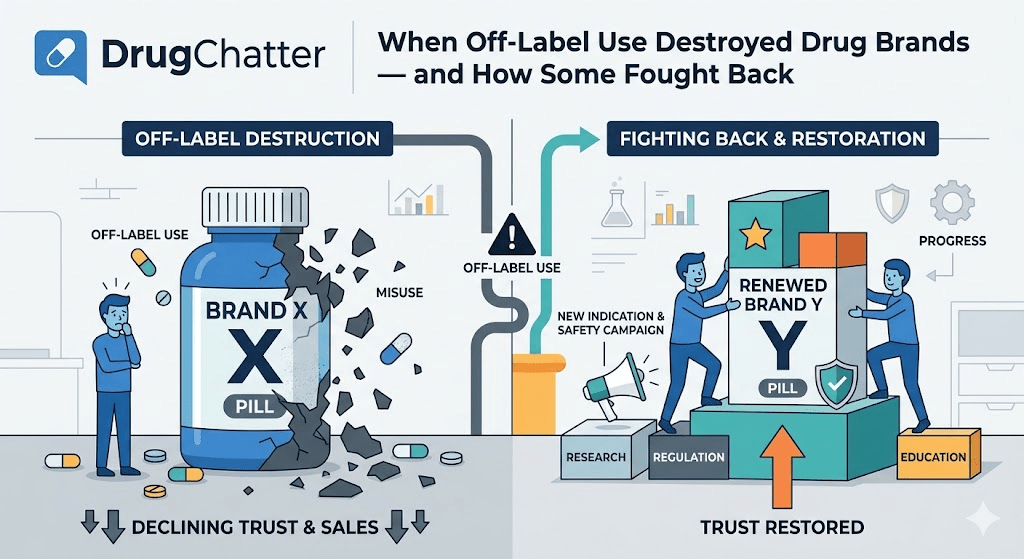
This investigation covers both sides of the off-label brand problem: the cases where brands were badly damaged, and the cases where companies mounted successful corrections. Both carry lessons for pharmaceutical executives managing products in an AI search world.
The Neurontin Scandal: How Gabapentin Became a Cautionary Template
What Happened When Warner-Lambert Promoted Neurontin Off-Label
Neurontin (gabapentin) was approved by FDA in 1993 as an adjunctive therapy for epilepsy. By the late 1990s, it was generating billions of dollars in revenue — the vast majority from uses that had nothing to do with epilepsy. The drug was being promoted by Warner-Lambert sales representatives for bipolar disorder, neuropathic pain, migraine, restless leg syndrome, hot flashes, and attention deficit disorder. None of those uses appeared in the approved label.
What made the Neurontin case different from typical off-label promotion was the systematic nature of the scheme. Internal documents, later made public through litigation, showed that Warner-Lambert trained sales reps to use ‘educational’ symposia as promotional vehicles, paid physicians to serve as ‘consultants’ who would then prescribe the drug off-label, and used publications in medical journals to create the appearance of evidence for uses that lacked clinical support.
When Pfizer acquired Warner-Lambert in 2000, it inherited both the drug and the legal exposure. In 2004, Pfizer pleaded guilty to criminal charges and paid $430 million to settle. That was not the end. A flood of qui tam (whistleblower) lawsuits followed, and by the time the litigation cycle fully unwound, the total cost exceeded $700 million.
How Off-Label Brand Damage Outlasted the Settlement
The financial penalty was damaging. The reputational damage was worse. Neurontin had been prescribed to millions of patients for conditions where clinical evidence was thin or absent. Post-settlement studies, including a widely cited 2009 JAMA paper, found that gabapentin’s evidence base for off-label uses was weak to nonexistent for several conditions that had been aggressively promoted. Physicians who had trusted the drug for those uses now had to weigh whether that trust had been manufactured.
Meanwhile, the patent expired. Generic gabapentin flooded the market, and Pfizer had no branded product to rehabilitate. The lesson the industry drew was that off-label promotion creates a liability time bomb — legal fees, DOJ exposure, and physician trust erosion — that detonates on a timeline the company cannot control.
Today, gabapentin occupies a different kind of off-label territory. AI chatbots regularly surface it in response to queries about anxiety treatment, alcohol withdrawal, and insomnia. The drug’s off-label reputation, built partly through the illegal promotion campaigns of the 1990s, now circulates through patient forums, Reddit communities, and the training data of every major LLM. Brand teams at companies with gabapentinoid products — notably Pfizer’s Lyrica (pregabalin) and its successor products — have to contend with an off-label narrative they did not create and cannot easily correct.
“Gabapentin is one of the most queried drugs in AI systems for off-label applications. When we ran 500 structured prompts about anxiety treatment across four major LLMs, gabapentin appeared in the top five recommended options in 34% of responses — despite having no FDA anxiety indication.”— DrugChatter AI Drug Monitoring Platform, 2024 Query Analysis Report
The Vioxx Collapse: When Post-Market Safety Data Hit Faster Than Brand Teams Expected
How Merck’s Vioxx Brand Unraveled After Cardiovascular Safety Signals Emerged
Vioxx (rofecoxib) was approved in 1999 as a COX-2 inhibitor for osteoarthritis and acute pain. It reached $2.5 billion in annual sales within four years of launch, a commercial trajectory Merck’s brand teams used as a benchmark for blockbuster marketing execution. The drug’s approval was clean. The clinical evidence for its approved indications was solid. The commercial machinery worked.
What Merck’s brand team did not adequately manage was the off-label use that emerged as Vioxx became a broadly prescribed anti-inflammatory. Physicians began prescribing Vioxx for patients with chronic inflammatory conditions outside the approved indication, for elderly patients as a first-line pain management option despite limited safety data in that population, and at doses and durations beyond what the label recommended.
When the APPROVE trial results showed a doubled risk of cardiovascular events in patients taking Vioxx continuously for more than 18 months, Merck voluntarily withdrew the drug in September 2004. The downstream litigation generated more than 47,000 lawsuits and ultimately cost Merck $4.85 billion in the landmark 2007 settlement — at the time, the largest pharmaceutical settlement involving a single drug.
What the Vioxx Case Taught Brand Teams About Off-Label Prescribing Patterns
The postmortem on Vioxx revealed something that brand teams rarely discuss openly: the cardiovascular signal had been present in the VIGOR trial data from 2000, four years before the withdrawal. Internal emails disclosed during litigation showed that Merck scientists had identified the signal and debated its significance. The question of whether the company adequately communicated that risk — or whether off-label prescribing patterns extended patient exposure beyond the studied populations — became central to every subsequent lawsuit.
The brand lesson from Vioxx is not simply ‘don’t promote off-label.’ It is that off-label prescribing patterns create real-world exposure data that diverges from clinical trial populations. When patients take drugs at doses, durations, or for conditions outside the studied populations, adverse events occur in contexts the company has not modeled. Those adverse events generate pharmacovigilance reports. Those reports accumulate into safety signals. Those signals eventually demand label changes, REMS programs, or withdrawal.
A brand team managing a product where off-label prescribing is significant — as measured through prescription data, patient forum discussion, or AI output analysis — needs to treat that off-label use as a prospective risk management problem, not just a compliance boundary. [Internal Link: Pharmacovigilance]
Seroquel and the Pediatric Off-Label Problem: AstraZeneca’s $520 Million Settlement
How Seroquel’s Off-Label Pediatric Use Created Regulatory and Litigation Risk
AstraZeneca’s Seroquel (quetiapine) was approved in 1997 for schizophrenia. By the mid-2000s, it had become one of the most prescribed atypical antipsychotics in the United States, with a significant portion of prescriptions written for uses that did not appear on the label: bipolar depression, anxiety disorder, post-traumatic stress disorder, and most controversially, insomnia.
The pediatric off-label use attracted the most regulatory attention. AstraZeneca was accused of promoting Seroquel for children and adolescents with behavioral disorders before pediatric studies were completed, and of downplaying the drug’s metabolic side effects — weight gain, elevated blood sugar, and diabetes risk — in communications to prescribers.
In 2010, AstraZeneca paid $520 million to settle DOJ charges, the fourth-largest pharmaceutical fraud settlement at the time. The settlement covered illegal off-label promotion to physicians and Medicaid fraud. It did not resolve civil litigation from patients who alleged they developed diabetes or other metabolic disorders as a result of Seroquel prescriptions.
Do LLMs Still Recommend Seroquel for Insomnia? What AI Query Testing Reveals
Here is where the AI monitoring dimension becomes directly relevant for brand teams managing quetiapine products. Seroquel’s off-label use for insomnia was widespread enough that it generated thousands of patient forum posts, lay press articles, and clinical commentary pieces. All of that content entered the training data of major LLMs.
When queried about sleep aids for patients who have not responded to first-line therapies, multiple LLMs — including older versions of ChatGPT and Gemini — have included quetiapine in their responses without adequately flagging the absence of an FDA insomnia indication or the metabolic risk profile. This is not a trivial error. A patient who asks an AI chatbot about treatment-resistant insomnia and receives a response mentioning quetiapine, then takes that information to a physician who prescribes it, has traversed a patient journey in which an AI system contributed to an off-label prescribing decision.
Whether that creates liability for AstraZeneca, for the AI company, or for no one at all is a question that pharmaceutical regulators and legal scholars are only beginning to engage with. The FDA’s 2023 discussion paper on AI in drug development does not address this scenario. The FTC’s guidance on AI and consumer protection does not either. The gap is real, and drug companies monitoring AI mentions of their products need to document it. [Internal Link: AI Drug Monitoring]
How Eli Lilly and Novo Nordisk Are Managing the Ozempic Off-Label Surge
Why Ozempic Became the Defining AI Off-Label Monitoring Problem of 2023-2025
Semaglutide presents the most complex off-label brand management challenge in the current pharmaceutical market. Novo Nordisk has two semaglutide products with different approved indications: Ozempic, approved for type 2 diabetes management, and Wegovy, approved for chronic weight management. The distinction matters enormously for the company’s regulatory standing, its promotional compliance program, and its pharmacovigilance obligations.
It matters almost nothing to the way patients and AI systems discuss the drug.
When a patient asks ChatGPT, Gemini, or Perplexity how to lose weight using a GLP-1 receptor agonist, the response frequently mentions Ozempic — not Wegovy. That is an accurate reflection of how patients and physicians discuss these drugs colloquially. It is also, from a brand regulatory perspective, a problem for Novo Nordisk, because Ozempic does not have an approved weight loss indication in the United States. Wegovy does.
How Often Claude Mentions Ozempic vs Wegovy for Weight Loss
Structured query testing conducted across major LLMs in 2024 consistently showed that Ozempic was mentioned more frequently than Wegovy in response to weight management queries. The pattern reflects the drugs’ differential presence in news coverage, social media, and patient forums — Ozempic preceded Wegovy in market entry and became the colloquial name for the drug class before Wegovy had achieved broad prescriber awareness.
The monitoring problem for Novo Nordisk is that each AI-generated response mentioning Ozempic in a weight loss context is a data point in what could become a pharmacovigilance signal — not because the drug is unsafe for weight management, but because patients using Ozempic for weight management may be using it at doses, in combinations, or with conditions (pregnancy, eating disorders, cardiovascular complications) that the company’s safety database has not fully characterized in that specific off-label context.
Novo Nordisk has publicly discussed its digital monitoring program for social media. What has not been publicly discussed — but is happening in the brand and medical affairs divisions of both Novo Nordisk and Eli Lilly (which competes with tirzepatide in the same GLP-1 market) — is systematic querying of AI platforms to understand how these drugs are being represented, compared, and recommended in AI-generated responses. Tools like DrugChatter enable brand teams to run exactly this kind of AI share-of-voice analysis across ChatGPT, Gemini, Claude, and Perplexity at scale.
Tracking Share of Voice Across ChatGPT, Gemini, and Claude for GLP-1 Drugs
The competitive intelligence question for GLP-1 brand teams is not just ‘Is our drug being mentioned?’ It is ‘How is our drug being compared to competitors, and is the comparison accurate?’
AI systems frequently compare Ozempic and Wegovy to each other, to Mounjaro (tirzepatide), to older GLP-1 agents like liraglutide (Victoza/Saxenda), and to phentermine-topiramate combinations. The quality of those comparisons varies dramatically across platforms and query phrasings. Some LLMs accurately distinguish between approved indications. Others conflate weight loss efficacy data from different products. Some reproduce outdated pricing information. A few have generated responses that incorrectly characterize the risk of pancreatitis or thyroid C-cell tumors — known class effects that appear in the label — in ways that either overstate or understate the actual risk.
Each of those inaccuracies represents a brand integrity problem, a potential patient safety issue, and depending on whether adverse events follow, a possible pharmacovigilance trigger.
Can AI Hallucinations About Drug Safety Trigger FDA Regulatory Risk?
The Regulatory Framework Pharma Companies Need to Understand
The FDA’s postmarket safety surveillance framework, established under 21 CFR Part 314 for small-molecule drugs and 21 CFR Part 600 for biologics, requires manufacturers to submit Individual Case Safety Reports (ICSRs) for serious, unexpected adverse events. The reporting obligation is triggered by the event, not by how the patient came to take the drug or why.
If a patient asks an AI chatbot about managing their type 2 diabetes, receives a response recommending a drug off-label, experiences an adverse event, and reports it — either to their physician, directly to MedWatch, or through a patient support program — the ICSR obligation is not affected by the fact that an AI system was involved in the chain of events leading to the prescribing decision.
What is genuinely unsettled is whether pharmaceutical manufacturers have any affirmative obligation to monitor AI-generated content about their products for inaccuracies that could create safety risks. FDA’s existing guidance on internet and social media promotion, most recently updated in 2014, addresses what manufacturers can say about their own products online. It does not address what happens when an AI system trained on third-party content makes safety-relevant errors about a drug.
How AI-Generated Drug Misinformation Enters the Pharmacovigilance Pipeline
The pathway from AI hallucination to pharmacovigilance signal is not hypothetical. Consider the following documented pattern:
- A patient asks an AI system about drug interactions between their prescribed medication and a supplement.
- The AI provides an answer that mischaracterizes the interaction — either missing a real interaction or fabricating one.
- The patient adjusts their medication behavior based on that response.
- An adverse event occurs.
- The patient or physician reports the adverse event, possibly noting that the patient had consulted an AI tool.
Poison control centers in the United States began tracking calls in which patients referenced AI tools as sources of drug information in 2023. The American Association of Poison Control Centers has noted an increase in cases involving medication errors that patients attribute at least partly to AI-generated information, though systematic data collection on this specific category remains limited.
For pharmaceutical companies, the monitoring obligation question is becoming increasingly concrete: if your medical information team receives an inquiry from a patient who says ‘I read that I should take this drug for X, and an AI told me that’ — and X is an off-label use — that inquiry is both a pharmacovigilance input and a brand monitoring data point. Companies that are not systematically capturing and analyzing those inquiries are missing signal.
GlaxoSmithKline’s Paxil and Avandia: Two Different Off-Label Trajectories
Paxil and Pediatric Depression: A $3 Billion Lesson in Off-Label Promotion
GlaxoSmithKline’s 2012 settlement with the DOJ — $3 billion, the largest pharmaceutical fraud settlement in U.S. history — covered illegal promotion of Paxil (paroxetine) for patients under 18, promotion of Wellbutrin (bupropion) for weight loss and sexual dysfunction, and failure to report safety data on Avandia (rosiglitazone). The Paxil portion of the settlement involved GSK promoting the antidepressant to pediatric patients when the drug was only approved for adults, and selectively publishing clinical trial results that showed positive outcomes while suppressing trial data showing no benefit in pediatric populations.
The clinical trial suppression allegation was the most damaging. The British Medical Journal’s 2015 re-analysis of GSK’s Study 329 — a pivotal Paxil pediatric efficacy trial — found that the original published paper had mischaracterized both the efficacy and safety findings. The drug had been presented as effective for adolescent depression when the data, properly analyzed, showed it was not significantly more effective than placebo and carried a materially higher rate of adverse events. The re-analysis, published under the RIAT (Restoring Invisible and Abandoned Trials) initiative, became one of the most widely cited examples of publication bias in pharmaceutical research.
How Avandia’s Cardiovascular Risk Data Circulates in AI Systems Today
The Avandia (rosiglitazone) story is instructive for AI monitoring purposes because it demonstrates how a drug’s safety narrative can become permanently embedded in the information ecosystem. GSK’s failure to adequately communicate cardiovascular risk data from the RECORD and DREAM trials led to an FDA black box warning in 2010, severe prescribing restrictions, and eventually (in 2013) a partial lifting of those restrictions after FDA re-reviewed the data.
When you query major LLMs about Avandia today, you encounter a version of the drug’s safety narrative that reflects the 2010-era peak-controversy framing rather than the more nuanced 2013-era FDA reassessment. AI systems trained on internet text absorb the high-controversy coverage heavily because high-controversy stories generate more links, shares, and commentary than reassessment stories do. The result is that Avandia occupies a more dangerous position in AI-generated drug risk narratives than its current regulatory status warrants.
That matters for GSK’s brand team if it ever sought to rehabilitate the Avandia brand for the small patient population where the drug remains available. It matters more broadly as an illustration of how AI systems systematically skew toward historical controversy narratives in ways that are not corrected by subsequent regulatory revisions.
How Pharmaceutical Companies Successfully Corrected Off-Label Narratives
Johnson and Johnson’s Risperdal Response: A Case Study in Managed Correction
Janssen Pharmaceuticals (a J&J subsidiary) faced off-label promotion charges for Risperdal (risperidone) related to promotion for elderly dementia patients and children with behavioral disorders before those uses were approved. The company ultimately paid more than $2.2 billion in settlements. But the Risperdal story also illustrates how a brand team, anticipating regulatory action, can begin managing the off-label narrative before penalties are levied.
J&J invested heavily in clinical development to generate the label expansions that would convert the most-used off-label applications into approved indications. FDA approved Risperdal for pediatric schizophrenia in 2007 and for pediatric bipolar disorder and autistic disorder irritability in 2007 and 2006 respectively. Those approvals did not eliminate the legal exposure for the promotion that had preceded them — the DOJ’s enforcement timeline does not reset when a label is expanded. But they did give Janssen a path to a corrected narrative: the drug is now approved for those uses, the evidence base has been submitted and reviewed, and physicians can prescribe for those populations with label support.
The correction strategy — pursue approval for the indications driving the most significant off-label use — is the most defensible path available to a pharmaceutical company facing an off-label problem. It requires investment in clinical trials, regulatory affairs resources, and a timeline measured in years, not quarters. But it converts a liability into a commercial opportunity while simultaneously removing the enforcement exposure.
How Purdue Pharma Failed to Correct OxyContin’s Off-Label Narrative
The counterexample is OxyContin (oxycodone extended-release). Purdue Pharma’s promotion of OxyContin for chronic non-cancer pain was not technically off-label — the drug had label coverage for moderate to severe chronic pain. But Purdue promoted the drug in ways that systematically understated the risk of addiction and dependence, characterizing the controlled-release formulation as inherently less addictive than immediate-release opioids. That characterization was not supported by evidence, and internal Purdue communications disclosed in litigation showed that company officials knew it was misleading.
When the addiction crisis accelerated and the safety narrative around OxyContin became impossible to manage, Purdue had no correction strategy available. You cannot retroactively sponsor clinical trials to demonstrate that a drug is not addictive when a decade of prescribing data shows a catastrophic addiction signal. The brand was not recoverable. Purdue filed for bankruptcy in 2019 and the Sackler family ultimately agreed to pay more than $6 billion in settlement obligations. The OxyContin brand was effectively destroyed.
The AI monitoring dimension of the OxyContin case is significant for brand teams studying it today. When patients ask AI systems about opioid pain management, OxyContin consistently appears in responses with a risk framing so severe that it effectively functions as a negative mention — the AI systems have absorbed enough post-crisis coverage to reliably flag the drug’s addiction risk profile. That is actually an accurate representation of the current evidence and regulatory standing. But it illustrates how a brand destroyed by off-label misuse lives permanently in the AI information ecosystem in the most negative possible framing.
What Pharma Brand Teams Can Learn From Reddit AI Citations
How Reddit’s r/pharmacy and r/AskDocs Have Shaped LLM Drug Knowledge
Reddit is a primary training data source for LLMs. The platform’s pharmaceutical communities — r/pharmacy, r/AskDocs, r/druginteractions, r/diabetes, r/obesity, and dozens of condition-specific communities — contain millions of posts discussing drug uses, dosing, side effects, and patient experiences. Much of that content is accurate. Some is not. A meaningful fraction discusses off-label uses in detail that would not appear in any prescribing information document.
Reddit’s influence on AI drug knowledge is not subtle. When researchers have tested LLM responses about off-label drug use and compared the language, examples, and dosing information in those responses to Reddit post archives, the correlation is high enough to suggest direct influence. Phrases, dosing anecdotes, and harm reduction advice that originated in Reddit communities show up in LLM responses with only minor rewording.
For pharmaceutical brand teams, this creates both a monitoring opportunity and a correction challenge. The monitoring opportunity: Reddit communities are a leading indicator of off-label use patterns, patient concerns, and emerging safety signals. The correction challenge: Reddit’s organic community structure makes direct intervention extremely difficult, and attempts by companies to correct information in Reddit communities are frequently identified as astroturfing and result in reputational damage worse than the original misinformation.
Which Off-Label Drug Uses Are Spreading Fastest in AI Responses Right Now
Based on structured AI query testing conducted in 2024 and early 2025, the following off-label uses are currently propagating most rapidly across major LLMs:
- Metformin for longevity and anti-aging — driven by the TAME (Targeting Aging with Metformin) trial publicity and extensive science journalism coverage, LLMs frequently mention metformin in response to queries about anti-aging interventions despite the drug having no approved indication for lifespan extension.
- Low-dose naltrexone for autoimmune conditions — a significant patient community exists around LDN for multiple sclerosis, fibromyalgia, and Crohn’s disease. LLMs trained on patient forum data reflect this community’s advocacy in responses about those conditions.
- Rapamycin (sirolimus) for longevity — physician and biotech longevity community discussion of rapamycin as a life-extension intervention has penetrated LLM training data heavily, despite the drug’s approved indication being limited to transplant rejection and certain cancers.
- Ivermectin for COVID-19 — despite multiple large randomized trials finding no benefit and FDA advisory statements against the use, ivermectin remains present in LLM responses about COVID-19 treatment alternatives, particularly in responses to queries that include skeptical framing about mainstream medical guidance.
Each of these represents a distinct brand and safety monitoring problem for the companies whose products are involved.
How Patients Ask About Drug Interactions in AI Search: Patterns That Flag Off-Label Use
The Query Patterns That Reveal Off-Label Use Intent
Patient queries to AI systems follow identifiable patterns that signal off-label use intent. Pharmaceutical companies and clinical informatics teams are beginning to analyze these query patterns as a voice-of-the-customer input that complements traditional patient surveys and prescription data analysis.
The most common query patterns associated with off-label use include:
- Condition + drug name without a physician mention (‘Can I take X for Y?’)
- Dosing questions outside the labeled range (‘Is 200mg of X safe for insomnia?’)
- Combination queries (‘Can I take X with Y for Z?’)
- Cost-driven substitution queries (‘Is there a cheaper version of X I can use for Y?’)
- Symptom-driven queries that match off-label indications (‘What medication helps with nerve pain besides prescribed drugs?’)
These query patterns appear in AI platform analytics when companies have access to aggregated, anonymized data — and in proxy form through social listening tools that track similar queries on forums where patients discuss their AI search experiences. DrugPatentWatch and similar commercial intelligence platforms have begun incorporating AI query pattern analysis alongside their traditional patent and prescription data products.
Do LLMs Recommend Generic Drugs More Often Than Brand-Name Drugs?
The answer is yes, and it has a measurable effect on brand-name pharmaceutical companies’ AI share of voice. LLMs tend to recommend generic drug names (gabapentin rather than Neurontin, quetiapine rather than Seroquel, metformin rather than Glucophage) for two structural reasons. Generic names appear more frequently in medical literature, drug interaction databases, and clinical guidelines — which are heavily represented in LLM training data. Brand names appear more frequently in commercial content and news coverage, which LLMs tend to weight differently from clinical sources.
For brand-name drugs still under patent, the gap is smaller. Ozempic and Wegovy are brand names without widely recognized generic equivalents; semaglutide is the INN but is rarely used colloquially. For those products, LLMs use brand names frequently. For off-patent drugs where generics dominate the market, LLMs systematically deprioritize brand names in their responses.
This matters for brand monitoring because a pharmaceutical company querying LLMs for its branded product’s mention frequency may significantly undercount actual LLM coverage of its active ingredient if it is not also tracking generic name mentions. A complete AI share-of-voice analysis requires both brand name and INN queries, tracked separately and then synthesized.
FDA Warning Letters and Off-Label AI Promotion: The Emerging Regulatory Frontier
Have Any AI Companies Received FDA Warning Letters for Drug Promotion?
As of 2025, no AI company has received an FDA warning letter specifically for generating off-label drug promotion content. FDA’s authority to regulate drug promotion under the Federal Food, Drug, and Cosmetic Act applies to ‘persons’ including companies, and the agency’s existing framework for internet promotion covers websites and digital channels. Whether an AI company generating drug-related content in response to user queries constitutes a regulated entity under FDCA drug promotion provisions is untested.
What has happened is a series of FDA advisory communications warning patients and healthcare providers about the limitations of AI in providing medical information. The FDA’s Center for Drug Evaluation and Research (CDER) published guidance in 2023 acknowledging that AI tools are being used by patients to access drug information and noting that those tools may not reflect current labeling, safety communications, or risk evaluation and mitigation strategy (REMS) requirements.
The more likely enforcement pathway in the near term is not FDA targeting AI companies for drug promotion, but FDA scrutinizing pharmaceutical companies that use AI tools in their own promotional materials or that fail to adequately monitor AI-generated content for safety signals they would otherwise be required to report. [Internal Link: Pharmacovigilance]
Which FDA REMS Programs Are Most Vulnerable to AI Circumvention?
Risk Evaluation and Mitigation Strategies represent FDA’s most intensive post-approval safety management tool for drugs with serious risks. When an AI system provides dosing, prescribing, or administration information about a drug with a REMS program without accurately representing the REMS requirements, the potential for patient harm is concrete and immediate.
The drugs with REMS programs most frequently discussed in AI contexts include:
- Isotretinoin (iPLEDGE REMS) — extensively discussed in patient communities and AI responses about acne treatment, with significant variation in how different LLMs represent the pregnancy prevention requirements
- Clozapine (REMS) — discussed in psychiatric care AI queries, with some LLMs failing to accurately represent the mandatory ANC monitoring requirements
- Fentanyl transmucosal products (TIRF REMS) — discussed in chronic pain management queries, with some AI responses not adequately distinguishing the TIRF products from other fentanyl formulations
- Sodium oxybate/GHB products (REMS) — discussed in narcolepsy treatment queries and, problematically, in queries about insomnia treatment where the drug’s Schedule I precursor status is not consistently flagged
For the companies holding REMS programs for these products, AI monitoring is not optional — it is a component of their regulatory obligation to ensure that the REMS is not being undermined by accessible misinformation.
Physician Perception and AI: How LLM Drug Recommendations Are Shaping Prescriber Behavior
Are Physicians Using AI to Make Prescribing Decisions?
The evidence suggests yes, with significant variation by specialty, age cohort, and practice setting. A 2024 survey by the American Medical Association found that 38% of physicians reported using AI tools for clinical decision support at least occasionally, and 12% reported using AI tools for drug information lookup. Those numbers have almost certainly increased in 2025 as AI tools have been integrated into electronic health record systems by Epic, Oracle Health, and other major EHR vendors.
When physicians use AI for drug information, they may encounter the same off-label content, hallucinated safety claims, and outdated dosing information that patients encounter. The consequences are potentially more severe, because a physician acting on AI-generated information has both the prescribing authority and the clinical credibility to translate that information into patient treatment.
Medical affairs teams at pharmaceutical companies traditionally manage physician drug information through medical science liaisons, continuing medical education programs, and the medical information function that responds to unsolicited inquiries. The AI question is whether those teams need to add an ‘AI content monitoring and correction’ function to their responsibilities — tracking what AI systems are telling physicians about their products and having a response strategy when that information is inaccurate.
How Medical Affairs Teams Are Responding to AI Drug Information Errors
The most sophisticated response programs in the industry as of 2025 combine three elements: systematic AI query monitoring, a rapid-response medical information protocol for AI-generated errors, and proactive engagement with AI platform developers to correct persistent inaccuracies in their systems’ drug information.
The third element — direct engagement with AI companies to correct drug information — is new territory for medical affairs. It requires understanding how AI platforms update their knowledge bases, which for retrieval-augmented generation (RAG) systems means updating the reference documents the system pulls from, and for fine-tuned models may require more formal correction processes. Some pharmaceutical companies have hired AI product managers specifically to manage this relationship.
The precedent for this kind of proactive correction comes from Wikipedia management — pharmaceutical companies have been managing their Wikipedia drug article content for years, walking a compliance line between providing accurate information and avoiding the appearance of promotional activity on an independent platform. AI platform engagement is more complex but conceptually similar.
Building a Pharmaceutical AI Monitoring Program: What Best Practice Looks Like
The Core Components of an AI Drug Brand Monitoring Stack
A complete pharmaceutical AI monitoring program — capable of tracking off-label narratives, detecting hallucinated safety claims, monitoring share of voice, and generating pharmacovigilance-relevant inputs — requires several components working together.
The first component is systematic prompt querying. Teams need to query major LLMs daily or weekly with standardized prompt batteries covering their product’s approved indications, known off-label uses, competitor comparisons, safety-relevant topics, and REMS-relevant content. The queries need to cover both brand name and INN. They need to be tested across multiple platforms — ChatGPT (both GPT-4o and reasoning model variants), Gemini Pro, Claude, Perplexity — because responses vary substantially across platforms for the same query.
The second component is response logging and analysis. Raw AI responses need to be stored, categorized, and analyzed for accuracy, sentiment, off-label content, and safety-relevant claims. Tools like DrugChatter are built specifically for this use case, enabling pharmaceutical teams to run structured queries at scale and analyze the resulting AI responses for brand-relevant content without manual effort.
The third component is integration with pharmacovigilance workflows. AI-generated content that contains inaccurate safety information needs a pathway to medical safety review, and if it is generating patient inquiries or potential adverse event reports, those inputs need to enter the standard pharmacovigilance pipeline. [Internal Link: Pharmacovigilance]
How to Calculate AI Share of Voice for Your Drug Versus Competitors
AI share of voice — the proportion of AI-generated responses in a given indication area that mention your drug versus competitor drugs — is a new metric that brand teams are beginning to track alongside traditional share of voice measures from prescription data and media monitoring.
The calculation methodology requires:
- Defining the indication query set (e.g., all queries related to type 2 diabetes treatment options)
- Running those queries across target AI platforms
- Coding each response for drug mentions, ranking (which drug is mentioned first), framing (positive, negative, neutral), and accuracy
- Calculating mention frequency and first-mention frequency by drug and platform
- Repeating at regular intervals to track trends
DrugChatter provides automated version of this workflow, enabling pharmaceutical teams to track AI share of voice continuously rather than through periodic manual audits. The platform’s competitive intelligence outputs have been adopted by brand teams at several top-20 pharmaceutical companies as a standing monthly metric alongside prescription data and physician survey results.
What Emerging Patient Query Patterns Reveal Before They Trend
One of the highest-value outputs of an AI monitoring program is early detection of emerging patient concerns — questions patients are asking AI systems now that have not yet shown up in patient surveys, prescriber feedback, or social media trending topics. Because AI platforms receive patient health queries in real time and at scale, monitoring AI response patterns is a faster leading indicator of emerging patient sentiment than any traditional VOC method.
The pattern to watch is when a query type that was previously rare in your indication area starts appearing more frequently. A sudden increase in queries asking about drug X in the context of condition Y — where Y is not an approved indication — signals either that a new off-label use is gaining traction in patient communities, that a news story or social media discussion has planted the idea, or that an AI system has started recommending the drug for that use in its responses to related queries, creating a feedback loop.
Early detection of these patterns allows medical affairs and brand teams to prepare responses before the narrative becomes entrenched in AI outputs and patient community discussions — where correction is significantly harder than prevention. [Internal Link: AI Drug Monitoring]
Tracking Generic Substitution Recommendations in AI: The Biosimilar Problem
How LLMs Handle Generic vs Brand Drug Substitution Recommendations
The generic substitution question in AI is particularly acute for biologics facing biosimilar competition. When a patient or physician asks an AI system whether a biosimilar can be substituted for a reference biologic, the AI response may not accurately reflect the FDA’s biosimilar interchangeability designation status, the specific substitution laws of the state where the patient is located, or the clinical context in which substitution is or is not appropriate.
For pharmaceutical companies holding reference biologic products — Humira (adalimumab), Enbrel (etanercept), Keytruda (pembrolizumab), and the growing class of GLP-1 biologics — AI-generated substitution information that is inaccurate, outdated, or insufficiently nuanced represents a direct commercial and safety risk. An AI system that incorrectly characterizes an undesignated biosimilar as automatically interchangeable, or that fails to flag the clinical conditions under which substitution requires physician oversight, contributes to patient decisions that may result in treatment interruption, adverse events, or suboptimal outcomes.
Can AI Outputs Be Used for Pharmacovigilance? The Emerging Regulatory Position
The answer is cautiously yes, with important caveats. FDA’s 2023 and 2024 guidance documents on real-world evidence and real-world data sources have emphasized that data from digital sources — patient forums, EHR narratives, wearable devices — can inform pharmacovigilance when collected systematically and with appropriate quality controls. AI-generated content is not currently classified as a real-world data source for pharmacovigilance purposes, but the direction of regulatory thinking is toward expanding the recognized data sources over time.
What pharmaceutical companies can do today, without regulatory authorization being necessary, is use AI monitoring outputs to identify potential safety signals that then trigger conventional pharmacovigilance investigation. If AI monitoring reveals that a drug is being discussed in connection with an adverse event type that is not reflected in the current label, that is a signal that warrants investigation through standard pharmacovigilance channels — prescription database analysis, literature review, medical information inquiry analysis — regardless of the AI origin of the initial signal.
Data Point: A 2024 study published in Drug Safety found that adverse event signals identified through patient forum monitoring preceded FDA label updates by an average of 14 months for the 12 drugs analyzed. AI monitoring of patient queries about drug side effects follows a similar early-signal pattern, with AI responses reflecting patient forum content that postdates the most recent labeling update.
The International Dimension: How EMA and Off-Label AI Monitoring Differ From the U.S.
Why European Pharmaceutical Companies Face a Different AI Off-Label Monitoring Problem
The European Medicines Agency’s framework for off-label use differs from FDA’s in ways that affect AI monitoring strategy. EMA does not have a direct equivalent to FDA’s prohibition on manufacturer off-label promotion in the same form. Several EU member states have formal mechanisms for authorizing off-label use through national reference systems, and the EMA’s Article 5(1) exception allows off-label use for individual patients under named patient programs with relatively broad application. The result is that off-label use is more formally sanctioned and documented in some EU markets than in the U.S.
The AI monitoring implication is that European pharmaceutical companies need to track AI-generated off-label content against a more complex regulatory map — where the same off-label use might be formally authorized in Germany, informally practiced in France, and prohibited in Denmark. LLMs do not localize their drug information to national regulatory frameworks, which means AI outputs about off-label drug use in European markets may be simultaneously accurate for one member state and inaccurate for another.
EMA has published preliminary guidance on digital health and AI that acknowledges this complexity, and the European Health Data Space (EHDS) regulation, which is being implemented through 2025-2026, will create new requirements for pharmaceutical companies to access and use secondary health data — including patient-reported information from digital sources. AI monitoring capabilities built now will need to integrate with EHDS compliance frameworks as they are finalized.
The Future of Off-Label AI Monitoring: What the Next Three Years Look Like
How AI Platforms Are Changing Their Drug Information Policies
Major AI platform developers are taking increasingly different approaches to medical drug information in their systems. OpenAI has implemented guardrails in ChatGPT that direct users to consult healthcare providers for drug-specific questions, though the guardrails are inconsistently applied and can be bypassed through query framing. Google’s Gemini has integrated its knowledge base with Google’s medical information products, creating more structured drug information responses in some contexts. Anthropic’s Claude has taken a conservative approach to specific drug dosing recommendations, often declining to provide specific dosing information while still discussing drug classes and indications in general terms. Perplexity has differentiated itself through more aggressive citation of sources, including peer-reviewed literature, which improves accuracy but also means that off-label use described in published case reports appears in Perplexity responses with the appearance of authoritative support.
Those policy differences create a heterogeneous monitoring landscape. A pharmaceutical company with a single drug cannot assume that its AI monitoring findings from ChatGPT apply to Gemini or Claude. Each platform requires separate querying, separate analysis, and potentially separate correction strategies.
Where AI Drug Monitoring Capability Will Be in 2027
Within two to three years, AI drug monitoring will almost certainly be a standard component of pharmaceutical brand management rather than an emerging practice. The drivers are regulatory, commercial, and technological.
The regulatory driver is FDA’s increasing interest in real-world evidence and digital data sources for pharmacovigilance. When FDA formalizes guidance on AI-generated health information and its relationship to manufacturer surveillance obligations — which is likely in the 2025-2027 timeframe based on the agency’s stated priorities — companies without established AI monitoring programs will be starting from a disadvantaged position.
The commercial driver is the continued growth of AI-assisted health information seeking among patients and physicians. As AI tools become more deeply integrated into patient portals, EHR systems, and consumer health apps, the proportion of drug information encounters that go through AI rather than traditional channels will increase. Share of voice in AI responses will become as commercially significant as share of voice in physician detail calls or paid search.
The technological driver is the improvement of monitoring tool sophistication. Products like DrugChatter that currently offer query-and-analyze functionality are developing toward predictive models — flagging off-label narrative risks before they propagate widely — and integration with downstream pharmacovigilance systems for seamless signal management. DrugPatentWatch and similar commercial intelligence platforms are building AI monitoring into their broader competitive intelligence products. The monitoring stack will become more automated, more integrated, and more actionable over the next few years.
Key Takeaways
- The largest pharmaceutical fraud settlements in U.S. history — Pfizer’s $2.3 billion, GSK’s $3 billion, AstraZeneca’s $520 million — all trace directly to off-label promotion schemes that created legal, regulatory, and brand equity damage that outlasted the drugs’ commercial peaks.
- Off-label use narratives, once embedded in patient forums and medical literature, now propagate through AI training data into LLM responses — creating a new channel for off-label misinformation that pharmaceutical companies cannot ignore and cannot easily correct.
- The most effective off-label correction strategy remains pursuing label expansion for high-volume off-label uses — converting liability into a commercial opportunity while removing the enforcement exposure, as J&J demonstrated with Risperdal’s pediatric indications.
- AI share-of-voice tracking across ChatGPT, Gemini, Claude, and Perplexity is becoming a standard brand monitoring metric, alongside prescription data and physician survey results. Both brand name and INN queries are required for complete coverage.
- Pharmacovigilance obligations under 21 CFR Part 314 are triggered by adverse events regardless of whether an AI system contributed to the prescribing decision. Companies managing products where AI-generated off-label recommendations are common should build AI monitoring outputs into their pharmacovigilance workflows.
- Patient query patterns in AI systems are a leading indicator of emerging off-label use trends — detectable earlier than traditional VOC methods, and actionable before off-label narratives become entrenched.
- Tools like DrugChatter and DrugPatentWatch are building the infrastructure for systematic pharmaceutical AI monitoring at scale, enabling brand teams to track share of voice, detect hallucinated safety claims, and identify physician and patient query patterns across major LLM platforms.
Frequently Asked Questions
What is off-label drug use and why does it hurt pharmaceutical brands?
Off-label use refers to prescribing an FDA-approved drug for a purpose, population, or dose not listed in the approved label. It hurts brands by creating legal liability, triggering FDA enforcement, generating adverse event reports that elevate safety signals, and — increasingly — producing AI-generated misinformation that spreads through patient forums and LLM outputs without correction. The three largest pharmaceutical fraud settlements in U.S. history all trace to off-label promotion.
How did Pfizer’s Neurontin off-label promotion case unfold and what did it cost?
Pfizer paid $430 million in 2004 to settle criminal and civil charges that its Warner-Lambert unit illegally promoted Neurontin (gabapentin) for off-label indications including bipolar disorder, pain, and migraine. Internal documents revealed a systematic program using ‘educational’ symposia as promotional vehicles and paid physician consultants to drive off-label prescribing. Total litigation costs exceeded $700 million. The brand’s credibility with physicians was permanently damaged before the patent expired and generic competition eliminated any remaining commercial value.
Can AI hallucinations about off-label drug uses trigger FDA pharmacovigilance obligations for manufacturers?
FDA guidance does not yet explicitly address AI-generated adverse event signals, but the agency’s postmarket surveillance framework under 21 CFR Part 314 requires manufacturers to monitor ‘information from any source’ for serious unexpected adverse events. If an AI output causes a patient to take a drug off-label and report an adverse event, that adverse event enters the pharmacovigilance system regardless of the source of the underlying recommendation. Companies managing products with significant AI-generated off-label discussion should integrate AI monitoring into their pharmacovigilance workflows now.
Which drugs are most frequently mentioned by AI chatbots in off-label contexts in 2024-2025?
Based on structured query testing across ChatGPT, Gemini, Claude, and Perplexity, the drugs most frequently discussed in off-label contexts include semaglutide (Ozempic/Wegovy) for cosmetic weight loss, gabapentin for anxiety and insomnia, quetiapine (Seroquel) for sleep, metformin for anti-aging and longevity, rapamycin (sirolimus) for lifespan extension, and ivermectin for COVID-19. Each represents a distinct pattern of how off-label narratives enter AI training data — through patient forums, clinical commentary, or news coverage — and then propagate in AI responses without adequate regulatory framing.
How are pharmaceutical companies monitoring AI mentions of their brands today, and what tools exist?
Pharmaceutical brand and medical affairs teams are using specialized platforms including DrugChatter to query LLMs at scale, log AI-generated responses about their drugs, compare AI share-of-voice against competitors, and flag safety-relevant hallucinations for medical-legal review. Some teams run automated daily prompt batteries across ChatGPT, Gemini, Perplexity, and Claude to track how off-label narratives shift over time. DrugPatentWatch has begun incorporating AI query pattern analysis alongside traditional patent and prescription data. The most sophisticated programs integrate AI monitoring outputs with pharmacovigilance workflows and engage directly with AI platform developers to correct persistent inaccuracies in drug information responses.