Generic substitution shouldn’t be a guessing game. And yet—here we are.
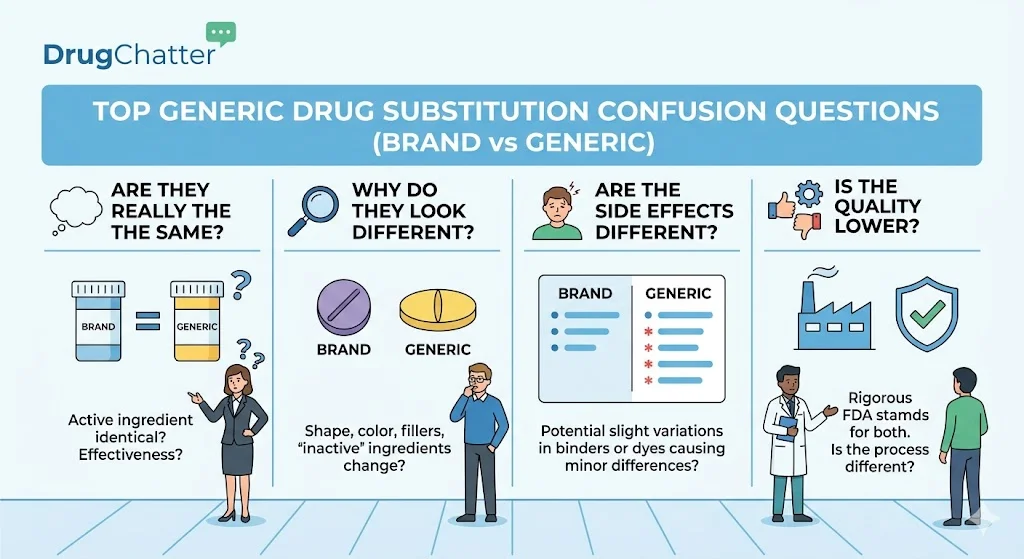
Every so often, a reader calls in with the same bewilderment: the label says one thing, the pharmacy hands over another, and suddenly everyone wants to know whether they just swapped one drug for a chemically equivalent twin… or for something close enough to be dangerous. The questions below—pulled from recurring DrugChatter discussions—show where confusion tends to cluster: brand names that look familiar, generics that sound right, and substitutes that don’t behave the way people assume.
1) “Is this brand actually the one people say it is?”
Sometimes the problem is simple identity. A brand name in one country doesn’t map cleanly onto what someone expects elsewhere. If you’re seeing a non-obvious brand/generic pairing, start by confirming the active ingredient and formulation details.
2) “Why did my medication disappear from the current lineup?”
Substitution confusion isn’t always about equivalence. Sometimes it’s about availability and therapeutic reality—why a drug falls out of favor, is no longer used, or is superseded by something newer.
3) “If it’s ‘the generic,’ why does the dosing routine feel different?”
Even when the active ingredient is the same, people worry about day-to-day differences: instructions, timing, and interactions. That’s especially true when the question involves what to do around food.
- What’s the waiting time for dairy after lipitor?
- What’s the recommended time interval between lipitor and yogurt
Note the pattern: “brand vs generic” quickly turns into “timing vs absorption,” because patients and caregivers know that practical instructions are part of the real-world outcome.
4) “What’s the generic name for this brand?”
This is the classic first domino. If you can’t reliably translate a brand into a generic name, you can’t confidently compare substitutions—especially across countries or insurance formularies.
5) “Is there a generic for my exact medicine?”
Sometimes the confusion is about whether a generic even exists yet—or whether what’s being offered is a true generic versus a different branded product with different status, approvals, or formulations.
6) “Are the risks the same after substitution?”
Patients often want reassurance that side effects won’t change—or that the warning story is still the same story. That question tends to surface when a patient already has concerns about the medication class, liver effects, drug interactions, or unusual symptoms.
- What are the potential risks of choosing lipitor?
- Have you brought up lipitor’s liver impact with your physician?
Once again: brand-vs-generic quickly becomes “Are we talking about the same risk profile in practice?”
7) “Is this the same drug—just packaged differently?” (The brand-name rabbit hole)
Brand confusion isn’t limited to “generic names.” People also ask the reverse: if they know the ingredient, what’s the brand name? That’s often how substitution problems get resolved at the pharmacy counter—or how they start.
8) “Does it matter which version I get?” (Even for the same active ingredient)
Some readers aren’t mainly worried about whether the molecule matches—they’re worried about the formulation details that can change how the medication behaves (release type, dosing schedule, and the “how it hits” question).
9) “Could substitution change how I feel—like new joint pain?”
When patients notice a symptom after a switch (or after any change), the instinct is to connect dots: was it the generic? was it the brand? was it timing? In reality, symptoms may be coincidental, but the concern is understandable—and worth addressing directly with clinicians.
10) “How do I recognize the ‘real’ thing?” (Discount cards and authenticity anxieties)
Some substitution confusion isn’t chemical at all—it’s trust and verification. When people worry about authenticity, they start asking procedural questions instead of therapeutic ones.
What these questions have in common
Across brand/generic confusion, the emotional core is the same: people want confidence that the substitute is (1) truly the same active ingredient, (2) truly the same practical medication, and (3) truly consistent enough that their monitoring and routines still make sense.
That’s why the highest-yield next step in any substitution story is straightforward: confirm the active ingredient, check the formulation (especially if you’re dealing with extended-release or specific salt forms), and align on timing and monitoring with your prescriber/pharmacist.
If you want, I can also reorganize these into a “quick checklist” for what to verify when a pharmacy substitutes a brand for a generic (or vice versa) using your specific medications.