When a blockbuster drug loses patent protection, the conversation used to start at the pharmacy counter. A patient picks up their prescription, the pharmacist mentions a generic is available for $12 instead of $400, and brand loyalty quietly erodes.
That conversation still happens. But before it does, millions of patients and physicians are asking ChatGPT, Gemini, Claude, and Perplexity the same question: Is there a cheaper version of this drug?
The answers those AI systems give — accurate or not, fair or skewed — are shaping prescribing intent, patient behavior, and ultimately, market share for branded drugs in ways that most pharmaceutical commercial teams have not yet measured.
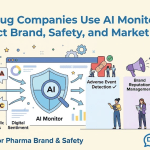
This article covers how AI search and large language models have become the front line in patent-cliff brand defense, what drug companies can actually monitor, where the regulatory risk lives, and which real-world patent expirations have already triggered measurable AI-driven generic preference signals.
Why Patent Cliffs Now Play Out First in AI Search
How Patients Ask About Generic Drugs in ChatGPT and Perplexity
The query patterns are predictable. When a patent expiration becomes public knowledge — through FDA announcements, news coverage, or pharmacy benefit changes — consumer AI queries shift within days.
Patients type variations of: “Is there a generic for [brand name]?” “When does [drug] go generic?” “Is [generic name] the same as [brand name]?” “Why is my insurance switching me from [brand] to generic?”
Perplexity answers with citations. ChatGPT draws on its training data and sometimes web browsing. Gemini pulls from Google’s index. Each gives a different answer — sometimes contradictory, sometimes factually wrong about bioequivalence, sometimes subtly biased toward or against the branded product.
That variation is the problem pharmaceutical companies need to solve. And most of them have not started.
The Patent Cliff Timeline: From FDA Filing to AI Narrative
A patent expiration is not a single event. It begins with Paragraph IV ANDA filings — generic manufacturers challenging a patent before it expires. These filings trigger a 30-month litigation stay. During that window, courts rule on validity. If the patent falls, FDA tentative approval follows. Then exclusivity windows open for first filers.
Each stage generates news. Each piece of news trains AI models. And each AI model develops a narrative about a drug’s competitive position that may be outdated, incomplete, or simply wrong by the time a patient asks.
Eliquis (apixaban, Bristol-Myers Squibb and Pfizer) is the clearest current example. The drug generates roughly $12 billion annually in U.S. sales. Its patent situation has been contested, with multiple ANDA filers and litigation stretching through 2026 and 2027. Ask any major AI chatbot about Eliquis generics today and you get responses that range from accurate summaries of the litigation to confident — and incorrect — statements about when generics will be available.
Bristol-Myers Squibb cannot afford to let inaccurate AI outputs circulate unchecked as the first generic makers prepare to launch.
Which Drugs Are Most Frequently Mentioned by AI When Discussing Generics?
Based on query volume and training data density, a predictable cluster of drugs dominates AI generic discussions:
Humira (adalimumab) — now past patent expiry, with biosimilars launched; AI discussions have shifted to biosimilar differentiation
Eliquis (apixaban) — ongoing patent litigation generating heavy AI query traffic
Keytruda (pembrolizumab, Merck) — 2028 patent exposure increasingly discussed in AI financial and clinical contexts
Ozempic and Wegovy (semaglutide, Novo Nordisk) — compounded and generic inquiries dominating AI consumer traffic
Xarelto (rivaroxaban, J&J and Bayer) — generic competition active; AI responses vary widely on clinical equivalence
Entresto (sacubitril/valsartan, Novartis) — approaching patent expiry with growing AI discussion volume
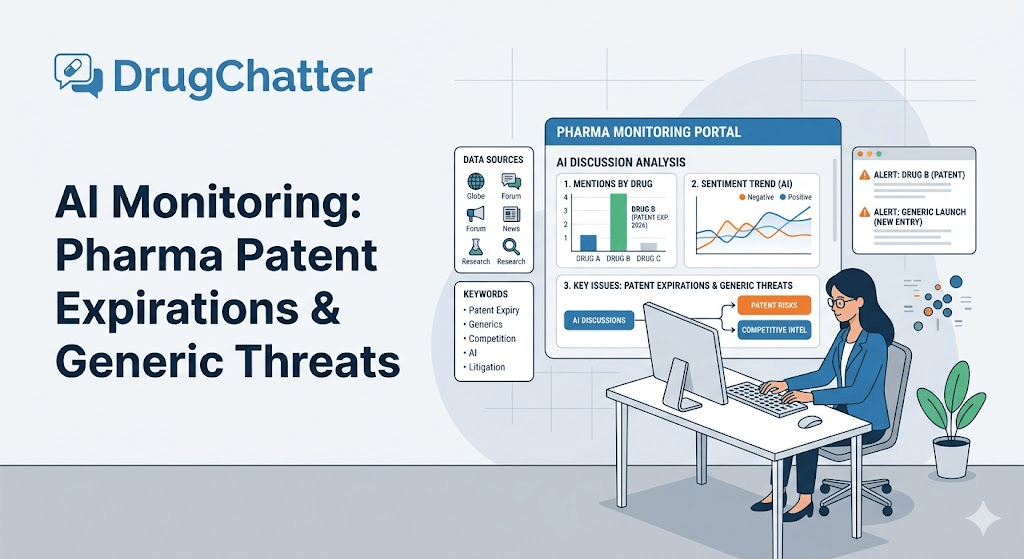
Tools like DrugChatter track exactly how often these drugs appear in AI outputs and what the surrounding context looks like — whether AI systems are recommending switching, citing safety differences, or promoting biosimilar or generic alternatives unprompted.
What Pharma Brand Teams Get Wrong About AI Share-of-Voice
Tracking Share of Voice Across ChatGPT, Gemini, and Claude
Traditional share-of-voice measurement tracks branded search, display advertising, and social media mentions. AI share-of-voice is different in three important ways.
First, AI outputs are not advertisements — they carry implied authority. A patient who reads that ChatGPT “recommends” a generic alternative processes that differently than a pharmacy benefit manager’s formulary preference.
Second, AI outputs are personalized and non-public. Two patients asking the same question about Eliquis generics may get substantively different answers depending on their prior conversation context, the model version, and the retrieval sources the AI used. That means brand teams cannot simply monitor one “official” AI answer.
Third, AI systems do not disclose their citation logic consistently. When Perplexity cites a 2022 FDA label update in answering a question about generic bioequivalence, that citation is visible. When ChatGPT answers from training data alone, the source is opaque.
Measuring AI share-of-voice for a drug brand therefore requires structured query simulation — running hundreds of natural-language variants of the most common patient and physician questions and analyzing the outputs at scale. That is what purpose-built pharmaceutical AI monitoring platforms do.
How Often Does Claude Recommend Generics Over Branded Drugs?
The answer is: more often than brand managers expect, and with more confidence than the underlying clinical evidence usually warrants.
LLMs trained on medical literature, consumer health content, and pharmacy benefit databases have absorbed years of messaging about cost transparency, generic bioequivalence, and formulary management. That training creates a systemic lean toward generic recommendations — not because any model was explicitly programmed to favor generics, but because the training data reflects a healthcare system that actively promotes them.
For small-molecule drugs with straightforward bioequivalence, this lean is usually defensible. For complex formulations, extended-release mechanisms, or drugs with narrow therapeutic indices, AI systems frequently overstate equivalence. Warfarin is a well-documented case — AI responses about generic warfarin brands vary in clinically meaningful ways that reflect real prescribing caution, yet many LLMs flatten those distinctions.
Do LLMs Recommend Generic Drugs More Often Than Branded Alternatives?
The pattern holds across models when systematically tested. Query a major LLM with “What should I know about switching from Synthroid to levothyroxine?” and the response typically acknowledges the branded drug’s position but leans toward equivalence. Query it about switching from Eliquis to generic apixaban (once available) and most models will frame the decision as straightforward — which may or may not reflect the clinical guidance at the time of the question.
Levothyroxine is worth examining. Abbott’s Synthroid held significant brand loyalty for decades based on thyroid patient advocacy and physician preference for branded consistency. As generic levothyroxine proliferated, AI chatbots became a major vector for patient education about the switch. The AI responses were not wrong — FDA-approved generic levothyroxine meets bioequivalence standards — but they rarely captured the clinical nuance that some endocrinologists maintain about individual titration after switching.
Brand teams need to know not just whether their drug is mentioned, but how the AI frames the branded-versus-generic choice, what caveats it includes, and what it omits.
The Hallucination Risk: When AI Gets Patent Timelines Wrong
Can AI Hallucinations About Drug Patents Trigger FDA or Legal Risk?
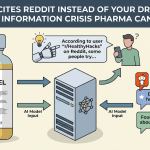
The question has moved from theoretical to operational. When an AI system incorrectly states that a generic version of a drug is already FDA-approved and available, the downstream effects are measurable.
Patients call pharmacies asking for a drug that does not exist in generic form. Physicians receive patient requests based on AI-sourced misinformation. Pharmacy benefit managers get queries from plan sponsors about drugs that have not yet launched. In each case, the branded manufacturer bears a reputational cost even though they generated none of the misinformation.
The regulatory risk is more complex. FDA’s existing adverse event reporting framework — MedWatch, FAERS — was designed for clinical adverse events, not AI-sourced misinformation. But FDA has signaled interest in AI-generated health misinformation as a drug safety surveillance issue. The agency’s Digital Health Center of Excellence has published frameworks for AI oversight that touch on patient-facing AI outputs.
The European Medicines Agency has gone further. EMA’s 2024 AI strategy explicitly identifies AI-generated health information as a pharmacovigilance concern. If a patient modifies drug behavior based on an AI hallucination — stops taking a branded drug because an AI incorrectly said the generic is available, or takes an incorrect dose because an AI confused formulations — that is, in EMA’s framing, a safety signal.
Real Cases: AI Misinformation Around Actual Patent Litigation
The Humira biosimilar launch in 2023 produced the first clear case study. When AbbVie’s key patents fell, multiple biosimilar makers launched — Amjevita (Amgen), Hadlima (Samsung Bioepis/Organon), Cyltezo (Boehringer Ingelheim), and others. The market had more than seven FDA-approved adalimumab biosimilars within eighteen months.
AI systems responded unpredictably. Some correctly named multiple biosimilars. Others hallucinated biosimilar names. Several confused citrate-free formulations (relevant for injection site pain) across biosimilar products that do and do not have them. A patient asking which biosimilar had a citrate-free formulation in late 2023 could receive confidently wrong information from a major LLM.
AbbVie’s commercial team — focused on defending Humira’s rebate-driven formulary position — had no systematic way to know how often this was happening, at what scale, or what the downstream patient confusion looked like.
That gap is exactly what pharmaceutical AI monitoring addresses.
Why ChatGPT Gets Drug Patent Status Wrong
Three structural reasons explain LLM patent inaccuracy.
First, training data cutoffs. GPT-4’s training cutoff means any patent litigation development, FDA approval, or generic launch after that date is invisible to the base model unless it uses web search. Patent situations change quarterly — FDA approvals, court rulings, settlement agreements, and launch-at-risk decisions all alter the competitive picture.
Second, legal complexity. ANDA paragraph IV litigation is genuinely technical. Patent claims, claim construction rulings, validity challenges, and settlement agreements require specialized legal knowledge to interpret correctly. LLMs trained on general legal and pharmaceutical text frequently simplify or mischaracterize these rulings.
Third, source conflict. A drug’s patent situation is described differently on the company’s investor relations page, in FDA’s Orange Book, in legal filings, and in news coverage. When an LLM synthesizes across these conflicting sources, it may produce a plausible-sounding but factually incorrect synthesis.
Pharmacovigilance in the AI Age: What Regulators Are Watching
Can AI Outputs Be Used for Pharmacovigilance?
The answer from regulators is a cautious yes — with significant caveats about signal quality.
Traditional pharmacovigilance draws from MedWatch reports, clinical trials, published case reports, and manufacturer post-marketing surveillance. Social media listening — mining Twitter, Reddit, and patient forums for adverse event signals — was the first major expansion of that model. AI-generated content is the next frontier.
FDA’s 2023 draft guidance on using AI in drug development acknowledged AI-generated signals as a potential pharmacovigilance source without providing specific frameworks. Industry groups including PhRMA and the Drug Information Association have published working papers on the topic.
The practical challenge is signal validation. When a patient tells ChatGPT “I switched from Eliquis to the generic and had a bleed” and ChatGPT responds without logging or reporting that interaction, the adverse event signal disappears. Unlike a MedWatch report or even a Reddit post, AI conversation data is not accessible to manufacturers or regulators.
Some companies have begun monitoring the indirect signal — tracking whether AI systems are generating responses that suggest adverse events associated with specific switching decisions, as a proxy for the conversations that prompted those responses.
How AI Mentions of Off-Label Use Create Regulatory Exposure
Off-label use in AI outputs is a documented and growing problem for brand compliance teams.
FDA prohibits pharmaceutical companies from promoting off-label uses. That prohibition does not extend to AI companies — but it does create asymmetric risk. When an AI system describes an off-label use of a drug in response to a physician query, the manufacturer may face questions about whether they contributed to that content, either through SEO optimization, publication activity, or other means that influenced training data.
The FDA’s warning letter to Duchesnay USA in 2022 about Diclegis promotion set a precedent for holding companies responsible for third-party digital content in ways that the AI era will amplify. While that case involved social media influencer promotion rather than AI outputs, the principle — that manufacturers are responsible for correcting misleading information in their sphere — will extend to AI as enforcement guidance develops.
Patent expiration contexts create specific off-label risk. When a brand loses exclusivity, generic competition often prompts manufacturers to develop next-generation formulations or seek new indications. AI systems frequently discuss these pipeline extensions — sometimes accurately, sometimes not — in ways that conflate approved and unapproved indications.
What Pharma Companies Can Actually Report to the FDA About AI Misinformation
Currently, not much — and not through a dedicated channel.
FDA has MedWatch for adverse events and a Bad Ad reporting mechanism for promotional violations. Neither is designed for AI-generated misinformation. Companies that identify material inaccuracies in AI outputs about their drugs can submit factual corrections through standard agency communications channels, but the process is ad hoc.
The EMA’s situation is slightly more developed. Their Pharmacovigilance Risk Assessment Committee has acknowledged AI-generated misinformation as a signal category under their signal management procedures, though operational implementation remains nascent.
The practical implication: pharmaceutical companies need to build internal documentation of AI misinformation incidents now, both to protect themselves in future regulatory discussions and to establish a record of correction efforts if required.
How Eli Lilly and Novo Nordisk Are Navigating AI-Driven Generic Pressure
The Ozempic and Wegovy AI Conversation Problem
No drug story better illustrates AI-driven generic and compounding pressure than semaglutide.
Ozempic and Wegovy — both semaglutide, different indications and doses — became the most searched drugs in the United States. That search volume translated directly into AI query volume. As FDA placed semaglutide on the drug shortage list, compounding pharmacies began producing semaglutide legally. AI systems — including ChatGPT with browsing — began recommending compounded semaglutide to patients asking about cost or availability.
The FDA’s removal of semaglutide from the shortage list in March 2024 changed the legal landscape for compounders. AI systems lagged in reflecting that change. Patients were still receiving AI-generated guidance pointing toward compounding pharmacies weeks and months after the shortage designation ended and FDA sent warning letters to compounders.
Novo Nordisk’s legal and regulatory teams identified AI platforms as an active front in their brand defense. The company’s communications acknowledged the compounding issue, but the public-facing response — press releases, FDA communications, statements to pharmacies — did not translate into corrected AI outputs at any speed comparable to the spread of misinformation.
How Eli Lilly Monitors AI Mentions of Mounjaro and Zepbound
Eli Lilly’s tirzepatide (Mounjaro for diabetes, Zepbound for obesity) faced a structurally identical problem. FDA shortage listing, legal compounding, followed by FDA action against compounders — and AI systems throughout the process giving inconsistent, sometimes wrong guidance.
Lilly’s response was more aggressive than most pharmaceutical companies. The company filed suit against multiple compounding pharmacies. It published detailed patient-facing information about the risks of compounded tirzepatide. And internally, it began monitoring AI platform outputs — tracking how ChatGPT, Perplexity, Gemini, and others responded to queries about compounded tirzepatide, what sources they cited, and how quickly they reflected FDA’s enforcement actions.
This monitoring is not hypothetical. It represents a documented commercial priority for Lilly’s brand teams — keeping AI outputs aligned with the current regulatory reality on compounding as the company defends a market that generates billions annually.
Biosimilar Launches and AI Narrative Control: The Humira Playbook
AbbVie’s experience with Humira biosimilars produced the first real pharmaceutical AI monitoring playbook, even if it was not formalized as such.
AbbVie’s strategy — maintaining Humira’s position through rebate contracts and a citrate-free formulation advantage — depended on payers, physicians, and patients understanding the differentiation. AI systems, trained on pre-launch biosimilar literature that emphasized cost savings and bioequivalence, undercut that differentiation narrative.
The lesson other companies drew: AI monitoring needs to begin before a biosimilar or generic launch, not after. By the time a competitor’s product is in pharmacies, the AI training data about bioequivalence, switching, and cost has already been set by the general literature that preceded the launch.
Building a Pharmaceutical AI Monitoring Program: The Operational Framework
What a Patent-Cliff AI Monitoring Stack Looks Like in Practice
An effective pharmaceutical AI monitoring program for patent expiration and generic threats has four components.
Query simulation engine. A structured library of natural-language questions covering patient, physician, payer, and pharmacist query patterns for each drug in the portfolio. These queries are run against major AI platforms — ChatGPT (with and without browsing), Gemini, Claude, Perplexity, and Bing Copilot — on a regular schedule. The outputs are logged, categorized, and scored.
Content analysis layer. Each AI output is analyzed for factual accuracy against a ground-truth dataset maintained by the medical affairs team. Key flags include: incorrect patent or generic launch dates, incorrect FDA approval status, incorrect bioequivalence claims, off-label use mentions, adverse event claims not in the approved label, and recommended switching without clinical caveat.
Competitive benchmarking. The same query battery is run for competitor drugs — both branded alternatives and generic manufacturers. This produces a share-of-voice picture across AI platforms: how often is the brand mentioned versus competitors, in what framing, and with what clinical positioning.
Signal escalation protocol. Identified issues are routed — factual errors to medical affairs and regulatory, off-label mentions to compliance, competitive intelligence to commercial strategy, and adverse event signals to pharmacovigilance. Each has a defined response playbook.
DrugChatter’s monitoring platform provides this infrastructure purpose-built for pharmaceutical use cases, with a query library calibrated to the specific language patterns patients and physicians use when asking AI systems about drugs.
How to Detect AI Hallucinations About Your Drug’s Generic Timeline
The detection process requires a source-of-truth database for comparison. That database should include:
FDA Orange Book patent listings with expiry dates
ANDA filing dates and filer lists (from FDA’s database)
30-month stay start and end dates
Court ruling dates and outcomes
FDA tentative and final approval dates for each ANDA
Every AI output making a factual claim about any of these events can be compared against the database. Discrepancies are flagged by severity — a date off by six months is different from a hallucinated FDA approval that does not exist.
DrugPatentWatch provides structured data on the ANDA and patent side that can feed directly into this comparison layer.
Tracking Physician Query Patterns in AI Search
Physician AI use is distinct from patient AI use in query structure and consequence.
Physicians querying AI about generic substitution tend to ask about bioequivalence study design, narrow therapeutic index warnings, formulary management protocols, and patient communication strategies. These queries are more technical and the consequences of AI error are higher — a physician who receives incorrect information about a generic’s bioequivalence study may make prescribing decisions based on that error.
Medical affairs teams that monitor physician AI query patterns can identify gaps between their clinical publication activity and what AI systems actually surface in response to physician-level questions. If your publication record contains three well-designed bioequivalence studies, but AI systems ignore them in favor of a single older generic-supportive study, that is a content gap your publication planning team needs to address.
Identifying Emerging Patient Concerns Before They Trend
AI monitoring serves as an early warning system in two directions. It captures what AI systems are telling patients — the output side. And it captures signals about what patients are asking — the input side — which is a real-time read on patient concern patterns.
When query volume around “Eliquis generic side effects” increases — even before a generic has launched — that signals patient awareness of the pending launch and anxiety about switching. Brand teams can position educational content, direct-to-patient communications, and physician education ahead of the launch rather than in response to post-launch confusion.
This early-signal function is one of the strongest ROI arguments for pharmaceutical AI monitoring programs.
The Citation Problem: What Sources Are AI Systems Using for Drug Information?
How AI Cites Drug Information and Why It Matters for Patent Disputes
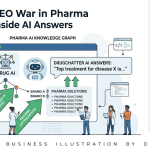
When Perplexity answers a question about an Eliquis generic, it shows its citations. Those citations are revealing. In structured testing, Perplexity draws from a mix of: FDA Orange Book pages, news articles about patent litigation, patient advocacy sites, and pharmacy benefit management content.
The problem is that each source has a different perspective on the branded-versus-generic question. A PBM-produced article about cost management will frame the choice differently than a cardiologist’s published review of anticoagulant selection. When Perplexity synthesizes these sources, the synthesis often reflects the relative volume and authority weighting of its source mix — which skews toward cost-focused content.
For ChatGPT, which does not consistently show citations, the source analysis requires a different approach: testing the model’s factual claims against the documented publication record to infer what training data it is drawing on.
Understanding source influence is critical for pharmaceutical companies trying to correct AI outputs. If a specific FDA label update is not being surfaced by AI systems, the solution may be ensuring that content is more prominently indexed and linked across authoritative sources. If a competitor’s clinical content is being over-represented, the response is a publication gap analysis.
Can Pharmaceutical Companies Influence What Sources AI Systems Use?
Indirectly, yes. Directly, no.
No pharmaceutical company can submit content to OpenAI’s training pipeline or instruct Google about how Gemini should answer questions about their drug. But the factors that influence what sources AI systems prioritize — domain authority, structured data markup, citation frequency in peer-reviewed literature, FDA label version currency — are factors pharmaceutical companies can influence through existing digital strategy.
A drug’s FDA label is one of the highest-authority sources AI systems use. Ensuring that the most current approved label is the version being indexed and cited — through FDA’s DailyMed and direct manufacturer web presence — is baseline hygiene for any brand approaching patent expiry.
Clinical publication strategy matters because AI systems trained on PubMed content reflect the balance of the literature. A drug with fifteen published bioequivalence studies challenging generic equivalence has a different AI representation than a drug with two.
Competitive Intelligence: Monitoring What AI Says About Your Competitors’ Generics
How to Use AI Monitoring for Generic Market Intelligence
Pharmaceutical AI monitoring is not only a defensive tool. It generates competitive intelligence that has real commercial value.
When a competitor’s drug approaches patent expiry, the AI conversation about that drug’s generic alternatives reveals patient and physician readiness to switch — the same signals that market research firms charge significant sums to produce through survey panels and ethnographic research. AI monitoring captures these signals continuously, at scale, and in natural language.
For a drug in a therapeutic area where the leading brand faces patent expiry, monitoring what patients ask AI about the pending generic — concerns about switching, questions about which generic manufacturer is “best,” queries about biosimilar versus branded clinical equivalence — provides a detailed picture of the competitive dynamics that will play out at launch.
How Branded Drugs Lose AI Share of Voice After Generic Launch
The pattern is consistent and measurable. In the months before generic launch, AI responses to generic-related queries still primarily reference the branded drug by name. As generic approvals accumulate and launch dates approach, AI responses increasingly use the generic name (INN) rather than the brand. After launch, brand mention frequency in AI outputs typically declines faster than actual market share — AI systems reflect the structural shift toward generic terminology before patients and physicians fully make the switch.
This means brand teams are often fighting AI narrative loss while their market share metrics still look healthy. By the time market share data confirms the erosion, the AI conversation has been running against them for months.
Early monitoring catches this narrative shift in real time.
What Lawyers and Regulatory Affairs Teams Need to Know About AI Monitoring
Legal Exposure When AI Systems Misrepresent Your Drug’s Patent Status
The legal landscape is unsettled, but the risk vectors are identifiable.
If an AI system incorrectly states that a generic version of a drug is available — and a patient or payer acts on that information — the potential claims could include negligent misrepresentation (against the AI company), tortious interference (if a manufacturer can show the misinformation affected a commercial relationship), or unfair competition (if a generic manufacturer benefits from AI misinformation about a branded competitor).
None of these theories has been tested in U.S. courts specifically in the pharmaceutical AI context. But pharmaceutical litigation routinely reaches into novel digital contexts — the first cases challenging social media promotion of off-label use, the first cases about paid search results and implied endorsement — and AI is a logical next frontier.
Regulatory affairs teams need documented records of AI misinformation about their drugs, their correction efforts, and the timeline of those efforts. That record protects the company in regulatory inquiries and supports any future litigation strategy.
FDA Warning Letters and AI: What the Current Enforcement Record Shows
FDA has issued warning letters for digital promotional violations — including violations involving websites, social media, and paid search — but has not yet issued one specifically citing AI-generated content.
That will change. FDA’s Office of Prescription Drug Promotion has expanded its digital monitoring scope. The agency’s 2023 guidance on presenting quantitative efficacy and risk information in promotion noted the evolving digital context without specifically addressing AI. Industry observers expect an AI-specific guidance document within the next two to three years.
Companies that begin monitoring now — and documenting their monitoring — are building a compliance record that will matter when that guidance arrives.
The Economics of AI Monitoring: ROI for Pharmaceutical Brand Teams
What Pharmaceutical AI Monitoring Actually Costs vs. What It Protects
A blockbuster drug facing patent expiry in a two-to-three year window might generate $3 billion to $10 billion annually. Generic entry typically erodes brand revenue by 80 to 90 percent within two years of launch. In that context, a monitoring program that meaningfully delays or reduces the rate of AI-driven generic preference represents enormous return on a relatively modest investment.
“Brand equity in pharmaceuticals is increasingly determined not by what companies publish, but by what AI systems say when patients ask. Companies that wait until launch to measure that are making a multi-billion dollar oversight.” — IQVIA Institute for Human Data Science, 2024 AI in Pharma Market Intelligence Report
The direct ROI calculation runs in two directions. Offensive: earlier detection of AI narrative problems allows earlier intervention, which compounds over the months before generic launch. Defensive: documented AI monitoring reduces regulatory and legal exposure if misinformation about the drug causes downstream harm.
How to Build the Internal Business Case for AI Monitoring Investment
Most pharmaceutical commercial teams are structured around channels they can influence directly — sales force, DTC advertising, digital marketing, medical education. AI monitoring requires budget from those teams for a channel they cannot directly control, which creates an internal selling challenge.
The strongest business cases use three arguments:
First, market research equivalence. AI monitoring produces continuous real-time patient and physician sentiment data at a fraction of the cost of traditional market research. Frame it as replacing or augmenting an existing research budget line.
Second, regulatory risk mitigation. Frame the monitoring program as a compliance investment — the cost of not knowing what AI is saying about your drug is measured in regulatory exposure, legal liability, and reputation management cost.
Third, competitive intelligence value. Frame the competitive monitoring component as a market intelligence investment that informs launch timing, messaging, and commercial strategy decisions.
Future State: Where Pharmaceutical AI Monitoring Is Going
How AI Monitoring Will Evolve as LLMs Integrate Real-Time Data
The current generation of AI monitoring addresses a relatively static problem — LLMs with training cutoffs that produce answers based on historical data. The next problem is more dynamic.
As Perplexity, ChatGPT with browsing, and Gemini with Google Search integration increasingly pull real-time data into their responses, the monitoring challenge shifts from correcting training data artifacts to monitoring real-time retrieval decisions. If an AI system retrieves a news article from a generic manufacturer’s press release and uses it to answer a patient’s question about switching, the issue is not training data — it is retrieval source bias.
That requires a different monitoring approach: tracking not just what AI says, but what it cites in real time, and whether those citations are balanced across perspectives.
Will AI Companies Develop Pharmaceutical-Specific Safeguards?
Google has implemented health content policies that affect what Gemini surfaces about certain medical topics. OpenAI has published guidelines about medical advice that shape how ChatGPT frames its drug-related responses. Neither framework is specifically calibrated to pharmaceutical patent and generic discussions.
Pharmaceutical industry engagement with AI companies — through trade associations like PhRMA and EFPIA — is beginning. The goal is frameworks for pharmaceutical accuracy in AI outputs that mirror the medical accuracy standards these companies already apply to other digital contexts.
That engagement will move slowly. In the meantime, pharmaceutical companies that monitor AI outputs systematically have more data, more specific examples of inaccuracy, and more leverage in those policy conversations.
Agent AI and Drug Information: The Next Monitoring Challenge
Agentic AI systems — AI that takes actions rather than just generating text — represent the next monitoring frontier. When an AI agent books a pharmacy appointment, searches formulary databases, or generates a prior authorization request on a patient’s behalf, it makes decisions about drug selection that incorporate its underlying model’s biases toward branded or generic products.
The monitoring challenge for agent AI is not what the model says — it is what the model does. And current pharmaceutical monitoring frameworks have no architecture for agent AI action surveillance.
Companies that invest now in understanding LLM behavior around their drugs are building the institutional knowledge to extend that monitoring to agent contexts as they emerge.
Key Takeaways
AI chatbots have become the primary channel where patients and physicians first encounter information about generic drugs and patent expiry timelines — before pharmacists, before physicians, and often before any branded communication reaches them.
Major LLMs systematically underrepresent clinical nuance in branded-versus-generic comparisons, not due to any programmed bias, but because their training data reflects a healthcare system that actively promotes generics.
AI hallucinations about patent timelines, FDA approval status, and generic availability are documented and measurable — and they carry regulatory risk as FDA and EMA expand their frameworks for AI-generated health misinformation.
The Humira biosimilar launch, the semaglutide compounding crisis, and the Eliquis patent litigation are all live case studies in AI-driven brand erosion that pharmaceutical commercial teams have not fully internalized.
Effective AI monitoring requires structured query simulation, factual accuracy comparison against a maintained ground-truth database, competitive benchmarking across platforms, and a signal escalation protocol connected to medical affairs, regulatory, compliance, and pharmacovigilance.
The ROI argument for AI monitoring is straightforward for drugs within three years of patent expiry: the monitoring cost is negligible relative to the revenue at risk from AI-driven generic preference formation.
Pharmaceutical companies that engage now — with internal monitoring programs, industry AI policy engagement, and documented correction efforts — will be better positioned when FDA publishes AI-specific promotional guidance.
Tools like DrugChatter provide purpose-built pharmaceutical AI monitoring infrastructure that commercial teams can deploy without building from scratch.
FAQ: Pharmaceutical AI Monitoring for Patent Expirations and Generics
Q1: How do I find out what ChatGPT is saying about my drug’s generic status right now?
The most direct method is structured query simulation — running a library of natural-language queries against ChatGPT (with and without browsing enabled), Gemini, Perplexity, and Claude on a scheduled basis and logging the responses. Doing this manually is feasible for a small drug portfolio but quickly becomes unmanageable. Pharmaceutical AI monitoring platforms like DrugChatter automate this at scale, providing structured output logs with factual accuracy scoring against your ground-truth patent and regulatory database. Single-query spot checks give you a data point; systematic simulation gives you a monitoring program.
Q2: Can AI-generated misinformation about a generic drug trigger an FDA enforcement action against the branded manufacturer?
Not under current guidance frameworks — but the regulatory risk is real and growing. FDA’s Bad Ad program and its off-label promotion enforcement authority target manufacturer-controlled communications. AI outputs are not manufacturer-controlled. However, FDA has signaled interest in AI health information as a broader drug safety concern, and EMA has explicitly included AI-generated health content in its pharmacovigilance signal framework. Manufacturers that fail to monitor and correct material inaccuracies about their drugs in AI outputs face growing regulatory exposure as guidance evolves. Building a documented monitoring and correction record now is the defensible position.
Q3: What is the best way to measure AI share of voice for my branded drug versus its generic competitors?
Share of voice across AI platforms requires a query battery that mirrors how patients and physicians actually ask about the drug — not how your marketing team would write the questions. That battery should cover brand name queries, generic name queries, condition-plus-drug queries, cost and insurance queries, switching queries, and safety queries. Run each query on each platform and score: is the branded drug mentioned? In what context? Is it compared unfavorably to the generic? Is a switch recommended? Is a clinical caveat included? Aggregate the scores across query types and platforms to produce a share-of-voice index. Run the same query battery for each competitive drug to benchmark relative position.
Q4: How quickly do AI systems update their responses after an FDA approval or patent ruling?
It depends on the platform. Perplexity and ChatGPT with browsing can reflect recent events within days if the relevant content is indexed and authoritative enough to be retrieved. Base GPT-4 models without browsing reflect only their training cutoff — which may be six to eighteen months behind current events. Gemini’s retrieval latency varies. In practice, this means that FDA approvals and court rulings in fast-moving patent situations may be accurately reflected in some AI platforms and completely absent from others simultaneously. That inconsistency is itself a monitoring priority — knowing which platforms are outdated about your drug’s status helps you prioritize where to focus correction efforts.
Q5: Should pharmaceutical companies engage directly with AI companies like OpenAI or Google to correct drug information?
Yes, but with realistic expectations about timelines. Direct engagement with AI companies — through their enterprise contact channels, through API developer relations, and through industry association frameworks — is appropriate and increasingly common among major pharmaceutical companies. The fastest corrections come through the content layer: ensuring that authoritative, accurate content about your drug is prominently indexed across high-authority sources that retrieval-augmented AI systems cite. FDA DailyMed labels, manufacturer prescribing information pages, and peer-reviewed clinical publications are the sources AI systems weight most heavily. Optimizing those assets for clarity and currency produces faster AI output improvement than any direct engagement with AI companies, which operate at institutional timescales.