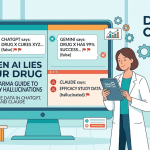
Last year, a patient asked ChatGPT whether it was safe to take semaglutide with a sulfonylurea. The model answered confidently. It was also wrong — the response omitted the boxed warning about hypoglycemia risk with concomitant secretagogue therapy, a warning that appears prominently on the FDA-approved label for Ozempic.
No regulator tracked that conversation. No pharmacovigilance system flagged it. The drug company almost certainly never knew it happened.
That gap — between what AI says about a drug and what the FDA label actually says — is now one of the least-monitored risks in the pharmaceutical industry. And it is widening fast.
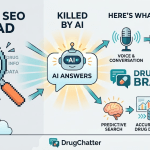
AI search is no longer a novelty. Perplexity processes over 100 million queries per month. ChatGPT has more than 200 million weekly active users. Google’s AI Overviews appear on billions of searches. When patients and physicians type drug questions into these systems, the answers they receive are not verified against package inserts. They are generated from model weights trained on data that may be months or years old, pruned for safety filters that do not map to regulatory standards, and optimized for conversational clarity rather than label fidelity.
Pharmaceutical companies have spent decades building pharmacovigilance systems to capture adverse event signals from clinical trials, spontaneous reports, and literature. None of those systems were designed to monitor what a large language model tells a patient about their medication at 11 p.m. on a Tuesday.
That is the problem this article addresses: what label adherence means in an AI search world, how to measure it, what the regulatory exposure looks like, and how companies are starting to build systematic monitoring programs around it.
What ‘FDA Label Adherence’ Actually Means in an LLM Context
The Package Insert as a Compliance Baseline
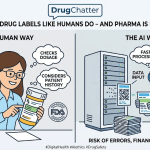
The FDA-approved package insert — formally called the prescribing information — is the legal and scientific baseline for what can be said about a drug in the United States. It defines approved indications, contraindications, warnings, precautions, adverse reactions, dosing, and patient counseling information. Every promotional communication from a manufacturer must be consistent with this document.
AI systems are not manufacturers. They are not regulated as promotional vehicles. That distinction matters legally, but it does not eliminate the risk.
When an AI model tells a user that a drug is appropriate for a use not listed on the label — or omits a black-box warning — the manufacturer cannot be held liable for that statement in the same way they would be for a sales rep’s off-label claim. But the patient harm is identical, and the reputational and pharmacovigilance implications for the brand are real.
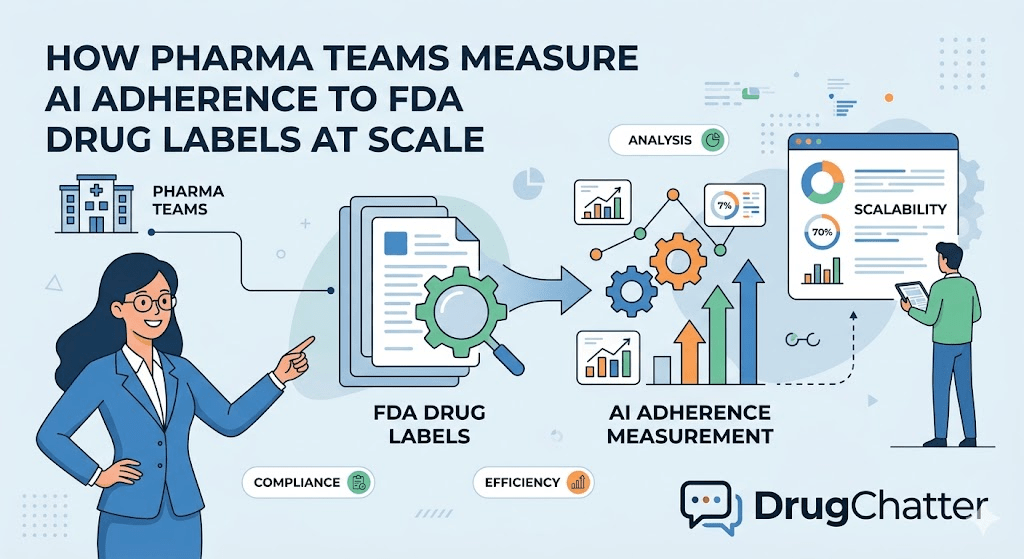
Label adherence, in this context, means measuring the degree to which AI-generated responses about a drug align with the content of the current, approved prescribing information. It is not about whether AI reproduces the label verbatim. It is about whether AI responses contradict it, omit critical safety information, or introduce claims — efficacy or safety — that have no basis in the approved text.
How AI Models Are Trained and Why Label Accuracy Degrades
Large language models are trained on snapshots of the internet and curated text corpora. Their drug-related knowledge reflects whatever appeared in training data: journal abstracts, patient forums, news articles, clinical trial press releases, Reddit threads, and sometimes — but not always — actual FDA label text.
Several specific failure modes drive label non-adherence:
- Training cutoff lag: A model trained with data through early 2024 will not know about label updates, new warnings, or newly approved indications added after that date. Tirzepatide’s label, for instance, has been updated multiple times as new formulations and indications received approval.
- Consensus averaging: LLMs tend to produce responses that reflect the statistical center of their training data. If 80% of internet text about a drug downplays a known side effect — as often happens when early enthusiasm precedes full safety characterization — the model will too.
- Source conflation: Models blend information from clinical trial data, patient testimonials, international labels (which differ from FDA labels), and informal health writing. The FDA label for Eliquis says one thing about renal dosing; a Canadian prescribing monograph says something slightly different. A model trained on both may produce a hybrid that matches neither.
- Post-training alignment: Safety fine-tuning and RLHF can suppress accurate but sensitive information. A model trained to avoid discussing overdose risks may under-report genuine clinical warnings, producing responses that feel safer but are less complete.
Which Drug Categories Carry the Highest Hallucination Risk
Not all drug categories are equal. Based on structural characteristics of the categories most frequently queried in AI systems, a few areas carry disproportionate risk:
- GLP-1 receptor agonists (semaglutide, tirzepatide, liraglutide): High query volume, rapidly evolving labels, high off-label weight-loss use, aggressive DTC marketing, and a large informal information ecosystem online.
- Oncology biologics: Complex, indication-specific dosing; frequent label updates from post-marketing studies; high physician query rates for off-label use in tumor types not yet approved.
- Anticoagulants (apixaban, rivaroxaban, dabigatran): Dosing depends on renal function, indication, and patient characteristics in ways that are easy to collapse incorrectly in a summary response.
- Psychiatric medications: High patient self-research rates; stigma-driven queries; historical misinformation ecosystems on Reddit and patient forums that contaminate training data.
- Biosimilars vs. reference products: Interchangeability designations, switching protocols, and indication extrapolation are frequently misrepresented by AI systems that conflate the biosimilar’s label with the reference biologic’s broader indication set.
Can AI Hallucinations About Drugs Trigger FDA Regulatory Risk?
The Regulatory Gray Zone Pharma Can’t Afford to Ignore
The short answer is: not yet directly, but the conditions for it are forming.
The FDA’s current framework for regulating drug information focuses on manufacturer communications. The agency has authority over labeling, promotional materials, DDMAC-reviewed advertising, and sales force communications. It does not regulate what Google’s AI Overview says about Jardiance. It does not audit ChatGPT responses for off-label promotion.
But the regulatory exposure is real in at least three indirect pathways.
First, adverse event reporting. If a patient or caregiver learns of a drug use from an AI system, acts on it, and experiences harm, the report that eventually flows into FAERS may lack the information source. Pharmacovigilance teams analyzing signal data will not know that the action was AI-mediated. That distorts signal detection.
Second, the FTC and state consumer protection statutes are increasingly attentive to AI-generated health misinformation. While these are not FDA actions, they create liability pathways that touch the pharmaceutical industry when AI outputs about their products cause demonstrable harm.
Third, and most directly relevant for regulatory affairs teams: the FDA’s evolving guidance on digital health technologies and AI/ML-based software suggests the agency is building the conceptual apparatus to eventually address AI-generated drug information. The 2021 action plan on AI/ML software as a medical device established the principle that ongoing post-market monitoring of AI outputs matters. That principle, extended to AI-generated drug information, points toward a world where manufacturers will be expected to know what AI systems say about their products — even if they did not produce those systems.
Real FDA Warning Letters That Foreshadow AI Risk
The FDA has issued warning letters for digital communications that misrepresent drug information in ways structurally similar to what LLMs produce. These are not AI cases — yet — but they establish the regulatory logic.
In 2023, the FDA issued a warning letter to a company promoting a prescription drug through social media content that omitted risk information. The letter specifically cited the company’s failure to present “a fair balance” of benefit and risk information. An AI model that returns a response emphasizing efficacy claims from clinical trial press releases while omitting boxed warning content is producing the same imbalance — just without a human author behind it.
The FDA has also warned about sponsored search results that present off-label uses without adequate context. When AI Overviews or AI-cited search results surface off-label information prominently — as has been documented for GLP-1 agonists and various oncology agents — the structural problem is identical.
Pharmaceutical brand and regulatory teams watching this space should not wait for an AI-specific warning letter before building monitoring infrastructure. The regulatory logic already exists. The application to AI is a matter of when, not whether.
How Off-Label AI Responses Create Liability Exposure
Off-label prescribing is legal in the United States. Physicians can and do prescribe drugs outside approved indications. What is illegal is manufacturer promotion of off-label use.
The question for pharmaceutical legal teams is whether an AI system trained on a manufacturer’s own materials — press releases, sponsored content, disease awareness campaigns — that subsequently recommends off-label uses could be construed as manufacturer-sponsored promotion. This has not been litigated. But the argument is available, and plaintiff attorneys are aware of it.
More concretely: if a company’s medical affairs team has published content that AI models index and use as training data or retrieval sources, and that content influences AI outputs toward off-label recommendations, the manufacturer’s distance from those outputs is thinner than it appears.
How ChatGPT, Gemini, Claude, and Perplexity Handle Drug Safety Information Differently
Measuring Share of Voice Across AI Systems
Pharmaceutical brand teams have tracked share of voice in traditional media, social listening tools, and search engine rankings for years. The same concept applies to AI — but the measurement infrastructure barely exists.
Share of voice in AI search means: when patients or physicians ask about a therapeutic category, which brands does the AI mention, in what order, with what framing, and with what level of safety qualification? For a brand manager at Eli Lilly watching Mounjaro and Zepbound compete against Novo Nordisk’s Ozempic and Wegovy in the GLP-1 category, understanding AI share of voice is as commercially relevant as tracking TV ad awareness.
The challenge is that AI systems are not consistent. Ask ChatGPT the same question about semaglutide dosing three times and you may get three slightly different answers. Ask it in different geographies or with different account settings and the variance increases. Measuring AI share of voice requires systematic query sampling, not one-time snapshots.
Tools like DrugChatter are designed for exactly this problem — monitoring what AI systems say about specific drugs, tracking changes over time, and comparing AI brand mentions against competitors across multiple LLM platforms.
Does Claude Mention Ozempic More Than Wegovy? Testing Brand Asymmetry in LLMs
Brand asymmetry in LLM outputs is a real and measurable phenomenon. It reflects training data distribution, not brand quality or regulatory status. A drug that has been covered more extensively in online health journalism, clinical commentaries, and patient forums will appear more frequently in AI responses — even if a competitor drug has an equivalent or superior clinical profile.
Ozempic has received vastly more media coverage than Wegovy since its approval, partly because of its off-label weight-loss use. That coverage concentration almost certainly biases AI models toward Ozempic mentions in weight-management queries even though Wegovy is the FDA-approved product for that indication. This is a direct label-adherence problem: AI systems are implicitly directing patients toward a product for a use case where another product carries the actual approval.
Brand teams at Novo Nordisk have commercial and pharmacovigilance reasons to monitor this asymmetry. Patients who obtain semaglutide for weight loss specifically may be prescribed Ozempic when Wegovy would be appropriate — and may encounter dosing, formulation, and insurance coverage issues as a result. AI-driven brand asymmetry contributes to this confusion.
Why Perplexity’s Citation Model Changes the Risk Profile
Perplexity operates differently from ChatGPT or Claude in one important way: it surfaces citations alongside answers. When Perplexity answers a question about drug interactions, it names the sources it used. That transparency cuts both ways.
On the positive side, users can evaluate source quality. If Perplexity cites an FDA label directly, the information is likely more accurate than a response synthesized from general web content. On the negative side, Perplexity’s citation model means that the quality of a drug’s AI representation is directly tied to the quality and recency of indexed sources about that drug. Companies whose product information pages are not structured for AI indexing — or whose FDA label is not easily retrievable by AI crawlers — are at a disadvantage even in a “citation-aware” AI system.
How Google’s AI Overviews Handle Prescription Drug Queries
Google has applied restrictions to AI Overview generation for certain sensitive health queries, but the boundaries are inconsistently enforced. Prescription drug queries frequently trigger AI Overviews that blend label-consistent information with off-label content indexed from health journalism and patient communities.
The commercial implications are significant. An AI Overview that appears above the fold on a Google search for a brand name drug becomes the de facto first impression for millions of patients — and it is not reviewed by the manufacturer’s medical-legal-regulatory team before it appears.
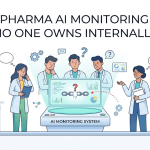
Building a Pharmaceutical AI Monitoring Program: The Operational Framework
What a Drug Brand Monitoring Stack for AI Looks Like in Practice
A functional AI monitoring program for a pharmaceutical brand requires four components that most companies do not yet have integrated:
- Query design: A systematic library of prompts that mirror how patients, caregivers, and physicians actually query AI systems. These are not marketing questions. They are clinical, behavioral, and often anxiety-driven: “Can I take [drug] if I have kidney disease?” “What happens if I miss a dose of [drug]?” “Is [drug] safe during pregnancy?” Each query must be grounded in the label’s actual content domains.
- Multi-platform sampling: The same queries deployed across ChatGPT, Gemini, Claude, Perplexity, and Bing Copilot on a regular cadence — weekly at minimum for high-priority brands. This generates comparable data across platforms rather than anecdotal observations.
- Label-adherence scoring: A structured rubric comparing AI responses to the current approved label. At minimum, this should score responses on indication accuracy, safety completeness (black box warnings, contraindications), dosing accuracy, and off-label content presence. Manual review by a medically qualified reviewer is necessary for high-stakes brands; AI-assisted scoring can work for lower-priority products.
- Trend tracking and alerting: A mechanism to detect when AI responses about a brand shift — after a label update, after a safety signal emerges in FAERS, after a news event, or after competitor activity changes the information landscape. This is the pharmacovigilance integration point.
How to Turn AI Query Logs into Pharmacovigilance Intelligence
The most underexplored opportunity in pharmaceutical AI monitoring is using AI query patterns as a pharmacovigilance input. Patient queries to AI systems are a form of unsolicited adverse event signal — patients are not filing formal reports, but they are documenting their experiences and concerns in query form.
When patients ask “Can Ozempic cause gastroparesis?” or “Is hair loss from Wegovy permanent?” they are often describing personal experiences or concerns prompted by personal experiences. Aggregated at scale, these queries precede social media trend spikes, which themselves precede spontaneous adverse event reports, which eventually surface in FAERS.
Platforms like DrugChatter are positioned to aggregate this signal — capturing not just what AI says about drugs, but what questions patients are directing to AI systems, effectively creating an early warning layer upstream of traditional pharmacovigilance channels.
“Social listening and AI query monitoring together represent a three-to-six month lead time over traditional spontaneous reporting for emerging adverse event signals in high-volume consumer products.” — IQVIA Institute for Human Data Science, 2023 Digital Health Trends Report
Detecting Hallucinated Safety Claims Before They Spread
Hallucinated safety claims in drug-related AI responses take several forms. The most dangerous are not outright fabrications but plausible-sounding synthesis errors — responses that combine real clinical data in ways that produce false conclusions.
Documented examples from systematic testing include:
- AI systems combining efficacy data from one study population with safety data from another, producing a net benefit-risk framing that does not exist in any single study or label section.
- Responses that describe a drug’s contraindications correctly for one indication but incorrectly for another indication carried by the same molecule.
- Statements about drug interactions that are accurate for one drug in a class but not the specific brand being asked about — a particular problem in classes where class-wide effects are often incorrectly attributed to individual molecules.
- Dosing instructions that reflect older label versions rather than current approved dosing.
Detecting these errors at scale requires a comparison framework anchored to the current label. This is not a task a general-purpose search monitoring tool can perform. It requires pharmaceutical domain knowledge applied systematically to AI output evaluation.
Tracking Label Updates and Monitoring AI Response Lag
The FDA processes hundreds of label updates each year. Supplemental applications, post-marketing safety studies, REMS additions, and new indication approvals all modify the prescribing information. AI models update their knowledge on training cycles that range from months to over a year — meaning there is always a window during which an AI system is operating on an outdated label.
For pharmaceutical companies, this lag is not just a patient safety concern; it is a competitive intelligence issue. If a competitor’s drug receives a new safety restriction and AI systems have not yet incorporated that information, the competitive landscape in AI search is temporarily distorted in the competitor’s favor. Companies that monitor AI response lag after their own label updates — and after competitors’ label updates — have an intelligence advantage.
Do LLMs Recommend Generic Drugs More Often Than Branded Products?
Generic Substitution Bias in AI Search Results
This question matters commercially, and the answer appears to be yes — with nuance.
AI models trained on general health content reflect a bias toward generic prescribing that exists in medical culture broadly: physicians, pharmacists, and patient advocacy groups consistently emphasize cost-effective generic alternatives when available. This bias is appropriate in many clinical contexts. It becomes a label-adherence problem when AI systems recommend generic substitution for drugs where bioequivalence or clinical equivalence is disputed, or where branded formulation characteristics matter.
Extended-release formulations are a clear case. The brand-name version of a drug may have a specific release profile that differs meaningfully from generic versions, particularly in narrow therapeutic index drugs. AI responses that treat these as interchangeable — as many do — are producing clinically significant inaccuracies that favor generic products.
Biosimilars present a more complex case. FDA interchangeability designations matter enormously here. An AI system that describes a biosimilar as interchangeable with a reference biologic when no interchangeability designation exists is making a regulatory error with direct clinical implications. Brand teams for reference biologics should be monitoring AI responses in this space closely.
How Physicians Query AI for Drug Information and What They Find
Physician AI use for drug information queries is growing faster than most pharmaceutical companies realize. A 2024 survey by the American Medical Association found that over 40% of physicians had used an AI tool to look up drug information in the prior three months. The majority used ChatGPT or a general-purpose AI tool rather than a specialized clinical decision support system.
Physician queries differ from patient queries in structure but not necessarily in the label-adherence risks they expose. Physicians tend to ask more specific clinical questions: dosing adjustments for renal impairment, drug-drug interactions in complex polypharmacy, off-label dosing supported by clinical evidence. AI responses to these queries are more likely to blend FDA label content with peer-reviewed literature in ways that are difficult to disaggregate — and that may produce responses the physician interprets as label-consistent when they are not.
Medical affairs teams have direct professional interest in the accuracy of AI responses to physician queries. This is an opportunity for proactive medical information strategy: ensuring that the content ecosystems AI models draw from for clinical queries reflects the most current and accurate label information.
How Eli Lilly, Novo Nordisk, and AstraZeneca Are Approaching AI Brand Monitoring
What Pharma’s AI Monitoring Leaders Are Actually Building
Public disclosures from major pharmaceutical companies about AI brand monitoring are sparse, but a picture emerges from conference presentations, regulatory filings, and conversations in the industry.
Eli Lilly has been among the most aggressive in building AI infrastructure across its commercial and regulatory operations. The company has deployed AI-assisted pharmacovigilance across multiple programs and has discussed the challenge of monitoring AI-generated drug information in the context of its GLP-1 portfolio. Given that semaglutide and tirzepatide are arguably the most AI-queried drug names in the world right now, this is not an abstract concern for Lilly’s brand teams.
Novo Nordisk faces the same challenge. Its AI brand monitoring imperative is particularly acute because its two flagship GLP-1 products — Ozempic (type 2 diabetes) and Wegovy (weight management) — are frequently conflated in AI responses. A patient asking an AI system about weight loss options should encounter Wegovy; they often encounter Ozempic. This is a label-adherence failure that has commercial and pharmacovigilance dimensions simultaneously.
AstraZeneca has been public about its investments in AI-assisted medical information and pharmacovigilance. Its 2023 and 2024 annual reports both reference AI as a key component of post-marketing surveillance strategy. The specific application to LLM output monitoring has not been disclosed, but the organizational infrastructure exists to build it.
Why Mid-Sized Pharma and Specialty Companies Are Behind
The AI monitoring gap is most acute at mid-sized pharmaceutical companies and specialty firms with one to three marketed products. These companies have smaller regulatory affairs and pharmacovigilance teams, no dedicated digital or AI function, and limited budget to build bespoke monitoring tools.
They are also, often, the companies with the highest relative exposure. A specialty drug with a narrow indication and a complex safety profile — say, a biologic for a rare autoimmune condition — is exactly the kind of product where a single AI hallucination about contraindications or dosing could produce a serious adverse event. And these are exactly the drugs with the thinnest online information ecosystems, meaning AI models are working from sparse, often outdated training data.
For these companies, purpose-built tools like DrugChatter represent the most practical path to AI monitoring without requiring the internal AI infrastructure of a large pharma organization.
What Patients Are Actually Asking AI About Their Medications
Common Drug Interaction Queries in AI Search Systems
Understanding what patients ask is the foundation of any meaningful monitoring program. AI systems have made drug information queries more accessible to non-expert users, and the pattern of questions reveals both clinical concerns and potential pharmacovigilance signals.
The most common patient query categories for prescription drugs in AI systems cluster around four themes:
- Safety in specific populations: pregnancy, breastfeeding, elderly patients, patients with renal or hepatic impairment. These are precisely the populations for which label sections are most detailed and most frequently misrepresented by AI.
- Drug interactions: often driven by patients self-managing complex medication regimens without adequate access to pharmacist or physician consultation.
- Symptom attribution: “Is [symptom] a side effect of [drug]?” — this query type is direct pharmacovigilance signal. Patients experiencing adverse effects are frequently using AI as a first-line symptom checker before deciding whether to contact their physician.
- Dose management: missed doses, dose titration, maximum doses. AI responses here are frequently inaccurate when drugs have complex titration schedules or dose-capping requirements that differ by indication.
How Patient Sentiment in AI Queries Reveals Emerging Adverse Event Trends
Sentiment analysis applied to AI queries — or to the user follow-up behavior that follows AI responses — can detect early signals of adverse event clustering. This is methodologically different from traditional social listening, which monitors what patients post on public forums. AI query sentiment monitoring captures what patients are thinking before they post, at the moment of maximum information-seeking anxiety.
Consider the gastroparesis signal for GLP-1 receptor agonists. Long before the FDA issued communications about the potential association, patient queries to AI systems — asking about nausea severity, inability to eat, and gastrointestinal symptoms — were spiking in volume. A monitoring system designed to detect query volume anomalies around specific symptom clusters would have identified the emerging concern months before it reached mainstream clinical or regulatory attention.
This is the most compelling argument for building AI query monitoring into pharmacovigilance operations: it does not replace FAERS monitoring, literature surveillance, or clinical data review. It adds a layer with a fundamentally different and earlier signal profile.
The SEO Implications: How AI Label Non-Adherence Affects Branded Search
When AI Citations Replace Brand-Owned Drug Information Pages
For a decade, pharmaceutical digital teams have invested in ensuring their brand websites rank for high-intent drug queries. This strategy is increasingly undermined by AI-generated answers that replace the click entirely.
When Google’s AI Overview answers “What are the side effects of Humira?” with a synthesized response, users do not visit AbbVie’s product site. They accept the AI answer. If that answer contains inaccuracies relative to the current label — whether through outdated information, source conflation, or genuine hallucination — the manufacturer has no visibility into the error and no mechanism to correct it.
This is not only a pharmacovigilance problem. It is a search engine optimization problem that pharmaceutical digital teams have not yet fully reckoned with. Traditional SEO optimized for human click behavior. AI search optimization — sometimes called Answer Engine Optimization or AEO — requires structuring content so that AI systems can retrieve and accurately represent it.
How to Optimize Drug Information Pages for AI Indexing and Label Accuracy
The practical steps for AI search optimization in pharmaceutical contexts draw on both technical SEO and medical information strategy:
- Structured data markup: Using Schema.org MedicalEntity and Drug markup on product information pages improves the probability that AI retrieval systems identify the page as an authoritative source for label information.
- Clear, crawlable label summaries: Full prescribing information PDFs are not easily parsed by AI retrieval systems. Brands that publish HTML versions of key label sections — indication summary, black box warning, dosing, contraindications — in crawlable format are more likely to see accurate AI outputs.
- Frequent content freshness signals: AI retrieval systems favor recently updated content. Brands that update their information pages promptly after label changes signal to crawlers that the content is current.
- Question-format content targeting patient query patterns: FAQ sections on drug information pages, written to address the actual questions patients ask AI systems, increase the likelihood that those answers are indexed and used as retrieval sources by citation-based AI systems like Perplexity.
Tracking AI Share of Voice Against Competitor Drugs in Your Therapeutic Category
Share of voice measurement in AI requires systematic query testing, not search console data. The metric that matters is: for the top 50 patient and physician queries in a therapeutic category, how often does my brand appear in AI responses, and how often do competitor brands appear?
This analysis should be run across ChatGPT, Gemini, Claude, and Perplexity separately, because share of voice varies across platforms based on training data and retrieval mechanism differences. A brand with strong presence in clinical literature may perform well in Perplexity, which weights academic and medical sources, while performing poorly in ChatGPT, which reflects broader internet content distribution.
The share of voice data should also distinguish between neutral mentions, positive clinical framing, safety-qualified mentions, and off-label mentions. A brand that appears frequently in AI responses but primarily in the context of safety concerns has a different strategic situation than one that appears frequently with positive clinical framing.
Can AI Outputs Be Incorporated Into Formal Pharmacovigilance Workflows?
Regulatory Expectations for AI-Assisted Pharmacovigilance in 2025
The EMA and FDA have both published guidance on the use of AI in pharmacovigilance, primarily focused on AI tools used by manufacturers to process adverse event data. The EMA’s 2023 reflection paper on AI in the drug life cycle explicitly addresses AI-assisted signal detection from unstructured data sources including social media. AI-generated content is not explicitly addressed, but the principle — that manufacturers should use available data sources to detect safety signals — is broad enough to encompass it.
ICH E2B harmonizes adverse event reporting globally. Any systematic monitoring of AI outputs that captures potential adverse event signals creates an obligation question: if an AI query monitoring program detects what appears to be an adverse event report embedded in a patient’s query, does that trigger a reportable event? The FDA’s definition of an adverse event report requires an identifiable patient, an identifiable reporter, a suspect product, and an adverse event. AI queries satisfy some of these criteria in aggregated form but not in the individual-report format required for expedited reporting.
The likely regulatory resolution — though it has not yet been codified — is that AI query monitoring will be treated as a signal detection source requiring further investigation, not as a spontaneous reporting channel. Companies should document their AI monitoring programs and their signal escalation criteria now, before regulatory guidance catches up to the practice.
Building AI Monitoring Into Signal Management SOPs
For pharmaceutical companies with mature pharmacovigilance operations, integrating AI monitoring into existing signal management standard operating procedures is the natural path. The integration points are:
- AI query volume anomalies around specific adverse event terms feed into the same signal detection workflows as social media listening data
- AI response accuracy assessments for a brand are reviewed alongside periodic safety update reports
- Label adherence scores across AI platforms are tracked in the brand’s competitive intelligence reporting and flagged to regulatory affairs when material deviations are detected
- Identified AI hallucinations about safety information are documented and, where appropriate, form the basis of proactive outreach to AI platform companies
This last point deserves emphasis. Pharmaceutical companies have the ability to contact AI platform companies about factual inaccuracies in drug-related outputs. This is not a formal regulatory mechanism, but Google, OpenAI, and Anthropic all have processes for reporting health information inaccuracies. Using these channels is both a risk mitigation step and a brand protection measure.
The Competitive Intelligence Advantage of Systematic AI Monitoring
What Your Competitor’s AI Label Adherence Score Tells You
AI monitoring is not only defensive. It is a source of competitive intelligence that most pharmaceutical companies have not yet begun to extract.
When a competitor drug receives a new safety warning, AI systems eventually incorporate that information — but with a lag that varies by platform and by how widely the update is covered in indexed content. During that lag period, AI search continues representing the drug without the new warning. A competitor that monitors this lag is watching a window of opportunity: the moment when their competitor’s safety profile worsens but AI search hasn’t caught up is exactly the moment to ensure their own drug’s AI representation is current and favorable.
Systematic competitor AI monitoring also reveals how competing brands are framed in AI responses relative to label content. A competitor drug that is consistently described in AI outputs with efficacy language that exceeds its approved label claims is accumulating a risk exposure that may eventually attract regulatory attention. Knowing about this creates both a competitive intelligence advantage and a potential adverse event reporting obligation if the AI-inflated claims relate to safety comparisons.
Using DrugPatentWatch and Drug IP Events to Anticipate AI Representation Shifts
Patent expiration creates predictable AI representation shifts. When a branded drug loses exclusivity and generics enter the market, the volume of online content about the drug changes — generic launch press releases, pharmacy pricing content, and patient cost-comparison content flood the internet. AI models that are retrained or updated during this period absorb this content and shift their representation of the drug toward generic framing.
Companies monitoring patent timelines — using resources like DrugPatentWatch to track upcoming exclusivity expirations across their portfolio and competitors’ — can anticipate when AI representation shifts are likely and prepare content strategies to maintain brand accuracy in AI outputs during the generic transition period.
Key Takeaways
- AI systems regularly produce drug information that diverges from FDA-approved labels. The divergence is not random: it reflects training data lag, source conflation, and alignment decisions that prioritize conversational clarity over regulatory precision.
- The regulatory exposure from AI label non-adherence is indirect today but accumulating. The FDA’s existing framework for fair balance in drug promotion, applied to AI-mediated patient information, points toward a future monitoring obligation for manufacturers.
- GLP-1 receptor agonists, oncology biologics, anticoagulants, and biosimilars carry the highest AI label non-adherence risk due to label complexity, query volume, and information ecosystem density.
- AI query monitoring is a pharmacovigilance signal source with a three-to-six month lead time over spontaneous reporting for patient-experienced adverse events. Integrating it into signal management workflows is operationally feasible now.
- Share of voice in AI search is measurable, competitive, and consequential. Brands that track their AI representation across ChatGPT, Gemini, Claude, and Perplexity systematically have a commercial and regulatory intelligence advantage over those that do not.
- Content structure for AI indexing — structured data markup, crawlable label summaries, question-format FAQ content — is the pharmaceutical industry’s version of AI search optimization, and it directly affects label adherence in AI outputs.
- Purpose-built platforms like DrugChatter address the monitoring gap that general-purpose social listening and SEO tools cannot fill: systematic, label-grounded evaluation of AI drug representations at scale.
FAQ
What does FDA label adherence mean when applied to AI-generated drug information?
FDA label adherence in the context of AI refers to the degree to which AI-generated responses about a drug align with the content of the current FDA-approved prescribing information. It does not require verbatim reproduction. It requires that AI responses do not contradict the label, omit required safety information such as boxed warnings, introduce unapproved indications, or frame benefit-risk in ways inconsistent with the approved text. Measuring it requires comparing AI outputs against the current label using a structured rubric evaluated by medically qualified reviewers.
Can an AI hallucination about drug safety create regulatory liability for a pharmaceutical manufacturer?
Not directly under current FDA regulations, which govern manufacturer communications rather than AI platform outputs. Liability exposure is indirect: through FAERS signal distortion, through FTC and state consumer protection exposure if AI-indexed manufacturer content drives off-label recommendations, and through the emerging regulatory logic that manufacturers should monitor available post-market data sources — a principle broad enough to eventually encompass AI output monitoring. The more immediate liability pathway is through plaintiff litigation if a patient acts on AI-generated drug information derived from manufacturer-published content.
How often should pharmaceutical companies test AI systems for drug label accuracy?
For high-priority brands — high query volume, complex labels, active competitor landscape — weekly testing across at least four major AI platforms (ChatGPT, Gemini, Claude, Perplexity) is the appropriate cadence. Testing should be triggered immediately after any FDA label update to measure AI response lag. For lower-priority products, monthly testing may be sufficient. The query library should be reviewed quarterly to ensure it reflects current patient and physician query patterns rather than static assumptions about what users ask.
What is the difference between AI brand monitoring and traditional social listening for pharmaceuticals?
Traditional social listening monitors what patients and physicians say about drugs in public forums: Reddit, patient advocacy sites, Twitter, health news. It captures expressed experience and opinion. AI brand monitoring captures what AI systems say about drugs in response to queries — which increasingly mediates between patient experience and patient behavior. The two are complementary but distinct. Social listening reflects what people are saying; AI monitoring reflects what the information infrastructure is telling them. For pharmaceutical companies, both are pharmacovigilance inputs, but AI monitoring operates at the moment of decision — when a patient or physician is actively seeking drug information — which gives it a different signal character.
Which AI platform produces the most accurate drug information relative to FDA labels?
Accuracy varies by drug category, query type, and platform training and retrieval architecture. Perplexity, which uses retrieval-augmented generation with explicit citations, tends to produce more label-consistent responses for drugs with strong online documentation because it can cite FDA label pages directly. ChatGPT and Claude, which rely more heavily on parametric knowledge from training data, show greater variance — higher accuracy when training data was dense and high-quality, greater deviation when training data was sparse, old, or heavily contaminated by informal health content. Systematic testing rather than platform reputation should drive which systems a pharmaceutical monitoring program prioritizes.