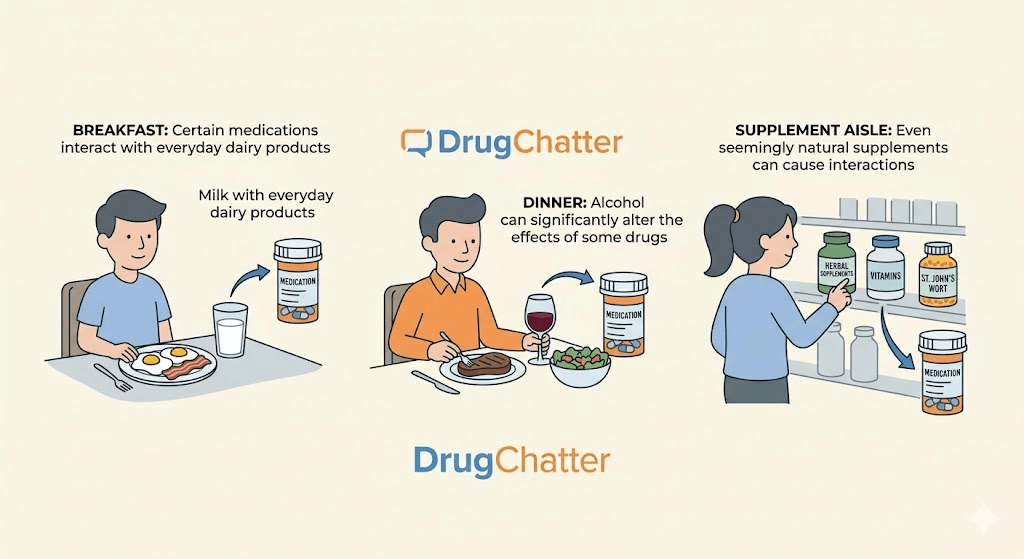
And while clinicians think in terms of CYP enzymes and receptor binding, patients often think in simpler terms: Can I still have grapefruit? Can I still have wine? Can I still take my “natural” supplement that smells like a farmer’s market?
Below is a tour through the most common—and most surprisingly nuanced—food and drug interaction questions pulled from DrugChatter, grouped by theme. Think of it as pharmacology’s version of “don’t shoot the messenger,” except the messenger is your refrigerator.
1. Statins: where dinner meets metabolism
Few drug classes collide with food culture as often as statins, especially Lipitor.
The classic is grapefruit, but the real-world list is broader: dairy, alcohol, garlic, avocado, even how exercise recovery feels.
- Can grapefruit oil reduce Lipitor’s cholesterol benefits?
https://www.drugchatter.com/chat/20584/can-grapefruit-oil-reduce-lipitor’s-cholesterol-benefits - What specific citrus fruits interact with Lipitor?
https://www.drugchatter.com/chat/2258/what-specific-citrus-fruits-interact-with-lipitor - How does dairy affect Lipitor’s potency in most people?
https://www.drugchatter.com/chat/33424/how-does-dairy-affect-lipitor’s-potency-in-most-people - How does garlic interact with Lipitor’s cholesterol lowering ability?
https://www.drugchatter.com/chat/13417/how-does-garlic-interact-with-lipitor’s-cholesterol-lowering-ability - Is avocado consumption safe while taking Lipitor?
https://www.drugchatter.com/chat/35104/is-avocado-consumption-safe-while-taking-lipitor - Can eating avocado reduce Lipitor’s side effects?
https://www.drugchatter.com/chat/53771/can-eating-avocado-reduce-lipitor’s-side-effects - How long after taking Lipitor can I drink wine?
https://www.drugchatter.com/chat/56206/how-long-after-taking-lipitor-can-i-drink-wine - Is there a way to counteract Lipitor’s effect on wine taste?
https://www.drugchatter.com/chat/52390/is-there-a-way-to-counteract-lipitor’s-effect-on-wine-taste - Are there common side effects when restarting Lipitor?
https://www.drugchatter.com/chat/18714/are-there-common-side-effects-when-restarting-lipitor
Even exercise shows up in the discourse:
- How might cholesterol drugs like Lipitor affect exercise performance?
https://www.drugchatter.com/chat/4457/how-might-cholesterol-drugs-like-lipitor-affect-exercise-performance
The underlying theme is not that food “cancels” statins—it’s that metabolism is never isolated. It’s always contextual. Even dinner.
2. Painkillers, blood thinners, and the alcohol problem
Nonsteroidals are where everyday pain relief meets real pharmacologic friction. Advil shows up everywhere in interaction discussions, especially with antidepressants, anticoagulants, and alcohol.
- Can I take Advil with antidepressants?
https://www.drugchatter.com/chat/53988/is-it-safe-to-take-advil-with-antidepressants - What side effects to watch for with Advil + antidepressant use?
https://www.drugchatter.com/chat/20837/what-side-effects-to-watch-for-with-advil-antidepressant-use - Can Advil intensify warfarin’s impact on blood thinning?
https://www.drugchatter.com/chat/44078/can-advil-intensify-warfarin’s-impact-on-blood-thinning - Can I take Aleve with my metoprolol?
https://www.drugchatter.com/chat/21646/can-i-take-aleve-with-my-metoprolol - Are there alternatives to Advil post procedure?
https://www.drugchatter.com/chat/53087/are-there-alternatives-to-advil-post-procedure
Alcohol complicates things further:
- How much alcohol reduction lowers liver disease risk?
https://www.drugchatter.com/chat/20085/how-much-alcohol-reduction-lowers-liver-disease-risk
Here, the pattern is simple but uncomfortable: many “routine” OTC combinations are pharmacologically active, especially when layered on top of chronic therapy.
3. Antidepressants, supplements, and the “natural” illusion
Psychiatric medications are frequently treated as metabolically fragile, but the real issue is often combination effects with supplements and sedatives.
Prozac and Zoloft often appear in comparison questions, while supplements quietly enter via sleep aids and herbal products.
- What is the difference between Prozac and Zoloft?
https://www.drugchatter.com/chat/7739/what-is-the-difference-between-prozac-and-zoloft - Is it safe to take L-theanine with my sleep medication?
https://www.drugchatter.com/chat/19539/is-it-safe-to-take-l-theanine-with-my-sleep-medication - Can I take melatonin with quetiapine?
https://www.drugchatter.com/chat/27588/can-i-take-melatonin-with-quetiapine - Can I take melatonin with norepinephrine?
https://www.drugchatter.com/chat/47106/can-i-take-melatonin-with-norepinephrine
The recurring issue is not danger per se, but unpredictability: sedatives stack, serotonergic agents overlap, and supplements rarely come with interaction data that matches prescription standards.
4. GLP-1 drugs and the new food relationship
With modern metabolic therapies, food is no longer just an interaction variable—it becomes part of the mechanism.
Ozempic, Wegovy, and Mounjaro have created a new category: drugs that change how food is experienced.
- How does Ozempic impact brain signals for food cravings?
https://www.drugchatter.com/chat/15169/how-does-ozempic-impact-brain-signals-for-food-cravings - Does Ozempic change how much food you eat at once?
https://www.drugchatter.com/chat/10921/does-ozempic-change-how-much-food-you-eat-at-once - Can semaglutide cause bloating after small meals?
https://www.drugchatter.com/chat/30058/can-semaglutide-cause-bloating-after-small-meals - How does Ozempic compare to Zepbound?
https://www.drugchatter.com/chat/16700/how-does-ozempic-compare-to-zepbound
These aren’t classic “interaction” questions. They’re behavioral pharmacology questions disguised as dietary ones.
5. Antibiotics, liver stress, and hidden vulnerability
Some drugs don’t interact dramatically with food—but they interact intensely with physiology. Liver function is often the silent mediator.
tigecycline is a good example, where hepatic effects shape monitoring and dosing decisions.
- Does tigecycline use frequently cause liver enzyme elevation?
https://www.drugchatter.com/chat/10812/does-tigecycline-use-frequently-cause-liver-enzyme-elevation - What precautions should be taken with tigecycline due to liver risk?
https://www.drugchatter.com/chat/14105/what-precautions-should-be-taken-with-tigecycline-due-to-liver-risk - How does liver dysfunction affect tigecycline dosing?
https://www.drugchatter.com/chat/10800/how-does-liver-dysfunction-affect-tigecycline-dosing - What factors increase liver test frequency during tigecycline use?
https://www.drugchatter.com/chat/44702/what-factors-increase-liver-test-frequency-during-tigecycline-use
A related class of concerns shows up with older anti-inflammatory drugs:
- Can methotrexate cause liver damage over time?
https://www.drugchatter.com/chat/43238/can-methotrexate-cause-liver-damage-over-time - How does alcohol affect methotrexate’s efficacy?
https://www.drugchatter.com/chat/9075/how-does-alcohol-affect-methotrexate’s-efficacy
The theme is consistent: liver metabolism is the great bottleneck of pharmacology.
6. Supplements and “healthy” foods as unregulated co-therapies
Not all interactions come from obvious drugs. Sometimes they come from foods marketed as health enhancers.
- How do chia seeds EPA levels measure up to Vascepa?
https://www.drugchatter.com/chat/19656/how-do-chia-seeds-epa-levels-measure-up-to-vascepa - Does Vascepa interact negatively with other omega 3 supplements like fish oil?
https://www.drugchatter.com/chat/43732/does-vascepa-interact-negatively-with-other-omega-3-supplements-like-fish-oil
Vascepa sits at the intersection of prescription lipid therapy and over-the-counter nutrition culture—a reminder that “supplement” is not a pharmacologic category, even if it feels like one.
Closing thought
Food–drug interactions are often framed as edge cases. But the evidence in patient questions suggests something else: they are the default background condition of pharmacology.
Medications don’t operate in isolation. They operate in kitchens, restaurants, sleep schedules, supplement stacks, and the occasional grapefruit someone insists is “just half a fruit.”
Or, as the data quietly suggests: the body never reads the label alone.