When a patient types “Is Ozempic safe for long-term use?” into ChatGPT, they get an answer. That answer cites no box warning. It may not mention the FDA’s 2023 review of thyroid C-cell tumor risk. It probably does not distinguish between semaglutide’s approved indications and the flood of off-label prescriptions driving the GLP-1 boom. And if the patient is asking about your drug instead of Novo Nordisk’s, the same risks apply — except now the answer may be wrong about your drug, and you have no idea.
This is the monitoring gap that every pharma brand team, medical affairs group, and regulatory affairs officer should be treating as a live operational problem.
AI search is not a future concern. ChatGPT surpassed 100 million users faster than any consumer application in history. Perplexity now handles millions of medical queries per day. Google’s AI Overviews — the new format that pushes a generated summary above all organic results — appear on a large share of health-related queries. Patients, caregivers, and physicians are getting answers about your drugs from systems that were never trained to be pharmacovigilance tools and are not held to the same accuracy standards as a drug label.
The pharmaceutical companies that build structured AI monitoring programs now will see adverse event signals earlier, catch hallucinated safety claims before they spread, and understand how AI systems compare their drugs against competitors. The companies that wait will be reacting to what’s already happened.
What ‘AI Search’ Actually Means for Drug Brands in 2025
AI search is not one thing. It is at least five distinct surfaces where patients and physicians now get drug information, each with different architectures, training data, and citation behaviors.
ChatGPT vs. Gemini vs. Claude vs. Perplexity: Which LLM Mentions Your Drug Differently?
OpenAI’s ChatGPT, Google’s Gemini, Anthropic’s Claude, and Perplexity all handle drug queries differently — not just in tone, but in the factual content they surface. Claude tends toward hedging with safety caveats. ChatGPT, depending on the version and memory settings, may give more directive answers. Perplexity cites sources aggressively, which means its drug answers are only as accurate as the web pages it pulls. Gemini, embedded into Google Search, carries the weight of Google’s Medical Knowledge Graph but still generates answers that may contradict a drug’s approved label.
For a brand team, the implication is direct: the same question about drug interactions, dosing, or contraindications will yield different answers across these platforms. If your drug’s label information is not well-indexed in the training data or current web corpus, all of these systems may give outdated or incorrect answers — consistently, at scale, to millions of people.
How Google AI Overviews Are Changing Who Controls Drug Information
Google AI Overviews represent a structural shift in health information access. When they appear, they push the FDA label, the drug manufacturer’s site, and peer-reviewed literature below the fold. The AI-generated summary becomes the first thing a patient reads. For high-volume queries — “metformin side effects,” “Humira biosimilar alternatives,” “Jardiance vs. Farxiga” — this means the summary that Google’s model generates is now the primary information surface for most users, not the brand’s website or the FDA drug label page.
Google has stated it grounds AI Overviews in authoritative health sources, but the system is not infallible. A query about a drug with recent label updates may surface the old information if the model’s index has not caught up. For drugs with complex REMS programs or black box warnings, any inaccuracy here is a patient safety issue and potentially a regulatory exposure.
Why Perplexity’s Source Citations Create a New Pharmacovigilance Risk
Perplexity’s model is citation-driven, which sounds more trustworthy. In practice, it means the accuracy of its drug answers depends entirely on which sources it selects. If a popular Reddit thread about a drug’s side effects ranks higher than the FDA’s MedWatch page in Perplexity’s retrieval index, the AI answer will reflect Reddit’s anecdotes — with a citation that makes the answer look authoritative. Patients and physicians may not distinguish between a cited Reddit post and a cited clinical trial.
This dynamic requires pharmaceutical companies to treat their own web presence as a component of AI safety infrastructure. Pages that are well-structured, consistently updated, and semantically clear about indication, dosing, and safety information are more likely to be retrieved and cited correctly by AI systems like Perplexity. Pages that are primarily designed for promotional purposes, loaded with marketing copy and thin on clinical content, are a liability in this environment.
Can AI Hallucinations Trigger FDA Enforcement Action?
This is the question pharmaceutical regulatory affairs teams are only beginning to ask formally — and the answer is not as simple as “no.”
What FDA Warning Letters Say About Drug Misinformation Online
The FDA has issued warning letters for decades over promotional materials that misrepresent drug safety or efficacy. Those letters have targeted print ads, television commercials, websites, and social media posts. The agency’s Office of Prescription Drug Promotion (OPDP) evaluates whether materials are misleading, omit material facts, or make unsupported superiority claims.
AI-generated content exists in a legal grey zone that OPDP has not fully addressed. The FDA does not currently hold drug manufacturers responsible for what ChatGPT or Gemini says about their products — those are third-party outputs. But the grey zone becomes darker in two scenarios. First, if a pharmaceutical company uses AI-generated content in its own promotional materials without adequate human review, that content is subject to OPDP scrutiny like any other promotional piece. Second, if a company is aware that widely-used AI systems are making materially false safety claims about its drug and takes no corrective action, that awareness starts to look like negligence in a civil litigation context, even if regulatory liability is unclear.
The FAERS Problem: Are AI Outputs a Source of Unreported Adverse Events?
The FDA Adverse Event Reporting System (FAERS) depends on voluntary and mandatory reporting from manufacturers, healthcare providers, and patients. The agency knows FAERS captures only a fraction of actual adverse events — estimates of underreporting in the literature range from 90% to 99% of actual events.
AI platforms are now repositories of patient-reported experiences. When a patient tells ChatGPT “I’ve been taking Keytruda and I’ve developed a rash that won’t go away,” that is a potential adverse event signal. The AI answers the patient’s question. No report is filed. The signal is invisible to FAERS and invisible to the manufacturer’s pharmacovigilance team — unless that team is systematically monitoring AI interactions.
The EMA’s Good Pharmacovigilance Practices (GVP) guidelines already require manufacturers to monitor “patient support programs” and “social media” for potential adverse event signals. It is a short interpretive step for regulators to eventually classify AI platform interactions — particularly those involving manufacturer-sponsored chatbots — as subject to the same monitoring requirements. Companies that build that capability now will not be scrambling to retrofit it later.
Off-Label AI Recommendations: When Does a Chatbot Create a Liability?
Off-label prescribing is legal. Off-label promotion by manufacturers is not. The question of where AI falls in that distinction is genuinely unresolved.
If a patient asks ChatGPT “Can I take tirzepatide for weight loss if my doctor hasn’t prescribed it?” and the AI provides a detailed answer about dosing and expected weight loss outcomes — information derived from the clinical literature on Mounjaro and Zepbound — that answer exists independently of Eli Lilly’s promotional activities. But if a pharmaceutical company’s own AI-powered patient engagement tool suggests off-label uses, or if a company’s sponsored content is being retrieved by AI systems and used to generate off-label suggestions, the line between independent AI output and manufacturer-attributable promotion starts to blur.
The FDA has not issued final guidance on AI in drug promotion as of mid-2025, but the agency has been actively soliciting public comment on AI in drug development and promotion since 2023. Regulatory affairs teams would be prudent to treat AI-generated drug information — especially information retrieved from their own digital assets — as promotional material subject to existing rules.
How Often Do AI Systems Get Drug Safety Information Wrong?
The honest answer is: often enough to matter, and with enough consistency to create systematic risk.
Real Examples of AI Drug Hallucinations That Reached Patients
In 2023, researchers at the University of California San Francisco tested ChatGPT’s ability to answer common drug interaction questions and found the model gave incorrect answers on a meaningful percentage of queries — particularly for combinations involving newer medications with complex interaction profiles. The study, published in JAMA Internal Medicine, found that AI systems performed worse on interaction queries involving drugs approved after the model’s training cutoff, a predictable structural limitation that has not been resolved by subsequent model versions.
A separate analysis published in BMJ Quality and Safety tested multiple LLMs on drug dosing queries and found that errors were not random — they clustered around renally-adjusted dosing, pediatric dosing, and pregnancy safety categories. These are precisely the highest-risk categories for patient harm.
The pattern is not that AI systems are unreliable in general. It is that their errors concentrate in the highest-stakes clinical situations — recent approvals, complex patient populations, newly identified safety signals — where accurate information matters most.
Which Drug Categories Have the Highest AI Hallucination Rates?
Based on published research and structural features of how LLMs are trained, four drug categories carry elevated hallucination risk:
Drugs approved within 18-24 months of a model’s training cutoff. Training data is thin for new approvals, and models often conflate a new drug’s profile with older drugs in the same class.
Drugs with REMS programs. The specific prescribing, dispensing, and monitoring requirements embedded in Risk Evaluation and Mitigation Strategies are precisely the kind of procedural, frequently updated information that LLMs handle poorly.
Biosimilars. The distinction between a reference biologic and its biosimilars — including interchangeability designations and any differences in approved indications — is consistently poorly handled by current AI systems.
Combination therapies in oncology. Dosing regimens, sequencing decisions, and toxicity monitoring protocols for combination chemotherapy and immunotherapy regimens are highly context-dependent and poorly represented in AI outputs.
Do LLMs Recommend Generic Drugs More Often Than Branded Drugs?
There is emerging evidence that AI systems display a systematic bias toward generics in therapeutic categories where generics are available — not because of any intentional design choice, but because the training corpus reflects broader consumer and payer discourse, which heavily favors generics on cost grounds. Patient forums, payer websites, consumer health publications, and physician education materials all skew toward generic recommendation when a generic is available. AI models trained on that corpus reflect that skew.
For pharmaceutical companies with branded drugs facing generic competition, this means AI systems may be accelerating generic substitution at scale — not through any individual physician’s prescribing decision, but through millions of patient conversations about which drug to ask their doctor about, which drug their insurance will cover, and whether the generic is “the same” as the branded product. Monitoring how specific AI systems handle branded-vs-generic queries for your therapeutic area is now a legitimate competitive intelligence function.
Tracking AI Share of Voice: Ozempic, Wegovy, and the GLP-1 Case Study
The GLP-1 agonist category is the clearest illustration of how AI search is reshaping pharmaceutical brand dynamics.
How Often Claude Mentions Ozempic vs. Wegovy — and Why It Matters
Ozempic (semaglutide for type 2 diabetes) and Wegovy (semaglutide for chronic weight management) are the same molecule at different doses with different FDA approvals. But in AI search outputs, they are not treated equivalently. Ozempic has dramatically more training data — it preceded Wegovy’s approval, generated more media coverage, and became a cultural phenomenon in a way Wegovy has not. In practice, this means that when patients ask AI systems about semaglutide for weight loss, many systems default to Ozempic-branded language even when describing weight management use — potentially reinforcing off-label use of the diabetes-indicated product over the weight-management-approved Wegovy.
For Novo Nordisk, this is a live brand management challenge. The company has invested significantly in building Wegovy’s distinct identity, but AI systems are systematically undermining that effort by treating Ozempic as the default semaglutide reference. Monitoring this dynamic — which LLMs use which brand names, in which query contexts, with what frequency — is an AI share-of-voice measurement problem that did not exist three years ago.
Tirzepatide, Mounjaro, and Zepbound: How Eli Lilly Is Navigating AI Brand Confusion
Eli Lilly faces an analogous challenge with tirzepatide, which is marketed as Mounjaro for type 2 diabetes and Zepbound for chronic weight management. The Zepbound approval came in November 2023, relatively late in the training window for current large language models. As a result, AI systems frequently conflate Mounjaro and Zepbound, attribute Zepbound’s weight loss efficacy data to Mounjaro’s label, or fail to distinguish between the two approved indications.
In patient conversations, this confusion has practical consequences. Patients asking about Zepbound coverage may be told by AI systems to check Mounjaro’s coverage policies. Physicians asking about Zepbound’s titration schedule may get Mounjaro’s schedule, which differs at higher doses. These are not catastrophic errors, but they are errors at scale — and they create documented patient and physician confusion that is attributable, at least in part, to how AI systems handle Eli Lilly’s brand portfolio.
Humira, Adalimumab Biosimilars, and What AI Gets Wrong About Interchangeability
The adalimumab biosimilar market — with more than ten biosimilars now approved in the United States — is a test case for how poorly AI systems handle biosimilar complexity. FDA interchangeability designations, which allow pharmacists to substitute a biosimilar without contacting the prescriber, apply only to specific products and are not universal across all adalimumab biosimilars. Formulary differences between payers add another layer.
When patients or physicians ask AI systems about Humira alternatives, the answers they receive frequently conflate interchangeable and non-interchangeable biosimilars, misrepresent which products have been designated interchangeable, and fail to note that formulary coverage varies by plan. AbbVie, which markets Humira, and the biosimilar manufacturers all have a stake in ensuring that AI systems accurately represent the regulatory status and coverage landscape for adalimumab — but none of them currently has systematic visibility into what AI systems are saying.
What Pharma Brand Teams Can Learn From Reddit and Patient Forums in AI Search
Reddit has become an outsized source for AI training data and AI retrieval. When Perplexity, ChatGPT with Browse, or Google’s AI Overviews retrieve current web content to supplement their training, Reddit threads frequently appear in the retrieved corpus. This matters for pharmaceutical companies because Reddit’s drug-related communities — r/diabetes, r/ChronicPain, r/MultipleSclerosis, r/Fibromyalgia — are active, detailed, and often highly critical of branded drugs.
How Patient Forum Content Shapes AI Drug Answers
A patient asking ChatGPT about a specific drug’s side effect profile may receive an answer that reflects the experiences shared on r/ChronicPain more heavily than the drug’s FDA label, because Reddit content is recent, indexed, and highly relevant in semantic search. The AI system is not choosing Reddit over the FDA — it is retrieving semantically relevant content, and patient forums generate enormous volumes of semantically relevant content about drug experiences.
For pharmaceutical companies, this creates a monitoring imperative: patient forum content that shapes AI answers is effectively influencing prescribing conversations and adherence decisions at scale. The company that knows its drug is generating “fatigue” and “brain fog” complaints on Reddit in Q1 — before those signals appear in FAERS, before they trend on social media — has a meaningful early warning advantage. That same company can structure its own web presence to ensure that accurate safety and management information is available for AI systems to retrieve.
How Patients Ask About Drug Interactions in AI Search — and What They’re Really Asking
Patient queries to AI systems about drug interactions follow predictable patterns that differ significantly from how those questions appear in clinical literature. Patients do not ask “What is the pharmacokinetic basis for the interaction between metformin and contrast dye?” They ask “Can I take my diabetes medicine before my MRI?” or “My doctor gave me a new antibiotic — can I still take my blood pressure pill?”
Understanding how patients phrase drug queries in natural language — and what AI systems tell them in response — gives pharmaceutical medical affairs teams actionable intelligence about patient knowledge gaps, misunderstandings about their products, and the specific concerns driving adherence failures. This is voice-of-customer research conducted at scale, in real time, without a patient survey budget.
“Health-related queries account for approximately 7% of all Google searches — roughly one billion queries per day worldwide — and AI-generated health answers now appear above organic results for a substantial share of those queries.” — Rock Health Digital Health Consumer Adoption Survey, 2024
How Pharmaceutical Companies Monitor AI Mentions — What Existing Programs Look Like
Most pharmaceutical companies have well-developed social listening programs. They monitor Twitter/X, Facebook, Instagram, Reddit, and patient advocacy forums for brand mentions, adverse event signals, and sentiment data. What very few of them have is a systematic program for monitoring AI-generated content about their drugs.
Why Traditional Social Listening Tools Miss AI-Generated Drug Mentions
Social listening tools like Brandwatch, Sprinklr, and Talkwalker are designed to index and analyze public posts on social platforms. They crawl public URLs, index text, and run sentiment analysis. They are not built to systematically query AI systems, capture AI-generated answers, analyze the sources those answers cite, or compare how different AI systems handle the same drug query.
AI monitoring requires a fundamentally different approach: structured querying of AI systems with standardized prompts, systematic capture and storage of responses, comparison across models and over time, and analysis frameworks designed for AI output rather than social post volume. The companies building this capability are doing it with custom tooling, purpose-built platforms like DrugChatter, or hybrid approaches that combine AI querying tools with existing pharmacovigilance infrastructure.
What a Pharmaceutical AI Monitoring Program Actually Measures
A structured pharmaceutical AI monitoring program measures at least four things:
Answer accuracy: Does the AI system’s response match the drug’s approved label, including indications, contraindications, warnings, and dosing? Where does it deviate?
Share of voice: How frequently is your drug mentioned relative to competitors in response to category-level queries? Does frequency correlate with indication, mechanism, or approval recency?
Source attribution: When AI systems cite sources for drug information, which sources do they cite? Are those sources the FDA label, peer-reviewed literature, manufacturer websites, or patient forums?
Sentiment and framing: How does the AI system characterize your drug’s benefit-risk profile? Is the language consistent with your drug’s positioning, or does it systematically favor competitor framing?
Can AI Outputs Be Used for Pharmacovigilance Signal Detection?
The answer is yes, with significant caveats.
AI system outputs are not primary patient reports — they are generated text, not patient experiences. But they are increasingly a reflection of what patient communities are discussing, because those communities heavily influence AI training data and retrieved web content. A consistent pattern of AI systems mentioning a specific adverse event in response to queries about your drug — even if the event is not in your label — is a signal worth investigating.
The pharmacovigilance value is greatest when AI monitoring is combined with other signal sources: FAERS data, patient forum monitoring, EHR analytics, and incoming spontaneous reports. AI monitoring adds a real-time, high-volume signal layer that traditional pharmacovigilance infrastructure is not designed to capture. The companies that integrate AI monitoring into their signal detection workflows will be better positioned when regulators eventually — and they will — require manufacturers to demonstrate that their safety surveillance covers AI-generated information environments.
AI Search Optimization for Pharmaceutical Brands: What Actually Works
Search engine optimization has spent thirty years adapting to how Google’s algorithm ranks web pages. AI search optimization is a newer discipline with different rules — but the core principle is similar: make your information easy for AI systems to retrieve, parse, and cite accurately.
Why Your Drug’s Website May Be Undermining Its AI Search Presence
Most pharmaceutical brand websites are built for two audiences: patients seeking general disease and treatment information, and healthcare providers seeking clinical data. They are built with compliance requirements in mind — every claim is reviewed, every safety communication is documented, every page is approved by medical, legal, and regulatory reviewers. What they are rarely built for is AI retrievability.
AI retrieval systems favor content that is clearly structured, semantically unambiguous, and comprehensive without being promotional. A drug’s FDA-approved prescribing information, posted as an unstructured PDF, is difficult for AI systems to parse accurately. A structured, HTML-formatted version of the same information — with clear headers for indications, dosing, contraindications, warnings, and adverse reactions — is far more likely to be retrieved accurately and cited correctly.
The investment required to restructure pharmaceutical web content for AI retrievability is modest compared to the brand risk of having AI systems consistently misrepresent your drug’s safety profile. This is a content infrastructure problem that marketing, medical affairs, and IT teams can solve together.
How to Structure Drug Safety Content for AI Retrieval
Four principles apply across AI systems:
Use semantic HTML with clear schema markup. MedicalWebPage, Drug, and MedicalCondition schema types help AI retrieval systems understand the context and authority of your content.
Publish FAQ content in natural language. AI systems are trained on conversational text. A FAQ page that answers “What should I do if I miss a dose of [drug]?” in plain language is far more likely to be retrieved for that query than a clinical monograph section on missed dose management.
Update content immediately after label changes. AI systems that retrieve web content for their answers will surface outdated safety information if your web content lags label updates. Automated workflows that trigger content updates within 24-48 hours of label changes are now a safety requirement, not just a best practice.
Build topical authority across the full indication spectrum. AI retrieval systems weight topical authority. A drug website that comprehensively covers its indication, related conditions, patient populations, and treatment alternatives builds the authority signals that make it more likely to be retrieved over a patient forum or news article.
How Physician and Patient Queries About Your Drug Differ in AI Search
Physicians asking AI systems about drugs tend to phrase queries in clinical terminology: mechanism of action, drug-drug interactions, pharmacokinetics, evidence grade, guideline recommendations. Patients phrase queries in experiential terms: “What does this medication feel like?” “Will this drug make me tired?” “Can I drink alcohol while taking this?”
Both query types require different content structures to answer accurately, and both are currently underserved by most pharmaceutical brand websites. Building content that answers both query types — and is structured for AI retrieval — doubles the surface area for accurate AI citations and reduces the probability that AI systems will rely on patient forums or Wikipedia for your drug’s basic information.
Competitive Intelligence Through AI: What LLM Monitoring Reveals About Your Market
AI monitoring is not just a defensive tool. It is a competitive intelligence function that generates data pharmaceutical companies currently have no other way to collect.
Which Drugs Are Most Frequently Mentioned by AI in Your Therapeutic Area?
Running structured queries across ChatGPT, Gemini, Claude, and Perplexity for category-level therapeutic area questions — “What are the best medications for rheumatoid arthritis?” “What drugs are used for HER2-positive breast cancer?” “What are the treatment options for treatment-resistant depression?” — produces a map of AI share of voice that reflects how these systems have internalized clinical and commercial information about your market.
That map reveals things that traditional market research cannot: whether a competitor’s drug is systematically over-recommended relative to its evidence base; whether your drug’s approval in a second indication is being reflected in AI recommendations; whether a generic drug is being recommended over branded alternatives in ways that correlate with payer pressure or patient forum sentiment. These are actionable intelligence signals.
How to Track Generic Substitution Recommendations Across LLMs
For brands with patent cliffs approaching, or brands already facing generic competition, AI monitoring can quantify something that traditional market research estimates indirectly: the rate at which AI systems actively recommend generic substitution. This matters because patients who interact with AI systems before their physician appointment are increasingly arriving with specific questions or requests shaped by what the AI told them — including questions about whether they should ask for the generic version of their branded drug.
Systematic tracking of how AI systems handle branded vs. generic queries for your drug — which they recommend first, whether they note clinical equivalence, how they describe price differences — gives brand teams concrete data about an emerging source of branded-to-generic shift that no IMS or IQVIA dataset currently captures.
What AI Citation Sources Tell You About Your Competitors’ Digital Strategy
When AI systems cite specific sources for drug information, those citations are a competitive intelligence window. If a competitor’s drug is consistently cited with references to recent peer-reviewed publications while your drug is cited from its FDA label page or Wikipedia, that gap reflects a difference in digital content strategy — specifically, in how well the competitor has built topical authority across the AI retrieval ecosystem. The gap is closable, but you need to see it first.
Systematic analysis of AI citation sources for competitor drugs — what sources AI systems retrieve, how recent those sources are, whether clinical trial data or promotional content dominates the citation profile — gives brand teams a detailed picture of where their competitors are investing in digital authority and where they are not.
Building an AI Search Monitoring Program: Practical Steps for Pharma Teams
The operational question for most pharmaceutical companies is not whether to build an AI monitoring program, but how to build one that integrates with existing pharmacovigilance, brand management, and regulatory functions without requiring a complete organizational redesign.
Step One: Define the Query Corpus for Your Drug Portfolio
Start with a structured set of 50-100 standardized queries for each drug in your portfolio. Include queries that map to:
Core approved indications and patient populations
Key safety concerns and black box warnings
Common patient questions about dosing, side effects, and adherence
Physician-facing clinical queries about mechanism, evidence, and guideline status
Competitor comparison queries
Generic substitution queries
Run these queries across ChatGPT (GPT-4o), Gemini Advanced, Claude, and Perplexity on a weekly basis. Capture the full response text, not just summary metrics. Store responses in a structured database that allows longitudinal comparison as AI systems are updated and as your drug’s label changes.
Step Two: Build a Cross-Functional Review Process
AI monitoring outputs need to be reviewed by people with different expertise. Medical affairs reviewers assess clinical accuracy against the current label. Regulatory affairs reviewers assess whether AI outputs could constitute promotional concern — either because they misrepresent your drug or because they could be attributed to your digital content in ways that create OPDP exposure. Brand teams assess share of voice and competitive positioning. Pharmacovigilance reviewers flag any AI-generated content that suggests new adverse event signals.
This cross-functional review does not need to happen in real-time. A weekly structured review of flagged AI outputs — those that differ significantly from label information, show unexpected competitive positioning, or surface new adverse event framing — is manageable for most organizations and actionable in ways that passive social listening rarely is.
Step Three: Integrate AI Signals Into Pharmacovigilance Workflows
AI-generated drug content should not be treated as a distinct signal source that sits outside the pharmacovigilance system. It should be integrated as one input among many — alongside FAERS data, EHR analytics, patient registry data, and spontaneous reports. The integration question is practical: when an AI monitoring system flags a consistent pattern of a specific adverse event being mentioned in AI responses about your drug, what is the workflow for evaluating whether that pattern warrants a signal assessment?
Companies that have built this workflow will be ahead of regulatory expectations. Companies that treat AI monitoring as a brand management exercise, separate from pharmacovigilance, will need to retrofit the integration later — likely under pressure from regulators or following an adverse event that the AI ecosystem had been signaling for months.
Step Four: Measure and Report AI Share of Voice as a Business Metric
AI share of voice should be a reported metric alongside traditional share of voice measures. Leadership teams that understand how AI systems position their drugs relative to competitors — and how that positioning is changing as AI systems are updated — will make better decisions about digital content investment, label language optimization, and medical communications strategy.
Platforms built specifically for pharmaceutical AI monitoring, such as DrugChatter’s monitoring tools, offer structured querying, longitudinal tracking, and competitive benchmarking capabilities that allow brand teams to operationalize AI share of voice measurement without building custom infrastructure from scratch.
The Regulatory Horizon: What FDA and EMA Are Watching
Regulatory agencies are not passive observers of AI’s impact on drug information. Both the FDA and EMA have active workstreams on AI in drug development, promotion, and pharmacovigilance — and the direction of travel is clear.
FDA’s AI Action Plan and What It Means for Drug Promotion Oversight
The FDA published its AI Action Plan in early 2024, outlining priorities that include AI-assisted drug review, AI in manufacturing quality, and — critically — AI in drug information and promotion. The agency has explicitly acknowledged that AI-generated content in drug promotion raises questions about review processes, accuracy standards, and disclosure requirements that existing guidance does not fully address.
The FDA’s OPDP has not yet issued specific guidance on AI-generated promotional content, but the agency has been soliciting public comment through multiple docket processes. The regulatory trajectory points toward requirements for human review of AI-generated promotional content, disclosure requirements for AI-generated patient communications, and potentially, expanded social media monitoring requirements that explicitly include AI platforms.
EMA’s Stance on AI in Pharmacovigilance
The EMA has moved more quickly than FDA on AI in pharmacovigilance. The agency’s Good Pharmacovigilance Practices (GVP) Module VI, which covers the management and reporting of adverse reaction reports from sources other than healthcare professionals and patients, already creates a framework that can be interpreted to include AI-mediated adverse event signals.
The EMA’s Innovation Task Force has been examining AI tools for signal detection since 2022, and the agency’s position — as articulated in multiple guidance documents — is that manufacturers bear responsibility for adverse event signal detection across all information environments where patients discuss their drugs. That position has not yet been explicitly applied to AI platforms, but the interpretive foundation is in place.
What the Vioxx Litigation Teaches Us About Early Warning Systems
The Merck Vioxx litigation remains the most instructive precedent for pharmaceutical companies thinking about what they knew and when they knew it regarding drug safety signals. Merck faced liability in part because plaintiffs argued the company had access to adverse event signals — through clinical trial data, FAERS reports, and published literature — that it did not act on promptly enough.
The legal standard is not whether the company acted on every signal, but whether it had reasonable systems to detect signals and respond appropriately. In the AI era, a company that has no systematic monitoring of how AI systems represent its drug’s safety profile — particularly when that monitoring is technically feasible and commercially available — may face a similar argument: you could have known, you should have known, and you chose not to build the system that would have told you.
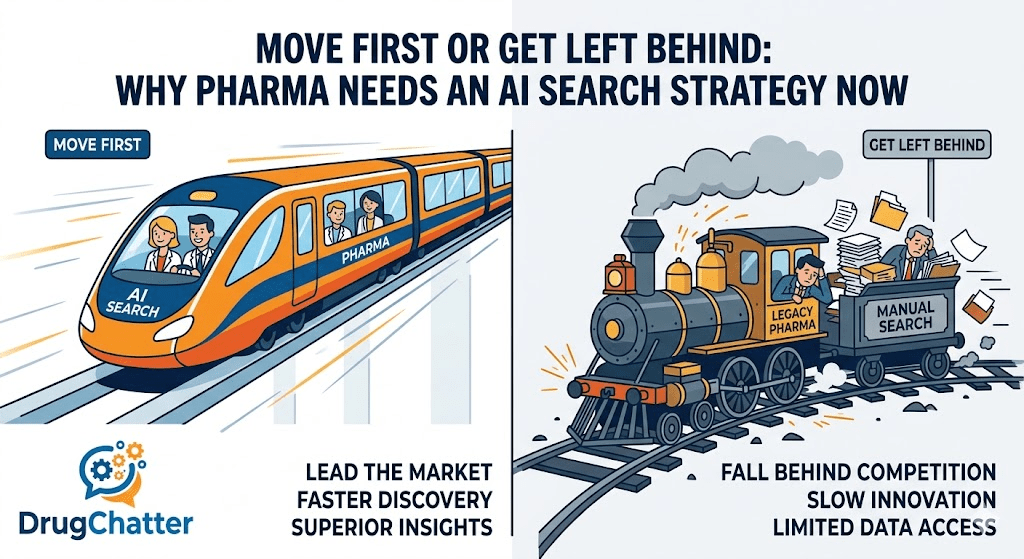
The First-Mover Advantage in Pharmaceutical AI Strategy Is Real
The pharmaceutical industry’s instinct is to wait for regulatory clarity before investing in new compliance infrastructure. That instinct has served the industry reasonably well in areas where regulatory requirements are the primary driver of investment. AI monitoring is different.
The companies that build AI monitoring programs now are not just building compliance infrastructure. They are building competitive intelligence capabilities, early warning systems for patient safety signals, and brand management tools that generate direct commercial value — independent of any regulatory requirement. The first-mover advantage in this space is substantial, and it compounds over time as longitudinal AI monitoring data accumulates.
A pharmaceutical company with two years of structured AI monitoring data on its drug portfolio has visibility into how AI share of voice has shifted as competitors launched, as generic entry occurred, and as AI systems were updated. It can demonstrate to regulators that its pharmacovigilance system is comprehensive and forward-looking. It can show investors and boards that it has systematic intelligence on how AI is reshaping patient and physician decision-making in its therapeutic areas. It can build the content and digital infrastructure that makes its drugs more accurately represented in AI systems — a direct brand protection investment.
The company that waits for competitors to build these capabilities — or waits for an FDA warning letter to catalyze investment — will be building under pressure, without the longitudinal data that makes AI monitoring genuinely useful, and will be paying a premium for commercial AI monitoring tools that the first movers helped define and shape.
The conversation happening inside every major pharmaceutical company’s digital health, medical affairs, and regulatory teams right now is the same conversation. The companies that move from conversation to program in the next 12 months will have an advantage that is difficult to replicate. The window for that advantage is open, but it is not permanent.
Key Takeaways
AI search platforms — ChatGPT, Gemini, Claude, Perplexity, and Google AI Overviews — now handle millions of drug-related patient and physician queries daily. The information they provide is often inaccurate, especially for recently approved drugs, biosimilars, and complex REMS products.
FDA and EMA regulatory frameworks are evolving to address AI in drug promotion and pharmacovigilance. Companies that build monitoring programs now will be ahead of formal requirements, not retrofitting compliance under pressure.
AI monitoring generates three distinct value streams: brand protection (catching hallucinated safety claims), competitive intelligence (tracking AI share of voice), and pharmacovigilance signal detection (identifying emerging adverse event patterns before they appear in FAERS).
Traditional social listening tools are not designed for AI monitoring. Purpose-built platforms and structured querying programs are required to systematically capture, store, and analyze AI-generated drug content across multiple LLMs.
Pharmaceutical web content infrastructure — brand websites, prescribing information pages, disease education content — needs to be restructured for AI retrievability. Pages that are not semantically clear, structurally organized, and regularly updated will be superseded by patient forums and news articles as AI citation sources.
The first-mover advantage in pharmaceutical AI monitoring is real and compounds with time. Longitudinal AI monitoring data is a strategic asset. The companies building that data asset now will have intelligence and compliance advantages that late movers cannot easily replicate.
FAQ: Pharmaceutical AI Search Monitoring
What is pharmaceutical AI search monitoring?
Pharmaceutical AI search monitoring is the systematic practice of querying AI systems — including ChatGPT, Gemini, Claude, and Perplexity — with standardized drug-related prompts, capturing and storing the AI-generated responses, and analyzing those responses for clinical accuracy, competitive share of voice, adverse event signals, and regulatory compliance risk. It gives drug manufacturers structured visibility into how AI systems represent their products to patients and physicians at scale.
Can AI hallucinations about drug safety create regulatory liability for pharmaceutical companies?
Direct regulatory liability for third-party AI outputs is currently limited. The FDA’s OPDP does not hold manufacturers responsible for what independent AI systems say about their drugs. Liability exposure increases in two scenarios: when pharmaceutical companies use AI-generated content in their own promotional materials without adequate review, and when civil litigation argues that a manufacturer was aware of systematic AI misinformation about its drug’s safety and took no corrective action. The legal framework is evolving, and building a monitoring program now is a form of proactive risk management.
How do AI systems decide which drugs to recommend when answering patient treatment questions?
AI systems reflect the statistical patterns in their training data. Drugs with more published literature, more media coverage, more patient forum discussion, and more recent web content tend to be mentioned more frequently in AI responses to treatment questions. This means older, well-documented drugs — particularly those with extensive clinical trial publication histories — tend to outperform newer drugs in AI share of voice, regardless of comparative clinical efficacy. Pharmaceutical companies can influence this dynamic by building comprehensive, well-structured web content that AI retrieval systems can find and cite.
What is AI share of voice, and how is it measured for pharmaceutical brands?
AI share of voice measures how frequently a pharmaceutical brand is mentioned — and how favorably — in AI-generated responses to category-level treatment queries. It is measured by running standardized queries across multiple AI platforms, counting brand mentions per response, analyzing the context and framing of each mention, and comparing those metrics against competitor brands over time. Platforms like DrugChatter offer pharmaceutical-specific AI share of voice tracking with longitudinal benchmarking and competitive comparison capabilities.
Are AI platforms required to comply with FDA drug promotion regulations?
As of mid-2025, the FDA has not issued final guidance establishing that general-purpose AI platforms like ChatGPT or Gemini are subject to drug promotion regulations when they respond to user drug queries. Those platforms are not drug manufacturers and do not promote drugs in a commercial sense. The regulatory picture changes for pharmaceutical manufacturer-sponsored AI tools — chatbots, patient support applications, and AI-powered healthcare provider portals — which are subject to OPDP oversight in the same way that other promotional materials are. The FDA has signaled through public comment processes that it is actively developing guidance for AI in drug promotion, and requirements for both AI tools and AI monitoring programs are expected to evolve over the next regulatory cycle.
This article was produced for informational purposes. It reflects publicly available regulatory information and published research. Nothing in this article constitutes legal, regulatory, or medical advice.