When a physician in Ohio types “best GLP-1 for weight loss” into Perplexity and receives a two-paragraph synthesis with no branded search results, no ten blue links, and no sponsored placements, the companies whose drugs are not mentioned in that answer have already lost. The physician will not scroll further. The query is resolved. The patient, if referred, will get whichever drug Perplexity decided to surface that morning.
This is not a hypothetical. It is the operational reality of AI-mediated information in 2026. And the pharmaceutical industry—an industry that spends more on regulatory compliance per dollar of revenue than almost any other sector—has been startlingly slow to treat AI-generated drug narratives as a category that demands the same rigor it applies to a television commercial or a journal ad.
The companies that get ahead of this will have a structural advantage. The ones that do not will find themselves correcting the record after their drugs have been hallucinated into obscurity, linked to false contraindications, or quietly displaced by a generic in every LLM’s default recommendation.
Why AI-Generated Drug Information Is Now a First-Line Information Source
The shift from search engines to AI assistants happened faster than the pharmaceutical industry’s regulatory and brand teams could adapt. Google’s AI Overviews, which appear above organic results for a significant share of health-related queries, draw on synthesized content rather than ranking individual pages. Perplexity, ChatGPT, and Claude handle medical questions daily for hundreds of millions of users who treat the output as informed guidance rather than an AI estimate.
Patient behavior data from several recent surveys is consistent: a large portion of patients who use AI tools for health questions report that the AI output influenced their conversation with their doctor. That influence travels upstream into prescribing decisions. Brand teams at pharmaceutical companies built their measurement frameworks for a world of paid search, DTC broadcast, and professional detailing. None of those frameworks captures what ChatGPT says about a drug’s renal dosing when a user asks a question the FDA never anticipated an AI would answer.
How Patients Ask About Drugs in AI Search—and Why the Phrasing Changes Everything
Patients do not query AI systems the way they query Google. They ask conversational, contextual questions: “I have Type 2 diabetes and my A1C is 8.2, my doctor mentioned Ozempic but I’m worried about the thyroid cancer stuff I read—what should I know?” That query, posed to four major LLMs, produces four different answers with different risk framings, different drug comparisons, and different amounts of off-label content. One of those four answers may be accurate by FDA-approved labeling standards. The others may not be. None of the companies whose drugs appear in those answers are automatically notified.
The phrasing of the query also governs whether a branded or generic drug name appears. Ask about “semaglutide” and you get pharmacology and mechanism. Ask about “Ozempic” and you get brand-specific information that may or may not reflect the drug’s current approved label, depending on when the model’s training data was last updated. Ask “what’s the cheapest option for weight loss injections” and you may get a response that names compounded semaglutide from telehealth platforms—a category with active FDA enforcement actions that a brand team should know their drug is being compared against.
Which Conditions and Drug Classes Are Most Exposed to AI Narrative Risk
Not every therapeutic area faces equal exposure. The risk concentrates where patient self-education is high, where treatment options are numerous, where there is active generic or biosimilar competition, and where social media discussions are dense enough to contaminate LLM training data with anecdotal or misleading claims.
By those criteria, the highest-exposure categories in 2026 include:
- GLP-1 agonists (semaglutide, tirzepatide, dulaglutide)
- Oncology (checkpoint inhibitors, CDK4/6 inhibitors, KRAS-targeted agents)
- ADHD and mental health medications (amphetamine salts, bupropion, SSRIs)
- Biosimilars and their reference biologics (adalimumab, etanercept, bevacizumab)
- Anticoagulants (apixaban, rivaroxaban, warfarin)
In oncology, the stakes are particularly acute. A patient asking an AI about pembrolizumab (Keytruda) versus nivolumab (Opdivo) for a specific tumor type may receive an answer that does not reflect the most current approved indications, that conflates trial data across tumor types, or that misrepresents response rates. Merck and Bristol Myers Squibb both run substantial medical information programs. Neither has publicly disclosed a systematic program for monitoring what AI systems say about their drugs in real time.
Can AI Hallucinations Trigger FDA Risk? The Regulatory Exposure Pharma Has Not Priced In
The legal and regulatory exposure from AI drug hallucinations sits in an ambiguous zone that pharma legal teams should be mapping now rather than after the first enforcement action lands.
The FDA’s current framework for drug misinformation focuses on the manufacturer as the responsible party for promotional materials. Third-party AI-generated content is not promotional material in the traditional sense, and the FDA has not issued guidance specifically addressing LLM outputs as a category requiring manufacturer response. But the agency has been clear in several recent communications that it is watching how AI is used in healthcare broadly, and that existing pharmacovigilance obligations do not have a carve-out for AI-generated adverse event signals.
What FDA Warning Letters Reveal About Information Control Obligations
A review of FDA warning letters over the past five years shows a consistent enforcement theme: companies are held responsible for the information environment surrounding their products even when they did not directly create the offending content. Third-party websites, reprints, and speaker programs have all generated warning letters for companies whose products were discussed in ways that contradicted approved labeling.
The doctrinal logic transfers to AI. If a pharmaceutical company’s medical affairs team discovers that ChatGPT consistently describes their drug as having a black box warning it does not have, or conflates it with a competitor that does have that warning, the question of whether the company has an obligation to act is not clearly answered by existing guidance. But the reputational and competitive damage begins immediately regardless of regulatory posture.
Off-Label AI Discussions and What They Mean for Your Compliance Team
Off-label discussions present a sharper regulatory edge. LLMs are trained on text that includes medical journal articles, preprint servers, patient forums, Reddit, clinical trial registries, and healthcare news. That corpus contains abundant off-label discussion: physicians discussing their clinical experience, researchers reporting early data, patients sharing outcomes. When a model synthesizes an answer about a drug, it draws on all of that, which means off-label use information routinely appears in AI responses about drugs with narrow approved indications.
For brand teams, this creates a perverse dynamic. A company’s drug may be receiving more favorable AI coverage for off-label uses than for its approved indication—because the off-label use generated more clinical discussion and patient forum activity that made it into training data. Monitoring this is not optional if you have a regulatory affairs team that treats label compliance seriously.
“Adverse event data from non-traditional digital sources, including AI-generated content, is increasingly part of the pharmacovigilance signal landscape. Companies that build structured intake for these signals before they are required to will have a compliance advantage when the regulatory framework catches up.”— IQVIA Institute for Human Data Science, Digital Pharmacovigilance Signal Detection Report, 2025
How Often Do LLMs Mention Ozempic vs. Wegovy—and Does the Answer Change by Platform?
The Ozempic versus Wegovy distinction is instructive because it illustrates how brand-level AI share-of-voice diverges from market share in ways that brand teams cannot predict without systematic measurement.
Both drugs contain semaglutide. Ozempic is approved for Type 2 diabetes; Wegovy is approved for chronic weight management. Novo Nordisk runs two separate marketing programs. But in AI outputs, the two drugs are frequently conflated, with Ozempic appearing in weight loss answers (where Wegovy should appear by label) and Wegovy appearing in diabetes discussions (where Ozempic should appear). This is not random—it reflects the fact that patient and media discussion of semaglutide for weight loss predominantly used the name “Ozempic” even when referring to the weight management indication, and that training data encoded this imprecision.
Tracking AI Share-of-Voice Across ChatGPT, Gemini, and Claude
Share-of-voice measurement in AI systems requires a different methodology than traditional search share-of-voice. In search, you measure ranking positions and click-through rates. In AI, you measure appearance frequency, mention context (positive, negative, neutral, comparative), placement within the answer (first-mentioned versus mentioned as alternative), and the framing language used around the mention.
A systematic program for tracking AI share-of-voice across platforms would run a structured query set—covering disease-state queries, symptom queries, comparison queries, cost queries, and physician-perspective queries—across ChatGPT, Gemini, Claude, and Perplexity at regular intervals, capturing outputs and coding them against a rubric. The rubric would score mention frequency, label accuracy, competitor framing, safety claim accuracy, and source citation behavior.
DrugChatter, one of the purpose-built vendors in this space, runs exactly this kind of automated query-and-capture workflow, with output fed into dashboards that brand and regulatory affairs teams use to track share-of-voice trends over time. DrugPatentWatch, which has historically focused on patent expiry and generic entry intelligence, has added AI-mention tracking to its platform as an adjacent intelligence layer.
Do LLMs Recommend Generic Drugs More Often Than Branded Drugs?
The short answer is: increasingly yes, in cost-sensitive and access-sensitive query contexts. And the degree varies by model.
Models that have been more recently updated—or that integrate live search results—are more likely to reflect the current genericized landscape for older drug classes. For drugs with recent patent expiry and significant generic penetration, LLMs trained on recent data will surface the generic name because the bulk of accessible, high-frequency content (prescribing databases, formulary tools, pharmacy content) uses the generic name.
For drugs still on patent, models tend to use branded names when the brand has achieved high cultural penetration—Ozempic, Humira, Eliquis—but may use generic names when queries come from what the model infers is a clinical or technical context. “What do I prescribe for AF stroke prevention” gets a different answer than “what is the best blood thinner,” even when the underlying drug recommendation might be the same.
Biosimilar displacement is where this gets commercially consequential. adalimumab biosimilars—Hadlima, Hyrimoz, Cyltezo, and others—are now mainstream on major formularies. In AI answers about rheumatoid arthritis treatment, which name appears and in what context is a live competitive intelligence question for AbbVie’s Humira team every week.
What Pharma Brand Teams Can Learn From Reddit AI Citations
Reddit occupies an unusual position in the AI training data ecosystem. It is one of the largest sources of first-person patient experience text in the English language. Subreddits like r/diabetes, r/weightloss, r/ChronicPain, r/pharmacy, and dozens of condition-specific communities contain millions of posts where patients describe their experiences with specific drugs in language that is more granular, more emotional, and more clinically specific than anything that appears in approved promotional materials.
Reddit’s data licensing deal with Google and its use in LLM training at various model developers means that patient experiences from these communities are structurally embedded in AI training datasets. When a model answers a question about a drug’s side effects, it is drawing partly on Reddit posts where patients describe their actual experiences—which may be accurate, exaggerated, underreported, or simply atypical.
Why AI Adverse Event Signals From Patient Forums Outpace Traditional Pharmacovigilance
Traditional pharmacovigilance relies on spontaneous adverse event reports submitted to MedWatch, Yellow Card, or EMA’s EudraVigilance. Submission rates are historically low—estimates range from 1% to 10% of actual adverse events being reported through formal channels for any given drug. Patient forums capture a much higher share of adverse event experience, but in unstructured, informal text that was never designed to meet regulatory reporting standards.
AI systems that ingest this data and surface it in answers effectively democratize adverse event signal detection—but without the clinical adjudication, causality assessment, or reporting structure that formal pharmacovigilance requires. A company whose drug is generating consistent AI-surfaced adverse event narratives—even if those narratives are drawn from Reddit anecdotes—faces a brand perception problem whether or not those narratives are regulatory-grade AE reports.
Several pharmacovigilance vendors, including Oracle Health Sciences and Veeva Vault Safety, are developing intake pipelines for digital signal data that include AI output monitoring. Companies that build this capability now will have both a head start on competitors and a potential argument to regulators that they are running a comprehensive pharmacovigilance program.
Physician Perception of Drugs in AI: How Medical Professionals Are Using LLMs for Drug Information
Physician use of AI tools for clinical decision support is growing faster than medical associations have been able to create guidance for it. Survey data from multiple sources suggests that a substantial proportion of physicians in the United States have used an AI tool to look up drug dosing, drug interactions, or treatment guidelines in clinical settings. A smaller but still significant proportion report using AI to check their clinical reasoning on complex cases.
The implications for pharmaceutical companies are direct. A physician asking Claude about the renal dosing adjustment for a drug and receiving a response that cites an outdated label—or that conflates the drug with a same-class competitor—may form a clinical impression that persists. The drug’s medical science liaison has no visibility into this interaction. The company’s medical information line was never called. The labeling error exists only in an AI output that no one has screenshotted or flagged.
How Eli Lilly and Novo Nordisk Are Approaching AI Mention Monitoring
Neither company has issued a formal public framework for AI mention monitoring, but both have left visible footprints in job postings, conference presentations, and investor communications that suggest active programs.
Eli Lilly’s digital health and data science team has posted roles that explicitly reference “LLM output monitoring” and “AI-generated content analysis” within the context of their competitive intelligence and pharmacovigilance functions. Lilly’s investment in AI-driven drug discovery is well documented; their application of similar AI capabilities to post-market surveillance of AI mentions is a logical extension.
Novo Nordisk has been more public about its digital listening programs. Given the extraordinary volume of public AI discussion their GLP-1 portfolio (Ozempic, Wegovy, Victoza, Rybelsus) generates, failing to monitor AI-generated narratives about those drugs would represent a material gap in their brand intelligence program. At the 2025 DIA Annual Meeting, Novo Nordisk’s regulatory affairs team presented on expanding pharmacovigilance signal sources to include non-traditional digital data, a category that encompasses AI outputs.
What Smaller Pharma Companies Can Do Without a Full AI Monitoring Budget
The enterprise investment required for a full AI monitoring program—vendor platforms, data science staff, regulatory integration—is not accessible to every company. But the core capability is more accessible than it appears.
A brand team with limited budget can run a structured manual query program: a defined set of queries run monthly across four major platforms, captured in a shared document, reviewed by medical and regulatory affairs. This produces signal even if it does not produce the volume or the statistical rigor of an automated platform. Tools like DrugChatter reduce the manual burden by automating the query-capture-code workflow at a price point that mid-tier specialty pharma companies can absorb.
The minimum viable program for a drug with meaningful market share includes:
- Monthly queries across ChatGPT, Gemini, Claude, and Perplexity on disease-state, safety, comparison, and cost topics
- A labeling accuracy review of AI outputs against the current approved label
- Competitor mention tracking to establish relative share-of-voice
- Off-label content flagging for regulatory review
Detecting Hallucinated Safety Claims Before the FDA Does
Hallucinated safety claims are the category of AI error that carries the most acute risk for pharmaceutical companies. When a model incorrectly assigns a contraindication, overstates a drug interaction risk, fabricates a black box warning, or understates a known adverse event, the error is not a competitive inconvenience—it is a potential patient safety issue and a compliance exposure.
The hallucination risk varies by drug and by query type. Drugs with complex safety profiles—multiple boxed warnings, extensive drug interaction tables, REMS programs—are more likely to generate inaccurate AI responses than drugs with simpler profiles. Drugs that share a name fragment or mechanism class with other drugs are prone to cross-contamination in AI outputs.
Real Hallucination Patterns in LLM Drug Responses: What Studies Have Found
Several published studies and preprints have evaluated LLM performance on drug safety questions. A 2024 study in Drug Safety tested six LLMs on 200 drug safety questions drawn from FDA-approved labeling and found error rates ranging from 12% to 34% depending on the model and the query category, with the highest error rates in drug interaction queries and REMS program details. A separate evaluation published in JAMA Network Open found that GPT-4 performed better than earlier models but still produced clinically meaningful errors in approximately 15% of drug-specific queries.
The mechanism of hallucination in drug safety contexts is worth understanding. LLMs do not have access to a live FDA label database when they generate answers—they draw on training data that may predate the most recent label update. If a drug received a new black box warning six months after the model’s training cutoff, the model has no knowledge of that warning. If a drug’s REMS program was modified or discontinued, the model may still describe the old REMS requirements. Label currency is a hallucination vector that many brand teams have not specifically accounted for.
Building a Hallucination Detection Workflow for Your Drug Portfolio
A workable hallucination detection workflow starts with a query set built directly from the current approved label. For each drug in the portfolio, the team constructs queries that correspond to sections of the label most likely to be queried by patients or physicians: indications, dosing, contraindications, warnings and precautions, adverse reactions, and drug interactions.
Each query is posed to each target LLM. The output is compared against the current approved label using a structured rubric. Discrepancies are classified by severity: minor (wording differences that don’t change clinical meaning), moderate (missing or incomplete information), and major (false information, fabricated warnings, omitted contraindications). Major discrepancies are escalated to medical affairs and regulatory for assessment of whether a response to the platform developer or FDA notification is warranted.
This is not a hypothetical workflow—it is what several leading pharma companies are beginning to operationalize, and what the more sophisticated pharmacovigilance vendors are building into their platforms.
AI Search Visibility: The New SEO Problem No One in Pharma Is Fully Solving
The pharmaceutical industry invested billions in search engine optimization across the dot-com era, the mobile era, and the voice search era. Each transition required rebuilding assumptions about how patients and physicians find drug information. The AI search transition is no different—but the tactics required are less familiar to brand teams trained in traditional SEO.
In traditional search, pharmaceutical companies could not run Google Ads on competitor drug names without legal exposure, but they could optimize their own content to appear when patients searched branded terms. In AI search, the company has no direct mechanism to influence what the model says about its drug. The model’s response is a synthesis of training data, and the company’s ability to shape that response runs through the quality and distribution of its own content in the training data ecosystem.
How Content Strategy Influences What LLMs Say About Your Drug
LLMs trained on publicly available web content will include manufacturer websites, FDA.gov pages, clinical guidelines, medical journal articles, patient advocacy content, and news coverage. The weighting each source receives varies by model and is not publicly disclosed, but it is reasonable to assume that high-authority, frequently linked, widely indexed content carries more weight in model outputs than low-authority or lightly distributed content.
Pharmaceutical companies that maintain high-quality, FDA-compliant public-facing content about their drugs—detailed prescribing information pages, patient education content, clinical evidence summaries—are giving LLMs accurate source material to draw on. Companies whose best content is locked behind HCP portals or requires authentication to access are effectively absent from the training data ecosystem for the most authoritative version of their own drug information.
This is a meaningful argument for pharmaceutical companies to invest in public-facing clinical content: not just for patient education, but because the accuracy of AI-generated responses about their drugs may depend on it.
Why Perplexity AI Citations Matter More to Pharma Than Google Page Rankings
Perplexity AI is distinctive among major AI search tools because it explicitly cites sources in its answers. When Perplexity answers a drug question, it shows which sources informed the response—often including FDA.gov, peer-reviewed journal articles, manufacturer websites, and news coverage. This means pharmaceutical companies can audit which sources Perplexity is using when answering questions about their drugs.
If Perplexity is sourcing a drug answer primarily from a patient forum or a news article that contains inaccurate information, the company knows where the problem originated. If the FDA label is being cited alongside a competitor’s website in a comparison answer, the company knows that its direct content is in the mix. This citation transparency makes Perplexity a uniquely useful diagnostic tool in an AI monitoring program, and gives pharmaceutical content teams a more actionable feedback loop than the black-box models provide.
Patient Sentiment Analysis in the AI Age: What Brand Teams Are Missing
Traditional patient sentiment analysis used social listening tools to monitor Twitter, Facebook, patient forums, and consumer review sites for mentions of branded drugs. The output fed into brand health tracking, managed care messaging, and pharmacovigilance signal detection. Those programs are still running. They are now incomplete.
AI-generated patient education content—health chatbot outputs, AI-written condition guides, AI-generated FAQ pages on hospital and payer websites—is producing a new layer of patient-facing content that existing social listening tools were not designed to capture. This content is often syndicated broadly, carries implicit institutional authority because it appears on health system websites, and may contain AI-generated information that diverges from approved labeling in ways the health system never audited.
Identifying Emerging Patient Concerns Before They Trend on AI Platforms
The temporal dynamics of AI misinformation differ from social media misinformation. A false claim about a drug on Twitter spreads fast and triggers fast detection. A false claim embedded in an LLM’s training data spreads slowly but persistently—it appears every time someone asks the relevant question, to every user, without the visibility that a viral social post generates.
Companies that monitor AI outputs regularly can detect when a new concern is gaining traction in AI answers before it shows up on social listening dashboards. If a model begins incorporating a new adverse event narrative—possibly drawn from recently published case reports, newly posted patient forum discussions, or recent news coverage—the AI output is an early signal. A brand team that sees this signal three months before it trends on Twitter has time to develop a response, inform medical affairs, update its managed care messaging, and prepare its medical science liaison team. A team that only monitors traditional social media sees the trend when it is already amplified.
How Voice-of-Customer Data From AI Queries Can Replace Traditional Market Research
The queries that patients and physicians pose to AI systems are an extraordinarily rich voice-of-customer dataset. They are unprompted, uninfluenced by survey design, representative of actual information needs, and available at scale. A pharmaceutical company that systematically analyzes the query patterns around its disease state—what questions are being asked, in what language, with what expressed concerns—has access to market research intelligence that traditional focus groups and surveys can approximate but not match.
Tools that aggregate and analyze AI query data for pharmaceutical intelligence purposes are nascent but emerging. DrugChatter’s platform, for example, captures not just model outputs but the query context that generated them, enabling brand teams to understand the question landscape around their drug as patients and physicians actually experience it.
The Competitive Intelligence Dimension: What AI Reveals About Your Rivals
AI monitoring is not only defensive—it is one of the most productive competitive intelligence channels currently available to pharmaceutical brand and market access teams.
When a competitor’s drug is hallucinated with an inaccurate safety profile, a brand team should know that before the competitor corrects it. When a competitor’s Phase 3 data is being selectively represented in AI answers in a way that understates their response rates or overstates their adverse event burden, a brand team should know that too—not to exploit the misinformation, but to understand the AI information environment their prescribers are operating in.
How to Run a Competitive AI Share-of-Voice Analysis
A competitive AI share-of-voice analysis runs the same structured query set across your drug and your direct competitors. For each disease-state query, you measure:
- First-mention rate: which drug is named first in the AI response
- Overall mention rate: which drugs appear at all in the response
- Framing valence: positive, neutral, or negative language associated with each drug
- Safety language parity: are adverse events mentioned equally across competitors
- Generic substitution rate: how often does the model recommend generic alternatives
Run across four platforms and over time, this produces a competitive intelligence picture that existing IMS/IQVIA prescription data cannot generate. IQVIA and ZS Associates have the prescribing behavior data. AI share-of-voice analysis captures the information environment that is shaping prescriber and patient attitudes before those attitudes translate into prescribing behavior.
Tracking Biosimilar and Generic Substitution Recommendations in LLM Outputs
Generic and biosimilar substitution recommendations in AI outputs are a direct commercial threat to branded drugs, and one that most brand teams are not measuring. When a patient asks ChatGPT “is there a cheaper version of [branded drug]” or “does [branded drug] have a generic,” the AI response may recommend biosimilars or generics that are appropriate on-label, or it may recommend products that are off-label for the patient’s indication, or it may recommend compounded alternatives with active FDA enforcement concerns.
For AbbVie’s Humira, for Amgen’s Enbrel, for the Ozempic-adjacent compounded semaglutide market—these queries are live, high-volume, and commercially consequential. The AI answer to those queries is not controlled by the brand. The only companies with visibility into those answers are the ones that are asking the questions systematically.
Building an AI Monitoring Program: What a Functional Infrastructure Looks Like
A functional AI monitoring infrastructure for a pharmaceutical company operating in 2026 has four components: a query library, a capture and coding workflow, an escalation protocol, and an output reporting structure.
The Query Library: What to Ask and How Often
The query library is the foundation. It should be built by a cross-functional team including brand marketing, medical affairs, regulatory affairs, and pharmacovigilance. It must cover:
- Disease-state queries from patient and physician perspectives
- Branded and generic name queries for your drug and direct competitors
- Safety queries corresponding to every section of the approved label
- Cost and access queries that might surface generic or biosimilar recommendations
- Off-label indication queries for any indication with active investigational interest
- Drug interaction queries for the highest-risk combinations in your drug’s interaction table
Query frequency depends on drug risk profile and commercial stage. Newly launched drugs, drugs with recent label updates, and drugs facing biosimilar or generic entry should run monthly at minimum. Established drugs with stable profiles might run quarterly.
The Escalation Protocol: What Happens When a Major Discrepancy Is Found
The escalation protocol determines what the company does when the query program finds a significant AI error. It should define the severity classification system, the internal escalation path (who in medical affairs, regulatory, and legal receives each severity class), and the external response options.
External response options currently include: submitting corrections through AI platform developer feedback mechanisms (all major platforms have these, with varying effectiveness), publishing or republishing accurate content to improve training data quality, and for severe hallucinations, consulting with regulatory counsel about whether FDA notification is appropriate. None of these options are fast or guaranteed, which is precisely why early detection is the primary value of the monitoring program.
Integrating AI Output Monitoring With Existing Pharmacovigilance Systems
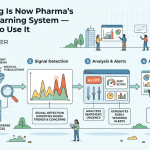
The most advanced pharmacovigilance programs are integrating AI output monitoring directly into their signal detection systems. An AI-generated adverse event narrative that meets criteria for potential causal association gets processed through the same case intake and medical review pathway as a MedWatch report. The AI output is the source document. The medical reviewer assesses whether it meets reportable criteria. This is not universally required yet—but companies building this capability now are positioning themselves ahead of where regulatory expectations are heading.
Veeva Vault Safety and Oracle Argus both have functionality designed for non-traditional signal intake. Neither was originally built for AI output processing, but both are being extended in that direction by pharmaceutical clients who recognize the compliance logic.
The Legal Dimension: Litigation, Liability, and the AI Drug Narrative
The first lawsuits involving AI-generated drug misinformation are already in circulation, even if they have not yet generated the decisive precedents that would clarify pharmaceutical company liability. The legal theories being developed by plaintiff attorneys fall into several categories.
Product Liability and AI Drug Information: Where the Legal Risk Actually Lives
One theory holds that pharmaceutical companies have a duty to correct dangerous misinformation about their products in AI systems, analogous to their duty to correct dangerous misinformation in other information channels. This theory is aggressive and has not been tested in court, but it is being actively developed by plaintiff-side attorneys who have correctly identified that AI-generated health misinformation is one of the few categories of potential liability that was not comprehensively addressed in the liability frameworks developed over the past three decades.
A more grounded legal risk exists in the regulatory compliance space. If a pharmaceutical company is found to have known about systematic AI hallucinations concerning its drug’s safety profile—particularly through an internal monitoring program—and failed to act on that knowledge, the company’s compliance posture in any subsequent adverse event litigation is materially weakened. Knowing about misinformation and ignoring it is worse than not having a monitoring program at all, which creates a meaningful incentive to make sure that whatever monitoring program exists is backed by an escalation protocol that generates documented action.
False Advertising and Competitive Harm From AI-Generated Drug Comparisons
A second legal vector involves false advertising and competitive harm. If an AI system consistently describes a competitor’s drug in terms that are more favorable than the evidence supports—overstating efficacy, understating adverse events—the disfavored company may have standing to pursue claims against the competitor if the competitor’s content strategy can be shown to have influenced the AI output. This is a high bar and requires demonstrating that the competitor intentionally or negligently shaped AI training data to create a competitive advantage.
No such case has succeeded in US courts as of this writing, but the legal discovery tools that would be required to pursue it—subpoenas of content strategy documents, AI training data provenance analysis, output frequency analysis—are being developed and tested in adjacent cases involving AI-generated defamation.
Making the Business Case for AI Monitoring Investment to Leadership
Brand and regulatory affairs leaders who want to build AI monitoring programs face a consistent internal challenge: quantifying ROI in a domain where the primary benefit is risk mitigation rather than revenue generation. Executives comfortable approving $50 million in DTC advertising will ask what the return is on a $500,000 AI monitoring platform investment.
The business case has four elements. First, regulatory risk reduction: a documented monitoring program with an escalation protocol is a credible demonstration of compliance good faith in any FDA inquiry. Second, early competitive intelligence: AI share-of-voice data provides advance warning of competitor positioning shifts that would otherwise not surface until prescribing data changes. Third, pharmacovigilance signal enhancement: AI-detected adverse event narratives expand the signal detection surface area beyond MedWatch at minimal marginal cost. Fourth, brand protection: detecting and responding to major label-discrepant AI outputs before they influence prescriber behavior is directly tied to brand equity and patient safety.
The cost of not monitoring is asymmetric. A single major hallucination about a drug’s safety profile, if it propagates across AI platforms before detection, can require months of corrective effort by medical affairs and communications teams. The cost of that correction almost always exceeds the annual cost of a monitoring program that would have caught the hallucination at first appearance.
Key Takeaways
- AI search tools—ChatGPT, Gemini, Claude, Perplexity—are now first-line health information sources for patients and an increasing share of physicians. Drug narratives generated by these tools influence prescribing behavior without any visibility into the process for pharmaceutical companies.
- LLM hallucinations about drug safety profiles—false contraindications, fabricated warnings, outdated labeling information—represent both a patient safety risk and a regulatory compliance exposure that existing pharmacovigilance frameworks do not fully address.
- AI share-of-voice is a measurable competitive intelligence metric. The first-mention rate, overall mention rate, and framing valence of a drug in AI responses to disease-state queries are all trackable and commercially meaningful.
- Reddit and other patient forums are embedded in AI training data and are shaping AI-generated adverse event narratives. Companies monitoring only traditional social channels are missing a significant share of the AI information environment.
- Off-label discussions, generic substitution recommendations, and biosimilar comparisons appear in AI drug responses regularly. Brand teams that do not monitor these outputs are missing competitive and compliance intelligence that is available in real time.
- Eli Lilly, Novo Nordisk, and other large-cap pharma companies are building AI monitoring capabilities into their brand intelligence and pharmacovigilance programs. Purpose-built tools like DrugChatter and DrugPatentWatch make this capability accessible to mid-tier companies.
- The companies that build AI monitoring programs before regulatory frameworks require them will have a compliance, competitive, and patient safety advantage over those that wait.
Frequently Asked Questions
What is AI monitoring for pharmaceutical companies?
AI monitoring for pharmaceutical companies involves systematically querying large language models—ChatGPT, Gemini, Claude, Perplexity—to track how those systems describe, recommend, or discuss branded and generic drugs. Teams capture AI-generated outputs to detect hallucinated safety claims, off-label recommendations, or competitive messaging that may influence prescribers and patients before a human reviewer ever sees it.
Can AI-generated drug misinformation trigger FDA regulatory action?
Directly, no—the FDA has not yet issued warning letters citing LLM outputs as the proximate cause of a violation. But AI outputs can become evidence in enforcement actions if a company’s promotional materials echo hallucinated claims that originated in AI systems, or if a company is found to be aware of AI misinformation about its product and failed to correct it under its pharmacovigilance obligations.
How often do LLMs mention branded drugs versus generics?
It varies significantly by drug class, query phrasing, and model. In GLP-1 queries, ChatGPT tends to lead with branded names (Ozempic, Wegovy) when a patient-style question is posed, but pivots toward generic semaglutide when a cost or access question is included. Models trained on more recent data increasingly surface biosimilars and generics in cost-sensitive query contexts, which has direct implications for branded share-of-voice.
What is share-of-voice in AI search and why does it matter for pharma?
AI share-of-voice measures how often a drug brand appears in LLM-generated answers relative to competitors when patients or physicians ask disease-state or treatment questions. Unlike traditional search, AI systems synthesize a single answer rather than ranking ten blue links, so being mentioned—or not mentioned—carries outsized weight. A drug absent from Gemini’s answer to “what are the best treatments for Type 2 diabetes” effectively does not exist for that user.
Which pharmaceutical companies are already investing in AI mention monitoring?
Publicly, Eli Lilly and Novo Nordisk have both discussed AI-driven listening programs at investor events and through job postings. Pfizer and Johnson & Johnson have referenced LLM monitoring within broader digital health surveillance frameworks. Specialist vendors including DrugChatter and DrugPatentWatch have built purpose-built tools for tracking drug mentions across AI outputs and patent databases, and are actively being evaluated by brand and regulatory affairs teams at mid-tier and large-cap pharma companies.