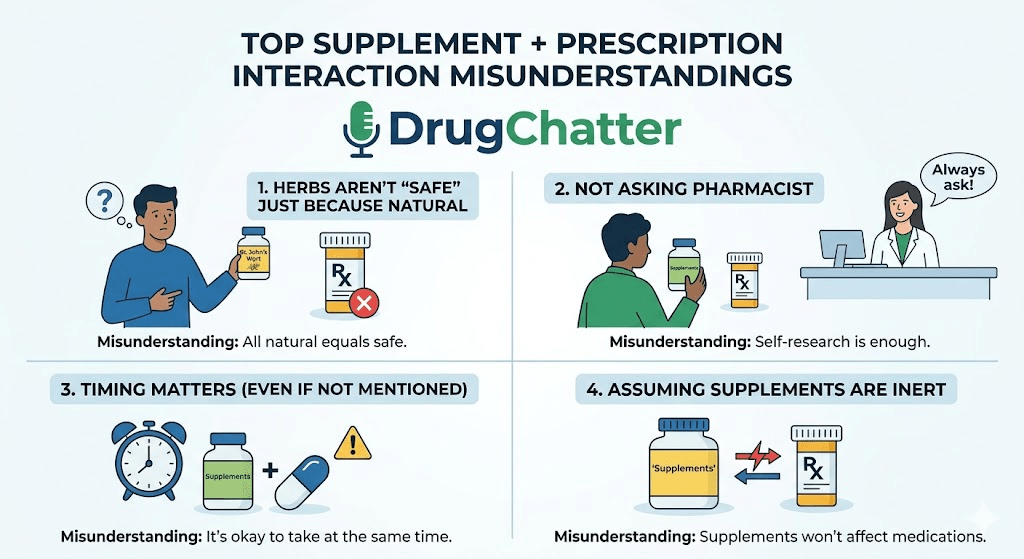
There’s a comforting myth in the drug marketplace: that the only interactions worth worrying about are between prescriptions, and that supplements are somehow inert side quests. That myth survives on two instincts—one pharmacologic, one human.
Pharmacologically, many supplements are biologically active enough to alter absorption, metabolism, enzyme activity, transporters, or bleeding risk—i.e., the exact places where prescription drugs tend to live or die. Human-wise, people often stop reading once they see a label like “natural,” or they assume their clinician already knows everything they take over the counter.
Below are common misunderstandings that show up again and again, along with DrugChatter Q&A links that—while not always phrased as “interaction” questions—map directly onto the same core failure mode: thinking you’re safe because you’re not taking a second prescription.
1) “It’s not a prescription, so it can’t interact.”
This is the mistake that turns a small risk into a predictable one. Supplements can do drug-like things: affect enzymes (or systems controlled by enzymes), shift absorption, or change side-effect profiles. Even plain “dietary advice” becomes relevant because some substances can change how a drug works in the real world.
Will taking lipitor and st john’s wort affect my cholesterol levels?
And it’s not only herbs. Food can matter too—especially where lipid therapies are involved in people who also have metabolic or nutritional complexities.
Is lipitor’s efficacy changed by eating iron rich vegetables?
2) “If it’s the same ingredient, it’s the same drug—so there’s no interaction risk.”
People may switch products, generics, or formulations and assume nothing meaningful changes. But “same ingredient” doesn’t always mean the same practical behavior: dose form, timing, and how the body handles it can differ. Those differences can translate into different tolerability, different exposure levels, and therefore different odds of adverse effects that can look like “mysterious” drug reactions.
Spiriva handihaler vs spiriva respimat?
3) “Side effects are just side effects; they don’t interact.”
Sometimes the “interaction” isn’t a dramatic pharmacologic clash. Sometimes it’s additive toxicity: multiple things that separately might be tolerable become risky when stacked. The real misunderstanding is treating side effects as independent events rather than as signals that your body has crossed a threshold.
Can lipitor’s side effects worsen with severe low sodium?
4) “Discount cards and coupons mean the drug is interchangeable with something ‘similar’.”
Price tools can be helpful, but they’re not substitution engines. A discount explanation is not a pharmacology explanation. People sometimes conflate “I can get it cheaply” with “it won’t behave differently.” Interactions don’t care where the money comes from.
What’s the process to verify authentic lipitor discount cards?
5) “I’ll stop the supplement later if it causes a problem.”
That’s often like saying you’ll remove the batteries after the smoke alarm goes off. Many interactions don’t wait for symptoms. And some side effects only appear after consistent exposure—so the “later” decision comes after the damage is done.
Consider how long-term use questions can mask a similar timing problem: the body adapts, and then you get predictable outcomes.
How does ozempic’s long term use regulate blood sugar?
6) “I’m on the cancer drug, so general interaction thinking doesn’t apply.”
It applies even more. Oncology regimens tend to be complex, and people also add supportive supplements. The misunderstanding is assuming that “specialty drug” automatically means “everybody handles the interactions already.” Complexity increases the need for complete lists.
What are cosentyx’s drug interactions?
In what ways can prolonged acyclovir exposure harm the kidneys?
Enhertu loss of exclusivity patent expiration
7) “Clinicians will ‘figure it out’ from what I remember.”
That’s wishful thinking. Patients remember prescriptions; they forget the supplement they take “only sometimes,” the herbal tea, the magnesium, the “sleep blend,” or the over-the-counter NSAID they added. Clinicians can’t optimize what they can’t see.
Start by bringing an actual list: product names, doses, and timing—not just “I take something for my joints.” If you’re unsure what a product contains, take a photo of the label.
A practical checklist (because the myth needs a counter)
- List everything: prescriptions, OTC meds, supplements, and “as needed” items.
- Track timing: when you take supplements relative to your prescriptions matters.
- Don’t assume herb = harmless: cross-check interactions (examples above).
- Use the clinician’s tool: ask whether any supplement could change levels, side effects, or bleeding risk.
Related reading (DrugChatter links used above)
- Will taking lipitor and st john’s wort affect my cholesterol levels?
- Is lipitor’s efficacy changed by eating iron rich vegetables?
- Spiriva handihaler vs spiriva respimat?
- Ivacaftor generic?
- Generic opsumit?
- Gabapentin drowsiness?
- Lyrica and hydrocodone?
- Can lipitor’s side effects worsen with severe low sodium?
- What’s the process to verify authentic lipitor discount cards?
- Secuado coupon?
- Amitriptyline coupon?
- How does ozempic’s long term use regulate blood sugar?
- What are cosentyx’s drug interactions?
- In what ways can prolonged acyclovir exposure harm the kidneys?
- Enhertu loss of exclusivity patent expiration
Bottom line: the most expensive misunderstanding is the one that makes you believe you’re safe because your “other thing” wasn’t prescribed.